This site is supported by our readers. We may earn a commission, at no cost to you, if you purchase through links.
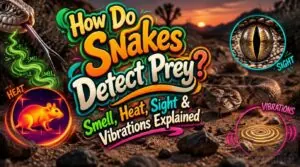
A snake doesn’t need to see you to find you. Before a mouse takes its third step across a forest floor, a python already knows its weight, direction, and body heat — all without opening its eyes.
Snakes built their predatory edge over 100 million years of evolution, stacking sensory systems that work together like instruments in an orchestra. Jawbones read ground vibrations. Pit organs map heat. A forked tongue samples the air for chemical traces.
Understanding how snakes detect prey reveals something unexpected: these animals perceive the world in dimensions most creatures never access.
Table Of Contents
- Key Takeaways
- How Do Snakes Detect Prey?
- Snake Sensory Adaptations
- Snake Hunting Strategies
- Snake Predation Techniques
- Ecological Role of Snakes
- Unique Snake Adaptations
- Types of Snake Predators and Hunting Tactics
- Snake Venom and Its Effects
- Snake Prey Preferences and Strategies
- Hunting Process and Capture Methods
- Snake Sensory Abilities
- Frequently Asked Questions (FAQs)
- Conclusion
Key Takeaways
- Snakes layer four distinct senses simultaneously — heat, vibration, chemistry, and motion — building a precise 3D picture of prey that no single sense could create alone.
- Pit organs detect temperature differences as tiny as 0.003°C, giving snakes functional thermal vision that works in complete darkness — no light, no problem.
- Whether squeezing or injecting venom, every hunting method traces back to millions of years of fine-tuning, matching the snake’s body type, prey size, and habitat perfectly.
- Snakes aren’t just predators — they’re ecosystem regulators, quietly keeping rodent populations in check and holding food webs together across forests, wetlands, and grasslands.
How Do Snakes Detect Prey?
Imagine running through total darkness — no flashlight, no map — and still knowing exactly where your next meal is hiding. Snakes pull this off every single day, thanks to a multi-sensory detection system built over millions of years of evolution.
Their heat pits, forked tongues, and keen chemical senses work together as a surprisingly sophisticated toolkit — explore how snakes detect prey in complete darkness to see just how precise this system really is.
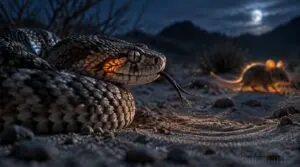
When prey moves nearby, several things happen simultaneously. The snake’s jawbones pick up ground vibrations, its heat-sensing pits detect body warmth, and its forked tongue delivers chemical signals straight to the vomeronasal organ — Jacobson’s organ — on the roof of its mouth. That organ converts those particles into nerve signals, building a precise 3D chemical map of the surroundings.
Snakes simultaneously read ground vibrations, body heat, and airborne chemicals to build a precise 3D map of nearby prey
The result? A layered, real-time picture of prey location — stitched together from seismic, thermal, chemical, and visual cues all at once. Specifically, specialized pit organs detect temperature differences as small as 0.003°C.
Snake Sensory Adaptations
Snakes don’t rely on just one sense — they layer several together to build a complete picture of their surroundings. Each adaptation has its own job, from detecting a heartbeat underground to mapping heat in total darkness. Here are the key sensory tools that make snakes such effective hunters.
Ground Vibrations Detection
Snakes don’t need eyes to find you — they feel you coming. Their jawbones act as seismic detectors, picking up ground vibrations created by nearby movement. That mechanical energy travels through the quadrate bone directly to the inner ear. This is mechanoreception at its finest.
Soil type matters too — moisture and density affect how well vibrations travel, sometimes carrying signals over a meter away. The brain then integrates these tactile sensitivity signals with chemical and visual data, building a precise picture of prey location before the snake ever moves.
Heat Pit Thermal Sensing
Ground vibrations tell a snake where to look — but heat-sensing pits tell it exactly what’s there.
Pit vipers, pythons, and boas have loreal pits — tiny facial organs sitting between the eye and nostril. These aren’t just passive holes. Each pit contains a delicate membrane packed with TRPA1 ion channels that fire when temperature rises even slightly. We’re talking pit membrane sensitivity down to 0.003°C — a razor-thin margin most technology struggles to match.
Here’s what makes these organs genuinely impressive:
- Thermal map construction happens in real time, building a 3D heat image of nearby space
- Temperature gradient detection separates warm prey from cool background surroundings instantly
- Pit placement variation differs by species — lip pits in pythons, facial pits in pit vipers
- Heat signal integration blends thermal data with visual input to sharpen strike accuracy
- Infrared radiation in the 5–30 micrometer range is what these membranes actually respond to
The result? A snake can locate warm-blooded prey in total darkness, from roughly a meter away, using thermal sensing alone — no light required.
Chemical Signals and Smell Detection
Heat pits reveal something’s nearby — but chemical trail tracking tells the full story.
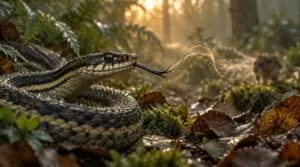
A snake’s forked tongue flicks constantly, collecting scent particles from air and ground. Those particles transfer to the vomeronasal organ — the core of a snake’s olfactory system — located on the roof of the mouth. Specialized neurons convert those chemical signals into a real-time odor gradient map, pinpointing where prey has been. Scent discrimination separates prey from predators, while pheromone detection reveals how recently a target passed through.
| Chemical Sense Feature | How It Works | Hunting Benefit |
|---|---|---|
| Forked tongue | Samples two air and ground points at once | Determines precise scent direction |
| Vomeronasal organ | Converts chemicals into neural signals | Identifies prey type accurately |
| Odor gradient mapping | Tracks shifting scent concentrations | Follows chemical trails efficiently |
| Pheromone detection | Reads chemical markers from prey or mates | Gauges proximity of target |
| Scent discrimination | Distinguishes prey from predator odors | Reduces wasted pursuit energy |
Visual Movement Detection
What actually happens the moment a snake locks onto moving prey? It comes down to visual motion detection — a highly tuned system built not for sharp detail, but for catching movement fast.
- Retinal ganglion cells fire instantly when prey shifts position, triggering lightning-quick strike decisions.
- Motion contrast — movement against textured backgrounds like foliage — sharpens detection accuracy markedly.
- Looming cues signal an approaching target’s size increase, cueing precise strike timing.
Saccadic tracking and neural integration combine these signals, making ambush predators remarkably effective hunters.
Infrared Vision
Some snakes don’t need light — they hunt by heat. Pit vipers, pythons, and boas use pit organs — small pits near the nose — to detect infrared radiation from warm-blooded prey.
These work like built-in thermal imaging cameras, resolving temperature differences as tiny as 0.003°C. The result? A precise 3D heat map, letting them strike accurately in total darkness.
Snake Hunting Strategies
Snakes don’t hunt by luck — they’ve evolved some seriously effective strategies for taking down prey. Whether a snake uses venom, brute squeezing force, or a combination of both, each method is built around one goal: a secure meal.
Here’s a closer look at the main hunting strategies snakes rely on.
Venom Use for Immobilization
Some snakes skip the chase entirely — they come armed with chemistry. Venomous species inject a precisely engineered cocktail through hollow fangs directly into prey tissue.
Neurotoxins block nerve signal transmission almost instantly, causing rapid muscle paralysis. Hemotoxins disrupt blood clotting, compounding the systemic shutdown. These toxins work synergistically, meaning each component amplifies the others.
Evolution has fine-tuned this venom delivery system to neutralize prey fast — before it can flee or fight back.
Constriction for Prey Subjugation
Constriction is nature’s slow-motion vice grip — and it’s more precise than you might expect. Rather than simply squeezing the air out, coil pressure dynamics work by halting blood circulation to essential organs. As prey exhales, respiratory restriction mechanics prevent the next inhale. The coils tighten rhythmically, coordinated through muscle coordination patterns along the snake’s entire body.
- Coils cinch the chest first
- Blood flow to organs stops
- Prey struggles, coils tighten further
- Subjugation completes within minutes
Combining Venom and Constriction
Some snakes don’t choose between venom and squeezing — they use both at once. This integrated hunting sequence starts with a precise bite, then immediately follows with coiling. The venom delivery timing is deliberate: toxins begin weakening the prey’s nervous system or blood pathways while constrictive pressure coordination cuts off circulation simultaneously.
- Venom reduces prey resistance, so coils tighten with less effort
- Synergistic prey immobilization subdues faster than either method alone
- Combined toxin mechanics target both nerves and blood flow
- Reduced struggle shortens the overall hunting cycle
- Strike precision determines how effectively both tactics succeed together
Active and Ambush Hunting
Two strategies define how snakes hunt: relentless pursuit and patient ambush. Active hunters push speeds up to 12 mph, using sensory adaptations like thermal sensing and scent trails for precise prey localization. Ambush predators do the opposite — stillness is their weapon. Their camouflage tactics make them nearly invisible until prey steps close enough.
- Strike precision determines whether the hunt succeeds or fails
- Energy efficiency keeps ambush hunters effective for hours without moving
- Some Cuban boas even coordinate locations to cut off escape routes
Snake Predation Techniques
Snakes have refined their killing techniques into a few distinct approaches, each shaped by body type and evolution. From powerful coils to hollow fangs, the physical tools vary quite a bit across species. Here’s a closer look at the key predation techniques that make snakes such effective hunters.
Constrictors’ Physical Characteristics
Constrictors are built like living cables. Their muscular trunk runs the full body length, transmitting enormous force through every coil. The cylindrical body shape ensures pressure distributes evenly around prey.
Elastic skin stretches to accommodate animals far larger than the snake’s head, while jaw ligaments let the mandible bend around irregular shapes. Backward-angled teeth grip tight, and the tail provides counterbalance during coiling — nothing escapes once those loops lock in.
Venomous Snakes’ Fangs and Injection
Where constrictors squeeze, venomous snakes stab — and their tools are startlingly precise.
Fang morphology determines everything. Vipers carry hollow fangs that fold neatly against the mouth’s roof, swinging forward only at the moment of a strike. Those fangs connect directly to venom glands through venom ducts, channels that channel toxin straight into the wound.
Here’s what makes the system so effective:
- Fang replacement happens continuously, so worn fangs are never a problem
- Muscular gland compression creates hydraulic pressure during injection
- Neurotoxins and cytotoxins target nerves or tissues almost immediately
- Venom volume delivered can vary — sometimes a full dose, sometimes none at all
The injection mechanics are fundamentally a biological syringe, engineered over millions of years.
Bite-and-Release Strategy
After the fangs retract, the real strategy begins.
Quick bite timing keeps contact under a second — just enough to inject a modulated venom dose calibrated to size. The snake disengages immediately, then uses heat-sensing pits alongside its vomeronasal organ to track chemical signals and scent trails from a safe distance.
| Phase | Detail |
|---|---|
| Bite Timing | Fraction-of-a-second contact |
| Venom Dose | Adjusted by prey size |
| Retreat Behavior | Immediate post-bite disengagement |
| Tracking Method | Forked tongue and vomeronasal organ |
| Secondary Capture | Constriction or follow-up strike |
Prey release mechanics do the work — the snake simply waits, then follows.
Arboreal Vipers’ Hunting Behavior
Some pit vipers take hunting vertical. Canopy ambush tactics let arboreal vipers claim sunlit branches — sunlit perch selection isn’t random; it sharpens both thermal sensitivity and prey timing. Heat-sensing pits scan below, forked tongues sample the air, and the vomeronasal organ reads chemical trails through the canopy.
- Vertical strike precision delivers venom mid-air or onto branches
- Tail whip stabilization anchors the body during sudden downward strikes
- Post-strike monitoring means waiting motionless until prey succumbs
- Forked tongues track fallen prey across foliage
Ecological Role of Snakes
Snakes do far more than hunt — they quietly hold entire ecosystems together. From controlling rodent populations to supporting biodiversity, their role in nature runs deeper than most people realize. Here’s a closer look at the key ways snakes shape the world around them.
Prey Population Regulation
Think of snakes as nature’s built-in population control. When rodent numbers spike, predator-prey balance kicks in — snakes step up their hunting, pulling prey density back down before damage spreads to crops and vegetation. This cycle prevents destructive overabundance without human intervention.
Their sharp sensory adaptations let them detect prey across varied terrain, making them consistently effective regulators. When prey populations drop, predation naturally slows too, creating self-correcting population cycles that keep ecosystems stable and functioning exactly as they should.
Biodiversity Contribution
Snakes quietly hold ecosystems together in ways most people never notice. Their presence upholds multi-species food web interactions, helping maintain communities of animals across forests, wetlands, and grasslands. They occupy diverse ecological niches as both predators and prey — a balance that sustains regional biodiversity.
- Regulate prey to prevent destructive overabundance
- Connect food webs across trophic levels
- Support genetic diversity within wildlife populations
- Inspire conservation education and community science
- Signal ecosystem health through their sensitivity to habitat change
Habitat Preference and Conservation
Many snake species thrive across diverse habitat mosaics — shrublands, wetlands, rocky outcrops, and forest edges each fill a distinct ecological niche. Conservation efforts now prioritize protected area design and conservation corridors to restore habitat connectivity across fragmented landscapes. Smart land use planning integrates species range shifts driven by climate change, helping snakes track necessary environmental cues and sustain their contribution to biodiversity maintenance and ecosystem stability.
| Conservation Strategy | Role in Snake Survival |
|---|---|
| Protected area design | Shields critical denning and foraging grounds |
| Conservation corridors | Restores gene flow across fragmented habitat |
| Land use planning | Reduces road mortality and habitat loss |
| Habitat restoration | Increases prey availability and shelter |
| Species range monitoring | Tracks climate-driven distribution shifts |
Maintaining Ecological Balance
Remove a snake from the equation, and watch the ripple effects. Rodent populations explode, crops suffer, and disease risk climbs — fast. Snakes as predators sit at the heart of this balance, quietly regulating prey numbers across grasslands, wetlands, and forest edges.
- Controlling rodent outbreaks that damage crops and spread disease
- Strengthening food web integrity at every trophic level
- Supporting biodiversity conservation by preventing single-species dominance
- Boosting ecosystem resilience against climate-driven disruptions
- Reinforcing habitat connectivity by stabilizing prey across linked landscapes
Impact of Conservation Threats
When threats close in on snake populations, entire ecosystems feel the strain. Habitat loss, climate change, and pollution don’t just reduce snake numbers — they directly impair prey detection abilities, disrupting finely-tuned thermal and chemical senses. Illegal trade accelerates species decline further.
Without these sensory specialists keeping prey populations in check, ecosystem stability quietly collapses, and biodiversity maintenance becomes nearly impossible to sustain.
Unique Snake Adaptations
Snakes are built differently — and not just in the obvious "no legs" way. Every part of their body, from jaw to tail, is fine-tuned for finding and catching a meal. Here are some of the most unique adaptations that make snakes such effective hunters.
Agility, Speed, and Stealth
Few creatures blend speed, silence, and timing quite like a snake on the hunt.
Rapid pursuit speed varies wildly between species. Black mambas hit over 12 mph, while most snakes favor patience over pace. Ambush predators stay completely still, relying on stealthy approach glide and camouflage to stay invisible until the perfect moment.
Here’s what makes their movement so effective:
- Silent body motion produces no footsteps, no rustling — just pure glide
- Quick strike timing launches in milliseconds once prey is within range
- Agile coil release converts resting posture into explosive forward motion instantly
- Seismic sense guides prey tracking through faint ground vibrations
- Active hunting species use infrared pits and chemical cues together for precision targeting
Flexible Jaws for Large Prey Consumption
Speed and silence get prey within range — but then what? The jaw takes over, and it’s genuinely impressive engineering.
Snake jawbones aren’t fused like yours. Through jaw disarticulation, each lower jaw half moves independently, dramatically increasing mouth capacity. Backward-angled teeth prevent any escape during prey swallowing, gripping tighter the more the animal struggles.
Their elastic skin stretches to accommodate the bulk. Once swallowed, powerful digestive enzymes break down bone, fur, and feathers over several days — handling meals that would seem impossible from the outside.
Forked Tongues and Poor Eyesight
The jaw processes the meal — but finding it is another story. Snakes aren’t sharp-eyed hunters. Most have limited depth perception and struggle to distinguish stationary objects. Instead, they rely on something far more precise: their forked tongue.
- Airborne particle sampling — constant tongue flicking gathers chemical traces floating in the air and along the ground.
- Jacobson’s organ role — those particles transfer to the vomeronasal organ on the roof of the mouth, where specialized neurons convert chemical signals into a 3D scent map.
This olfactory system lets snakes track prey trails even in complete darkness — no sharp vision required.
Muscular Bodies
A forked tongue finds the target — but it’s raw muscle that closes the deal. Snakes are built around axial muscle coordination, with long segmented muscles running the full length of the spine. These let one section stay rigid while another bends sharply.
- Spinal flexibility mechanics across 100–400+ vertebrae distribute force evenly
- Ventral muscle control grips surfaces during rectilinear and lateral movement
- Locomotion muscle waves travel head to tail, pushing the body forward
- Swallowing muscle dynamics advance prey deeper through peristaltic contractions
- Constriction methods tighten coils during each exhale, cutting circulation
That segmented design makes prey immobilization surprisingly efficient — no extra movement needed.
Ambush Predation
All that muscle power means nothing without the right moment to strike.
Snakes using ambush predation stay completely still — sometimes for hours — relying on camouflage techniques and predator positioning near prey travel routes. Their heat-sensing pits and forked tongues handle prey detection quietly, letting them conserve energy until the perfect strike timing makes escape impossible.
Types of Snake Predators and Hunting Tactics
Not all snakes hunt the same way — and that difference shapes everything about how they find, catch, and subdue their prey. Some rely on raw power, others on precision chemistry, and a few on near-invisible patience. Here’s how the main types stack up.
Constrictors Vs. Venomous Snakes
Two strategies, one goal — catch the meal. Constrictors use raw muscle power, coiling around prey to cut off blood flow, while venomous snakes inject precision toxins to immobilize targets fast. Here’s how they differ:
- Energy cost: Constriction burns muscle energy; venom production replenishes slowly.
- Prey preference: Constrictors target larger mammals; venomous species favor smaller, quicker prey.
- Sensory integration: Both use forked tongues and thermal imaging to locate prey.
- Capture method: Constriction force subdues physically; venom disrupts nervous systems chemically.
Constrictors’ Size and Power
Reticulated pythons can reach 8 meters and top 50 kilograms — body mass scaling drives their raw power. Greater size means greater constriction pressure, spread across multiple coils for total prey immobilization. Boas and pythons rely on muscle distribution throughout the spine to tighten loops without fatigue.
Size-driven advantages define their constriction methods:
- Length-to-weight ratio determines how many coils a snake can form
- Coil efficiency intensifies with body size, making escape nearly impossible
- Wrapping the thorax cuts off breathing fastest
Venomous Snakes’ Agility and Venom Use
Venomous snakes don’t rely on size — they rely on precision. Species like rattlesnakes and cobras use rapid strike kinematics to close distance before prey can react. Some deliver multiple bites in under 100 milliseconds. That’s not aggression; that’s engineering.
Fang alignment precision and coordinated muscle motion guarantee venom hits deep tissue on contact. Venom delivery efficiency matters here — neurotoxins start shutting down the nervous system fast, making active hunting surprisingly effective for snakes that never needed bulk to begin with.
Stealth, Speed, and Ambush Tactics
Think of a snake as the prime still-life hunter — invisible until it isn’t. Camouflage techniques keep it locked into leaf litter or bark, motionless for hours. When prey finally steps close enough:
- Ambush positioning along trails maximizes strike opportunity
- Forked tongues map chemical trails left by passing animals
- Heat-sensing pits zero in on warm bodies in total darkness
- Ground vibrations signal exact prey distance before any move
Then comes the speed burst strike — venom delivered in under 0.2 seconds.
Snake Venom and Its Effects
Snake venom isn’t just poison — it’s a precision tool shaped by millions of years of evolution. Different species have developed wildly different chemical formulas, each designed to stop prey in its tracks in a specific way. Here’s how venom works, what it does to the body, and why no two snakes use it quite the same way.
Specialized Venom for Prey Subjugation
Snake venom isn’t random — it’s biochemical warfare, precision-engineered for prey immobilization. Neurotoxins hijack nerve signals, triggering rapid paralysis, while enzymatic components spread toxins quickly through tissue. Helper peptides boost diffusion, making venom injection devastatingly efficient.
Remarkably, venom regulation lets snakes conserve their supply across multiple hunts. Through toxin evolution, prey-specific toxins emerge — fine-tuned against preferred prey, staying one step ahead in nature’s arms race.
Variation in Venom Effects
No two venomous species produce the same venom — and that variation runs surprisingly deep. Regional venom profiles shift between populations of the same species, changing which toxins dominate. Ontogenetic venom shifts mean juveniles carry different toxin ratios than adults. Seasonal hunting pressures can even alter venom composition over time.
- Hemotoxic venoms destroy blood cells and disrupt clotting
- Cytotoxic venoms break down local muscle and tissue
- Hybrid venom mixtures from crossbreeding populations combine unpredictable functional properties
Paralysis, Bleeding, and Nervous System Disruption
Venom doesn’t just hurt — it systematically dismantles. Neurotoxic venom effects block nerve signals at the synaptic level, cutting communication between brain and muscle almost instantly. The prey can’t move, can’t fight back.
Hemotoxins take a different route, disrupting clotting and triggering hemorrhagic brain injury through uncontrolled internal bleeding. That bleeding increases pressure, compresses neural tissue, and risks spinal cord compression — sometimes within minutes. Recovery depends on bleed size, location, and treatment speed.
Snake Prey Preferences and Strategies
Snakes aren’t picky eaters — but they’re not random about it either. Everything from the size of their prey to how they track it down comes down to sharp instincts and smarter-than-you’d-think strategy. Here’s what drives their choices and how they pull it off.
Variety of Prey, Including Large Mammals
Few animals match the dietary range of snakes. From rodents and small birds to deer, pigs, and even crocodiles, snakes exploit nearly every prey type available. Large constrictors like anacondas and pythons pursue large mammal prey that can exceed 100 kilograms — a serious energy investment that pays off in calories. King cobras take a different route, targeting other snakes entirely.
- Pythons have taken down monkeys and crocodiles
- Anacondas pursue pigs and deer using thermal imaging to detect heat signatures
- Many species shift prey during seasonal diet shifts to balance energy needs
- Cooperative hunting is rare but documented among some populations
Prey Selection Based on Size and Species
Not every prey item makes the cut. Gape limitation determines maximum swallowable size. Beyond that, snakes apply energy yield balance, picking prey with the best caloric return per effort. Species specialization and habitat influence filter the rest, while prey availability shifts force diet adjustments when options thin out.
| Factor | Influence | Example |
|---|---|---|
| Size limits | Caps prey by jaw width | Rodents, not deer |
| Species focus | Targets specific prey groups | Cobras hunt snakes |
| Seasonal shifts | Adjusts when prey is scarce | Frogs over rodents |
Ambushing and Active Pursuit Strategies
Once prey size gets factored in, the next question is how to catch it. Snakes split cleanly into two camps: ambush predators and active hunters.
Rattlesnakes master ambush positioning — holding perfectly still along known prey trails, reading thermal cues, waiting for the ideal moment. Black mambas flip that script entirely, using explosive pursuit speed to run targets down. Both strategies are precision tools, shaped by habitat, prey behavior, and energy math.
Use of Smell and Vibration Detection
How does a snake hunt without keen eyesight? It reads the world through chemistry and vibration. Tongue sampling works constantly — the forked tongue collects airborne particles and delivers them to the vomeronasal organ, decoding scent trails with impressive precision. Meanwhile, ground vibrations travel through the jawbone, alerting the snake to movement nearby.
- Scent plume tracking follows prey odor across open ground
- Chemical signal integration confirms species identity before striking
- Seismic sense detects footsteps through soil or leaf litter
- Airborne cue processing guides tongue flicking rate during pursuit
Hunting Process and Capture Methods
Once prey is located, the real question becomes how the snake actually takes it down. That process looks very different depending on the species. Here’s how the hunting unfolds — and what separates a constrictor’s squeeze from a venomous snake’s strike.
Suffocation Vs. Venom Injection
Two methods dominate snake hunting: constriction and venom injection — and each tells a different evolutionary story.
Constrictors cut off blood flow, not just airflow. Oxygen deprivation reaches the brain before muscles even fail, dropping prey unconscious within seconds to minutes. Every exhale tightens the coils.
Venomous snakes work differently. Toxin delivery speed depends on species, but paralysis or tissue disruption can begin within seconds in small prey.
| Factor | Constriction | Venom Injection |
|---|---|---|
| Mechanism | Vascular compression | Chemical disruption |
| Immobilization Speed | Seconds to minutes | Seconds to hours |
| Prey Size Impact | More effective on larger prey | Optimized for smaller targets |
| Energy Cost | High muscular effort | Low — single strike |
| Evolutionary Trade-off | Strength over stealth | Precision over power |
Variation in Hunting Process by Species
No two snakes hunt the same way — and that’s exactly what makes them such impressive predators.
Pit vipers rely on thermal imaging to strike with precision in the dark, detecting warmth as small as 0.003°C. Pythons press their jaws to the ground, using seismic vibration detection to locate heavy-footed mammals nearby. Boas blend chemical sensing with constriction, confirming prey identity before committing.
- Diurnal hunters — like many colubrids — use motion-based vision in open, well-lit habitats.
- Nocturnal species shift toward heat pits and chemical cues when visibility drops.
- Arboreal vipers time strikes using overlapping sensory input, balancing thermal and visual data for accuracy.
Every strategy reflects a finely tuned match between species, habitat, and prey size.
Snake Sensory Abilities
Snakes don’t rely on just one sense — they layer several systems together to build a full picture of their surroundings. Each tool fulfills a different purpose, from detecting heat to reading chemical trails in the air. Here’s a closer look at the sensory abilities that make snakes such effective hunters.
Seismic Sense
The ground is always talking — snakes just know how to listen. Through jawbone vibration sensors, they pick up low-frequency ground vibrations between 5 and 50 Hz, converting those tremors into precise neural signals within milliseconds. This is somatosensory hearing at its finest.
Their lower jaw bones channel substrate waves through the quadrate bone straight to the brain. From there, neural spatial mapping pinpoints the source — turning every footstep into a confirmed location.
Thermal Sense
Picture an animal that "sees" warmth the way you see light. That’s exactly what pit vipers, boas, and pythons do using heatsensing pits — specialized facial organs that detect infrared radiation from nearby prey.
- Thermal detection resolves temperature differences as small as 0.003°C
- Temperature mapping builds a full 3D heat image in darkness
- Heat gradient detection separates prey from sun-warmed rocks
- Physiological heat sensors use ion channels and lipid membranes for rapid signal transmission
Thermal integration with vision and seismic cues sharpens strike accuracy markedly.
Chemical Sense
Think of a snake’s tongue as a living chemical antenna. Every flick pulls scent molecules from the air and delivers them directly to Jacobson’s organ — the vomeronasal organ on the roof of the mouth — where specialized neurons decode the signal instantly.
The forked tips don’t just collect; they sample two points simultaneously, giving the snake a directional scent map without moving an inch.
- Forked tongue sampling captures both airborne and surface-level chemical cues
- Prey odor discrimination separates fresh trails from old ones
- Chemical cue integration refines hunting decisions using environmental context
Visual Sense
Scent tells a snake where prey has been. Vision tells it where prey is.
Snakes aren’t sharp-eyed hunters, but motion detection is their visual superpower. Their retinas are tuned to contrast and movement, triggering strike sequences the moment something shifts. Pupil adaptation — slit-shaped in nocturnal hunters, round in diurnal ones — controls light intake precisely. Diurnal species even use color vision to distinguish prey against complex backgrounds.
Overall Sensory Tools
Every sense a snake owns feeds into one unified system. Forked tongues funnel airborne chemicals straight to the Jacobson’s organ, while pit organs map infrared radiation from warm-blooded prey nearby. Seismic cues and motion cues confirm what chemistry suggests. Here’s what that integrated toolkit looks like in action:
- Heat signatures identify warm-blooded targets in darkness
- Chemical trails reveal recent prey movement
- Seismic vibrations pinpoint hidden or burrowed animals
- Visual motion triggers the final strike sequence
- Neural processing fuses all inputs into one precise response
Frequently Asked Questions (FAQs)
How do snakes find their prey?
Snakes hunt using forked tongues, heat pits, and vibration sensing. They map scent trails, read heat signatures, and feel ground movement — turning every environment into a precise sensory grid that prey rarely escapes.
How do snakes detect food?
A snake detects food using forked tongues, heat-sensing loreal pits, and jaw-based vibration sensing. These tools map chemical trails, thermal gradients, and ground movement — turning the surrounding environment into a precise, multi-layered prey profile.
How do Snakes sense food?
Think about it — a creature with no hands, no nose, and no ears still never misses a meal. That’s the quiet genius of snake sensing.
A forked tongue doesn’t just smell — it samples two points simultaneously. Those particles reach Jacobson’s organ, a chemical-mapping system tucked into the roof of the mouth. It builds a directional scent trail from thin air.
Meanwhile, heat pit organs detect infrared radiation from warm bodies — think thermal camera, built in. Some species resolve temperature differences as small as 003°C. Even hidden prey has a heat signature.
Ground vibrations travel through the jawbone itself. Seismic sensing picks up movement size, distance, and direction — before any visual contact. And when prey finally moves, motion cue integration triggers an immediate strike response.
Together, these sensory adaptations don’t work in isolation. They layer — chemical, thermal, vibrational, visual — into one precise predatory picture.
How do snakes detect heat?
Pit vipers and certain boas use specialized facial pit organs to detect infrared radiation from warm-blooded prey. Even in complete darkness, these pits sense heat signatures with striking precision — no light required.
How do snakes detect pheromones?
Your snake uses its forked tongue to collect chemical signals from the air and ground, delivering them to Jacobson’s organ — where pheromones are decoded to locate mates and track chemical trails.
How do snakes hunt?
Hunting isn’t one-size-fits-all for snakes. Some stalk using scent trail navigation and thermal detection; others wait in silence. Whether injecting venom or applying concertina coiling, every strike reflects millions of years of precision.
What determines what prey a snake will eat?
Several factors shape a snake’s menu. Gape size sets the hard limit — prey too wide simply won’t go down. Venom potency, habitat availability, metabolic needs, and reproductive status all steer the final choice.
How do snakes detect you?
Snakes don’t miss a trick. You trigger vibration sensing the moment your footsteps travel through the ground to their jaw. Their heat signature activates infrared detection via pit organs, and your scent seals the picture.
How do snakes know how do you hunt?
Their sensory fusion system combines forked tongue chemical sampling, Jacobson’s organ analysis, and thermal imaging to build a precise prey map — triggering instinctive behavior that guides when, where, and how to strike.
Do snakes see humans as prey?
No, snakes don’t see humans as prey. You’re simply too large to fit their instinctive size-based prey profile — most will flee or strike defensively if they feel threatened, not out of hunger.
Conclusion
The next time you walk through tall grass, something may already know you’re there. That’s the quiet reality behind how snakes detect prey — a rich, layered system of heat, vibration, and chemistry that evolved long before humans arrived.
Snakes don’t rely on a single sense; they carefully stack them all. Each new signal sharpens the picture. Understanding this won’t just change how you see snakes — it’ll forever change how you move through their world.
- https://phys.org/news/2006-08-snakes-vision-enables-accurate-prey.html
- https://pmc.ncbi.nlm.nih.gov/articles/PMC2855400/
- https://www.geeksforgeeks.org/how-do-snakes-sense-their-prey/
- https://www.sciencedirect.com/science/article/pii/S259023852030521X
- https://www.sciencedaily.com/releases/2008/02/080221105350.htm