This site is supported by our readers. We may earn a commission, at no cost to you, if you purchase through links.
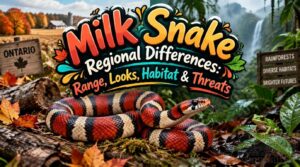
A milk snake in Ontario might top out at 90 cm, wear crisp red bands, and shelter under a log pile until October. Its cousin in a Honduran rainforest can stretch to 150 cm, blush with faint crossbands, and hunt frogs in damp leaf litter all year.
Same species group, wildly different lives. If you’ve ever wondered why two milk snakes look and behave like strangers, milk snake regional differences hold the answer. Climate, terrain, and prey shape everything from body length to pattern, and even danger varies by location. You’ll see how range, size, color, habitat, diet, and threats shift from the northern farmlands to the tropical highlands.
Table Of Contents
- Key Takeaways
- Milk Snake Species and Ranges Across The Americas
- How Milk Snake Size, Color, and Patterns Vary by Region
- Where Milk Snakes Live: Regional Habitats and Shelter
- How Diet and Seasonal Activity Differ by Region
- Regional Threats to Milk Snakes and Conservation Efforts
- Frequently Asked Questions (FAQs)
- What are the different subspecies of milk snakes?
- How do I tell what type of milk snake I have?
- What state has the worst snake problem?
- What snake looks like a milk snake but is poisonous?
- How do milksnakes breed in different regions?
- What regional predators threaten milksnake populations most?
- Which regions have the rarest milksnake subspecies?
- How does temperature affect milksnake regional distribution?
- What regional diseases commonly affect milksnake health?
- Are milk snakes venomous or dangerous to humans?
- Conclusion
Key Takeaways
- Where your milk snake lives shapes how it looks: cold-climate adults top out around 90 to 120 cm with crisp red bands, while tropical ones can reach 150 cm with faint, blushed crossbands.
- Habitat and diet follow the region, so temperate snakes shelter in log piles and rock crevices, hunt lizards and rodents from May to October, and brumate through winter, while tropical snakes chase lizards and frogs year-round.
- Your threats depend on your location too, with road mortality, habitat fragmentation, predators like cats and raccoons, drought, and pet poaching hitting different regions in different ways.
- You can identify a milk snake by combining its bands, its size, and where you found it, and you can relax because it isn’t venomous, but don’t confuse it with a coral snake, where red touches yellow.
Milk Snake Species and Ranges Across The Americas

Milk snakes live across a huge stretch of the Americas, and you’ll find that where one lives shapes how it looks and behaves.
That range explains why a milk snake in a Pennsylvania forest can look quite different from one in the desert Southwest, as this illustrated guide to milk snake facts, bite information, and pictures shows.
Below, we’ve split the milk snake species and ranges into two groups: North American populations, then Mexico to South America. Use each one to build your own mental map of who lives where.
North American Populations
The North American varieties of milk snake cover a lot of ground. You’ll find the Eastern Milksnake from southern Ontario down to Texas, while Western Variations show up in drier country. Here’s what to watch for:
- Regional Size Variation: adults average 60–90 cm.
- Pattern Morphs: red-banded, black-mouthed, speckled.
- Cooler north: darker snakes bask longer.
- Dense forest: tighter bands appear often.
Mexico to South America
Head south and the story changes. Central and South American Milksnakes stretch from Mexico into northern South America, and you’ll spot the Sinaloan Milk Snake, Honduran Milk Snake, and Atlantic Central American Milk Snake along the way.
Because these tropical and scrubland natives differ in size and temperament, it helps to read up on milk snake care requirements before choosing a Sinaloan or Honduran.
Regional Size Variation is real: adults run 60 to 120 cm. In humid lowlands, faint blushed crossbands replace sharp contrast, so look closely.
How Milk Snake Size, Color, and Patterns Vary by Region
Once you know where a milk snake lives, you can start predicting what it looks like. Geographic Influences on Milksnake Appearance are easy to spot once you know what to check.
Here’s what to look for:
- Regional Size Differences: cold-climate adults top out near 90 to 120 cm, while tropical snakes can reach 150 cm.
- Color Patterns in Different Habitats: desert snakes wear large blotches with pale speckling, while forest-edge snakes show narrow stripes.
- Prey Availability and Predator Pressure: small prey means smaller bodies, while big prey builds bolder patterns.
- Elevation: higher ground gives you duller colors.
- Tail bands: juveniles flash high-contrast bands to bluff predators.
Habitat Diversity Drives Behavioral Adaptations, so a snake’s look hints at how it hides.
Because a desert-dwelling snake and a forest-floor species face very different threats, it helps to understand how many hides a snake needs to feel secure in its enclosure.
Where Milk Snakes Live: Regional Habitats and Shelter
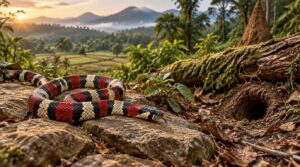
A snake’s look hints at how it hides, so let’s match each pattern to its home.
Geographic location shapes everything here. In the temperate U.S. and southern Canada, you’ll find milk snakes along forest edges, farmlands, and shrublands, tucked into rock crevices, log piles, and old rodent burrows.
Tropical milk snakes enjoy more habitat diversity. They use wet forests, riparian zones, termite mounds, and damp leaf litter, and they climb from sea level to about 2,500 meters. That altitude zonation matters, because cooler slopes call for sunnier basking spots.
Whatever range a milk snake calls home, its lifespan changes quite a bit under human care, and this guide to milk snake lifespan in captivity shows how habitat choices affect longevity.
Your best clue is microhabitat selection. Look for sunlit rock piles and fallen logs, and loose, well-drained soil for burrowing. Each one is a regional adaptation that balances warmth with cover.
How Diet and Seasonal Activity Differ by Region

A milk snake’s menu changes with its zip code, and so does its calendar. Prey availability and predator pressure shape both, so here’s what you’ll see across the Americas.
- Temperate North America: lizards and small rodents, with peak seasonal activity May through October.
- Brumation patterns: snakes shut down from November until March, cutting hunting time.
- Central America: lizards and frogs, hunted actively across humid, year-round conditions.
- Andes: small mammals and birds, with two short activity peaks after rains.
- Prey size: roughly 1 to 2 times head-body length up north, 0.8 to 1.2 farther south.
Foraging behavior shifts too: ambushers wait near rodent burrows. Tropical snakes chase prey, and cool highland ones strike slowly. Food-rich regions also show clutch size variation.
Regional Threats to Milk Snakes and Conservation Efforts

A milk snake’s biggest challenges depend on where you find it. Conservation challenges vary dramatically by location, so your local picture matters. Habitat fragmentation splits populations in the southeast, while road mortality can claim up to 20% of adults each year.
A milk snake’s greatest dangers depend on where it lives, from fragmented habitats to roads that claim up to 20% of adults yearly
| Region | Main Threat |
|---|---|
| Southeast | Road mortality |
| Peri-urban areas | Cats and raccoons |
| Southern range | Drought and warm winters |
Pet collectors still poach in border regions, and human-wildlife conflict persists when people kill harmless snakes. You can help. Back wildlife corridors, join citizen science projects, and report your sightings. Head-start programs also boost struggling juveniles.
Protected areas reconnect isolated groups, and monitored releases give declining cohorts a fighting chance. Small actions add up, so speak up for snakes in your neighborhood.
Frequently Asked Questions (FAQs)
What are the different subspecies of milk snakes?
You’ll find Milksnake Subspecies Across Regions in surprising variety. The Eastern Milk Snake covers North America, the Mexican Milk Snake wears red saddles, and the Honduran Milk Snake represents tropical Central and South American varieties.
How do I tell what type of milk snake I have?
Every band is a map. How do I tell what type of milk snake I have? Check Milk Snake Colors and Patterns, then your location, then Milk Snake Regional Differences: Range, Looks, Habitat & Threats.
What state has the worst snake problem?
Louisiana tops the list if you’re counting hospital visits, and Texas isn’t far behind. Warm summers drive snakebite incidence up, and human-wildlife conflict follows. Road mortality and habitat fragmentation matter too, so stay alert outdoors.
What snake looks like a milk snake but is poisonous?
Think you’d never confuse them? Plenty do. The coral snake is your venomous vs nonvenomous problem. Color mimicry aids predator deterrence.
Key differences coral snakes show: red touches yellow, not black. Never handle to check.
How do milksnakes breed in different regions?
Temperate females lay 2 to 12 eggs, tropical ones up to
Habitat diversity drives behavioral adaptations, phenotypic variation, genetic polymorphism, and geographic variation in breeding, with predator avoidance shaping where you’ll find hidden clutches.
What regional predators threaten milksnake populations most?
A milk snake mimics a coral snake, yet raccoons, skunks, and owls aren’t fooled. Predator avoidance only goes so far when habitat fragmentation pushes you toward edge habitats, where road mortality and human-wildlife conflict mount.
Which regions have the rarest milksnake subspecies?
Picture a shadow slipping between rock cracks along a dusty border. You’ll find the rarest milk snakes there, across the southern U.S. and northern Mexico, plus Central American highlands, where habitat fragmentation isolates tiny populations.
How does temperature affect milksnake regional distribution?
Do milksnakes need constant heat? Not quite. Temperature affects milksnake regional distribution through thermal regulation, so you’ll find them in cooler climates and rocky terrains, while altitudinal zonation and habitat fragmentation limit where populations persist.
What regional diseases commonly affect milksnake health?
Your snake’s health can crumble faster than you’d believe. Respiratory infections follow cool, damp enclosures, scale rot follows soiled substrate, and mites hitchhike in from wild stock. Keeping the enclosure’s humidity between 40% and 60%, and raising it to around 70% only during shedding, helps prevent many of these problems.
Habitat fragmentation adds stress, so watch it closely.
Are milk snakes venomous or dangerous to humans?
You can relax around a milk snake. It’s not venomous or dangerous to people, and bites are rare and mild. Wash any scrape with soap and water. Identification tips and subspecies variation help you avoid confusing it with true venomous look-alikes, so mimicry effectiveness shouldn’t fool you.
Conclusion
Picture a red-banded snake curled under frost-stiffened logs, then another gliding through steamy Honduran leaf litter. Those scenes capture how milk snake regional differences work: climate, terrain, and prey set the rhythm, the stage, and the menu.
Next time you spot one, read the clues. Its length, bands, and hiding spot tell you where it’s from and what it’s up against.
Protect that place. Habitat decides whether the next snake finds its log pile.