This site is supported by our readers. We may earn a commission, at no cost to you, if you purchase through links.
A coral snake killed three people in Florida between 2000 and 2021—while its harmless lookalike, the scarlet king snake, likely crossed hundreds of hiking trails without a second glance. That gap between panic and confidence usually comes down to one thing: knowing exactly what you’re looking at.
Both snakes wear the same red, black, and yellow warning colors, and both live in the same southeastern woodlands, making an accidental close encounter more common than most people expect. The difference between them isn’t subtle once you know the pattern—band color order, head shape, and body size all tell the story clearly.
This guide walks you through every reliable field marker so you can identify either snake with calm, confident eyes.
Table Of Contents
- Key Takeaways
- Coral Snake Vs King Snake Identification
- The Coral Snake Rhyme Explained
- Where These Snakes Live
- Behavior and Defensive Clues
- Venom, Bites, and Safety
- Diet, Hunting, and Lifespan
- Top 4 Boots for Safer Field Checks
- Frequently Asked Questions (FAQs)
- What is the rhyme for coral snakes and king snakes?
- Are coral snakes poisonous?
- Is a king snake poisonous?
- What is the difference between a kingsnake and a coral snake?
- How can you tell a coral snake from a king snake saying?
- Is a coral snake deadlier than a rattlesnake?
- How can you tell a coral snake from a king snake?
- What is the old saying about coral snakes?
- What is the rhyme for king snakes and coral snakes?
- How venomous is a coral snake?
- Conclusion
Key Takeaways
- The single most reliable way to tell these snakes apart is band order: red touching yellow means coral snake, red touching black means king snake.
- The classic rhyme ("red touch yellow, kill a fellow") works well across most of the U.S., but fails in places like Arizona where coral snake bands can appear pale or washed out.
- Coral snake venom is neurotoxic and symptoms are often delayed by hours, so any suspected bite means call 911 immediately — don’t wait to feel sick.
- King snakes are harmless to humans and actually hunt venomous snakes, benefiting from a natural immunity that makes coral snake venom ineffective against them.
Coral Snake Vs King Snake Identification
Getting these two snakes mixed up is an easy mistake, and sometimes the stakes are real. Luckily, nature gave them enough physical differences that you can tell them apart without getting close. Here are the five key identification features to look for.
Once you know what to look for, telling rough and smooth green snakes apart becomes surprisingly straightforward — even at a glance.
Red-yellow-black Band Order
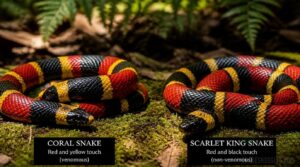
The coral snake’s red and yellow rings touch each other — that’s the key signal. This warning color purpose isn’t accidental; bright, high-contrast bands evolved to say "stay back" from a distance.
| Feature | Coral Snake | Detail |
|---|---|---|
| Band order | Red-yellow-black | Yellow touches red |
| Visibility | High contrast | Warns at distance |
| Tail bands | Black and yellow only | No red on tail |
Color pattern recognition starts here: red touches yellow, danger follows.
Red-black-yellow Band Order
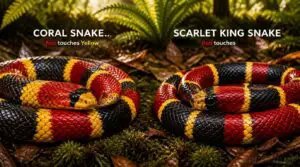
The scarlet king snake flips the script. Its red and black rings sit side by side, keeping yellow bands separated from red entirely. That band order rule — red touches black, safe to track — is your quick field check. Unlike its venomous lookalike, the king snake’s color pattern recognition is built on this one reliable difference.
| Feature | Scarlet King Snake |
|---|---|
| Band order | Red-black-yellow |
| Red touches | Black only |
| Yellow touches | Black only |
| Danger level | Non-venomous |
| Key clue | Red never meets yellow |
Head Shape Differences
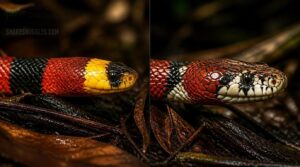
Band color gets most of the attention, but head shape can back up your ID when light is poor or the snake isn’t cooperating.
| Feature | Coral Snake | King Snake |
|---|---|---|
| Head size | Small, rounded | Slightly broader |
| Snout | Short, blunt | Longer, elongated |
| Neck separation | Barely visible | More distinct |
| Dorsal view | Uniform width | Wider near jaw |
| Jawline | Slender | Blockier silhouette |
Tail Banding Clues
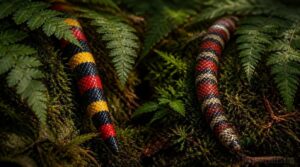
The tail tells its own story. On a coral snake, red and yellow rings wrap all the way to the tip — no break, no fade. King snakes, however, often show red and black rings or bands that get duller near the tail end.
| Feature | Coral Snake | King Snake |
|---|---|---|
| Tail contrast | High | Moderate |
| Band continuity | Unbroken to tip | May fade or break |
| Ring pattern | Vivid, consistent | Less uniform |
| Color pattern arrangement | Red-yellow sequence intact | Red-black, less striking |
Tail pattern visibility improves when the snake is extended — a quick glance at the tail can confirm your ID.
Body Size Comparison

Size is one of the easiest clues once you know what to look for. Coral snakes stay slim and short — usually 18 to 30 inches — with a slender, pencil-like build. King snakes run noticeably longer and stockier.
| Feature | Coral Snake | King Snake |
|---|---|---|
| Length | 18–30 inches | 24–48 inches |
| Build | Slender | Stout |
| Body ratio | High length-to-girth | Thicker midsection |
The Coral Snake Rhyme Explained
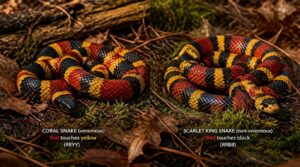
One little rhyme has helped hikers and campers tell these two snakes apart for generations. It works well in North America, but there are a few things worth knowing before you put all your trust in it. Here’s a closer look at what the rhyme really means and where it holds up.
Red Touches Yellow Warning
When red bands touch yellow bands, you’re looking at a coral snake warning. This color pairing isn’t accidental — red and yellow together create contrast, your eyes catch within seconds, even in low light.
If you want to put this rule to the test with real examples, this guide to Louisiana snake identification and coral snake lookalikes walks you through the color patterns side by side.
That’s why the rhyme exists: "red touch yellow, kill a fellow" gives you a fast, reliable cue before your brain has time to second-guess.
Red Touches Black Meaning
When you spot red touching black, you’re looking at a scarlet king snake — harmless and helpful. The second line of the rhyme, "red touch black, friend of Jack," exists precisely for this moment.
King snakes evolved their striking resemblance to coral snakes as a survival mimicry strategy, fooling predators while posing zero threat to you.
For accurate regional identification, consult the regional snake identification guide.
North American Reliability
The rhyme works remarkably well — but only within North American boundaries. Across the United States, the pattern holds consistently for correctly identifying coral snakes versus king snakes:
- Red touching yellow signals venomous coral snake
- Red touching black means harmless king snake
- Black and yellow tail bands confirm coral snake
- No red on tail reinforces the ID
This reliability makes it a trustworthy field tool.
Regional Color Exceptions
The rhyme has one real weak spot: geography. Arizona coral snakes produce bands so pale they look almost white, not yellow.
In humid Gulf Coast zones, humidity-induced morphs can dull red bands, while juveniles often show sharper, brighter contrast than adults.
Seasonal shedding temporarily fades colors too, making fresh post-shed scales look deceptively different from worn ones.
When Not to Rely
The rhyme is a helpful starting point, but don’t stake your safety on it alone. Four situations make it unreliable:
- Juvenile coloration — young snakes show faded or irregular bands
- Damaged tail bands — debris or molting obscures the tail pattern
- Regional mimics — non-venomous species copy similar red-yellow-black patterns
- Poor lighting — dusk and glare flatten color contrasts dangerously
Where These Snakes Live

Knowing where coral snakes and king snakes actually live changes how carefully you watch your step. Their ranges overlap in some surprising places — including backyards and hiking trails you might walk every week. Here’s a look at where each species calls home.
Eastern Coral Snake Range
If you live anywhere from the Carolinas to Louisiana, the eastern coral snake (Micrurus fulvius) is a real neighbor. This species ranges across the southeastern United States, favoring coastal plain habitats and pine flatwood ecosystems where sandy soil makes burrowing easy.
Habitat fragmentation and climate range shifts are gradually reshaping where these snakes appear — worth knowing before your next trail walk.
Texas Coral Snake Range
The Texas coral snake (Micrurus tener) shifts things westward.
While the eastern species hugs the Carolinas-to-Louisiana coastline, this one claims Gulf Coast Texas as its core territory — spreading through southern plains and riparian woodlands where sandy soil and mesquite communities provide ideal cover.
Seasonal rains bring higher activity, so wet‑weather field checks deserve extra caution.
Scarlet King Snake Range
While the Texas coral snake stakes out the Gulf Coast’s western edge, its harmless look‑alike roams far wider.
The scarlet king snake stretches from North Carolina to Texas, blanketing the southeastern United States.
It favors Coastal Plain habitats — sandy‑soiled pine forests and mixed woodlands — but disjunct Piedmont populations exist too.
You’ll even find one under backyard debris.
Shared Habitats and Overlap
So where does this overlap actually happen?
Across the southeastern United States, both snakes share riparian corridors, pine flatwoods, and moist woodland edges — anywhere small reptiles and amphibians gather. They’re drawn to the same sunlit basking patches for thermoregulation and retreat into identical leaf litter and rock piles when afternoon heat peaks.
Yard and Trail Encounters
Even familiar backyards can surprise you. Both snakes are drawn to leaf litter, wood piles, and rock gardens — common features in most yards.
Spring brings coral snakes closer to the surface, while king snakes peak in late summer.
Wear sturdy waterproof boots and tuck your pants in whenever you’re working near dense vegetation or debris.
Behavior and Defensive Clues
Watching how a snake moves and reacts can tell you almost as much as its color bands. Both coral snakes and king snakes have distinct habits that give them away — if you know what to look for. Here are five behavioral clues that help you tell them apart in the field.
Nocturnal Activity Patterns
Both coral snakes and king snakes follow nocturnal activity patterns, moving mostly between 9 pm and 4 am. Temperature drops slow them down, while rain reduces foraging but pushes both species closer to shelter. Watch for:
- Increased movement on warm, still nights
- Reduced activity on cold or rainy evenings
- Peak snake behavior during the darkest hours before dawn
Coral Snake Retreat Behavior
Spotting a coral snake in the open is rare — and that’s by design. When threatened, coral snakes retreat fast, diving into leaf litter, under logs, or into loose soil rather than standing their ground.
They favor shaded, damp microhabitats that hold steady moisture and temperature.
During daylight, look for subtle soil disturbances near debris piles — a quiet sign one passed through recently.
King Snake Tail Vibration
King snakes have a blunt but clever trick up their sleeve — they vibrate the tip of their tail rapidly when alarmed, mimicking the threat display of a rattlesnake.
Here’s what makes this defensive behavior worth understanding:
- The tail moves in short arcs while the body stays mostly still
- On dry leaves or loose soil, substrate vibration effects enhance the visual cue noticeably
- Temperature influence means warmer snakes vibrate faster and more frequently
- Muscle coordination mechanics allow brief, controlled bursts lasting just a few seconds
- Unlike rattlesnakes, no specialized rattle structure produces sound — it’s pure bluffing
This defensive bluffing tactic costs little energy but can make a predator pause long enough for the king snake to escape safely.
Climbing Versus Ground Dwelling
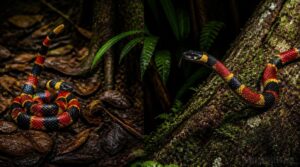
Where a snake spends its time can tell you a lot about which species you’re dealing with. Scarlet king snakes climb readily — trees, shrubs, even rough bark — while coral snakes stay close to the ground. That difference in habit reflects deeper physical realities: king snakes have stronger core muscles and better limb flexibility built for vertical grip mechanics.
| Trait | Coral Snake | King Snake |
|---|---|---|
| Movement style | Ground-dwelling | Climber and ground mover |
| Body build | Slender, smooth | Sturdy, muscular |
| Foraging strategy | Fossorial, low | Vertical and horizontal |
| Stability method | Body coiling | Multi-point limb contact |
| Speed preference | Slow, cautious | Faster across terrain |
Locomotion energetics differ too — climbing burns energy differently than horizontal movement, so king snakes forage across a wider vertical range, while coral snakes stick to leaf litter and soil.
Hiding Under Debris
Both species treat debris like a built-in shelter system. Leaf litter and rotting logs hold steady temperatures between 60–75°F, giving snakes a place to thermoregulate without crossing open ground.
Coral snakes, being fossorial by nature, favor these spots most — burrowing under leaf piles or logs fits their ground‑hugging lifestyle perfectly. Dense debris also breaks up a snake’s outline, making predator detection much harder.
Venom, Bites, and Safety
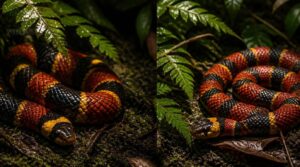
Knowing the difference between a coral snake and a king snake matters most in this moment — when one of them is close enough to bite. Coral snakes carry a venom that works quietly, and a king snake bite, while harmless, can still shake you up if you’re not prepared. Here’s what you need to know about both.
Coral Snake Neurotoxic Venom
Coral snake venom is unlike anything most snakes carry.
At its heart are neurotoxic three-finger toxins that latch onto nicotinic acetylcholine receptors, blocking the signals your muscles need to move. Phospholipase A2 enzymes join in, tearing apart muscle cell membranes.
Together, this venom synergy creates a sustained neuromuscular blockade that can escalate toward respiratory failure faster than most people expect.
Delayed Bite Symptoms
What makes a coral snake bite especially dangerous is how quiet it is at first. You might feel little to no pain right away — but delayed symptom onset means trouble can creep in hours, or even days, later.
A coral snake bite whispers before it screams — pain may be absent for hours while venom works silently
Watch for nausea, dizziness, muscle weakness, or spreading redness. These are signs of neurotoxic envenomation progressing silently through your system.
Emergency Medical Response
The moment you suspect a coral snake bite, call 911 immediately — don’t wait for symptoms.
While you wait, keep the person still and calm, remove jewelry or tight clothing near the bite, and gently clean the area. Position the limb at heart level.
Antivenom exists, but isn’t available at every hospital, so every minute counts.
King Snake Bite Risk
A king snake is nonvenomous — no venom, no emergency call needed.
But that doesn’t mean its bite is nothing. As a constrictor, it defends itself by biting, and those teeth can break skin, leaving a small wound prone to bacterial infection if ignored.
Clean it promptly with soap and water, apply antiseptic, and monitor for spreading redness.
Safe Encounter Steps
Whether it’s a coral snake or a lookalike, your first move is the same: stop and observe. Check band colors from a safe distance — never crouch in for a closer look.
Back away slowly, keeping at least several body lengths between you and the snake. Wear protective boots and long pants in brushy areas.
If bitten, call 911 immediately.
Diet, Hunting, and Lifespan
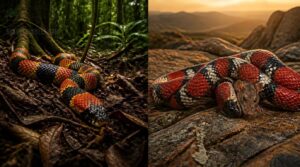
How these two snakes hunt and what they eat reveals just as much about them as their colors do. Each one has a completely different strategy for catching prey — and that difference shapes everything from their daily habits to how long they live. Here’s a closer look at what sets them apart.
Coral Snake Venom Hunting
Coral snakes don’t chase prey — they wait. Using stealth ambush tactics, a coral snake strikes fast, injecting neurotoxic venom through small rear-facing fangs in under a tenth of a second.
The venom then blocks acetylcholine receptors at the neuromuscular junction, cutting nerve signals and triggering rapid paralysis. Phospholipase enzymes help the toxins spread quickly, so prey rarely escapes.
King Snake Constriction
Unlike coral snakes, king snakes rely on pure physical force. Using an isometric coil, a king snake wraps its muscular body around prey in a spring-like spiral that maintains steady constriction pressure without wasted movement. This disrupts blood flow rather than just breathing — prey loses circulation fast.
Pressure scales with body size, giving larger constrictors a serious edge.
Eating Other Snakes
Watching a king snake take down another snake is something else entirely. These ophiophagous hunters strike the head first, clamping jaws around the prey’s skull to block any fang use. Then constriction kicks in.
They swallow prey headfirst while a highly flexible jaw accommodates even long, wriggling bodies. Their digestive systems handle full snakes efficiently over several days.
Venom Immunity Advantage
King snakes carry a built-in biological shield.
Through receptor site evolution, their nerve and muscle cells have changed so neurotoxins can’t bind effectively — meaning coral snake venom simply doesn’t hit the same targets it would in other animals. This inherited venom resistance is a coevolutionary survival strategy shaped over generations of predator-prey encounters.
Lifespan and Reproduction
Both species are oviparous, meaning they lay eggs rather than bear live young.
Coral snakes live roughly 6–10 years in the wild, while king snakes often reach 15–20 years.
Clutch sizes range from 3–10 eggs for coral snakes and 4–20 for king snakes, with 60–90 days of incubation before hatchlings emerge.
Top 4 Boots for Safer Field Checks
Good boots are one of the simplest ways to protect your ankles and lower legs during field checks in snake country.
Look for ankle-high or mid-cut waterproof construction that holds up in the leaf litter and rocky terrain where both coral and king snakes like to hide.
Here are four solid options worth considering before your next outing.
1. Nortiv Men Waterproof Hiking Boots
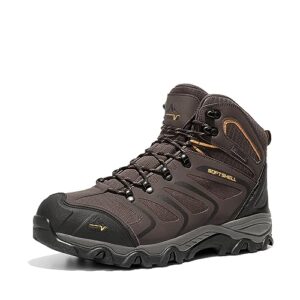
One solid pick for field work is the Nortiv Men Waterproof Hiking Boot, priced at an affordable $59.99.
Its EVA midsole keeps your feet light on long trails, while the high-traction rubber outsole grips wet, muddy, or uneven ground confidently.
The ankle-high design and cushioned insole work well if you have wide feet or bunions. Just note that sizing runs large — order a half size down for the best fit.
| Best For | Hikers, campers, and outdoor workers with wide feet or bunions who want a lightweight, affordable boot with solid grip on rough or wet terrain. |
|---|---|
| Water Protection | Water-resistant coating (not fully waterproof) |
| Outsole Type | Rubber with lug tread pattern |
| Midsole Cushioning | Lightweight EVA foam midsole |
| Ankle Height | Ankle-high mid-cut |
| Upper Material | Synthetic leather with water-resistant coating |
| Lace Closure | Speed-lace system with soft hooks |
| Additional Features |
|
- Cushioned, removable insole and soft side panels make it genuinely comfortable for wide feet, bunions, or pronation issues over long hours
- High-traction rubber outsole handles wet, muddy, snowy, and icy surfaces with confidence
- Lightweight EVA midsole keeps fatigue low on multi-day treks without sacrificing ankle support
- Not fully waterproof — fine for damp conditions, but deep water crossings will soak through
- Toe area material can break down after about a year of heavy use
- Sizing runs large, so most people need to order a half size smaller than usual
2. Columbia Waterproof Hiking Boots
Another great field boot is the Columbia Waterproof Hiking Boot at $63.75, a modest step up from the Nortiv but packed with meaningful upgrades.
The OMNI-TECH waterproof membrane seals out rain and wet brush without trapping heat, while the OMNI-GRIP outsole locks onto wet rock and gravel confidently. Leather and mesh uppers hold up well through repeated use.
One heads-up: the stock insole is thin, so pack aftermarket insoles if your arches need extra support on long days out.
| Best For | Hikers and outdoor workers who need reliable waterproofing and sure-footed traction on rugged, mixed terrain without breaking the bank. |
|---|---|
| Water Protection | OMNI-TECH seam-sealed waterproof membrane |
| Outsole Type | OMNI-GRIP rubber mixed-lug pattern |
| Midsole Cushioning | TECHLITE high energy return midsole |
| Ankle Height | Mid-cut ankle height |
| Upper Material | Leather and mesh with metal hardware |
| Lace Closure | Adjustable lace-hook eyelets |
| Additional Features |
|
- OMNI-TECH waterproofing keeps feet dry in rain, snow, and wet trail conditions
- OMNI-GRIP outsole delivers confident traction on wet rock, gravel, and uneven surfaces
- Durable leather and mesh upper with metal hardware holds up well through heavy use
- Thin stock insole offers minimal arch support — aftermarket insoles likely needed for long days
- Less breathable upper can feel warm in hot weather
- Heavier than ultralight trail shoes, which may be a drawback for weight-conscious hikers
3. Merrell Women Moab 3 Mid Waterproof
The Merrell Moab 3 Mid Waterproof steps things up noticeably for women who spend serious time on rugged terrain. Its Vibram TC5+ outsole grips confidently on wet rock, mud, and gravel — exactly the surfaces you’d find on a snake-monitoring day hike.
The waterproof membrane seals out moisture while the bellows tongue blocks debris. A contoured, removable insole with air-cushion heel keeps fatigue low on long field checks. Note: the fit runs snug, so size up if needed.
| Best For | Women who tackle rugged, wet terrain regularly and want a durable, well-cushioned mid-height boot with reliable traction and waterproof protection. |
|---|---|
| Water Protection | OMNI-TECH seam-sealed waterproof membrane |
| Outsole Type | OMNI-GRIP rubber blended-lug pattern |
| Midsole Cushioning | TECHLITE lightweight impact absorption |
| Ankle Height | Mid-height ankle support |
| Upper Material | Leather and mesh with metal hardware |
| Lace Closure | Standard lace-up with metal hardware |
| Additional Features |
|
- Vibram TC5 outsole grips confidently on wet rock, mud, and uneven surfaces
- Waterproof membrane with bellows tongue keeps feet dry and debris-free
- Air-cushion heel and contoured insole reduce fatigue on long hikes
- Fit runs snug — those with wider feet or thick socks may need to size up
- Waterproof membrane can trap heat, making feet warm in hot conditions
- Upper ankle area may cause pressure during extended wear until properly broken in
4. Columbia Newton Ridge Waterproof Hiking Boot
If the Merrell suits trail-focused women, the Columbia Newton Ridge is a dependable all-rounder that works equally well for men covering mixed terrain.
Its PU-coated leather and mesh upper, paired with a seam-sealed waterproof membrane, keeps moisture out during wet-ground field checks. The Techlite midsole cushions impact on rocky paths without adding bulk. At $89.99, it balances protection and value — a solid choice when you’re stepping carefully through snake country.
| Best For | Men who need a reliable, all-terrain hiking boot that handles wet, icy, and uneven ground without breaking the bank. |
|---|---|
| Water Protection | Waterproof membrane, moisture-wicking |
| Outsole Type | Vibram TC5+ rubber outsole |
| Midsole Cushioning | EVA foam with Merrell Air Cushion heel |
| Ankle Height | Mid-height ankle support |
| Upper Material | Pigskin leather and breathable mesh |
| Lace Closure | Lace-up with recycled laces and webbing |
| Additional Features |
|
- Waterproof full-grain leather and mesh upper keeps feet dry on wet trails and rainy-day outings
- Omni-Grip dual-zone rubber outsole delivers confident traction on ice, snow, mud, and rocky terrain
- Lightweight, cushioned midsole provides all-day comfort without adding unnecessary bulk
- Soft rubber outsole may wear down faster with heavy or frequent use
- Mesh tongue is only water-resistant, so prolonged heavy rain can let moisture in
- Long laces and oversized hooks can snag or come loose during more vigorous activity
Frequently Asked Questions (FAQs)
What is the rhyme for coral snakes and king snakes?
The rhyme goes: "Red touch yellow, kill a fellow; red touch black, friend of Jack." It’s a quick memory trick to spot venomous coral snakes in North America by their band colors.
Are coral snakes poisonous?
No, coral snakes aren’t poisonous — they’re venomous. Poison harms you through touch or ingestion, while venom is injected through a bite. It’s a small but important distinction.
If you’re curious which species actually pose a risk nearby, this guide to venomous snakes in Arizona breaks down how to spot them safely.
That mix-up isn’t unique to coral snakes, either — check out this breakdown of whether ringneck snakes are actually venomous to see how the same confusion plays out with another common backyard species.
Is a king snake poisonous?
King snakes are not poisonous — or venomous. They don’t produce any toxins harmful to humans. Instead, they kill prey by constriction, making them completely safe to encounter in the wild.
What is the difference between a kingsnake and a coral snake?
Like day and night, these two snakes look similar but aren’t. One carries neurotoxic venom; the other doesn’t. Band color order, head shape, and body size are your clearest clues.
How can you tell a coral snake from a king snake saying?
There’s an old saying that could save your life: "Red touch yellow, kill a fellow; red touch black, friend of Jack." It tells you instantly whether the snake nearby is dangerous.
Is a coral snake deadlier than a rattlesnake?
Both snakes are dangerous, but coral snake venom is more toxic per drop. However, rattlesnakes inject far more venom per bite, making their bites cause faster, more severe harm overall.
How can you tell a coral snake from a king snake?
The easiest clue is band color order. If red touches yellow, you’re looking at a coral snake. If red touches black, it’s a king snake — and harmless.
What is the old saying about coral snakes?
The classic saying goes: "Red touch yellow, kill a fellow; red touch black, friend of Jack." This simple rhyme helps you quickly tell dangerous coral snakes from harmless look-alikes across North America.
What is the rhyme for king snakes and coral snakes?
The rhyme goes: "Red touch yellow, kill a fellow; red touch black, friend of Jack." It’s a quick memory tool that helps you sort a venomous coral snake from a harmless king snake at a glance.
How venomous is a coral snake?
Coral snake venom is highly neurotoxic, attacking the nervous system rather than tissue. It can cause respiratory failure — and because symptoms are often delayed by hours, a bite may feel minor before becoming life-threatening.
Because Asian coral snakes like Sinomicrurus are mostly nocturnal, their bites often go unnoticed until symptoms set in — this coral snake species profile with photos and bite information can help you spot the warning signs early.
Conclusion
You don’t need a biology degree to tell them apart—just steady eyes and a reliable rule. Mastering coral snake vs king snake identification comes down to one habit: pause, observe the band order, check the head shape, and trust what you see.
The rhyme won’t always save you, but the full picture will.
When you know both snakes by detail rather than fear, every trail encounter becomes a moment of confidence instead of panic.