This site is supported by our readers. We may earn a commission, at no cost to you, if you purchase through links.

A snake has more than 600 vertebrae, and a single muscle can stretch its tendon across 30 of them. That’s the hidden machinery behind every slither, climb, and strike.
Without limbs, a snake asks its back to do everything: hold its weight, bend in three dimensions, and crush prey. Snake muscle anatomy explained clearly comes down to three long muscles running along the spine, joined by tendons that make up nearly three-quarters of each unit.
You’ll see how those muscles share the load, why a snake can swallow prey wider than its head, and how each movement draws on a different part of the body.
Table Of Contents
Key Takeaways
- Your snake’s back does the work of legs, and its 600-plus vertebrae, which resist twisting but bend freely, give it a flexible frame that ribs attached to nearly every body vertebra turn into a way to push against surfaces.
- Three long back muscles, the semispinalis-spinalis, longissimus dorsi, and iliocostalis, make up about 65% of axial muscle mass, and each one trades torque for posture differently.
- Each muscle gathers slips from several vertebrae into one long tendon, which makes up 68 to 75 percent of the unit, and the longest tendons belong to slender, climbing species.
- You’ll see the same muscles handle slithering, climbing, and constriction through shifting neuromuscular control, while an elastic jaw joint and swinging quadrate bones let your snake swallow prey wider than its head.
The Skeletal Framework for Snake Muscles
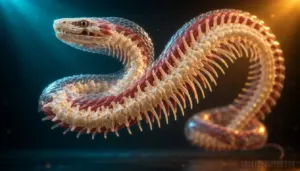
Because a snake has no limbs to carry its weight, your first look at its anatomy should start with the axial skeleton, the central bony axis that does nearly all the work. A snake’s vertebral column can hold over 600 vertebrae, each linked to its neighbor at five points, including the zygosphene-zygantrum pair found almost only in snakes. This design bends freely but resists twisting.
The snake skeletal system explains how ball-and-socket joints let muscle force travel cleanly along the spine while still allowing flexible sideways bending.
Ribs extend this framework. Hundreds of ribs attach to every body vertebra, free at their lower ends, so each one moves independently. Muscles attached to the ribs let them lift and push against surfaces, acting like miniature legs for propulsion.
The Three Main Snake Back Muscles
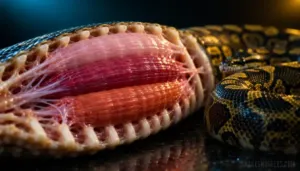
Those ribs need something to pull them, and that job falls largely to three muscles along your snake’s back: semispinalis-spinalis, longissimus dorsi, and iliocostalis. They sit from top to bottom in that order, and together they make up roughly 65% of its axial muscle mass.
Semispinalis-spinalis lifts and extends the spine. Iliocostalis does the opposite, bending it downward, and it drives most side-to-side flexion. Longissimus dorsi falls between them, so each muscle trades torque for posture differently.
Overlapping Muscle Segments and Long Tendons
Snake muscles don’t line up with the spine the way you might expect. Two features set them apart, and you’ll see both below. Each one changes how force travels along the body, so it’s worth understanding them before moving on.
Muscle Attachments Across Multiple Vertebrae
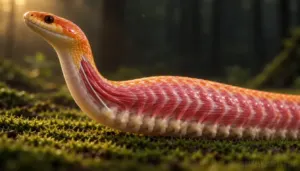
Picture a corn snake tensing its back to hold its head steady above the ground. The muscle doing that work doesn’t sit on one vertebra. Instead, each segment of the spinalis, one of the epaxial muscles running along the spine, starts as multiple muscular slips. These slips grip neighboring vertebrae at the rear. Keepers can support this muscle work by choosing a corn snake enclosure kit with sturdy branches and hides that encourage natural climbing and head-lifting.
Toward the front, those slips converge on a single tendon anchored to one vertebra. This many-to-one design is a fundamental feature of snake myology. It shapes the entire trunk musculature of snakes.
Tendon Length Along the Trunk
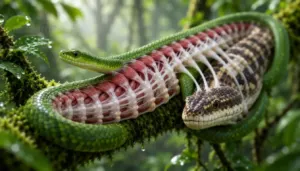
Those converging slips feed into a tendon, and its length changes along the body. Tendon makes up 68 to 75 percent of each musculotendinous unit, so contractile tissue is the smaller part.
Here’s what to remember:
- Corn snakes: the semispinalis-spinalis anterior tendon spans 11 vertebrae.
- The iliocostalis anterior tendon spans only 4 vertebrae.
- Some other colubroids exceed 30 vertebrae.
- Boas keep short tendons, spanning about 7 vertebrae.
- Arboreal colubroids have the longest tendons, matching their slender bodies.
Longer tendons suit climbing species with extremely thin bodies.
Pairing that build with climbing structures from these snake terrarium decor ideas lets arboreal species stretch and use their bodies naturally.
How Snake Muscles Power Movement and Constriction
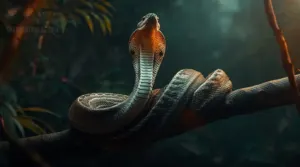
Those long tendons and overlapping segments do their real work once your snake starts to move or squeeze. Two actions show this best: locomotion and prey control. Below, you’ll see how the same muscles handle slithering, climbing, and rearing, and then how they coordinate during constriction.
Slithering, Climbing, and Rearing
Every move a snake makes is a three-dimensional bend. Your mental image of side-to-side wiggling is a lab artifact, since real snake locomotion mixes lateral and vertical curves that push against rocks, bark, and soil.
Forget the tidy sideways wiggle; a real snake travels by curving up and across at once, pressing into stone, bark, and dirt
| Task | Key muscles | Activity |
|---|---|---|
| Slithering | LD, IC | Unilateral, on convex bends |
| Rearing | SSP | Bilateral lift |
| Gap bridging | LD, IC | Sustained, bilateral |
Climbing relies on vertical bends that travel backward and push against branches. Descending needs almost no back muscle effort, but a horizontal gap demands maximal bilateral contraction to prevent sagging.
Muscle Coordination During Constriction
Why can a snake squeeze prey for minutes without wearing out? No catch holds the force, so neuromuscular control does the work.
- Epaxial muscles fire hard during the strike and coil formation.
- They shift to short bursts once the prey goes still.
- Prey heartbeats or breathing trigger extra squeezing right away.
- The front body keeps breathing while the mid-trunk holds.
That segmental muscle coordination splits ventilation from squeezing along the trunk. Muscle fiber orientation boosts force, and kingsnakes clearly exert greater constriction pressure than comparable ratsnakes.
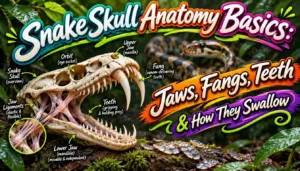
How Snake Jaw Muscles Stretch During Swallowing
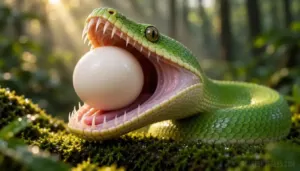
Picture a rubber band stretching around a grapefruit and snapping back unharmed. Your snake’s jaws do much the same.
This jaw mobility depends on three features:
- Elastic symphysis: the lower jaws join by stretchy tissue, not bone.
- Rotating quadrates: these bones swing nearly 90 degrees, deepening the gape.
- Independent jaw sides: each side moves separately.
That’s how a snake can swallow prey wider than its head, using strong muscles that pull one side forward while the other side holds fast.
Frequently Asked Questions (FAQs)
What happens to a snakes stretched muscles afterward?
After a big meal, your snake’s jaw muscles don’t stay stretched. Titin, a springy protein inside each fiber, pulls the sarcomeres back toward resting length. Then active muscle contraction finishes the job, restoring normal function without damage.
How many muscles does a snake have in total?
A snake has roughly 10,000 to 15,000 individual muscles, depending on the species. That’s far beyond the 700 to 800 in your own body, because the same set of axial muscles repeats at every vertebra.
Do snakes have more muscles than humans?
Yes, and by a margin that makes your own 600 to 800 muscles look like a rounding error. A snake can carry 10,000 to 15,000, mostly because every vertebra repeats the same pattern of attachments.
How do snake ribs differ from human ribs?
Your ribs stop at the chest, but a snake’s run nearly the whole body. Yours attach to a sternum, while its ribs float freely, so they expand dramatically around large prey.
Why do some snakes have tiny pelvic spurs?
Watch a male boa approach a female and you’ll see his spurs scratch along her flanks. These pelvic spurs are vestigial hind-limb remnants, kept because males use them to coax mating postures and settle rivalries.
Conclusion
How does a body with no limbs do so much? Snake muscle anatomy explained comes down to repetition and reach: three long muscles, overlapping segments, and tendons that span dozens of vertebrae.
That design lets one animal bend, climb, squeeze, and swallow using the same spine. You can see it in a slither or a tightening coil. Each movement borrows a different section of the body.
It isn’t missing limbs. It’s built around one backbone.