This site is supported by our readers. We may earn a commission, at no cost to you, if you purchase through links.

A red tail boa can grow from a pencil-thin hatchling into a 10-foot, 60-pound adult. The tank that holds a 20-inch baby won’t hold that snake for long.
Most beginners underbuild. They buy a cozy starter tank, then scramble when the boa outgrows it, escapes a flimsy lid, or sits in air that’s too cold or too dry. Temperatures above 95°F can cause brain damage, and a single heat rock can burn a boa badly.
A solid red tail boa enclosure setup prevents all of it. Start with the right dimensions, then build outward to security, heat, humidity, and furnishings.
Table Of Contents
Key Takeaways
- Size your boa’s enclosure for the adult it’ll become, starting at 4′ × 2′ × 2′ once it passes two feet and reaching at least 6′ × 2′ × 2′ (8′ × 4′ × 4′ for large females), and upgrade when your snake hits two-thirds of the current length.
- Secure every seam, latch, and vent with ¼-inch mesh, silicone, and locking closures, and push hard on each one before your boa moves in, since most escapes start with a small flex in a weak clip.
- Build a thermal gradient with a 90–95°F basking spot, an 80–88°F warm side, and 75–80°F at night, control every heat source with the right thermostat, and never use heat rocks or let temperatures pass 95°F.
- Hold humidity steady with at least 4 inches of damp-but-never-muddy substrate, check hygrometers daily at both ends, and keep airflow moving so moisture never stays above 80 to 90%.
Choose the Right Red Tail Boa Enclosure Size
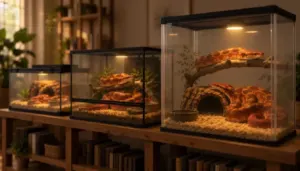
Your boa’s enclosure should match its size, and that size changes fast as your snake grows. Below, you’ll find the right enclosure size for each stage, from hatchling to adult. Pick the one that fits your snake today, and plan ahead for the next upgrade.
If you’d rather build the next upgrade yourself, these DIY snake cage ideas show how to make a custom enclosure at the right size.
Hatchling and Juvenile Enclosure Sizes
A hatchling under two feet does well in a 20-gallon tank, about 30" × 12" × 12", or an enclosure of 2′ × 1.5′ × 1′.
Move to 4′ × 2′ × 2′ once your boa passes two feet. Add shelves and sturdy branches, since these snakes love to climb. Plan your next upgrade when the snake reaches two-thirds of the current enclosure’s length.
Full-grown adults commonly reach 7 to 10 feet and need an enclosure of at least 6′ × 2′ × 2′.
Adult Sizes by Boa Species
Not every red tail boa stays the same size, so check which kind you own. A Boa constrictor constrictor female can pass 10 feet. Boa imperator usually tops out at 6 to 10 feet. Males run smaller across both.
Plan for a 6′ × 2′ × 2′ minimum for males. Females and large adults over 8 feet need 8′ × 4′ × 4′.
Build a Secure, Ventilated Boa Enclosure
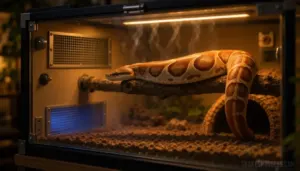
Once you’ve picked the right size, the walls around your boa matter just as much as the floor space inside them. A red tail boa will test every seam, so build for strength first.
If you’re still weighing dimensions, this guide to the recommended terrarium size for a red-tailed boa makes planning your build much easier.
Start with airflow. Vents on one side only leave the interior stagnant. Place a high vent on the warm side and a low vent on the cool side so air moves through. Tall enclosures need extra care, since heavy air pools near the bottom.
Use these checks before your snake moves in:
- Cover vents with ¼-inch galvanized mesh and press it by hand.
- Keep door gaps under 1/8 inch.
- Latch both ends of a hinged lid.
- Seal cable and probe entry points with silicone.
- Brace corners with metal brackets and silicone.
Recheck silicone after 24 hours to confirm it cured.
Set Up the Red Tail Boa’s Thermal Gradient
Your boa can’t regulate its body heat on its own, so you’ll build that control into the enclosure. Below, you’ll find the target temperature zones for day and night, plus the heating and monitoring gear that keeps them steady. Get these right, and you’ll set up a safe, stable home your snake can rely on.
For a closer look at setting up and maintaining these zones, this guide to regulating boa constrictor humidity and heat walks through each step in detail.
Basking, Ambient, and Nighttime Temperatures

Wild boas stay active from 62°F to 104°F, so your temperature gradient sits well inside their comfort range.
| Zone | Fahrenheit | Celsius |
|---|---|---|
| Basking | 90–95 | 32–35 |
| Warm side | 80–88 | 27–31 |
| Night | 75–80 | 24–27 |
Cap the basking spot at 90°F if unsure. Above 95°F risks brain damage. Switch daytime heat off at night, but add lightless heat if the room drops below 68°F.
Heat Sources, Thermostats, and Thermometers
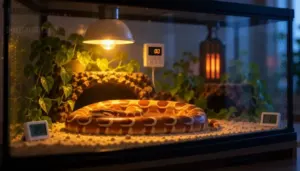
The right heating equipment keeps your boa safe and comfortable. Pair every heat source with the correct thermostat:
- Use a dimming thermostat for halogen bulbs and deep heat projectors.
- Use a pulse proportional model for ceramic emitters.
- Offset the probe slightly from the basking spot.
- Verify readings with digital thermometers.
Never use heat rocks, because they cause serious thermal burns.
Manage Boa Enclosure Humidity With Substrate
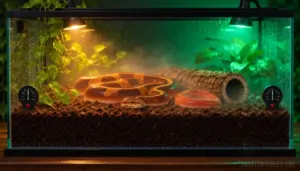
The substrate does more than cover the floor. It acts as a slow-release humidity source, so your substrate choices matter as much as your misting routine.
Pack in at least 4 inches and mix water through it until it’s damp, never muddy. The base stays moist while the surface dries, which prevents mold. Shredded cypress mulch for reptiles works well here because it holds moisture in the lower layers while the top stays dry.
| Substrate | Moisture performance |
|---|---|
| Cypress mulch | Holds well in thick layers |
| Coconut fiber | Retains well and allows burrowing |
| Aspen shavings | Dries fast; needs 2-3 weekly mistings |
Aim for roughly 80% in Amazon lineages and 50 to 60% for drier ones. Check humidity levels daily with hygrometers placed at both ends. Keep some airflow moving, since constant dampness above 80 to 90% invites mildew. Ease off if it’s wet.
Furnish, Test, and Maintain Your Boa Enclosure
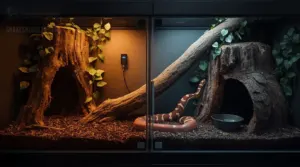
Picture a boa that’s been in its new home for two days. It leans against the screen top, pushes, and one clip bows just enough to let a nostril through. That’s how most escapes start, and it’s why you test before you trust.
Most escapes begin with a small flex in a weak clip, so push on every latch before your snake ever does
Screw your branches into the wall or floor, then hang your full weight on each one. Mopani and cork bark resist mold and hold up well. Add two identical hides, one warm and one cool, each two to three times your boa’s body width.
Push hard on every latch, track, and pass-through. Use hasp-and-padlock closures on adult enclosures.
Spot-clean daily. Do a full deep clean every 4 to 6 weeks with F10SC, chlorhexidine, or 3% bleach, and let everything dry completely before you rebuild.
Frequently Asked Questions (FAQs)
Do red tail boas need UVB lighting?
No, they don’t. Red tail boas are nocturnal and crepuscular, and whole prey gives them the D3 and calcium they need. Still, UVB is best practice. If you add it, aim for a basking UVI of 0 to
How long should I quarantine a new boa?
Ninety days is the bare minimum, and most keepers go 3 to 6 months. That window lets hidden illness show up and gives you time to run several fecal tests before you introduce the animal.
How long does it take for a red tail boa to reach full size?
Wondering when your boa will stop growing? Most reach adult size in 3 to 5 years, growing fastest in the first two. Females finish larger. After that, growth slows to a few inches each year.
How often should I feed my red tail boa?
A boa’s growth is genetically set, and feeding it more often won’t speed it up. Offer prey every 10–14 days for juveniles, then every 2–3 weeks for adults. Stretch the gaps in winter.
What signs show my boa is sick?
Watch for wheezing, clicking, mucus, or open-mouth breathing. Red, swollen gums, stargazing, soft blistered scales, and food refusal beyond two months also signal trouble. Call a reptile veterinarian promptly if you see any of these.
Can I handle my boa right after feeding?
No, wait at least 48 hours, and give a large boa three to four days. Handling too soon can press on the meal and force it back up, which can injure the oesophagus and waste that feeding.
Conclusion
Size it for the adult. Secure it against escape. Heat it with a thermostat. Every choice in your red tail boa enclosure setup answers one question: what does this snake need to thrive?
Get the basics right and the rest becomes routine. Check your temperatures daily, keep humidity steady, and spot-clean as needed. Your boa won’t notice the effort, only the stability.
Build it once, build it well, and you’ll own a calm, healthy snake.