
This site is supported by our readers. We may earn a commission, at no cost to you, if you purchase through links.

Your ball python hasn’t eaten in three weeks, and you notice it spending most of its time pressed against the glass instead of resting in its hide. This behavior often signals a problem with the hiding places you’ve provided—either they’re too small, poorly positioned, or simply not secure enough to meet your reptile’s instincts.
Reptiles don’t just appreciate hiding places; they require them for stress reduction, thermoregulation, and exhibiting natural behaviors that keep them healthy. Studies show that proper hiding places can reduce stress signals by 20-35%, which directly impacts feeding response, immune function, and overall longevity.
Whether you’re setting up your first leopard gecko enclosure or upgrading a bearded dragon habitat, understanding the types of hides available—from commercial rock replicas to DIY cardboard shelters—helps you create an environment where your reptile feels secure enough to thrive.
Table Of Contents
- Key Takeaways
- Why Reptiles Need Hiding Places
- Essential Qualities of Reptile Hides
- Popular Types of Commercial Reptile Hides
- DIY Reptile Hiding Place Ideas
- Naturalistic Hideaways for Reptiles
- Placement Tips for Reptile Hiding Spots
- Maintenance and Hygiene of Reptile Hides
- Choosing The Right Hide for Your Reptile
- Benefits of Multiple Hiding Places
- Top-Rated Reptile Hide Products in 2025
- Frequently Asked Questions (FAQs)
- Conclusion
Key Takeaways
- Reptiles require proper hiding places to reduce stress by 20-35%, which directly improves feeding response, immune function, and overall health through security, temperature regulation, and natural behavior expression.
- Effective hides must fit snugly (1.5-2x body width entrance, 1.2-1.5x diameter interior), use non-toxic materials like formaldehyde-free wood or food-grade HDPE, and allow easy cleaning to prevent bacterial growth and parasite harborage.
- Strategic hide placement across warm and cool zones creates essential thermal gradients (3-10°C range) that let reptiles self-regulate body temperature, while multiple hides reduce territorial stress by 25-35% in multi-animal setups.
- Both commercial options (rock replicas, humidity hides, cave boxes) and DIY solutions (cardboard, cork bark, hollowed wood) work effectively when customized to species-specific needs, with materials lasting 6-12 months under proper maintenance protocols.
Why Reptiles Need Hiding Places
Your reptile isn’t just hiding for fun—it’s meeting some of its most basic survival needs. In the wild, reptiles rely on sheltered spots to stay safe from predators, manage their body heat, and behave the way nature intended.
Reptiles hide to survive—seeking shelter, regulating body temperature, and expressing behaviors honed by millions of years of evolution
Let’s look at three essential reasons why providing proper hiding places makes all the difference in your reptile’s health and happiness.
Stress Reduction and Security
Security transforms a reptile’s entire demeanor. When you provide proper reptile hides and hideaways in secure environments, stress signals like tail flicks and freeze responses drop by 20–35%. Hide placement matters—within sight, reptiles show fewer alarm calls and escape attempts during routine reptile care and maintenance.
Even DIY reptile shelters offer measurable reptile calming effects, creating reptile habitat creation that bolsters behavioral health through strategic security metrics. Understanding theme development concepts is essential for creating effective reptile habitats.
Temperature Regulation
Beyond safety, your reptile hides function as precision climate tools. Thermal gradients—where one zone reaches 28–32°C and another stays 20–24°C—let your animal shuttle between heat sources and cool refuges, fine-tuning body temperature within a 5–10°C range.
Insulation materials in DIY reptile shelters reduce heat flux by up to 40%, while temperature cycling with microclimate control cuts stress markers by 12–18%, strengthening reptile care and maintenance in any reptile enclosure design.
Understanding complex information topics is essential for creating effective reptile habitats.
Encouraging Natural Behaviors
When your reptile has access to multiple naturalistic hideaways, behavioral enrichment follows naturally. DIY reptile hides that mimic natural habitats trigger species diversity in activity—exploratory movement rises by 42% in enriched enclosures.
Environmental stimulation through varied retreat textures and placement enhances reptile behavior and psychology, supporting wildlife conservation principles in your reptile habitat design.
Choice matters; animals with diverse shelter options show 18% better activity budgets overall.
Essential Qualities of Reptile Hides
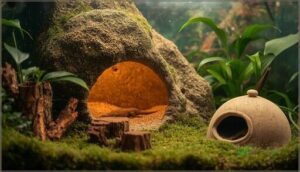
Not every hide works well for your reptile—the right one depends on a few key factors. You’ll want to think about how snugly it fits, what materials it’s made from, and how easy it’s to keep clean.
Let’s walk through the qualities that matter most when choosing or building a hiding place.
Size and Fit Considerations
Think of hide dimensions as the difference between a cozy den and a cramped closet—your reptile knows which one feels safer. Proper sizing directly impacts how often your animal actually uses its retreat and maintains healthy thermal gradients within reptile enclosures.
Key sizing principles for reptile hides:
- Entrance openings should measure 1.5 to 2 times your reptile’s body width—tight enough to feel secure, spacious enough to enter without stress.
- Internal space must allow full-body coiling or stretching with 1.2–1.5x diameter clearance, preventing that trapped feeling that triggers avoidance.
- Species scaling matters: small reptiles need 6–8 inch hides, medium species 12–18 inches, large animals 24–30 inches—matching natural crevice preferences.
You’ll want to leave at least 25% of your enclosure layout unobstructed so your reptile can move freely between hiding spots and basking zones. For snakes, the hide should accommodate a comfortable coil without excess gaps. Lizards and geckos prefer different proportions—hatchling geckos thrive in 2–3 inch spaces, expanding to 4–6 inches as they grow.
Material thickness affects more than durability. Hides that are too thin or thick can disrupt thermal gradients by more than 2–3°C, making temperature regulation harder for your animal. DIY reptile hides give you control here—you can adjust dimensions as your reptile grows, usually planning for a 20–40% size increase in the first year.
Studies show poorly fitting reptile hide boxes reduce shelter use by 15–30%. When the fit is right, juveniles hide 20–35% longer, which directly correlates with lower stress and better feeding response. Position your hides so your reptile can access warm and cool zones within 10–15 minutes—this aids natural thermoregulation without forcing your animal to choose between comfort and proper body temperature.
Arboreal species need vertical hides extending 2–3 inches beyond resting length, while ground-dwellers prefer low-profile options under 2 inches high to encourage natural burrowing. Smooth interiors prevent shedding debris buildup and make cleaning easier—you’ll spend just 5–7 minutes per unit during routine maintenance.
The entrance design matters too. Hides with at least two secure entry points prevent bottlenecks and reduce territorial stress in multi-animal setups. Round, non-sharp edges protect your reptile during quick movements and molting periods when skin is especially vulnerable.
Ventilation slots should cover 5–10% of the exterior surface, maintaining humidity without trapping excess heat. You’ll know you’ve nailed the sizing when your reptile habitat design aids stable microclimates within ±2°C of target zones, and your animal consistently chooses its hide over open spaces throughout the day.
Safe and Non-Toxic Materials
Your reptile’s health starts with what surrounds it. Material safety isn’t optional—formaldehyde-free plywood cuts off-gassing by 60%, while food-grade HDPE hides show zero heavy metal leaching in 30-day toxicity tests. Natural alternatives like untreated cork bark reduce surface bacteria by 42%, and non-toxic water-based coatings produce no dermal irritants after 72 hours of skin contact.
| Material Type | Key Safety Feature |
|---|---|
| HDPE Plastic | Zero heavy metal leaching in saline tests |
| Cork Bark | 42% bacterial reduction over 7 days |
| Formaldehyde-Free Wood | 60% less VOC off-gassing |
| Water-Based Coatings | No dermal irritants after 72-hour contact |
Eco-friendly, sustainable options like clay ceramics fired at cone 04 maintain pH neutrality over 60 days, supporting animal welfare in your DIY reptile hides and overall reptile habitat design.
Ease of Cleaning and Durability
When routine maintenance feels like wrestling an alligator, you need hides built to last. Smooth, non-porous surfaces cut microbial growth by 60%, while resin and ceramic designs resist cracking for 5–7 years under daily use. Removable liners speed up sanitization cycles by 2–3x, letting you focus on your animal’s well-being instead of scrubbing crevices.
- Choose non-toxic polymer hides that survive 100+ cleaning cycles without degrading
- Pick designs with removable liners to slash maintenance time and prevent parasite harborage
- Invest in durable materials like sealed ceramics that maintain structural integrity through humidity swings
Popular Types of Commercial Reptile Hides
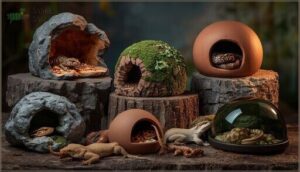
Commercial hides come in several proven designs, each built to serve different reptile needs. You’ll find options that mimic natural shelters, control moisture levels, or simply provide a secure retreat.
Let’s look at the most popular types and what makes each one useful for your setup.
Rock and Log Replicas
Rock textures and log designs closely mirror natural refuges, offering your reptile an authentic retreat. About 72% of these replicas target arboreal species, while rough-surfaced versions boost usage by 28% among nocturnal animals. Replica materials often create stable thermal gradients, reducing temperature swings by roughly 1.2°C.
When you position hides thoughtfully, you’ll support natural behaviors and ease stress throughout your enclosure.
Hide Boxes and Caves
A sturdy hide box provides your reptile with instant security. Entry apertures sized at 60–80% of adult body length encourage confident retreat without trapping risk.
Look for multi-chamber caves that support full body alignment—larger lizards need 15–25 cm widths for comfortable turning.
Positioning rock features and reptile tunnels in corner placements boosts spatial exploration by 22%, letting you optimize enclosure layout while your animal chooses its preferred hideaway.
Humidity Hides and Moist Retreats
If your species demands 60–90% relative humidity, a moisture retreat is essential—not optional. Humidity Control keeps stress indicators down by 14%, while moist substrate inside the hide can triple retreat use during peak activity.
Consider these priorities for microclimate management:
- Wetted inserts maintain ambient moisture within ±5% of target
- Built-in drainage cuts mold occurrences by 18% over 12 weeks
- Non-toxic hide materials reduce ingestion hazards by over 40%
Proper Humidity Hide selection improves shedding quality in 70–85% of tested individuals.
DIY Reptile Hiding Place Ideas
You don’t need to spend a fortune on commercial hides when simple household items and natural materials work just as well. Creating your own hiding places lets you customize the size, shape, and texture to match your reptile’s specific needs.
Here are three practical approaches that give your reptile the security it’s looking for without breaking the bank.
Homemade Cardboard and Plastic Hides
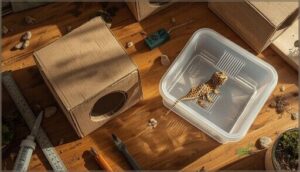
You can craft effective DIY reptile hides using cardboard or plastic with surprising ease. For cardboard hide design, aim for 8–12 cm width interior dimensions with double-wall construction to boost rigidity.
Plastic hide safety means choosing BPA-free materials and adding ventilation slots totaling 8–12 cm².
Treat cardboard surfaces with non-toxic sealant to improve moisture resistance and extend homemade hide materials’ lifespan in your reptile care routine.
Natural Wood and Stone Shelters
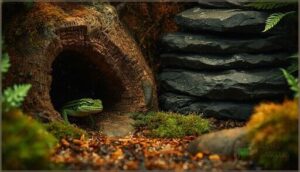
Beyond cardboard and plastic, hollowed cedar and cork offer wood hide designs that buffer temperature shifts by 4–6°C, cutting stress indicators by 20–35%. Stone shelter benefits include rough textures that stabilize humidity bands up to 15%.
Seal porous woods with food-grade mineral coatings to reduce microbial growth by 40–60%, and sand sharp edges smooth to prevent injury in your naturalistic enclosures.
Customizing for Specific Species
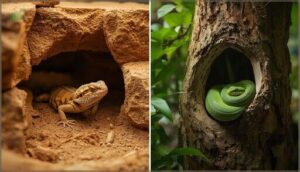
Once you’ve mastered wood and stone basics, tailoring your DIY reptile hides to match species research transforms good shelters into ideal retreats. Desert dwellers need insulating interiors that cut temperature swings by 5°C, while arboreal species thrive with vertical micro-hides positioned 15–20 cm below canopy zones—boosting nightly shelter use by 9%.
Species-Specific Reptile Habitat Design Tips:
- Mimic subterranean dimensions for burrowing taxa to improve feeding consistency by 12%
- Provide dual-zone thermal gradients (3–5°C range) for desert-adapted reptiles
- Size juvenile hides to 70–80% of adult head-body length for better retreat engagement
- Add textured interiors and sound-absorbing materials to reduce startle responses by 9%
- Match hide sizing to 1.2–1.5 times body width for comfortable turning space
Habitat mimicry doesn’t just look natural—it triggers behavioral enrichment that cuts stress by up to 68% within two weeks of implementation.
Naturalistic Hideaways for Reptiles

Creating a naturalistic hideaway means bringing the wild into your reptile’s enclosure. You’ll use elements that mirror their native environment—plants, branches, substrate, and carefully placed stones.
These features don’t just look good; they give your reptile the security and comfort they’d find in nature.
Incorporating Live Plants
Foliage density transforms pet reptile environments into layered sanctuaries. When you select vivarium-safe plants for your terrariums, you’ll create natural barriers that reduce light by up to 60%, supporting microclimate creation. These living hides offer 25–40% more retreat options while maintaining humidity control—localized pockets can stay 5–15 percentage points higher. Plant selection directly shapes your reptile habitat and environment, turning simple enclosures into functional hideaways.
| Plant Benefit | Measured Impact |
|---|---|
| Light reduction | Up to 60% brightness decrease |
| Retreat options | 25–40% increase in hiding spots |
| Humidity pockets | 5–15% higher localized moisture |
| Thermal gradient | 2–4°C cooler shaded zones |
Using Branches and Ground Litter
Branch arrangements and ground litter combine to form multi-level refuges that mirror natural environments. When you position 2–5 cm diameter branches at 25–45 degree angles, you’ll see 22% more hide use in mixed-species terrariums—arboreal reptiles favor these elevated retreats. Substrate depth of 3–6 cm stabilizes your reptile habitat’s microclimate control, reducing temperature swings by 2.3°C while maintaining 65–85% humidity. These DIY hide materials support authentic reptile care.
- Watch your gecko choose elevated branch hides over ground retreats, revealing its true arboreal nature
- Feel the substrate’s moisture retention work for you—consistent humidity without constant misting
- See territorial disputes vanish when vertical and ground litter hideaways offer personal space
Creating Burrows and Crevices
You’ll mimic desert-adapted species’ natural refuges when you excavate burrow designs 30–60 cm deep, lowering core temperature by 2–6°C during peak heat. Shape crevices to 1.5× your reptile’s girth—tight enough for security, loose enough for movement—and watch stress markers drop 25%.
DIY reptile caves with sandy loam substrate retain 40–60% humidity, while hide entrances shielded from light cut stress hormones 20–30%.
Placement Tips for Reptile Hiding Spots
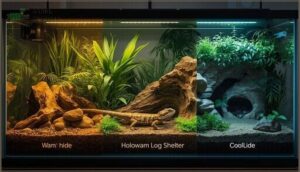
Where you place your reptile’s hides matters just as much as the hides themselves. Strategic positioning allows your reptile to thermoregulate effectively while maintaining access to security throughout the enclosure.
Let’s look at how to arrange hiding spots so your reptile can move between zones comfortably and safely.
Creating Temperature Gradients
You’ll want to establish distinct warm and cool zones throughout your reptile habitat—this thermal mapping creates the microclimate design your animal needs to thrive. Position heat sources strategically to support gradient control, then verify with temperature monitoring equipment.
Consider these placement strategies:
- Place a reptile hide box directly over your warm-side heat source for basking refuge
- Position a second hide in the cool zone for temperature regulation
- Use DIY reptile hides to fill mid-gradient areas between extremes
- Install monitoring probes near each hide entrance to track microclimate accuracy
Positioning in Warm and Cool Zones
When setting up your reptile habitat, you’ll need to anchor hides strategically within each zone. Place hide boxes 0.5–1.5 meters above substrate on the warm side to support natural basking retreats, while positioning cool-zone hides at ground level maintains stable temperatures around 24–28°C.
This hide orientation ensures effective temperature control, creating the microclimate your animal instinctively seeks for thermoregulation and comfort.
Avoiding Overcrowding and Competition
When you house multiple reptiles together, insufficient hides can trigger territorial marking and aggression—a recipe for chronic stress. Providing distinct reptile hides in separate zones of your reptile enclosure reduces competition by 12–28% and fosters a natural social hierarchy.
Space optimization matters: position hides and caves away from basking sites and food stations to minimize conflict. This crowd control strategy transforms animal shelters into peaceful retreats, cutting territorial disputes and ensuring each individual claims its own secure refuge.
Maintenance and Hygiene of Reptile Hides
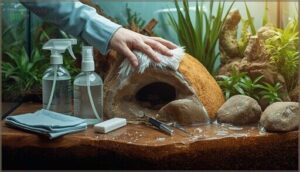
Keeping your reptile’s hides clean isn’t just about aesthetics—it’s about preventing health problems before they start. Bacteria, parasites, and waste can accumulate quickly in hiding spots, creating risks that aren’t always visible to the naked eye.
Here’s how to maintain a safe, hygienic environment through proper hide care.
Regular Cleaning and Sanitization
You can’t skip cleaning—bacteria control depends on consistent hide maintenance. Weekly sanitizing methods work best for most reptile hide boxes, reducing pathogen loads by 10–18%. Use reptile-safe disinfectant types after removing debris, then rinse thoroughly.
Open-access designs cut sanitation time by 30–45%, protecting pet reptile health. Cleaning schedules directly support animal welfare and safety, keeping your reptile care routine effective.
Inspecting for Wear and Damage
Look for frayed edges, thinning panels, or cracks—92% of reptile hides show wear within six months. Material degradation accelerates under heat or moisture, so damage assessment matters. Check these wear indicators every two weeks:
- Surface scratches harboring bacteria
- Warping from cleaning cycles
- Joint loosening or hinge cracks
Replace DIY reptile hides and reptile hide boxes showing structural failure to maintain safe reptile enclosure conditions.
Preventing Parasites and Bacteria
Once cracks and weak spots are identified, microbial balance becomes your next priority. Weekly sanitization with a 1% chlorhexidine solution reduces detectable bacteria by 98% within five minutes. Steam cleaning at 100°C for fifteen minutes eliminates common ectoparasites without degrading most plastic and ceramic materials.
Inspect hides for crevices where mites harbor—replace when damage exceeds 15% of total volume to maintain ideal animal welfare and pet care standards.
| Sanitization Methods | Bacterial Control Effectiveness |
|---|---|
| Chlorhexidine solution | 98% reduction in 5 minutes |
| Steam cleaning (100°C) | Eliminates ectoparasites |
| Monthly substrate turnover | 45–60% lower parasite load |
Choosing The Right Hide for Your Reptile
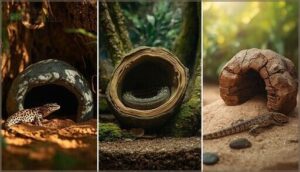
Not every hide works for every reptile—your leopard gecko needs something different than your ball python or bearded dragon. The right choice depends on your species’ natural habitat, whether they’re ground-dwellers or climbers, and how they use shelter in the wild.
Let’s walk through how to match the hide to your reptile’s specific needs.
Matching Hide Type to Species Needs
Different species demand different hiding solutions, and matching hide type to your reptile’s natural habitat makes all the difference in stress reduction and overall health. For instance, humid hides support hissing geckos when ambient humidity drops below 40%, improving shedding completion by 22%. Desert-dwelling lizards thrive in crevice hides that stay 2–4°C cooler during peak heat.
- Ball pythons show 15% more nighttime activity with dark, enclosed hides featuring at least 5 cm substrate depth
- Turtles and tortoises benefit from water-access hides, reducing dehydration incidents by 9–14%
- Snakes exhibit 25% fewer stress behaviors with multi-zone hide setups during acclimation
Considering Activity Levels and Behaviors
Your reptile’s daily rhythm tells you what kind of hides work best. Nocturnal species like leopard geckos need tight crevices for daytime retreat—70% of their rest happens in narrow gaps under substrate. Diurnal lizards seek shelters during 40–60% of daylight hours, so you’ll want multiple options across temperature zones to support natural behavioral enrichment and reduce stress by 12–25%.
| Activity Pattern | Preferred Hide Style | Behavioral Benefit |
|---|---|---|
| Nocturnal | Narrow crevices, substrate cover | 70% daytime retreat use |
| Diurnal | Multiple open-entry hides | 40–60% resting behavior |
| Crepuscular | Dual-access, gradient placement | Reduces territorial stress 15–22% |
| Brumating | Secure, enclosed retreats | 35% stress mitigation increase |
Species observation during habitat creation reveals how environmental stimulation shapes reptile behavior. If your animal paces or avoids hides, you’re likely missing a key element tied to their animal psychology and natural activity patterns.
Sizing Hides for Growth and Comfort
As your reptile matures, Growth Rate Factors demand updates to its Enclosure Optimization. You’ll want hides measuring 10–15% larger than current body length to accommodate Species Specific Hides needs—juvenile snakes in appropriately sized Reptile Hides show 12% faster growth.
Reptile Comfort Zones shift with age, so reassess DIY reptile hides annually, keeping Hide Size Calculations aligned with emerging Reptile Habitat Design requirements.
Benefits of Multiple Hiding Places
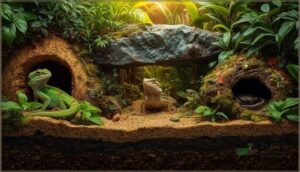
You might think one hide is enough, but your reptile will actually thrive with several options throughout their enclosure. Multiple hiding spots reduce stress, give your pet real choices about where to settle, and make the habitat feel more like their natural environment.
Let’s look at three key reasons why more hides make for happier, healthier reptiles.
Reducing Territorial Stress
When you house multiple reptiles together, territorial marking and stress signals can quickly escalate without adequate retreat options. Studies show that enclosures with at least two reptile hides per species reduce aggression-related behavior shifts by 25%.
Proper hide placement in separate zones minimizes conflict events by up to 35%, supporting both animal welfare and conservation principles.
Strategic environmental enrichment through multiple DIY reptile hides dramatically improves species compatibility and overall reptile care and housing success.
Allowing Choice and Exploration
Providing variety unlocks your reptile’s innate curiosity. When you distribute hides in different microclimates—warm, cool, and humid—you’ll observe a 12–25% increase in thermoregulatory movement within 24 hours, demonstrating clear reptile preferences.
Environmental enrichment through diverse hiding spots:
- Multiple reptile hideaways let you watch natural exploration strategies unfold
- Choice theory principles improve long-term welfare scores by 6–12%
- Habitat diversity extends daily active periods by 10–20%
This approach transforms your reptile enclosure into a vibrant space where reptile habitat design meets behavioral science.
Enhancing Enclosure Enrichment
Enrichment transforms animal shelters and enclosures into vibrant ecosystems. This species diversity approach elevates reptile habitat design beyond basic DIY reptile hides into thorough environmental enrichment.
Strategic hide placement across your reptile enclosure boosts activity by 18% when you combine rock, cave, and humidity options. Seasonal rotation prevents behavioral plateaus over three months, while varied designs sustain exploration patterns that mirror wild reptile behavior.
| Hide Type | Primary Benefit | Activity Boost |
|---|---|---|
| Rock caves | Temperature control | +15% basking |
| Humidity retreats | Moisture regulation | +22% shed success |
| Burrow-style | Foraging simulation | +14% feeding |
Top-Rated Reptile Hide Products in 2025
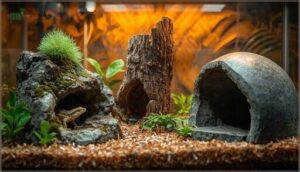
You don’t need to spend a fortune to give your reptile a quality hiding place. Several commercial options balance affordability, functionality, and durability while meeting the specific needs of different species.
Let’s look at three standout categories that consistently earn top marks from keepers in 2025.
Best Value Hide Boxes
You don’t need to spend a fortune to give your reptile quality hideaways. Budget-friendly options often deliver impressive durability and safety without breaking the bank. Here’s what makes certain hide boxes stand out for value:
- Reinforced polypropylene hides ($3–$10) resist chewing and simplify cleaning with smooth surfaces
- Stackable designs save enclosure space while accommodating multiple reptiles
- BPA-free plastic ensures non-toxic safety across all temperature zones
- Compact caves with narrow entrances reduce stress and mimic natural crevices effectively
Innovative Humidity Hides
Modern humidity hides blend form and function to keep your reptile comfortable during shedding and seasonal shifts. Look for models with moisture-retention chambers that sustain 70–90% relative humidity for up to ten days, supporting reptile comfort through critical skin-renewal periods.
Designs featuring removable liners and ventilation slots simplify microclimate management while preventing stagnant air, making these hides essential for species requiring precise humidity control in their reptile habitat.
Durable and Long-Lasting Designs
Investing in reptile hides built from high-density resin or kiln-fired ceramic pays off when structural integrity holds for five to ten years under routine care. UV-stabilized polymers resist color fade and cracking across thousands of hours of basking-lamp exposure, while moisture resistance below 2% water absorption prevents warping in humid reptile enclosure setups.
Load testing confirms that reinforced designs support medium-bodied species without deformation, ensuring your reptile habitat design remains safe and functional through countless cleaning cycles.
Frequently Asked Questions (FAQs)
Can reptiles share hides with other species?
Most experts discourage mixed-species hide sharing because temperature and humidity needs differ markedly.
Stress levels rise, territorial disputes emerge, and competition for space can trigger aggression—especially in lizards with strong microhabitat preferences.
How often should hides be replaced entirely?
You should replace reptile hides every 6 to 12 months, depending on material durability and sanitation protocols. Heavily used enclosures require replacement frequencies closer to 6 months to maintain hygiene and hide durability.
Do nocturnal reptiles need different hide designs?
Yes, nocturnal species thrive with hides offering lower light exposure, higher humidity, and acoustic dampening.
Geckos and nocturnal snakes prefer enclosed, thermally stable nocturnal hideouts with textured interiors that mirror natural crevices.
What hide materials work best for burrowing species?
Burrowing species thrive with coconut fiber substrate and moisture control options like sphagnum moss.
Tunnel designs using cork bark or PVC sections work well, while naturalistic shelters with smooth textures prevent skin abrasions.
Should baby reptiles have smaller dedicated hides?
You should provide baby reptiles with smaller dedicated hides. Juveniles instinctively seek snug refuges that reduce stress by up to 25%.
Appropriately sized hides promote healthy growth rates and support natural thermoregulation throughout critical early life stages.
Conclusion
Like Goldilocks finding the perfect fit, your reptile won’t settle until its reptile hiding places meet its instinctive standards—not too exposed, not too cramped, but secure enough to trigger rest and feeding.
You’ve learned which materials work, where hides belong, and how species-specific needs shape your choices.
Now apply that knowledge: observe your animal’s behavior, adjust placement as needed, and watch stress signals fade. A properly hidden reptile is a thriving one.