
This site is supported by our readers. We may earn a commission, at no cost to you, if you purchase through links.

You spot your corn snake coiled tight under the heat lamp, mouth gaping in silent distress. Overheating hits fast—minutes stretch into hours of potential organ damage before you notice.
Reptile thermostats for corn snake setups stop that nightmare cold. They lock in the 85-90°F hot spot your snake craves while keeping the cool side at 75°F, mimicking nature’s gradient.
Pick the wrong one, though, and fluctuations spark respiratory woes or digestion shutdowns. Nail your choice with proven models that deliver precision, safety, and ease—your snake thrives, you rest easy.
Table Of Contents
- Key Takeaways
- Why Thermostats Are Essential for Corn Snakes
- How Reptile Thermostats Work in Enclosures
- Key Features to Look for in Corn Snake Thermostats
- Types of Thermostats for Corn Snake Setups
- Digital Vs. Analog Thermostats for Corn Snakes
- Top 5 Reptile Thermostats for Corn Snake Setups
- Matching Thermostat Capacity to Heating Equipment
- Proper Installation and Probe Placement
- Maintenance and Safety Tips for Thermostat Use
- Common Thermostat Mistakes to Avoid
- Frequently Asked Questions (FAQs)
- What is the best heating setup for corn snakes?
- What temperature should a corn snake thermostat be?
- What is the perfect temperature for a corn snake?
- Is 30 degrees too hot for a corn snake?
- How often should a reptile thermostat be recalibrated?
- What happens if a thermostat probe fails mid-operation?
- Are WiFi or smart thermostats reliable for reptile enclosures?
- How can power outages affect thermostat performance for snakes?
- Conclusion
Key Takeaways
- A reptile thermostat is essential for corn snakes because it prevents dangerous overheating and maintains a safe temperature gradient across the enclosure.
- Accurate probe placement, regular calibration, and proper wattage matching ensure consistent heat control and protect against sensor drift or equipment failure.
- Digital thermostats with programmable settings and dual probes offer the most reliable temperature stability, while analog units carry higher risks of fluctuation and failure.
- Routine maintenance, redundancy checks, and adherence to manufacturer safety guidelines safeguard both the snake’s health and the electrical integrity of the setup.
Why Thermostats Are Essential for Corn Snakes
Corn snakes can’t sweat or shiver to control their body heat, so they depend on you to keep their enclosure just right. Without a thermostat, heat lamps or mats can spike dangerously high and stress your snake out.
For an easy setup that keeps temps steady and your snake comfortable, check out this corn snake heating guide from Snake Snuggles.
Corn snakes rely entirely on you for safe warmth, since they can’t self-regulate or handle sudden heat spikes
Here’s why you need one, starting with how it stops overheating and thermal stress.
Preventing Overheating and Thermal Stress
Thermal safety starts with strict temperature control so your corn snake never sits on a surface that quietly climbs past 31°C (88°F) and into dangerous thermal stress.
Use a reptile thermostat for precise heat regulation and thermal monitoring, and follow this simple heat management checklist: Maintaining a proper temperature gradient with a 28–32°C hot spot and cooler 21–24°C side, as outlined in this corn snake heating guide, helps prevent respiratory and digestive problems caused by incorrect temperatures.
- Set a firm upper temperature limit.
- Always run heat mats through a thermostat.
- Guard all overhead and ceramic heaters.
- Check hot spot readings with a separate digital thermometer to protect reptile health and thermoregulation.
Supporting Natural Thermoregulation
When heat stays steady, your corn snake can move smoothly between warm and cool zones to fine‑tune body temperature. A reptile thermostat keeps this natural balance through precise temperature regulation and microclimate control. For more context on safe heat sources and ideal ranges, see these.
| Thermal Balance | Heat Cycling | Temperature Gradients |
|---|---|---|
| Promotes calm activity | Mimics day-night shifts | Facilitates natural thermoregulation |
| Improves digestion | Prevents rapid swings | Encourages healthy basking |
| Aids rest and recovery | Stabilizes metabolism | Facilitates accurate thermoregulation techniques |
Avoiding Health Risks From Temperature Fluctuations
Stable warmth doesn’t just keep your corn snake comfortable; it protects it from real Health Risks tied to poor Temperature Control and Thermal Regulation. Sudden drops below the mid‑70s slow digestion, trigger regurgitation, and weaken immunity, while sharp spikes and swings cause Thermal Stress, respiratory issues, and lethargy.
A quality reptile thermostat smooths out these highs and lows so your snake’s thermoregulation, digestion, and overall Reptile Care stay on track.
How Reptile Thermostats Work in Enclosures
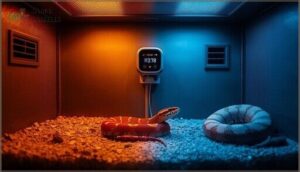
Thermostats act like the control center for your corn snake’s heat, constantly checking the temperature and telling the heater when to turn on or off. They help you keep a steady warm side and cool side so your snake can choose where to be.
In the next section, you’ll see how different thermostat options handle this job inside a real enclosure.
Role of Thermostats in Heat Regulation
Think of the reptile thermostat as the “brain” of your corn snake’s heat regulation, not an optional accessory. It reads the probe, compares that number to your set point, then cuts or restores power to the heater to keep Temperature Control tight, Thermal Balance steady, and Reptile Health protected through consistent Heat Cycles and Environmental Stability within your thermostat setup and thermal gradient.
- It shuts heaters off before surfaces pass safe warm-side temps.
- It brings heat back on as the enclosure cools to prevent drops.
- It reacts to room changes so your snake doesn’t pay the price.
Maintaining Stable Thermal Gradients
You rely on a reptile thermostat to keep Thermal Balance across the whole enclosure, not just to hit one number at the warm end. With good Gradient Control, you hold a hotspot around 32–34°C, a general warm zone near 29–32°C, and a cool end near 24–27°C, so Heat Distribution stays predictable and your snake always has a usable thermal gradient.
That kind of tight temperature control and thermostat accuracy prevents sudden Temperature Fluctuation, promotes long‑term Thermal Stability, and turns temperature regulation into a quiet background process instead of a daily fight with the dial.
Interaction With Heating Elements
Through precise Temperature Feedback Systems and Power Modulation Techniques, a reptile thermostat fine‑tunes how each heat source performs. It reads probe data, adjusts wattage, and prevents spikes that overwhelm heating systems.
Proper Heat Source Compatibility and Thermostat Calibration guarantee Element Control Methods match your thermostat setup, keeping temperature control consistent across lamps, mats, and emitters.
Key Features to Look for in Corn Snake Thermostats
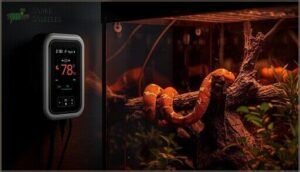
When you choose a thermostat for a corn snake, you’re really choosing how tightly you can control its environment. You want steady, accurate temperatures, simple controls you can program and trust, and a unit that actually matches your enclosure and heat source.
Let’s walk through the key features that matter before you pick a specific model.
Temperature Accuracy and Stability
Temperature accuracy isn’t negotiable — a misreading of just 2–3°F can push your corn snake’s basking zone into dangerous territory. Strong Thermal Sensing and Gradient Control start with choosing the right digital thermostat built for precision.
- Target ±1°C accuracy minimum for reliable temperature control
- Use Probe Calibration to correct sensor offset against a secondary thermometer
- Watch for Temperature Fluctuation signs like erratic Heat Cycling
- Confirm your thermostat setup holds basking zones at 85–90°F consistently
Programmable Schedules and Controls
A programmable thermostat does more than hold steady heat—it mimics sunrise and sunset through automated heating and Day Night Cycles. Digital thermostats use precise Temperature Control and Remote Monitoring to adjust on schedule. Regular Thermostat Calibration keeps readings honest, while a dependable thermostat controller ensures heat shifts smoothly to match your corn snake’s biological rhythm.
| Feature | Function | Benefit |
|---|---|---|
| Programmable Scheduling | Sets Day Night Cycles | Natural heat rhythm |
| Automated Heating | Adjusts output automatically | Stable temperatures |
| Remote Monitoring | App-based oversight | Real-time alerts |
| Thermostat Calibration | Re-aligns sensor data | Maintains accuracy |
Compatibility With Enclosure and Heat Sources
Think of your thermostat as the translator between your reptile enclosure and every heat source you plug into it. You need Wattage Matching that fits your mats or ceramic emitters, safe thermostat installation on glass or PVC enclosure materials, and a digital thermostat that allows fine temperature control, accurate Probe Placement Tips, and easy Thermostat Calibration for reliable Heat Source Options in any heat source inside your reptile enclosure.
- Picture a glass tank with a slim heat mat humming steadily beneath your corn snake’s favorite hide.
- Imagine a tall PVC vivarium where a ceramic heat source washes the upper branches in gentle warmth.
- Visualize your thermostat probe resting exactly where your snake coils to bask, not buried in deep substrate.
- See a tidy power strip where each labeled plug matches its thermostat channel, wattage checked and double-checked.
Types of Thermostats for Corn Snake Setups
You’ll see three main thermostat types used in corn snake enclosures, and each one regulates heat a little differently. Your goal is to match the control style to your heat source and the level of precision you want.
Here’s how the main options line up so you can choose what fits your setup best.
On/Off Thermostats
On/off thermostats act like a light switch for temperature control, cycling your heat source fully on, then fully off, to hold a safe band of warmth for your corn snake.
This simple reptile thermostat pairs best with slow, steady heaters like under-tank mats, as long as you respect wattage limits, prioritize careful thermostat installation, and keep up with basic Thermostat Calibration for long-term reptile safety.
Dimming Thermostats
Where on/off units slam power to your mat or bulb, dimming thermostats use smooth Dimming Mechanisms to ramp voltage up and down, creating precise snake habitat temperature management and gentler Temperature Ramping for corn snakes.
This style of temperature control for exotic pets pairs best with overhead lamps, rewards careful Thermostat Calibration and Heat Source Compatibility checks, and offers strong Thermostat Durability plus sophisticated thermostat features for animal habitats that support safe, stable reptile thermostat selection.
Pulse Proportional Thermostats
Where dimming slowly eases power up and down, pulse proportional thermostats use rapid Pulse Control bursts to lock in Heat Stability and cut Temperature Fluctuation in your corn snake enclosure.
This style of temperature control for exotic pets pairs best with non‑light heaters, rewards tight Thermostat Calibration, boosts Energy Efficiency, and gives you highly reliable snake enclosure temperature regulation through a quality digital thermostat and careful reptile thermostat selection.
Digital Vs. Analog Thermostats for Corn Snakes

Digital and analog thermostats both keep your corn snake warm, but they don’t do it in the same way. Digital models focus on precision and extra control, while analog units keep things basic and manual.
Let’s look at how each option works so you can pick the style that fits the enclosure setups below.
Benefits of Digital Thermostats
A quality digital thermostat gives you precise Temperature Control for your reptile enclosure, holding temperatures steady within about a degree. The LCD display and calibration options simplify Temperature Monitoring during thermostat installation, ensuring stable Digital Accuracy for healthy, low‑stress corn snake environments.
Quick feedback improves Heat Management and Energy Efficiency while maintaining Thermostat Reliability.
| Feature | Benefit |
|---|---|
| Digital Accuracy | Prevents temperature swings |
| Energy Efficiency | Reduces power use |
| Heat Management | Keeps steady gradients |
| Thermostat Reliability | Protects against overheating |
| Easy Monitoring | Confirms safe enclosure temps |
Limitations of Analog Thermostats
Digital thermostats offer tight temperature control, while analog thermostats present several challenges in a reptile enclosure. These challenges include temperature inaccuracy, limited adjustability, and higher safety risks due to gradual mechanical failure and reliability issues in their moving parts.
| Issue | What happens | Why it matters |
|---|---|---|
| Temperature Inaccuracy | Wide swings in basking temps | Hidden hot or cold spots |
| Limited Adjustability | No precise set points | Harder thermostat installation |
| Safety Risks | Stuck contacts overheat heaters | Greater fire and snake risk |
Analog thermostats’ mechanical failure and reliability issues can lead to these problems, making them less ideal for maintaining a stable environment in a reptile enclosure.
Choosing The Right Model for Your Needs
A smart Thermostat Selection starts with your corn snake’s heat source and ends with your tolerance for risk. Match Heat Source Compatibility, Temperature Precision, and Thermostat Durability to how you actually keep. For instance, a simple heat mat can run on an affordable digital thermostat, while multi-heater builds justify higher Energy Efficiency, tighter temperature control, and more careful thermostat installation around your primary reptile thermostat.
| Your priority | Best fit | Why it feels right |
|---|---|---|
| “I just use a heat mat.” | Basic digital thermostat | Simple, safe, focused on Temperature Precision. |
| “I run mat + overhead.” | Dual-channel digital thermostat | Clean Heat Source Compatibility and easier thermostat installation. |
| “I never want temp swings.” | High-end reptile thermostat | Maximum Thermostat Durability and Energy Efficiency for sensitive setups. |
Top 5 Reptile Thermostats for Corn Snake Setups
You need a reliable thermostat to keep your corn snake’s enclosure steady. I’ve picked the top five options that match corn snake needs like precise temps and easy setup. Each one manages the job without fuss.
1. Inkbird WiFi Reptile Thermostat Controller
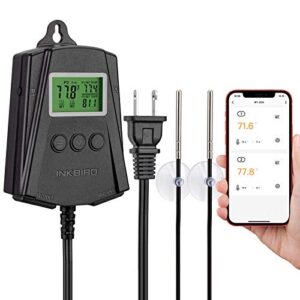
If you want tight control and easy oversight, this Inkbird WiFi controller gives you both. It runs two independent heating outlets, each with its own probe and up to 250 watts of load, so you can manage two corn snake enclosures or two zones from a single unit.
You adjust temps, review charts, and receive high/low alarms right on your phone over 2.4 GHz WiFi.
The compact controller hangs neatly beside your rack, while waterproof probes sit on the warm-side floor for accurate belly-heat readings.
| Best For | Reptile owners or hobbyists who need precise, dual-zone temperature control and remote monitoring for their enclosures. |
|---|---|
| Temperature Range | Not specified |
| Max Wattage | 250W per outlet |
| Probe Included | 2 probes |
| Heating Support | Yes |
| Temperature Alarm | High and low alarm |
| Material | Metal, Plastic |
| Additional Features |
|
- WiFi connectivity lets you monitor and adjust heat remotely through the INKBIRD APP.
- Dual probes and outlets allow independent control for two heating zones or tanks.
- Sends alerts for high, low, or probe error temperatures for peace of mind.
- Works only with heating devices, not cooling.
- Short cord limits placement flexibility.
- Screen isn’t backlit, so it’s hard to read in dim light.
2. BN Link Reptile Thermostat Controller
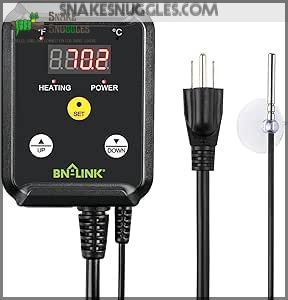
Simplicity and reliability make the BN Link Reptile Thermostat Controller an easy win for your first corn snake setup. You get a bright, easy-to-read display, clear heating and power LEDs, and a straightforward 3‑button interface, so you can dial in your target temperature without digging through menus.
It controls heat from 40–108°F, displays 32–140°F, and manages up to 1000 watts at 120VAC, which easily covers a typical heat mat or ceramic heater for a single enclosure.
Rugged plastic housing, ETL listing, and a grounded plug give you the safety margin you want when that heat source runs 24/7.
| Best For | Reptile owners or hobbyists who want simple, reliable temperature control for heat mats, incubators, or small enclosures. |
|---|---|
| Temperature Range | 40-108°F |
| Max Wattage | 1000W |
| Probe Included | 1 sensor probe |
| Heating Support | Yes |
| Temperature Alarm | Not specified |
| Material | Plastic |
| Additional Features |
|
- Easy 3-button setup and bright display make temperature adjustments quick and clear.
- Rugged build with ETL safety listing for peace of mind during continuous use.
- Works with various heating devices from mats to ceramic emitters.
- Heating only—no cooling function.
- Limited to 1000W, so not ideal for large setups.
- Cord length may restrict placement options.
3. Reptile Temperature Controller Thermostat
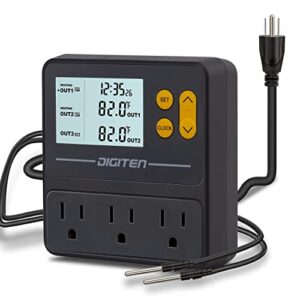
Looking for one box to run your whole corn snake enclosure instead of juggling separate timers and stats? The Reptile Temperature Controller Thermostat (like the SENSTREE unit) offers three independently controlled outlets, dual probes, and combined day/night temperature and timing control in a single head unit.
You can run a heat mat, overhead ceramic, and lights on separate programs, set high/low alarms, and calibrate readings in either ℃ or ℉. It suits terrariums, aquariums, and incubation.
However, be ready for a steeper learning curve, hit‑or‑miss instructions, and occasional reliability complaints about probes, clock drift, and internal build quality.
| Best For | Reptile keepers who want one controller to manage heating, lighting, and temperature cycles for their enclosures. |
|---|---|
| Temperature Range | Not specified |
| Max Wattage | Not specified |
| Probe Included | 2 dual probes |
| Heating Support | Yes |
| Temperature Alarm | High and low alarm |
| Material | ABS Plastic |
| Additional Features |
|
- Three separate outlets let you control multiple devices at once.
- Dual probes and day/night modes make it easy to mimic natural conditions.
- Offers alarms, calibration, and support for both ℃ and ℉.
- Instructions can be confusing during setup.
- Some users report short product lifespan and faulty probes.
- Clock may drift and internal wiring quality can vary.
4. Pymeter Digital Temperature Controller Thermostat
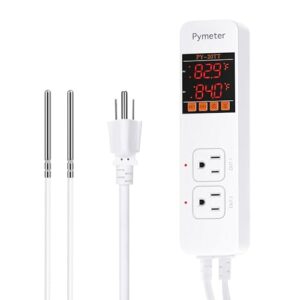
Want tight control over both sides of the tank without buying two separate stats? The Pymeter Digital Temperature Controller gives you dual probes and two independently controlled outlets, each assignable to heating or cooling, so you can run a warm‑side heat mat and a cool‑side fan or secondary heater with separate setpoints.
It reads in 0.1° steps across a wide range, includes high/low and difference alarms, and stores your settings through power cuts.
Just know you’re working with on/off logic only, a fairly dense interface, and a bulky cable bundle that takes some planning to route cleanly.
| Best For | Hobbyists or keepers who want to manage heating and cooling for two zones, like reptile tanks or greenhouses, with one reliable unit. |
|---|---|
| Temperature Range | Not specified |
| Max Wattage | 1200W |
| Probe Included | 2 waterproof sensors |
| Heating Support | Yes |
| Temperature Alarm | High and low alarm |
| Material | Polycarbonate |
| Additional Features |
|
- Dual probes and outlets let you control two independent heat or cooling sources.
- Offers precise temperature control with high/low and difference alarms.
- Easy to repurpose for projects like converting a freezer to a fridge.
- Interface feels cluttered and needs the manual at first.
- Thick cables can be tricky to run neatly in tight spaces.
- Only supports constant temperature—no day/night cycling.
5. Aiicioo Reptile Heat Mat Thermostat
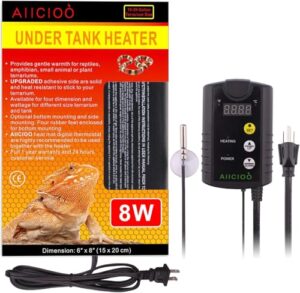
Pair your under-tank heater with the Aiicioo combo for dead-simple belly heat in small corn snake setups. This 8-watt, 6×8-inch mat sticks securely to glass bottoms or sides, delivering gentle 104-122°F warmth regulated by the digital thermostat’s 68-108°F control range.
You set precise targets via three buttons on the backlit LCD, with the probe monitoring ambient temps—not the mat itself—for accurate cutoffs. Heating lights confirm action. It’s energy-sipping and foolproof for 10-20 gallon tanks, but skip plastic enclosures and watch for drift.
| Best For | Reptile keepers with small glass enclosures who want steady, easy-to-control belly heat for snakes, hermit crabs, or lizards. |
|---|---|
| Temperature Range | 104-122°F |
| Max Wattage | 8W |
| Probe Included | 1 sensor probe |
| Heating Support | Yes |
| Temperature Alarm | Not specified |
| Material | PVC, Adhesive |
| Additional Features |
|
- Simple 3-button thermostat makes adjustments quick and clear.
- Sticks securely to glass and delivers consistent warmth.
- Energy efficient and ideal for small 10–20 gallon tanks.
- Not recommended for plastic or acrylic tanks.
- Can run slightly hot if probe placement is off.
- May not provide enough heat for larger reptiles or enclosures.
Matching Thermostat Capacity to Heating Equipment
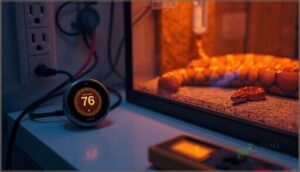
Your thermostat can only keep your corn snake safe if it’s actually rated to handle the heat equipment you plug into it. Use it as a quick check before you commit to a specific thermostat and heating setup.
In this next part, you’ll see how to match total wattage, outlet capacity, and safety margins so nothing is pushed past its limits.
Calculating Wattage Requirements
One reliable Wattage Estimation method is to add up every heat source on that thermostat, then size your Thermostat Capacity above that total for safe temperature management and Energy Efficiency.
A 20‑watt mat plus a 60‑watt ceramic heater gives you 80 watts of reptile heating, so you’d choose a higher‑rated unit during thermostat installation to avoid Temperature Fluctuation and keep temperature control stable.
Ensuring Safe Electrical Compatibility
After totaling your wattage, check that your thermostat matches your home’s voltage and wiring setup. Safe thermostat installation demands attention to every electrical detail:
- Voltage Matching prevents device burnout
- Grounding Safety keeps metal housings fault-free
- GFCI Protection reduces shock risk
- Fuse Ratings and Cable Management sustain thermostat safety and maintenance
Preventing Overloads and Short Circuits
You protected voltage and grounding with careful thermostat installation and calibration; now you need Electrical Safety that focuses on Overload Prevention, Circuit Protection, and fire prevention. Keep each thermostat well under its watt rating, avoid daisy-chaining strips, and spread heaters across circuits to reduce Short Circuit risk, improve Fault Detection, and support long-term thermostat safety and maintenance as temperature control demands grow.
| Risk Area | What You Do | Why It Matters |
|---|---|---|
| Thermostat overload | Stay below rated watts | Avoid internal overheating |
| Circuit Protection | Keep under 80% of breaker capacity | Prevent nuisance trips |
| Power strips and cords | Use grounded, heavy-duty hardware | Reduce fire risk |
| Heat tape runs | Stay within length and watt limits | Stop hot spots and shorts |
| Routine checks | Inspect plugs, cords, and outlets | Catch faults early |
Proper Installation and Probe Placement
Proper thermostat installation is what keeps your corn snake’s enclosure safe, stable, and predictable. In this section, you’ll see how to place the probe, set your day and night temperatures, and avoid the mistakes that cause dangerous spikes.
Use these guidelines as you work through each setup step in the list that follows.
Positioning The Temperature Probe Correctly
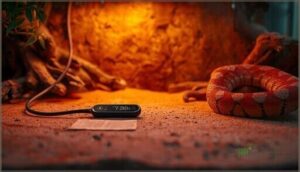
Precise probe placement is the backbone of accurate temperature monitoring. Position your temperature probe flat against the enclosure’s warm surface for reliable hot spot monitoring and stable thermal gradient control. Secure it with heat-safe adhesive to prevent displacement.
Regular sensor calibration ensures temperature accuracy, thermostat placement, and safety, improving consistency with any modern digital thermostat.
Setting Day and Night Temperature Parameters
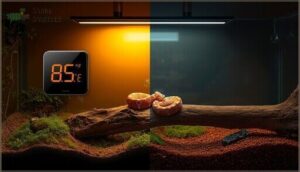
Your digital thermostat should mimic natural Thermal Cycles by programming distinct Day Night Gradients. Hold basking temperatures near 85°F by day and allow a safe dip to around 70°F overnight.
This controlled temperature gradient prevents sudden Heat Fluctuations, aids digestion, and keeps temperature control predictable through accurate thermostat placement and consistent temperature monitoring for safety.
Avoiding Common Setup Mistakes
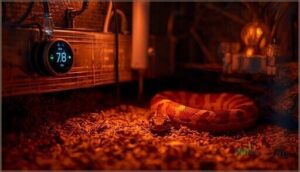
Three setup mistakes undo even the best thermostat installation — and they’re all avoidable.
- Loose probe placement lets your corn snake nudge it aside, causing dangerous temperature swings
- Burying the probe in damp substrate slows heat source response and causes overshoot
- Skipping probe calibration means displayed temps drift from real ones over time
- Overloading a low-rated thermostat risks electrical overload and relay failure
Nail these basics and thermostat safety takes care of itself.
Maintenance and Safety Tips for Thermostat Use
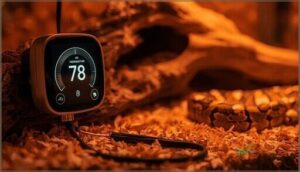
Keep your corn snake’s thermostat running right with simple maintenance and smart safety steps. You’ll catch problems before they start. Here’s how to monitor for sensor drift and set up backups.
Monitoring for Sensor Drift and Malfunctions
Serious temperature control means you don’t just “set and forget” a digital thermostat; you build a routine around it. Use Sensor Calibration and Drift Detection monthly by comparing sensors and probes to a trusted thermometer and logging readings.
Combine Alarm Systems, regular Probe Inspection, and basic Failure Analysis of odd swings or behavior changes to keep thermostat placement and safety on point.
Backups and Redundant Thermometers
Think of Thermostat Redundancy as a safety net under your digital thermostat, not a luxury. You back up temperature control with extra layers:
- Backup Controllers set a hard ceiling so temperature spikes stop before they turn dangerous.
- Redundant probes and smart Probe Placement give real‑time Temperature Verification across the gradient.
- Dual settings with separate thermometers on warm and cool ends confirm thermostat placement and safety.
- Regular Sensor Calibration and weekly temp‑gun checks keep every device honest.
Common Thermostat Mistakes to Avoid
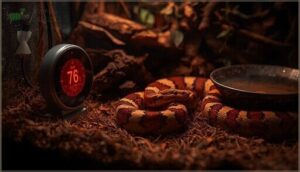
Regarding thermostats, most problems don’t come from the hardware—they come from how it’s used. A few repeat mistakes can undo all the care you’ve put into your corn snake’s setup.
In the next section, you’ll see the biggest issues to watch for so you can avoid them from day one.
Incorrect Probe Placement
Probe placement errors can wreck even the best reptile thermostats. A probe pressed to the heat source, buried too deep, or left in a cool zone sends false readings that disrupt temperature control.
Misjudged enclosure dynamics throw off your temperature gradient, and poor sensor calibration creates heat source interference that undermines reliable thermostat installation and temperature management.
Ignoring Manufacturer Guidelines
You don’t just buy a thermostat; you buy into its rulebook. When you ignore Wattage Limits, Electrical Safety notes, Environmental Factors, or Maintenance directions, you bake User Errors into your snake enclosures and wreck temperature control and overall reptile care and temperature management. Manufacturer guidelines exist to stop:
- Overloaded heaters and melted wiring
- Shock risk from bad outlets and wet hands
- Moisture, dust, and Maintenance Neglect from killing your thermostat
Delayed Replacement of Faulty Units
You followed the rules on paper; now you need to respect the clock. When a thermostat or temperature governor starts sticking “on,” you face real Failure Risks: belly burns, warped plastic, even fire from uncontrolled reptile heating and lost temperature control.
Your Safety Precautions, Emergency Protocols, and Replacement Strategies must be simple: unplug, pause feeding, switch to room‑temp snake care, and replace the unit immediately to avoid severe Thermal Consequences.
Frequently Asked Questions (FAQs)
What is the best heating setup for corn snakes?
Warm air above, cool retreat below: the best corn snake heating setup uses an overhead reptile heating source for a 90°F basking surface and a 75–82°F cool zone, creating a clear temperature gradient with a thermostat-controlled heat mat backup.
What temperature should a corn snake thermostat be?
Set your corn snake thermostat so basking temperatures peak around 88–90°F, with a warm-side temperature range near 80–85°F and a cool side around 75–80°F.
Program heat cycles to maintain this temperature gradient day and night.
What is the perfect temperature for a corn snake?
There isn’t one “perfect” number for a corn snake, but a tight temperature range and clear temperature gradient. Aim for basking spots around 85–90°F, a warm side near low–mid 80s, and a cool zone about 70–75°F for healthy digestion temperatures and a stable thermal environment across daily heat cycles and natural heat cycles.
Is 30 degrees too hot for a corn snake?
“Too much of a good thing can be bad.” For a corn snake, 30 degrees can sit at the upper edge of a safe basking zone if your temperature gradient is correct and enclosure temperature range includes a clearly cooler side. If the whole thermal environment sits at 30, you push past sensible Temperature Limits, increase Heat Stress risk, and compromise Thermal Safety.
Treat 30 as a warm peak for Basking Zones, then watch Snake Behavior closely: if your corn snake hugs the cool end, glass, or water, your temperature range and gradient need immediate adjustment.
How often should a reptile thermostat be recalibrated?
Reptile thermostat recalibration should be done every three to six months to correct thermostat drift and maintain temperature accuracy.
Use reliable recalibration methods, verify temperature control with a reference thermometer, and schedule sensor replacement as needed.
What happens if a thermostat probe fails mid-operation?
Probe Failure Risks aren’t theoretical; when a thermostat probe fails mid-operation, you can see Thermal Shock from wild swings in temperature control, loss of Overheat Protection, bogus Sensor Calibration, missed Emergency Shutdown, and only digital thermometers plus strict thermostat safety and maintenance catch bad probe placement in time.
Are WiFi or smart thermostats reliable for reptile enclosures?
Yes, WiFi or smart thermostats for pets can be reliable when you treat them as a digital temperature controller first and a convenience tool second. With good Thermostat Accuracy, smart controls, and probe placement, a WiFi reptile heat mat thermostat maintains solid Temperature Stability and Remote Monitoring.
However, you still need independent checks to confirm WiFi Reliability and catch rare failures in smart reptile thermostat systems and smart thermostats for pets.
How can power outages affect thermostat performance for snakes?
Power outages don’t just cut heat; they trigger Thermostat Failure risks, Power Surge damage, Temperature Spikes, and Gradient Loss that wrecks temperature control.
Use Backup Systems so your reptile thermostats protect snake care even when mains power doesn’t.
Conclusion
Think of your thermostat as the steady heartbeat of your corn snake’s world, quiet but indispensable. When you choose reliable reptile thermostats for corn snake setups, you control risk instead of reacting to emergencies. You keep heat focused where digestion, immunity, and comfort all depend on it.
Review your gear, verify wattage, test probes, and log readings. Your consistency turns a glass box into secure territory where your snake can live a long, predictable life.
- https://www.lopehare.com/temperature-and-humidity-requirements-for-a-healthy-corn-snake/
- https://surreyreptilecentre.co.uk/dangerous-setups-common-reptile-enclosure-mistakes-we-see-and-how-to-fix-them/
- https://www.arbreptiles.com/dim_vs_thermo.html
- https://www.herps-and-inverts.com/heat-mats-vs-ceramic-heaters-for-your-corn-snake/
- https://www.rspca.org.uk/adviceandwelfare/pets/other/cornsnake