This site is supported by our readers. We may earn a commission, at no cost to you, if you purchase through links.

ball python can survive a temperature swing that would kill a chameleon—but neither one will thrive when the readings on their enclosure are wrong.
Most keepers obsess over heating equipment and forget that the thermometer itself is the weakest link in the whole setup.
A sensor drifting five degrees off, or a hygrometer that lags during a shed cycle, doesn’t just give you bad data—it gives you false confidence.
Choosing the right reptile thermometers for humidity control means understanding accuracy tolerances, sensor placement, and how different units hold up inside a humid hide or a bioactive build over months of continuous use.
Table Of Contents
- Key Takeaways
- Top 6 Reptile Thermometer Hygrometers
- Key Features for Humidity Control
- Digital Vs Analog Gauge Accuracy
- Best Placement in Snake Enclosures
- Choosing a Reliable Terrarium Monitor
- Frequently Asked Questions (FAQs)
- How often should I replace thermometer batteries?
- Can I use one thermometer for multiple enclosures?
- Do wireless thermometers work through glass terrariums?
- What causes sudden humidity spikes at night?
- Are infrared thermometers accurate for substrate temperature?
- Can reptile thermometers work in outdoor enclosures?
- How do infrared thermometers differ from probe-based models?
- Are smart controllers compatible with all reptile heating equipment?
- How often should hygrometer sensors be replaced?
- Conclusion
Key Takeaways
- Your thermometer is only as trustworthy as its sensor—a unit drifting just 5°F doesn’t give you bad data; it gives you false confidence that can quietly harm your reptile.
- Digital hygrometers beat analog dials for reptile keeping because they stay within ±1–3% RH, update every 10 seconds, and can be recalibrated—analog gauges drift without warning and can’t be corrected.
- Where you place your sensor matters as much as which one you buy—put probes on the heated surface, mid-height on the cool side, and about an inch above the substrate inside the humid hide.
- Even quality sensors drift over time, so recalibrate every 3 months in high-humidity setups, replace humidity sensors every 1–2 years, and swap batteries before the 12-month mark to keep readings reliable.
Top 6 Reptile Thermometer Hygrometers
Finding the right thermometer hygrometer for your reptile’s enclosure doesn’t have to be overwhelming. Each pick on this list was chosen for accuracy, ease of use, and how well it holds up inside a live habitat. Here are six options worth your attention.
If you want to dig deeper before deciding, this thermometer hygrometer guide for reptile breeders breaks down what to look for based on your specific setup.
1. Fluker Digital Thermometer Hygrometer
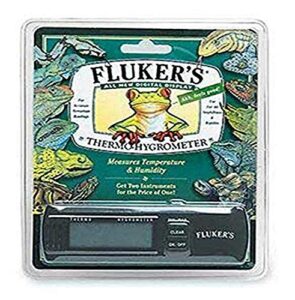
The Fluker Digital Thermometer Hygrometer is a solid entry-level pick for reptile keepers who want straightforward readings without spending much. It displays both temperature and humidity on a single LCD screen, covering 32–122°F and 10–99% RH.
Humidity accuracy can drift 5–10% throughout the day, so pairing it with a secondary gauge is smart for snakes with tighter requirements.
The strong adhesive backing mounts securely but can be tricky to reposition later.
| Best For | Hobbyist reptile and amphibian keepers who want an affordable, easy-to-read thermometer and hygrometer combo without the complexity of probe-based systems. |
|---|---|
| Display Type | Digital LCD |
| Mounting Method | Adhesive Backing |
| Power Source | Battery Included |
| Temp Units | °F and °C |
| Humidity Accuracy | ±5–10% RH |
| Housing Material | ABS Plastic |
| Additional Features |
|
- Displays both temperature and humidity on one screen, saving space and money
- Simple adhesive mounting makes setup quick for most tank types
- Battery included so it’s ready to use right out of the box
- Humidity readings can drift 5–10%, making it unreliable for species with tight humidity requirements
- The strong adhesive can be difficult to remove or reposition without damaging the tank
- Some units have reported early sensor failure, so longevity isn’t guaranteed
2. Zoo Med Dual Thermometer Hygrometer
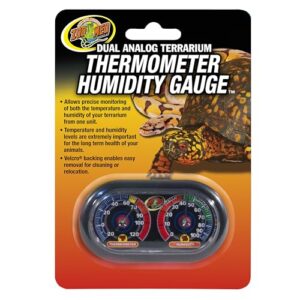
The Zoo Med Dual Thermometer Hygrometer trades digital precision for simplicity. Its analog dual-dial design shows temperature and humidity at a glance — no batteries, no setup.
The Velcro backing makes repositioning easy, which is handy when you’re dialing in your snake’s gradient.
That said, temperature increments run about 10°F, and humidity readings are estimated rather than exact.
For species like ball pythons needing tight humidity between 60–80%, treat this as a quick reference, not your primary gauge.
| Best For | Hobbyists and small-scale reptile keepers who want a no-fuss, battery-free way to spot-check temperature and humidity across different zones in their enclosure. |
|---|---|
| Display Type | Analog Dial |
| Mounting Method | Velcro |
| Power Source | No Battery Needed |
| Temp Units | °F and °C |
| Humidity Accuracy | Not rated |
| Housing Material | Plastic |
| Additional Features |
|
- No batteries or digital setup required — just mount and read
- Velcro backing makes it easy to reposition when dialing in your animal’s gradient
- Compact and lightweight, so it won’t crowd smaller terrariums
- Temperature increments of ~10°F make precise monitoring difficult
- Humidity readings are estimated, not exact — too imprecise for species with tight humidity needs
- Plastic housing can become brittle or allow moisture ingress with prolonged high-humidity exposure
3. Repti Zoo Digital Terrarium Thermometer Hygrometer
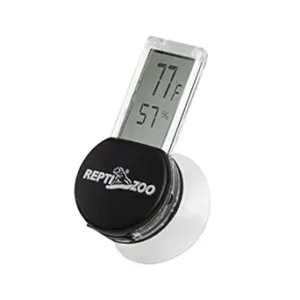
If analog dials feel too imprecise, the Repti Zoo Digital Terrarium Thermometer Hygrometer closes that gap fast.
Its LCD shows temperature and humidity simultaneously, and the suction cup mount sticks to glass without adhesives, so repositioning takes seconds.
Battery life runs over 12 months on two AAs. Accuracy sits around ±2–4°F and ±5% RH — solid for most species.
Just keep it away from splashing water, since it’s not fully waterproof.
| Best For | Reptile keepers who want a simple, budget-friendly way to monitor both temperature and humidity in their vivarium without dealing with adhesives or complicated setups. |
|---|---|
| Display Type | Digital LCD |
| Mounting Method | Suction Cup |
| Power Source | AA Battery |
| Temp Units | °F and °C |
| Humidity Accuracy | Not specified |
| Housing Material | ABS / Glass |
| Additional Features |
|
- Displays temperature and humidity at the same time on one easy-to-read LCD screen
- Suction cup mount lets you reposition it instantly — no sticky residue, no hassle
- Battery lasts over 12 months, and swapping it out requires no tools
- Suction cup can lose its grip on smooth or curved glass over time
- LCD can be tough to read under bright lighting without a light background behind it
- Not waterproof, so splashing water can cause it to fail until it’s dried out and the battery is removed
4. TempPro Indoor Hygrometer Thermometer
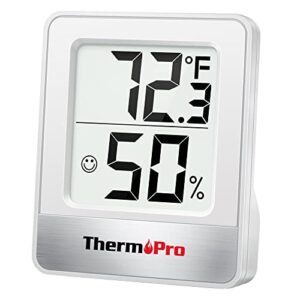
The TempPro stands out for its ±1°F / ±2% RH accuracy — tighter than most budget options and well within the tolerances reptile keepers need. Readings refresh every 10 seconds, so you’re never working from stale data.
For species with tighter thermal gradients, pairing this with solid snake enclosure temperature control practices helps you get the most out of that precision accuracy.
Its three mounting options — tabletop stand, magnetic back, or hanging hook — make repositioning easy. The IPX5 water-resistant housing manages humid enclosures without issue.
One honest drawback: battery life isn’t specified, so keep a spare on hand.
| Best For | Reptile keepers, gardeners, and anyone who needs reliable humidity tracking in small spaces like grow tents, nurseries, or RVs. |
|---|---|
| Display Type | Digital LCD |
| Mounting Method | Stand / Magnet / Hook |
| Power Source | Battery Included |
| Temp Units | °F and °C |
| Humidity Accuracy | ±2–3% RH |
| Housing Material | ABS Plastic |
| Additional Features |
|
- Tight ±1°F / ±2% RH accuracy keeps readings trustworthy without paying a premium price
- Three mounting options (tabletop, magnetic, hook) make it easy to place wherever you need it
- IPX5 water resistance holds up in humid enclosures without any special care
- Battery life is unspecified, so replacements can catch you off guard
- Comfort-face icons may take up to a month to activate on some units
- No external probe means it only reads the air immediately around it
5. Inkbird Digital Temperature Hygrometer
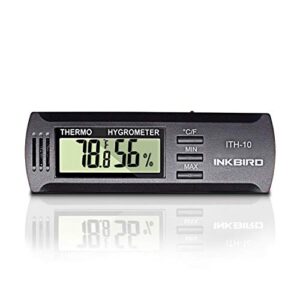
If you’re tracking humidity for a ball python or crested gecko, the Inkbird Digital Hygrometer earns its spot through solid accuracy — ±3% RH and ±1°C — which comfortably meets reptile husbandry standards. It records daily highs and lows, so you can catch overnight humidity dips without guessing.
The compact form fits neatly inside humid hides, and Bluetooth connectivity lets you monitor conditions from your phone. Calibration support through the app adds a layer of reliability you won’t find on basic budget units.
| Best For | Reptile keepers, guitarists, and anyone who needs a reliable, compact hygrometer to monitor humidity in enclosures, instrument cases, or small storage spaces. |
|---|---|
| Display Type | Digital LCD |
| Mounting Method | Velcro Straps |
| Power Source | CR2032 Cell |
| Temp Units | °F and °C |
| Humidity Accuracy | ±3% RH |
| Housing Material | ABS Plastic |
| Additional Features |
|
- Accurate readings at ±3% RH and ±1°C, meeting the precision needs of reptile husbandry and instrument storage
- Records daily high and low values, making it easy to catch overnight humidity swings without constant monitoring
- Slim, lightweight design fits easily inside hides, guitar cases, humidors, and other tight spaces
- No user-adjustable calibration, so accuracy can drift over time without a way to correct it at home
- Some units have reported humidity variance of up to ±5% RH, making pre-testing a smart step before relying on it
- No Bluetooth or app connectivity — monitoring is limited to physically checking the LCD display
6. Jedew Mini Digital Hygrometer
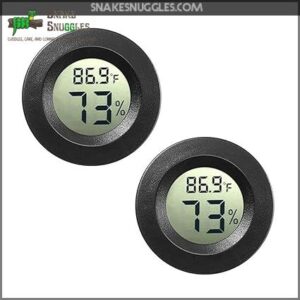
When budget is tight but accuracy still matters, the Jedew Mini is worth considering. This compact round hygrometer measures humidity from 10% to 99% RH and temperature from 32°F to 158°F, covering the full range most reptile enclosures need. Accuracy lands around ±1°C and ±5% RH — acceptable for general snake and gecko setups.
It runs on a button cell battery and displays both readings clearly. Sold in multi-packs, you can easily monitor warm and cool sides simultaneously.
| Best For | Budget-conscious reptile keepers who need to monitor temperature and humidity across multiple enclosures at once. |
|---|---|
| Display Type | Digital LCD |
| Mounting Method | Freestanding |
| Power Source | LR44 Cell |
| Temp Units | °F and °C |
| Humidity Accuracy | ±3–5% RH |
| Housing Material | ABS Plastic |
| Additional Features |
|
- Comes in multi-packs, so you can track warm and cool sides of an enclosure simultaneously
- Updates readings every 10 seconds and displays large, easy-to-read characters on a compact housing
- Includes a backup battery and runs up to 10 months on a single LR44 cell
- Humidity accuracy of ±3–5% RH may not cut it for precision-sensitive setups like high-end humidors or scientific use
- Humidity readings can lag behind rapid environmental changes
- Battery life varies with use, so replacements may come sooner than the 10-month estimate suggests
Key Features for Humidity Control
Not all thermometer hygrometers are built the same, and for reptile keeping, the differences really do matter. A few key features separate the reliable ones from the ones you’ll be replacing in six months. Here’s what to look for before you buy.
Temperature and Humidity Accuracy
A digital thermometer and hygrometer are only as useful as their accuracy. Most quality digital units hit ±1 °F temperature accuracy and stay within ±3–5% RH for humidity — close enough to keep your reptile’s enclosure climate control on track.
Capacitive hygrometry helps achieve this, and thermal compensation technology further tightens humidity readings when temperatures shift inside the enclosure.
Ensuring precise temperature measurements helps maintain ideal enclosure conditions.
Fast Sensor Response Time
When your snake starts basking or retreats to a humid hide, conditions can shift in seconds.
A good digital thermometer and humidity gauge need a fast probe response time — ideally under two seconds — so you’re seeing what’s happening now, not a minute ago.
Modern microcontroller update speeds of 1–10 Hz make that possible.
Min and Max Tracking
Min/max tracking turns your digital thermometer and humidity gauge into a data trend analysis tool. At a glance, you can see whether your reptile enclosure climate control stayed stable overnight — or swung dangerously.
Three readings worth checking daily:
- Max humidity in the hide for shedding humidity monitoring
- Min temperature on the cool side for dryness detection
- 24-hour spread for seasonal shift detection
Easy-to-read Display
When you’re checking in on your reptile at midnight, the last thing you want is to squint at a tiny screen. A high-contrast LCD screen on your digital thermometer and humidity gauge makes readings clear from several feet away. Look for digits at least 12 mm tall, with nighttime dimming so the display won’t disturb your animals.
Anti-glare coatings reduce reflections from enclosure lighting, and icon-based status indicators let you confirm battery level and alarm status at a glance, keeping your temperature and humidity monitoring simple and stress-free.
Alerts and Smart Monitoring
A clear display helps at midnight, but it won’t save you if conditions spike while you’re away. That’s where smart monitoring changes everything. A good environmental monitoring system sends mobile push notifications the moment temperature or humidity drifts out of range — no guessing, no morning surprises.
Digital Vs Analog Gauge Accuracy
Choosing between a digital and analog gauge comes down to more than just personal preference — accuracy matters when your snake’s health is on the line. Each type has real strengths and genuine trade-offs worth knowing before you commit. Here’s how they stack up across the factors that matter most.
Digital Sensor Precision
Digital sensors give you a real edge regarding humidity sensor accuracy. A quality digital hygrometer usually stays within 1–3% RH error, and built-in temperature compensation keeps readings stable even as enclosure temps shift. That matters because a single-degree swing can throw off humidity data without it.
| Feature | Digital Sensor | Acceptable Range |
|---|---|---|
| Humidity Accuracy | ±1–3% RH | ±5% RH |
| Resolution | 0.1% RH | 1% RH |
| Update Rate | Every 10 sec | Every 60 sec |
Signal noise and airflow can still reduce precision, so placement counts.
Analog Dial Limitations
Analog gauges can seem appealing — no batteries, no setup — but they come with real trade-offs. Needle jitter issues from enclosure fans make stable readings nearly impossible, and reading parallax distortion shifts your perceived value depending on your viewing angle. Mechanical wear factors quietly degrade accuracy over months.
| Limitation | Analog Gauge | Digital Sensor |
|---|---|---|
| Accuracy Range | ±5% RH or more | ±1–3% RH |
| Affected by Vibration | Yes — needle jitter | No |
| Calibration Drift | Gradual, hard to detect | Minimal with quality units |
| Data Logging | Manual transcription only | Automatic |
| Parallax Error | Common at off-angles | None |
Manual transcription errors add another layer of risk — you’re copying numbers by hand, which invites mistakes. Calibration drift challenges mean your analog hygrometer may quietly drift from true values without any warning, making consistent temperature and humidity monitoring unreliable over time.
Calibration Options
Knowing your gauge drifts isn’t enough — you also need to fix it. Salt solution methods are the industry benchmark here: a sealed container with saturated sodium chloride holds 75% RH, giving you a reliable reference point. Place your sensor inside, wait 8–12 hours, then apply a manual offset adjustment if the reading doesn’t match.
| Calibration Method | Best For |
|---|---|
| Salt solution (75% RH) | Humidity sensor calibration |
| Two-point (33% + 75%) | Multi-point accuracy across range |
| Software offset trim | Digital models only |
| No calibration support | Analog gauges |
Digital precision thermometers support offset adjustment through firmware or a trim setting, while analog gauges simply can’t be corrected this way. For calibration frequency, recalibrate every three months in high-humidity enclosures.
Sensor Drift Over Time
Even the best environmental monitoring equipment won’t stay accurate forever. Over time, sensor baseline shifts occur as material aging causes thermistors to read slightly high or low — sometimes by a full degree after 12 months.
| Issue | Cause | Effect |
|---|---|---|
| Temperature drift | Material aging | Under/overestimated temps |
| Humidity sensor drift | Polymer film degradation | Humidity underreporting |
| Calibration stability loss | Environmental aging impacts | Inaccurate RH readings |
Replace sensors every 6–12 months in demanding enclosures.
Best Choice for Snakes
For snakes like ball pythons, a digital reptile thermometer humidity gauge is the clear winner over analog. It gives you tighter accuracy — within ±1 °F and ±5% RH — which matters for enclosure climate control and shedding aid monitoring.
| Snake | Temperature Range | Humidity Target |
|---|---|---|
| Ball Python | 80–95 °F | 60–80% RH |
| Corn Snake | 75–85 °F | 40–60% RH |
| King Snake | 75–85 °F | 30–50% RH |
Best Placement in Snake Enclosures
Where you place your thermometer and hygrometer matters just as much as which one you buy. A reading that’s even a few degrees off — simply because the probe is in the wrong spot — can throw off your entire setup. Here are the five key placement points every snake keeper should know.
Warm Side Monitoring
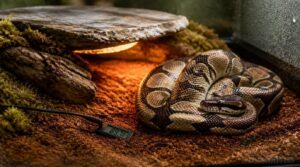
The warm side is where your snake spends the most critical hours of its day — basking, digesting, thermoregulating.
Place your digital reptile thermometer humidity gauge directly on the heated surface to capture the true hotspot.
Probe depth matters too: 1 to 2 inches below the substrate reflects what your snake actually feels while moving through the warm zone.
Cool Side Monitoring
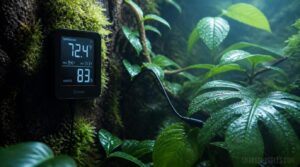
The cool side is your enclosure’s pressure valve — it tells you when the whole climate system is working.
Place your digital thermometer hygrometer at mid-height on the cool side, away from water dishes, to capture true ambient temperature monitoring without local splash interference.
- Keep probe cables secured and kink-free for accurate sensor response
- Set alert thresholds to trigger if humidity drifts more than 8%
- Use dual probes to detect vertical humidity gradients
Humid Hide Placement
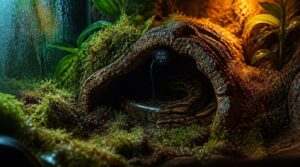
The humid hide is where your snake’s shedding success is quietly decided.
A snake’s shedding success is quietly decided by the humidity inside its hide
Place it on the warm side to boost evaporation from damp moss or coconut fiber substrate, but if that dries too quickly, shift it to the middle zone for slower, steadier moisture. A dual hide strategy — one warm, one cool — gives your snake options without forcing a choice.
| Hide Location | Evaporation Rate | Humidity Stability |
|---|---|---|
| Warm side | Fast | Needs frequent re-wetting |
| Middle zone | Moderate | More consistent |
| Cool side | Slow | Lower peak humidity |
Position your humidity sensor for terrarium about one inch above the substrate inside the hide for accurate microclimate readings. Target humidity accuracy within 5 RH to catch fluctuations before they disrupt a shed cycle.
Avoiding Airflow Interference
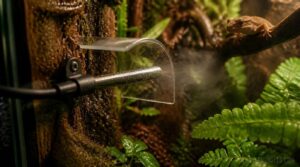
Ever notice readings jump after a vent cycles? That’s convective bias at work.
Shielding probe geometry with small barrier baffles blocks vent gusts, stabilizing humidity spikes your temperature and humidity sensor would otherwise misread. Good ventilation in terrarium setups still matters, but the probe placement effect means mid-height, away from direct flow, gives honest environmental monitoring—digital vs analog gauges.
Using Multiple Probes
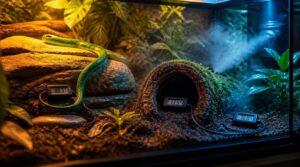
One probe never tells the whole story. A multisensor setup gives you real-time snapshots of every microclimate — warm side, cool side, and inside the humid hide — so you’re not guessing where conditions drift.
Pair that data in a data aggregation hub to catch cross-sensor bias before it throws off your readings and harms your snake.
Choosing a Reliable Terrarium Monitor
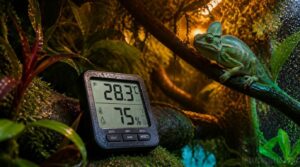
Not every monitor is built to last in the humid, heat-heavy environment of a reptile enclosure. Before you buy, a few practical factors — water resistance, battery life, mounting, and value — will separate a reliable long-term tool from one you’ll replace in six months. Here’s what to look for in each of those areas.
Water-resistant Designs
Reptile husbandry equipment takes a beating from constant moisture, so water-resistant design isn’t optional — it’s essential.
- IP67 or IP68 housings block water at every seam
- Hydrophobic nanocoatings shed condensation from the display
- Sealed probe technology keeps humidity sensors accurate when submerged
- Gasketed battery compartments protect terminals from corrosion
- Corrosion-resistant materials extend your digital thermometer hygrometer’s lifespan
Proper sealing keeps your humidity levels readings stable long-term.
Battery Life Expectations
A sealed housing does you no good if the batteries die mid-monitoring. Most battery-powered digital temperature gauges last 12–24 months on standard alkaline cells, but faster polling rates cut that time noticeably. If your device updates every 10 seconds, expect shorter life than one polling every minute. Enabling sleep mode can extend runtime by 20–40%.
| Factor | Effect on Battery Life |
|---|---|
| 10-second polling rate | Reduces life substantially |
| Sleep mode enabled | Extends life 20–40% |
| Temps above 40°C | Accelerates capacity loss |
| Discharge cycle count | 300–500 cycles before fade |
Schedule battery replacement annually to keep your temperature and humidity monitoring reliable year-round.
Secure Mounting Options
A dead battery won’t matter if your monitor slides off the glass. Choosing between adhesive vs mechanical mounts depends on your terrarium’s surface.
Suction cup mounting, magnetic back mounting, and 3-sided mounting options offer flexible attachment methods without drilling. For humid enclosures, pick corrosion resistant materials and mounting surface prep. Tamper proof security stops curious reptiles dislodging sensor mounting options.
Price Versus Performance
How much should you really spend on a precision thermometer?
Budget vs premium comes down to value for money, not just price. Units under $20 give basic readings; $30–$60 midrange models add dual sensors and memory.
Premium gauges above $60 sharpen accuracy but bring diminishing returns for casual keepers practicing cost-effective monitoring.
Long-term Maintenance Needs
Keeping your monitor accurate long-term takes a little routine.
Calibrate sensors every 6–12 months using a reference meter, and replace batteries every 12–24 months before drift creeps in.
Clean probe tips with distilled water monthly, inspect mounting hardware each quarter, and check for firmware updates biannually to maintain reliable readings, your reptile’s health depends on.
Frequently Asked Questions (FAQs)
How often should I replace thermometer batteries?
For most battery-powered gauges, replace every 6–12 months. Watch for dim displays or erratic readings — those are classic low battery signs. High humidity can corrode contacts, so check them regularly.
Can I use one thermometer for multiple enclosures?
Technically, yes — but it comes with trade-offs. Each enclosure has its own microclimate monitoring gaps, meaning rotating one sensor between habitats leaves you blind to real-time shifts in temperature and humidity ranges.
Do wireless thermometers work through glass terrariums?
Yes, wireless thermometers work well through standard glass. Radio signals at 433 MHz or 4 GHz pass through glass with minimal loss, giving you reliable temperature and humidity monitoring without drilling holes or running cords.
What causes sudden humidity spikes at night?
Nocturnal temperature drops cause air to hold less moisture, so relative humidity spikes as temperatures fall. Substrate moisture release, evening watering, and reduced ventilation airflow all intensify nighttime humidity fluctuations inside your enclosure.
Are infrared thermometers accurate for substrate temperature?
A digital infrared thermometer gives you fast surface readings, but substrate moisture and texture throw off accuracy. For depth and reliability in reptile husbandry, pair it with a contact probe.
Can reptile thermometers work in outdoor enclosures?
Most reptile thermometers can work outdoors, but only if they have weatherproof or IP-rated housings. Rain, UV exposure, and wide temperature swings will quickly degrade standard units and drift sensor readings.
How do infrared thermometers differ from probe-based models?
An infrared thermometer reads surface temperature without contact, detecting heat energy from a distance in under a second. A temperature probe makes direct contact, measuring internal core temperature more accurately, especially in dense substrates.
Are smart controllers compatible with all reptile heating equipment?
Smart controllers don’t work with every heater. Wattage rating limits matter most — always match your heating element compatibility before connecting. Pulse, dimming, and on/off thermostat control types each suit different heat sources.
How often should hygrometer sensors be replaced?
Plan to replace humidity sensors every 1–2 years in active reptile enclosures. High humidity and organic matter accelerate drift, so if calibration can’t restore humidity accuracy ±5% RH, replacement is overdue.
Conclusion
What separates a thriving snake from a struggling one often comes down to a single device mounted inside the enclosure.
The right reptile thermometers for humidity control don’t just display numbers—they give you the confidence to act before a bad reading becomes a bad outcome.
Trust sensors that hold accuracy through humid hides, seasonal changes, and years of daily use.
Your animal can’t tell you when something’s off. Your thermometer can.
- https://reptifiles.com/ball-python-care-guide/ball-python-humidity-temperatures
- https://reptileapartment.com/reptile-thermometer-analog-vs-digital
- https://docs.google.com/document/d/1ETuvgkvixUFOeow1j3C8mJtOF9XYcObxvB5qnYdblvo/mobilebasic
- https://calright.com/analog-vs-digital-hygrometer-which-is-better
- https://www.krawlo.com/best/best-reptile-probe-thermometer