This site is supported by our readers. We may earn a commission, at no cost to you, if you purchase through links.
A ball python’s shed problems almost always trace back to one thing: a $10 thermometer reading five points off. Snakes can’t tell you the humidity feels wrong. They just stop eating, hold onto old skin, or press against the glass looking for relief.
That gap between what your gauge shows and what your enclosure actually holds causes more health issues than keepers realize. Accurate digital thermometers for humidity monitoring close that gap, giving you real numbers instead of guesswork.
Some units track two zones at once. Others sync to your phone from across the room. Here’s what separates the tools worth trusting from the ones quietly costing your snake its comfort.
Table Of Contents
- Key Takeaways
- 9 Best Digital Thermometers for Humidity Monitoring
- 1. TempPro TP50 Digital Hygrometer Thermometer
- 2. TempPro TP49 Digital Hygrometer Indoor Thermometer
- 3. AyayaBoss Mini Indoor Thermometer Hygrometer
- 4. Govee Hygrometer Thermometer Bluetooth App Control
- 5. TempPro Digital Indoor Thermometer Hygrometer
- 6. Antonki 2 Pack Room Thermometer Indoor Hygrometer
- 7. Ayawiss Room Thermometer Hygrometer Digital Indoor
- 8. TempPro TempAir Digital Hygrometer Thermometer
- 9. JEDEW Digital Hygrometer Thermometer 2 Pack
- Key Features for Reliable Humidity Monitoring
- Choosing Thermometers for Snake Enclosures
- Proper Sensor Placement and Setup
- Best Options for Different Snake Keepers
- Frequently Asked Questions (FAQs)
- Conclusion
Key Takeaways
- Accurate humidity readings matter more than price, since a sensor off by just a few points can cause shedding problems, appetite loss, and stress in your snake.
- Look for a thermometer with ±1°F to ±2% RH accuracy, and place it away from vents, heat lamps, and direct sunlight to avoid false readings.
- Match your thermometer to your species’ needs and setup size, since ball pythons, boas, and corn snakes each require different humidity ranges, and larger enclosures need wider sensor range and dual placement on warm and cool sides.
- Keep sensors calibrated every 6 to 12 months, off the substrate, and free of dust, and check batteries regularly since most units need replacement within that same window.
9 Best Digital Thermometers for Humidity Monitoring
Humidity control makes or breaks a snake’s health, so your thermometer choice matters. Not every hygrometer holds up to enclosure conditions or gives you numbers you can trust. Here are nine models worth putting in your setup.
If you’re still dialing in your setup, this guide to snake enclosure humidity control walks through the ranges different species need and how to hit them consistently.
1. TempPro TP50 Digital Hygrometer Thermometer
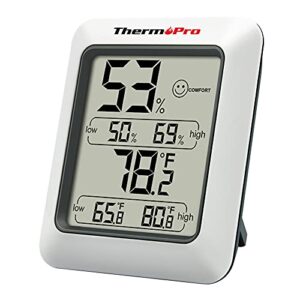
A small enclosure lives or dies on accurate numbers, and the TP50 delivers ±1°F and ±2% RH accuracy, updated every 10 seconds. Its NTC thermistor sensor covers 10-99% humidity, wide enough for humid tropical setups or drier desert species.
The compact LCD shows DRY, COMFORT, or WET at a glance. A magnetic back and kickstand let you mount it on wire enclosures or set it upright on a stand. At $15.99, it’s a solid entry point for keepers watching their budget.
| Best For | Reptile keepers and small enclosure owners who need a simple, accurate way to track temperature and humidity without dealing with apps or Wi-Fi setup. |
|---|---|
| Refresh Rate | 10 seconds |
| Humidity Accuracy | ±2–3% RH |
| Temperature Accuracy | ±1°F |
| Mounting Options | Stand, magnetic back |
| High/Low Memory | Yes |
| Power Source | 1 AAA battery |
| Additional Features |
|
- Delivers accurate readings (±1°F, ±2% RH) updated every 10 seconds, covering a wide 10-99% humidity range
- Magnetic back and kickstand make it easy to mount on wire enclosures or display upright
- Affordable price point at $15.99 makes it accessible for budget-conscious keepers
- No backlight on the display, which makes it hard to read in low-light conditions
- Some users have reported units failing after about a month of use
- Lacks remote monitoring, app connectivity, or long-term data logging
2. TempPro TP49 Digital Hygrometer Indoor Thermometer
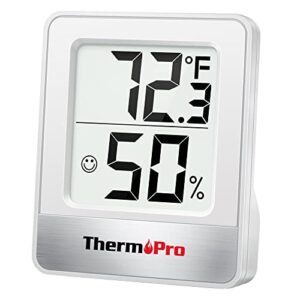
If the TP50 covers your basics, the TP49 is built for keepers who want a bit more clarity in a crowded reptile room. It shares the same ±1°F and ±2-3% RH accuracy, with a clear LCD and large digits you can read from across the enclosure. A built-in comfort icon flags dry, comfortable, or humid conditions instantly.
You can switch between °F and °C with one button, and the backlit display helps during late-night checks without disturbing your snake.
| Best For | Reptile keepers who want fast, easy-to-read humidity and temperature checks across a crowded terrarium setup. |
|---|---|
| Refresh Rate | 10 seconds |
| Humidity Accuracy | ±2–3% RH |
| Temperature Accuracy | ±1°F |
| Mounting Options | Stand, magnetic, hanging |
| High/Low Memory | No |
| Power Source | Battery (unspecified) |
| Additional Features |
|
- High-accuracy sensors (±1°F/°C and ±2–3% RH) with a comfort face icon for quick at-a-glance readings
- Large bold LCD digits and backlit display make late-night checks easy without disturbing your reptile
- Flexible mounting options (tabletop, magnetic, or hanging) plus a one-button °F/°C toggle for convenience
- Some users report the display failing after just a couple months of use
- Included battery may arrive defective or already depleted, requiring an early replacement
- Humidity readings below 30% RH may trigger an "unhappy" icon even when conditions are fine for drier climates
3. AyayaBoss Mini Indoor Thermometer Hygrometer
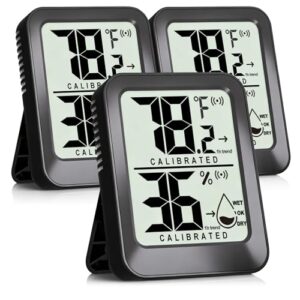
Space matters when you’re running several enclosures, and that’s where the AyayaBoss Mini earns its spot. Its compact footprint fits on shelves or tank lids without crowding your setup.
The clear digital display shows temperature and humidity in real time, with large digits readable across a room. No app or Wi-Fi required, just a quick glance for accurate spot checks. Button cell battery keeps it running for weeks. Keep it off substrate and away from heat lamps for reliable readings.
| Best For | Hobbyists managing multiple enclosures—like reptile terrariums, aquariums, or humidor boxes—who need a compact, no-fuss way to check conditions at a glance. |
|---|---|
| Refresh Rate | N/A (1-hour trend) |
| Humidity Accuracy | N/A |
| Temperature Accuracy | N/A |
| Mounting Options | Kickstand, adhesive tape |
| High/Low Memory | No |
| Power Source | CR2032 |
| Additional Features |
|
- Compact size fits easily on shelves or tank lids without taking up space
- Large, clear digits make temperature and humidity easy to read from across a room
- No app or Wi-Fi setup needed, just simple, accurate spot checks
- Needs about an hour after startup to stabilize before readings are fully accurate
- Battery life and overall durability can vary between units
- Must be kept away from substrate and heat lamps to avoid skewed readings
4. Govee Hygrometer Thermometer Bluetooth App Control
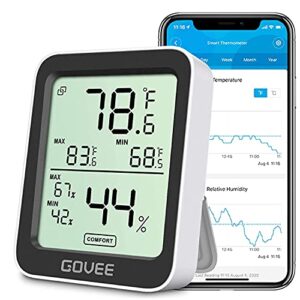
If you want data instead of just a glance, the Govee Hygrometer changes the game. Its Swiss-made sensor delivers ±0.54°F and ±3% RH accuracy, paired with Bluetooth app control for remote monitoring up to 164 feet.
You’ll get 20-day graphs, custom alerts, and CSV export for up to two years of history. No Wi-Fi means you’re checking readings within range, but for tracking trends across your snake room, that trade-off is worth it.
| Best For | Reptile owners, plant parents, and anyone who wants precise, trackable climate data for spaces like snake rooms, greenhouses, or wine cellars. |
|---|---|
| Refresh Rate | 2 seconds |
| Humidity Accuracy | ±3% RH |
| Temperature Accuracy | ±0.54°F |
| Mounting Options | Flat surface |
| High/Low Memory | Yes (max/min) |
| Power Source | 2 AAA (not included) |
| Additional Features |
|
- Swiss-made sensor offers excellent accuracy (±0.54°F, ±3% RH)
- 20-day graphs and CSV export make it easy to spot long-term trends
- Custom app alerts let you know right away if conditions drift out of range
- No Wi-Fi or cloud access, so you can only check data when you’re within Bluetooth range
- Full features require the Govee app, which adds a setup step
- No mounting accessories included, so placement options are limited
5. TempPro Digital Indoor Thermometer Hygrometer
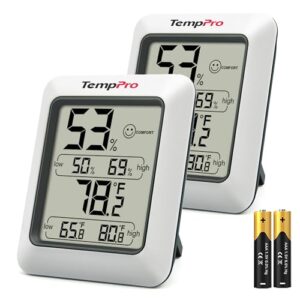
Simplicity has its place, and the TempPro TP50 earns it. This gauge sticks to the basics: temperature and humidity on a clear LCD, updated every 10 seconds, accurate to ±1°F and ±2-3% RH.
Its magnetic mount and high/low memory make it especially handy for anyone following a step-by-step corn snake breeding guide to keep incubation conditions steady from lay to hatch.
Range runs 14-122°F and 10-99% humidity, plenty for most enclosures. The magnetic back and tabletop stand make placement easy near your warm hide. Two AAA batteries keep it running for weeks with no app, no Bluetooth, just dependable numbers when you glance over.
| Best For | Reptile owners, cigar and greenhouse hobbyists, and anyone who wants a simple, no-frills way to keep an eye on temperature and humidity in a small space. |
|---|---|
| Refresh Rate | 10 seconds |
| Humidity Accuracy | ±2–3% RH |
| Temperature Accuracy | ±1°F |
| Mounting Options | Stand, magnetic back |
| High/Low Memory | Yes |
| Power Source | 2 AAA batteries |
| Additional Features |
|
- Accurate readings (±1°F and ±2-3% RH) with a fast 10-second refresh rate
- Versatile placement thanks to the magnetic back and included tabletop stand
- Easy-to-read comfort icon shows DRY/COMFORT/WET at a glance, no math required
- Several users report units failing after roughly a month of use
- No backlight, so the display is hard to read in dim rooms or enclosures
- No app, Bluetooth, or data logging, and high/low memory resets if batteries die or are removed
6. Antonki 2 Pack Room Thermometer Indoor Hygrometer

Two thermometers for the price of one makes sense if you’re running multiple enclosures. Each Antonki unit tracks temperature and humidity independently, with a kickstand for tabletop placement near your warm hide or cool end.
Battery life runs anywhere from 2 to 12 months, so check readings weekly at first. There’s no backlight, which makes night checks harder, and the units aren’t rated for moisture exposure. Keep them away from water bowls and misted substrate.
| Best For | Reptile keepers and terrarium owners who need to monitor temperature and humidity across multiple enclosures at once. |
|---|---|
| Refresh Rate | N/A |
| Humidity Accuracy | N/A |
| Temperature Accuracy | N/A |
| Mounting Options | Magnetic, kickstand |
| High/Low Memory | No |
| Power Source | CR2032 |
| Additional Features |
|
- Two independent units let you track separate enclosures or warm/cool zones simultaneously
- Magnetic backing and kickstand allow flexible placement on tabletops or metal surfaces
- Large LCD display makes readings easy to check from a distance
- No backlight, making nighttime readings difficult to check
- Not moisture-resistant, so units must be kept away from water bowls and misted substrate
- Battery life varies widely (2–12 months), requiring regular checks
7. Ayawiss Room Thermometer Hygrometer Digital Indoor
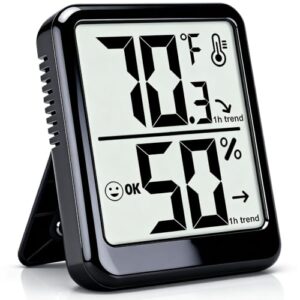
Simple and reliable sums up the Ayawiss unit. Its digital sensor auto-calibrates after power-on and displays temperature in Fahrenheit or Celsius with a quick toggle, giving you both readings on one compact LCD.
Large digits make the screen easy to read across a room, and the backlight helps during low-light checks. A single AAA battery runs it for months. The kickstand keeps it stable on a shelf, and its two-by-two-and-a-half-inch housing fits tight enclosure setups without crowding the tank.
| Best For | This thermometer/hygrometer is best for parents, plant lovers, and reptile owners who need a compact, easy-to-read way to monitor temperature and humidity in nurseries, offices, greenhouses, or terrariums. |
|---|---|
| Refresh Rate | N/A (1-hour trend) |
| Humidity Accuracy | ±5% RH |
| Temperature Accuracy | ±1.8°F |
| Mounting Options | Stand |
| High/Low Memory | No |
| Power Source | 1 AAA battery |
| Additional Features |
|
- Large digit display with WET/OK/DRY icons and a 1-hour trend indicator make readings easy to interpret at a glance
- Auto-calibrates on power-on and runs for months on a single included AAA battery
- Compact, stable design with a durable stand makes it easy to place or move between rooms
- Some users find humidity readings run slightly higher than the actual level
- No included instructions for adjusting display settings or getting a static readout
- A few customers feel the unit is smaller than expected, even with its compact design
8. TempPro TempAir Digital Hygrometer Thermometer
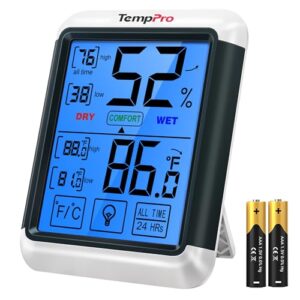
Fast response matters when humidity swings inside a tank, and the TempAir sensor answers in seconds with ±2 to ±3% RH accuracy and updates every 10 seconds.
The compact display shows temperature and humidity together, with a backlight for low-light checks. A calibration button on the side lets you fine-tune readings if drift occurs over time.
It tracks max and min humidity too, so you’ll catch overnight dips that a quick glance might miss.
| Best For | This hygrometer is best for anyone who wants to keep an eye on temperature and humidity in a space like a bedroom, greenhouse, RV, or wine cellar without needing constant, up-to-the-second precision. |
|---|---|
| Refresh Rate | 10 seconds |
| Humidity Accuracy | ±2% RH |
| Temperature Accuracy | ±1°F |
| Mounting Options | Fold-out stand, wall mount, magnets |
| High/Low Memory | Yes (24hr & all-time) |
| Power Source | 3 AAA batteries |
| Additional Features |
|
- Large, bold 4-inch display makes readings easy to see from across a room
- Touch-activated backlight allows for nighttime checks without disturbing others
- Tracks 24-hour and all-time max/min levels, making it easy to spot trends over time
- Backlight only stays on for about 15 seconds before shutting off
- Needs 15–30 minutes to adjust after exposure to extreme temperatures, so it’s not ideal for instant readings
- Plastic build may not hold up well in rougher or high-impact environments
9. JEDEW Digital Hygrometer Thermometer 2 Pack
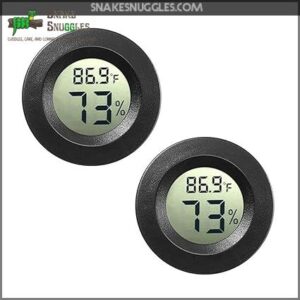
Got more than one enclosure? This 2-pack from JEDEW covers two tanks without buying separate units. Each hygrometer runs on included LR44 batteries and shows temperature and humidity on one LCD screen, with a Fahrenheit/Celsius toggle built in.
Accuracy sits at ±3% RH and ±1°F, fine for general monitoring but not precision breeding setups. No backlight means night checks need a flashlight. Double-sided tape is included, so mounting near the warm and cool sides takes minutes.
| Best For | Reptile, greenhouse, humidor, or filament storage owners who need to monitor multiple enclosures at once without buying separate hygrometers. |
|---|---|
| Refresh Rate | 10 seconds |
| Humidity Accuracy | ±3% RH |
| Temperature Accuracy | ±1°F |
| Mounting Options | N/A |
| High/Low Memory | No |
| Power Source | 2 LR44 cells |
| Additional Features |
|
- Two units in one pack make it easy and affordable to track humidity and temperature in multiple spaces
- Long battery life (up to 10 months per LR44 cell) means minimal maintenance
- Displays both Fahrenheit and Celsius readings for flexible use
- No backlight, so readings can be hard to see in dim or dark enclosures
- Humidity readings bottom out at 10%, even if actual levels are lower
- Accuracy (±3% RH, ±1°F) is fine for general use but not precise enough for specialized breeding needs
Key Features for Reliable Humidity Monitoring
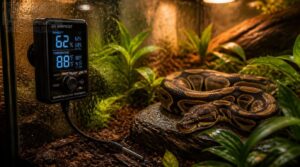
Not every thermometer earns a spot in your snake’s enclosure. Before you pick one, you need to know what actually makes a reading trustworthy. Here are the five features worth checking first.
Humidity and Temperature Accuracy
A snake doesn’t care about your thermometer’s price tag, only whether the numbers are true. Look for ±1°F to ±2% RH accuracy, since sensor placement near vents can skew readings 6-12%. Direct sunlight adds 2-4°C of false heat.
Regular calibration and sensor cleaning every 6 to 12 months also helps prevent drift and keeps readings dependable over time. A reliable digital hygrometer keeps your humidity control honest and your indoor air quality readings trustworthy, not guesswork.
Calibration and Sensor Response
Accuracy means little if your sensor lags behind reality. Two-point calibration corrects readings across 20-90% RH, while drift correction holds accuracy within 2% RH after 30 days.
Fast sensors reach 63% of a step change in 5-15 seconds; larger enclosures take 30-60 seconds.
Humidity compensation and firmware correction curves keep wireless sensors honest between calibrations, roughly every 6-12 months.
Minimum and Maximum Readings
Once calibration is solid, the next question is what happened while you weren’t watching. A digital thermometer logs the lowest and highest points during any stretch, catching cold spots or heat spikes on the warm side.
Use min temp tracking and max temp alerts for dual range monitoring, then reset function usage clears old data before each new logging cycle.
Display Clarity and Backlighting
Min and max logs mean nothing if you can’t read them fast, especially at 2 a.m. with a flashlight in one hand.
Min and max logs are useless if you can’t read them fast at 2 a.m. with only a flashlight
Look for screen brightness near 300 nits, a 1000:1 contrast ratio, and clean pixel clarity. A flicker free, 6500K backlit display keeps digits sharp without eye strain during quick warm-side checks.
Bluetooth Alerts and Data Tracking
A good display only helps if you’re standing there reading it. That’s where a wireless sensor with mobile app control earns its keep.
Set high and low humidity alerts, get push or vibration warnings, and check historical graphs anytime. Data exports in CSV or JSON make record-keeping easy, and automatic Bluetooth reconnection keeps sensor synchronization steady after dropouts.
Choosing Thermometers for Snake Enclosures
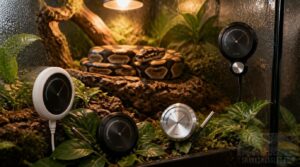
Not every thermometer fits every setup, and your snake’s enclosure has its own needs to think about. From species requirements to sensor range, a few key factors will point you toward the right pick. Here’s what to weigh before you choose.
Species-specific Humidity Requirements
Different species need different air, and your thermometer has to track that.
Ball python humidity stays best between 55 and 70 percent RH.
Boa enclosure moisture for emerald tree boas runs higher, near 75 to 85 percent.
Corn snake dryness works at 40 to 60 percent RH with airflow.
Rainforest species stability demands steady 80 to 90 percent RH readings.
Enclosure Size and Sensor Range
A 20-gallon tank and a six-foot custom enclosure don’t hold humidity the same way.
Larger air volume dilutes moisture swings but slows sensor response, so bigger builds need thermometers with wider sensor range and calibration to catch humidity gradients in far corners. Weak air circulation zones cause false readings.
Battery life and data logging should scale up too, since bigger setups mean longer monitoring stretches between checks.
Digital Display Versus App
When you’re checking on your snake at 2 a.m., screen visibility matters more than any app feature.
The digital display gives instant readings with zero lag, while a bluetooth connectivity app refreshes every 5-60 seconds and adds app data history, notification alerts, and cross-device sync for smart home use.
Single Versus Multiple Sensors
One sensor tells you about one spot, nothing more. Your enclosure has a warm side and a cool side, so microclimate impact reduction requires wireless sensors placed in both zones.
Dual-sensor technology allows humidity gradient mapping and data cross-validation, catching readings a single unit misses. For accurate temperature monitoring and relative humidity control, sensor coverage comparison favors multiples every time.
Battery Life and Reliability
A dead sensor at 2 a.m. is worse than no sensor at all. Most units run 6-12 months on a coin cell before replacement. Watch for:
- Screen dimming
- Delayed readings
- Signal drops
- Sensor drift
- Slow wake response
Sleep mode and lower brightness stretch battery life. Choose wireless sensors with proven reliability over cheap, short-lived alternatives.
Proper Sensor Placement and Setup
Where you put your sensor matters as much as the thermometer itself. A great reading from the wrong spot still leaves you guessing about your snake’s actual environment. Here’s how to place your equipment for numbers you can actually trust.
Measuring Warm-side Humidity
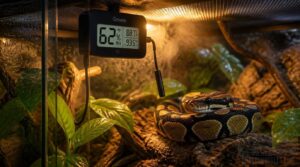
Warm air rises, so your sensor location makes or breaks accuracy. Place it 1 to 2 inches below the enclosure lid, at the animal’s level, away from heat mats and mister nozzles. Warm side accuracy depends on this placement.
Calibrate quarterly against a known reference, and check drift every two months with a second hygrometer. Good airflow keeps readings honest.
Monitoring The Cool Side
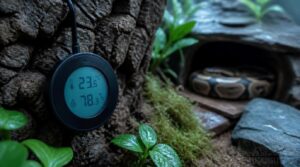
Your cool side sensor tells a different story than the warm end, and it should. Aim for 40 to 60 percent humidity here. If readings lag the warm side by more than 5 percent, that signals airflow imbalance.
Run a cool side calibration routine every 4 weeks to catch gradient shifts early and keep your reptile habitat monitoring accurate.
Avoiding Substrate Contact
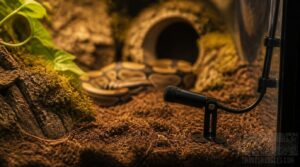
Loose bedding throws off readings fast. Keep probes off the substrate using substrate-free mounting or elevation methods, at least 5cm up. Add sensor protection covers and inert base liners to block dust.
Run weekly dust inspections on any indoor digital thermometer-hygrometer, including the AcuRite unit. Pair via Bluetooth, update firmware, and check the rechargeable battery during cleaning.
Checking Readings Before Use
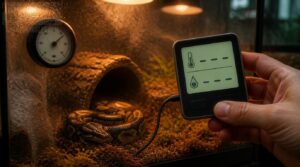
A clean probe means nothing if you skip the pre-use check. Before trusting any reading, run a quick display inspection, confirm the battery check passes, and push any pending firmware update.
- Watch for sensor stability over one minute
- Verify unit settings (F or C) match your setup
- Confirm smart home connection is syncing properly
- Cross-check temperature and humidity levels against a second hygrometer
Best Options for Different Snake Keepers
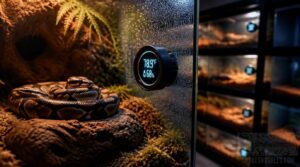
Every snake keeper has a different setup, and no single thermometer fits every situation.
Your ball python needs something different than your boa, and a rack of ten enclosures calls for a different tool than one terrarium in the living room.
Here’s how to match the right thermometer to your specific setup.
Best for Ball Python Habitats
Ball pythons need a tight gradient: 88-92°F basking, 78-85°F cool side, 50-60% humidity. The TempPro TP60B Wireless Indoor Outdoor Thermometer Hygrometer does this well, with 500ft range for remote checks. Place sensors mid-height near hides, never under substrate. Battery life matters during slow cleanings. Display clarity on the backlit screen makes quick reads easy without disturbing your snake.
Best for Boa Enclosures
Boas need higher humidity, 55-75%, to shed cleanly and breathe easy. The TempPro TP280B Wireless Home Weather Station tracks that range well, with forecast function and barometer readings.
Add a humidity shield and cypress mulch substrate to hold moisture. Mist regularly and check readings twice daily. Bigger enclosures call for stronger sensor range to match.
Best for Corn Snakes
Since corn snakes need a tighter 40-60% range, the TempPro TP60B fits well, with 500ft wireless range and high/low recording.
Set up a humidity gradient, warm side near 50-70%. Place sensors at head height, away from water bowls.
Check twice weekly during shedding. Bluetooth pairing lets you log data and catch drift early.
Best for Multiple Enclosures
A rack of six or more enclosures calls for enclosure clustering, grouping sensors so one hub reads them all. The TempPro TP280B’s 1,000ft wireless range covers most reptile rooms easily.
Run a humidity uniformity check weekly, comparing units side by side. Bluetooth pairing simplifies multi-unit synchronization, and data logging flags any sensor drifting off from the rest.
Best for Remote Monitoring
Traveling often? A WiFi connected device keeps you covered. Real-time data sync sends readings to your phone every 60 seconds, with cloud history storing 30 days for trend checks.
App controlled alerts flag threshold crossings within seconds, while remote calibration lets you fix drift without opening the enclosure. Multi-device tracking makes realtime monitoring simple across your whole collection.
Frequently Asked Questions (FAQs)
How often should I replace hygrometer batteries?
Most hygrometer batteries need swapping every 6 to 12 months. Backlit displays and Bluetooth models with app-based smart home connection drain faster, sometimes within 6 months. Watch for low battery indicators, and consider high-capacity alternatives to stretch life further.
Can I return a thermometer if inaccurate?
Roughly 30% of returned electronics test as "no fault found," yet defective units still qualify. Yes, most sellers honor returns and exchanges within 14-30 days with proof of purchase, covering models like the TempPro TP50 or TP60B.
Do these thermometers work in outdoor terrariums too?
Not without checking specs first. Outdoor use needs weatherproof enclosures, a solid waterproof sensor, and UV resistant housing.
Indoor outdoor hygrometers thermometers rated IPX6 handle splashes fine, but check battery performance and transmission range before mounting one outside.
Is a warranty included with digital hygrometers?
Most models carry a 1 to 2 year limited warranty covering defects, not batteries or misuse. You’ll need proof of purchase for any claim. Some brands offer extended coverage, worth checking before you buy your indoor hygrophygrometer thermometer.
How do I clean a humidity sensor safely?
Power off your unit first. Wipe the humidity sensor with a soft, lint-free cloth, dampened with distilled water if needed. Skip harsh chemicals. Air dry fully, then run a quick sensor calibration check before powering your digital hygrometer thermometer back on.
Conclusion
Picture a keeper who swapped a wall gauge for a probe sensor and watched incomplete sheds disappear within two weeks. That’s the real payoff of good digital thermometers for humidity monitoring: fewer guesses, fewer vet visits.
Your enclosure runs on numbers, not hope. Choose a unit with a proven sensor, place it correctly, and check readings daily. Get the data right, and your snake controls the rest. That’s the whole job.