This site is supported by our readers. We may earn a commission, at no cost to you, if you purchase through links.

A retained eye cap on a ball python isn’t just an aesthetic problem—it’s a medical emergency that can lead to permanent vision damage within days. Most new snake owners discover this the hard way, wondering why their otherwise healthy snake suddenly refuses food or becomes lethargic after what seemed like a successful shed.
The culprit is almost always incorrect humidity levels, which affect everything from respiratory function to skin integrity in ways that aren’t immediately visible until serious problems develop.
Understanding how to maintain proper humidity for snakes means learning to read your specific species’ needs, investing in reliable monitoring equipment, and creating environmental gradients that allow your snake to self-regulate its exposure to moisture throughout the day.
Table Of Contents
Key Takeaways
- Species-specific humidity requirements range from 30-50% for arid-adapted snakes like king snakes to 50-70% for tropical species like ball pythons, and matching these levels to your snake’s native habitat directly prevents shedding complications, respiratory infections, and long-term health deterioration.
- Accurate humidity management requires digital hygrometers calibrated monthly with ±2-3% accuracy, positioned at multiple zones within the enclosure to monitor gradients, paired with automated controllers that trigger misting systems or adjust ventilation when readings drift outside target ranges.
- Moisture-retaining substrates like coconut fiber and sphagnum moss stabilize humidity by absorbing and slowly releasing water vapor, while strategic placement of water bowls away from heat sources and proper ventilation adjustments prevent localized saturation that promotes mold growth and respiratory stress.
- Environmental gradients created through deliberate substrate placement, varied water source positioning, and controlled misting frequencies allow snakes to self-regulate their moisture exposure, replicating the natural microclimates found in burrows and leaf litter where humidity differs by 20% or more from ambient conditions.
Determining Your Snake’s Humidity Needs
You can’t treat all snakes the same regarding humidity, because each species evolved in wildly different environments that shaped their physiological needs. A ball python from the humid forests of West Africa requires fundamentally different moisture levels than a corn snake from the drier woodlands of the southeastern United States, and getting this wrong affects everything from shedding success to respiratory health.
You can’t treat all snakes the same regarding humidity, because each species evolved in wildly different environments that shaped their physiological needs
Let’s break down how to identify what your specific snake needs, understand why those numbers matter for their well-being, and research the natural conditions that’ll help you replicate their ideal environment.
Identifying Species-Specific Humidity Requirements
You’ll find that proper humidity control begins with species profiles, since each snake’s natural climate dictates their enclosure needs. Ball pythons thrive around 50–70% humidity, while king snakes prefer drier conditions at 30–50%.
Research your species’ native habitat to match those humidity ranges precisely, because mismatched humidity levels directly affect snake behavior, shedding cycles, and respiratory health. Climate matching isn’t optional—it’s foundational to humidity monitoring success. Understanding the importance of methodological rigor is essential for maintaining accurate environmental controls.
Effects of Humidity on Shedding and Health
Higher humidity directly improves shedding completeness in colubrids and boas, while low levels cause retained shed on eyes and tail scales—a clear signal you’re dealing with humidity stress.
Excessive moisture beyond ideal ranges, however, invites fungal growth and respiratory problems that compromise both skin condition and respiratory health.
That’s why humidity control and monitoring through deliberate humidity gradients protects the entire shedding process and long-term skin health.
Researching Natural Habitat Conditions
You’ll want to examine wild humidity patterns in your snake’s native range before setting target levels, since microclimates within burrows or leaf litter often differ from ambient conditions by 20% or more.
Seasonal humidity shifts also matter—ball pythons from West Africa experience 80% humidity during rainy months but tolerate 50% in dry seasons.
Environmental simulation and design that mirrors these habitat moisture cycles facilitates natural thermoregulation and hydration strategies in your reptile enclosure management approach.
Tools for Monitoring and Controlling Humidity
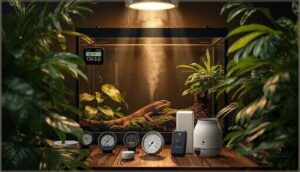
Maintaining proper humidity isn’t guesswork—it requires the right equipment to measure, monitor, and adjust moisture levels with precision throughout your snake’s enclosure. You’ll need reliable tools that work together as a system, from devices that track humidity in real-time to equipment that actively controls it when levels drift outside your target range.
Understanding how to select and use these tools effectively ensures you can create stable conditions that support your snake’s respiratory health, successful sheds, and overall well-being.
Choosing and Using Hygrometers
Accurate humidity management starts with selecting a reliable digital hygrometer, since most models offer ±2–5% accuracy across a 0–100% RH range. To guarantee your readings remain trustworthy, you’ll want to follow these essential steps:
- Calibrate your hygrometer monthly using the salt method or a commercial calibration kit to maintain accuracy testing standards.
- Position humidity sensors in multiple zones—near basking areas and substrate level—to monitor gradients effectively.
- Choose models with probe placement options for continuous digital readings and data logging capabilities.
- Verify measurements match your snake’s natural habitat requirements for ideal humidity control and health outcomes.
Setting Up Humidity Controllers
By integrating a humidity controller with your hygrometer, you’ll automate microclimate management and maintain stable humidity levels without constant intervention. Position sensors at snake eye level—away from direct misting system spray—to capture accurate readings, then calibrate them monthly using the salt method.
Most controllers let you set target RH ranges that trigger ventilation systems or humidifiers, ensuring precise humidity control and preventing sensor drift through redundant placement.
Using Misting Systems and Water Bowls
Misting systems work hand-in-hand with strategically placed water bowls to establish stable humidity gradients throughout your snake enclosure. Program your misting system to deliver fine aerosol bursts two to six times daily, adjusting frequency based on ambient conditions and species requirements, while positioning large shallow bowls opposite each other to create microclimate variation through differential evaporation rates.
- Use 30–60 mL per mist cycle to avoid substrate saturation
- Place water bowls near heat sources to boost evaporation rates
- Calibrate nozzles monthly and inspect tubing weekly for leaks
- Monitor humidity levels at multiple zones with your hygrometer
Selecting The Right Substrate for Humidity
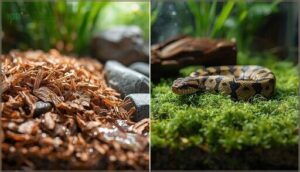
Your choice of substrate acts as the foundation for humidity control in your snake’s enclosure, functioning much like the forest floor or desert sand in their natural environment.
Some substrates naturally retain moisture and release it slowly, while others dry out quickly and work best for species that need arid conditions.
Understanding these differences will help you select the right material to maintain stable humidity levels without creating overly damp or excessively dry conditions.
Moisture-Retaining Vs. Dry Substrates
Choosing between moisture-retaining and dry substrates shapes your snake enclosure design and dictates how you’ll manage humidity levels. Moisture-retaining options like coconut fiber absorb and slowly release water vapor, maintaining humidity control for extended periods with less frequent misting. Dry substrates such as sand drain quickly, requiring you to monitor your hygrometer more vigilantly and mist more often to sustain proper moisture levels for snake health.
| Substrate Type | Humidity Impact |
|---|---|
| Moisture-Retaining (coconut fiber, sphagnum moss) | Holds water longer, reduces misting frequency |
| Dry (sand, mineral-based) | Drains quickly, needs frequent humidity adjustments |
| Cypress Mulch | Moderate retention with faster drainage |
| Moisture-Retaining | Aids shed recovery in high-humidity species |
| Dry | Favors arid-adapted snakes, lowers mold risk |
Benefits of Coconut Fiber, Cypress Mulch, and Sphagnum Moss
Each substrate brings distinct advantages that shape your humidity control strategy, so matching material to your snake’s humidity needs determines enclosure success. When you’re selecting substrate for moisture retention, consider these fiber benefits and moss applications:
- Coconut fiber retains moisture without becoming waterlogged, stabilizing humidity levels while supporting healthy shedding cycles.
- Cypress mulch resists mold growth between misting sessions, providing cushioning with natural odor control.
- Sphagnum moss creates localized humidity gradients within hides, holding outstanding moisture for species requiring elevated levels.
- Each material offers unique hygrometer-verified performance, allowing you to fine-tune humidity control and management based on your snake’s specific requirements.
Substrate Maintenance and Replacement Tips
You’ll know it’s time for substrate replacement when bedding becomes compacted or develops a pungent odor within 7–14 days, signaling bacterial activity that disrupts humidity control.
Maintain substrate depth at 2–4 inches for stable humidity levels, spot-clean daily to prevent moisture anomalies, and schedule full replacement every 6–12 months after shedding process cycles.
Use humidity mapping and moisture testing to validate ventilation adjustments and substrate rotation decisions.
Practical Methods to Maintain Humidity Levels
Once you’ve selected the appropriate substrate, the next step involves implementing practical techniques that keep humidity levels stable throughout your snake’s enclosure.
These methods work together to create the environmental conditions your species requires, from establishing thermal gradients to managing air circulation.
Let’s examine three core approaches that give you precise control over moisture levels while accommodating your snake’s behavioral needs.
Creating Humidity Gradients in The Enclosure
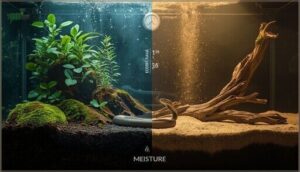
A well-designed gradient transforms your enclosure into a living ecosystem where your snake can thermoregulate and self-regulate moisture exposure, which is fundamental to enclosure optimization and humidity management.
- Humidity mapping reveals microclimates by placing calibrated hygrometers at multiple points, confirming gradient creation through moisture-retaining substrates near one end and enhanced ventilation control at the opposite side
- Position elevated hides or driftwood to create cooler, humid air pockets while lower areas stay drier, optimizing microclimate design
- Strategic misting temporarily raises humidity levels locally without flooding the entire space, supporting natural thermoregulation and climate control
Strategic Placement of Water Sources
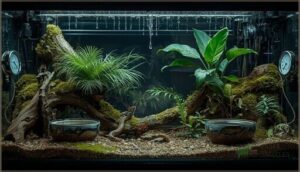
Where you position water bowls determines whether you’ll achieve balanced moisture distribution or localized humidity spikes that stress your snake. Placing your largest water source near the cool end prevents temperature-driven evaporation rates from saturating one zone, while elevated shallow dishes on branches create humidity gradients through controlled microclimate creation without waterlogging the substrate.
Using two smaller water bowls at opposite ends rather than one large dish helps you avoid concentrated moisture zones that promote mold growth. Position at least one water source under cover or driftwood to diffuse humidity more evenly across the enclosure, and keep bowls away from heat mats to prevent accelerated evaporation that over-saturates nearby areas.
Monitor with hygrometers at three to five fixed points after adjusting water source placement, then reassess weekly to confirm your setup maintains target humidity levels without creating standing water in corners.
| Placement Strategy | Humidity Impact | Best For |
|---|---|---|
| Near cool end | Reduces spikes, steady evaporation rates | Most species requiring moderate humidity levels |
| Elevated on branches | Localized pockets, gradual moisture distribution | Arboreal species, humidity control in vertical space |
| Under foliage/driftwood | Diffused humidity gradients, prevents pooling | Preventing over-saturation while maintaining moisture |
| Away from ventilation | Minimizes humidity loss, sustains levels | Species needing consistent higher humidity levels |
Adjusting Ventilation and Misting Frequency

Once you’ve positioned water sources, fine-tuning ventilation and misting schedules keeps humidity levels stable without trapping stagnant air.
Adjust vents to increase airflow during dry periods and reduce it when moisture levels need to climb, ensuring your misting systems deliver consistent humidity control without creating over-saturated zones that foster mold or respiratory stress in your snake.
Top 3 Products for Snake Humidity Control
Maintaining proper humidity for your snake doesn’t require guesswork when you have the right tools at your disposal. The following three products represent essential components of a well-regulated enclosure system, each serving a distinct function in humidity management based on your snake’s species-specific requirements.
These recommendations reflect proven solutions that herpetologists and experienced keepers rely on to create stable, health-promoting environments for their animals.
1. Zilla Coconut Husk Reptile Bedding
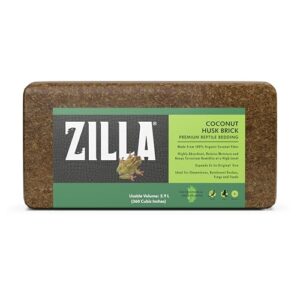
Zilla Coconut Husk Reptile Bedding offers a reliable solution for humidity control in snake enclosures, particularly for species requiring tropical conditions. This substrate, made from 100% organic coconut fiber, readily absorbs moisture and sustains humidity levels between misting cycles due to its fibrous structure, which creates microclimates that support proper shedding.
You’ll find it expands up to five times its packaged size when hydrated, covering a 55-gallon enclosure for $6.79, though you’ll need to monitor ventilation closely since excessive moisture can harbor mold and compromise respiratory health.
| Best For | Snake owners maintaining tropical or high-humidity enclosures who need an affordable, moisture-retentive substrate that supports natural shedding cycles. |
|---|---|
| Primary Use | Reptile substrate/bedding |
| Price Range | $6.79 |
| Humidity Control | Maintains humidity levels |
| Natural Material | 100% organic coconut |
| Ease of Use | Requires hydration |
| Target Environment | Tropical terrariums |
| Additional Features |
|
- Expands up to five times its size when hydrated, covering a 55-gallon enclosure for just $6.79
- Readily absorbs and holds moisture between misting cycles, creating stable humidity gradients that support proper shedding
- 100% organic and low-dust composition minimizes respiratory irritation while providing a naturalistic feel
- Requires careful monitoring to prevent mold growth in overly wet conditions
- Hydration process can be messy and needs calibration with enclosure ventilation systems
- Needs regular drying, cleaning, and replacement to maintain hygiene and prevent odor buildup
2. Mosser Lee Desert Sand
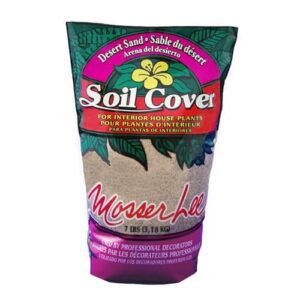
Mosser Lee Desert Sand suits terrestrial species adapted to arid environments, such as king snakes and certain uropeltids, where you’ll maintain humidity levels between 30-50% without risking respiratory complications from excessive moisture.
The 7-pound bag, priced around $11, provides stable digging substrate while preventing the moisture retention that coconut fiber offers, so you’ll need to pair it with strategic water bowl placement and targeted misting to create localized humidity gradients.
Its low moisture control makes it unsuitable for tropical species but ideal when you’re replicating desert conditions with controlled ventilation.
| Best For | Snake keepers maintaining arid-adapted species like king snakes that thrive in 30-50% humidity without needing moisture-heavy substrates. |
|---|---|
| Primary Use | Soil amendment/decoration |
| Price Range | Under $15 |
| Humidity Control | Helps retain moisture |
| Natural Material | Natural sphagnum moss |
| Ease of Use | Ready to use |
| Target Environment | Terrariums and planters |
| Additional Features |
|
- Creates stable digging substrate that mimics natural desert conditions while preventing compaction
- Low moisture retention helps avoid respiratory issues in species that need dry environments
- Decorative appearance works well in terrariums and can block fungus gnats from accessing soil
- Requires frequent misting and strategic water bowl placement since it doesn’t hold humidity on its own
- Some bags arrive with holes or defects that cause sand to leak out
- Pricier than alternatives and won’t work for tropical species needing consistent high humidity
3. Digital Indoor Thermometer Hygrometer Monitor
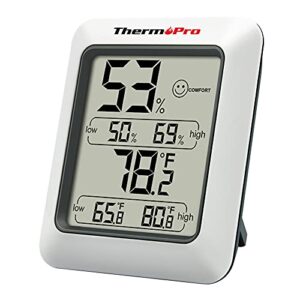
You’ll measure environmental control with precision using the ThermoPro Digital Hygrometer, which delivers ±2-3% RH accuracy and updates every ten seconds to track humidity levels critical for thermoregulation. Position the sensor at snake head height away from heat sources to guarantee reliable data logging, and calibrate monthly to maintain digital monitoring accuracy.
The device’s magnetic back allows flexible sensor placement, while its high/low memory helps you identify humidity fluctuations that affect shedding cycles, making it essential for maintaining humidity control across species-specific requirements from 30-85% RH.
| Best For | Snake keepers who need accurate, real-time humidity monitoring to maintain proper shedding conditions and prevent respiratory issues across different enclosure setups. |
|---|---|
| Primary Use | Humidity/temperature monitoring |
| Price Range | Under $20 |
| Humidity Control | Monitors humidity levels |
| Natural Material | Digital device |
| Ease of Use | Plug and play |
| Target Environment | Indoor environments |
| Additional Features |
|
- Updates every 10 seconds with ±2-3% RH accuracy so you can catch humidity swings before they affect your snake’s health
- Magnetic back and tabletop stand let you position it at snake head height or move it between enclosures easily
- Tracks high and low readings so you can see exactly when conditions dipped during the night or spiked after misting
- No backlight makes it tough to check readings in dim rooms without turning on lights that might stress nocturnal species
- Display is small and hard to read from across the room during routine enclosure checks
- Some units show slight temperature variations between devices, so you might need to test accuracy against a reference thermometer
Frequently Asked Questions (FAQs)
How does seasonal change affect snake humidity needs?
Seasonal shifts in your home mirror nature’s rhythm—winter heating dries indoor air while summer moisture rises, forcing you to recalibrate humidity levels, adjust ventilation, and monitor enclosures to prevent shedding complications and respiratory distress.
Can I use a humidifier for snake enclosures?
You can use a humidifier in snake enclosures, but it requires careful humidity control. This involves device calibration, proper enclosure ventilation, and regular monitoring to prevent over-humidification that causes respiratory issues or mold growth.
What causes mold growth in snake tanks?
Ironically, the very humidity control systems that keep your snake healthy—misting systems, moisture-retaining substrate, and water bowls—create perfect breeding grounds for mold when paired with poor ventilation and inadequate tank cleaning routines.
How do I increase humidity without raising temperature?
Place shallow water dishes on the cool side to achieve humidity uplift through passive misting.
Moisture-retaining substrates like coconut fiber create microclimates with evaporation control, maintaining thermal balance.
Automated humidity systems adjust levels without affecting temperature.
When should I adjust humidity during breeding season?
Many keepers mistakenly boost humidity only after breeding begins. You should increase levels several weeks beforehand to prepare reproductive tracts, maintain elevation during nocturnal mating cycles, then reduce post-ovulation preventing mold while supporting egg incubation success.
Conclusion
Your snake’s skin will tell you when you’ve failed, its eyes will cloud over when conditions fall short, and its body will weaken when you ignore the signs. Learning how to maintain proper humidity for snakes requires consistent monitoring, species-specific adjustments, and environmental modifications that replicate the precise conditions your animal evolved to thrive in—because preventable health crises don’t announce themselves until the damage has already taken root in ways you can’t reverse.
- https://academichelpexpress.blog/2024/08/please-use-the-bulleted-points-and-the-rubric-below-to-guide-your-work-your-pa/
- https://www.linkedin.com/posts/bohdanlukianets_tasks-study-research-activity-7373377539521667072-UTEi
- https://www.sciencedirect.com/science/article/pii/S0749208123000268
- https://pmc.ncbi.nlm.nih.gov/articles/instance/9553038/bin/pone.0275964.s005.docx
- https://www.scribd.com/document/356795007/Research-Methods-Knowledge-Base