This site is supported by our readers. We may earn a commission, at no cost to you, if you purchase through links.
A bearded dragon can’t shiver. When temperatures drop, it doesn’t generate heat—it becomes heat, or rather, it borrows it from its environment.
That single biological fact makes precision thermometry less of a nice-to-have and more of a life-support decision.
A basking zone running 5°F low won’t kill your animal today, but it quietly stalls digestion, suppresses immunity, and sets the stage for chronic problems that look like disease but trace back to a miscalibrated gauge.
Desert species push this challenge further—they’re built for extreme thermal swings, which means their enclosures demand equally extreme accuracy across multiple zones. The right reptile thermometers for desert species don’t just display numbers; they give you control over every system inside that enclosure.
Table Of Contents
- Key Takeaways
- Why Accurate Temps Matter for Desert Reptiles
- Desert Thermometer Types Compared
- Top 8 Reptile Thermometers for Desert Species
- 1. Flukers Digital Thermometer Hygrometer
- 2. Zoo Med Dual Thermometer Hygrometer
- 3. Repti Zoo Digital Terrarium Thermometer Hygrometer
- 4. TempPro TP49 Digital Hygrometer Thermometer
- 5. Inkbird ITH10 Digital Temperature Hygrometer Monitor
- 6. Vodolo Digital Reptile Thermometer Humidity Gauge
- 7. Serundo Mini Digital Hygrometer Thermometer
- 8. Paizoo LED Reptile Thermometer Hygrometer
- Thermometer Placement in Desert Enclosures
- Choosing The Right Desert Thermometer
- Frequently Asked Questions (FAQs)
- What’s the best thermometer for reptiles?
- Which thermometer is no longer recommended for use?
- What are the 4 types of thermometers?
- Can I use one thermometer for multiple enclosures?
- Do wireless thermometers work well for desert setups?
- How often should I replace thermometer batteries?
- Are infrared thermometers accurate for substrate temperatures?
- Whats the ideal nighttime temperature drop for deserts?
- How often should desert reptile thermometers be calibrated?
- Can one thermometer monitor multiple enclosures simultaneously?
- Conclusion
Key Takeaways
- Desert reptiles can’t regulate their own body heat, so even a 5°F error in your basking zone quietly stalls digestion, kills immune response, and compounds into chronic illness before you notice that anything is wrong.
- A proper thermal gradient — basking spots at 32–46°C depending on species, cool zones at 22–28°C, and nighttime drops of 15–25°F — isn’t optional; it’s the biological foundation every system that your reptile runs on depends on.
- Infrared guns give you fast surface spot-checks, digital probes track real-time zone data, and combo hygrometer units cover moisture too — using the right tool for each job is what turns guesswork into actual control.
- Place sensors at your reptile’s eye level, keep probes at least 15 cm from heat sources, use multiple sensors across all three zones, and calibrate monthly — because accurate placement matters as much as accurate hardware.
Why Accurate Temps Matter for Desert Reptiles
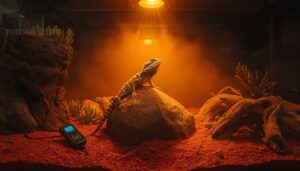
Desert reptiles don’t regulate their own body heat — they rely entirely on you to get it right. A few degrees off in either direction can slow digestion, weaken immunity, or worse.
That’s why dialing in the right setup with a reptile thermostat for beginners takes the guesswork out of keeping temps stable and safe.
what you need to know before picking up a thermometer.
Thermoregulation, Digestion, and Immune Support
Unlike mammals, your desert reptile can’t generate its own body heat — so thermoregulation isn’t a luxury; it’s survival. A proper thermal gradient drives enzyme activity for reptile feeding digestion, facilitates leukocyte circulation for immune system health, and keeps the gut microbiome balanced.
Desert reptiles don’t generate body heat — every biological system they have depends on you getting the temperature right
Heat stress effects compound fast when hydration balance slips.
Nail the temperature regulation, and nearly every biological system follows.
Risks of Readings That Are Too Low
Low readings do more damage than most keepers expect. When temperatures drop below target, digestive slowdown sets in fast — nutrient absorption can fall by up to 20 percent. Immune suppression follows, leaving your animal vulnerable to infections it would normally fight off.
Watch for these connected risks:
- Behavioral lethargy — excessive basking, fatigue, reduced exploration
- Breeding delays — suppressed courtship and slower embryo development
- Health blind spots — fevers and injuries go undetected in cool zones
- Chronic hypothermia — scale cracking and disrupted thermoregulation cycles
- Temperature fluctuations — irregular feeding patterns that compromise reptile health and temperature accuracy
Risks of Overheating and Dehydration
Too much heat is just as dangerous as too little. When temps spike, your reptile’s body can’t keep up — behavioral cooling failure kicks in, and there’s nowhere to escape.
Heat stroke sets in fast, driving organ failure and electrolyte imbalance.
Without humidity control and dehydration prevention, dehydration symptoms escalate quickly.
temperature accuracy and heat lamp safety aren’t optional — they’re what keep your animal alive.
Why Thermal Gradients Matter in Arid Setups
A proper thermal gradient isn’t just nice to have — it’s how desert reptiles survive. Wild arid environments swing 20–30°C between basking spots and shaded cool sides daily. Your enclosure needs to replicate that.
The extreme day‑night swings are driven by the sand’s low thermal inertia of sand and dry desert air. Gradient-Driven Activity, Thermal Stress Mitigation, and Energy Conservation Strategies all depend on it:
- Basking spots hit 32–45°C for digestion
- Cool sides stay 22–28°C for recovery
- Nighttime drops to 18–24°C support rest
Temperature Targets for Common Desert Species
Each desert species runs on its own internal thermostat, and hitting the right numbers isn’t guesswork — it’s survival science. Basking Temperature Ranges, Nighttime Cooling Targets, and Burrow Microclimate Goals all shift by species.
Juvenile Thermoregulation demands slightly cooler basking spots to limit water loss. Know your animal’s Species-specific Heat Limits before you set a single bulb.
| Species | Basking Spot (°C) | Cool Zone / Night (°C) |
|---|---|---|
| Bearded Dragon | 35–43 | 24–29 |
| Uromastyx | 40–46 | 22–27 |
| Leopard Gecko | 31–33 | 24–27 |
Desert Thermometer Types Compared
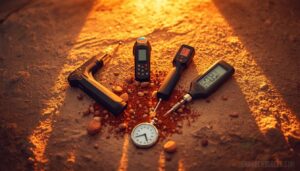
Not all reptile thermometers are built for the same job, and picking the wrong type can leave you with blind spots in your enclosure.
Each tool has a specific strength — whether that’s tracking trends overnight or catching a dangerously hot basking rock in seconds.
Here’s how the main types stack up so you can choose what actually fits your setup.
Digital Thermometers for Continuous Monitoring
digital thermometer built for continuous monitoring is your always-on guard dog.
It updates every few seconds, logs time-stamped readings, and syncs to the cloud so you can spot a temperature gradient shift before your beardie does.
Real-time alerts, remote monitoring, data export, sensor drift compensation, and battery optimization make these the backbone of any serious desert or tropical environment setup.
Probe Thermometers for Hot and Cool Zones
When mapping a thermal gradient, probe thermometers give you precision where it counts most.
A stainless steel tip placed at the basking spot or cool side captures actual temperatures, your reptile experiences — not guesses.
Four reasons they’re worth it:
- Probe Calibration keeps readings accurate every 3–6 months
- Cable Insulation prevents drift in hot desert enclosures
- Data Export lets you track trends alongside behavior logs
- Battery Management enables long-term, cord-free placement
Infrared Guns for Surface Spot-checks
infrared thermometer is the fastest tool for spotchecking basking surface temperatures — point, pull the trigger, read in under a second.
Etekcity Infrared Gun nails surface temperature measurement with ±0.5°F accuracy, adjustable emissivity for rocks and sand, and a solid Spot Size Ratio for tight targeting.
Laser Targeting Aid helps you aim precisely, while Rugged Housing and quick Response Time make it reliable daily.
Thermometer-hygrometer Combos for Arid Enclosures
A humidity hygrometer combo does double duty — one unit tracks both temperature and moisture, which matters even in arid setups where low humidity needs confirming, not assuming.
Models like the REPTI ZOO Thermometer Hygrometer and Govee WiFi Thermometer Hygrometer offer waterproof probes, calibration reminders to prevent sensor drift, and CSV export for trend tracking.
That’s serious monitoring in a compact package.
Digital Vs. Analog Accuracy Differences
Analog gauges look simple, but their noise susceptibility and calibration drift make them unreliable for precise desert setups. A digital thermometer wins here — consistent resolution limits aside, it compensates for drift automatically and samples reliably.
- Analog readings shift 5–20°F over time without recalibration
- Quantization error in digital units stays within ±2°F
- Sampling lag is minimal on modern digital sensors
- Noise susceptibility affects analog signal paths directly
- Drift compensation keeps digital readings stable long-term
For a leopard gecko’s tight 88–92°F basking window, that consistency isn’t optional.
Min/max Memory and Data Logging Benefits
Once you’ve locked in digital accuracy, min/max memory takes monitoring a step further. It silently tracks overnight lows and midday peaks — no manual logging needed.
That data becomes your baseline for anomaly detection, seasonal benchmarking, and calibration alerts when readings drift unexpectedly. Devices with data export and trend visualization let you analyze temperature data without guesswork, turning simple temperature logging into a real management tool.
Top 8 Reptile Thermometers for Desert Species
Not every thermometer is built for the extreme desert reptiles actually need. The eight options below were chosen for accuracy, durability, and how well they handle the heat ranges that species like bearded dragons and uromastyx demand.
Here’s what’s worth your money in 2026.
1. Flukers Digital Thermometer Hygrometer
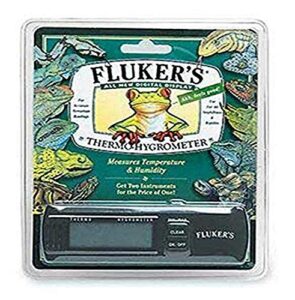
The Flukers Digital Thermometer Hygrometer is a solid entry-level pick for desert keepers watching their budget.
One unit tracks both temperature and humidity on a compact LCD display, and the MAX/MIN memory logs peak highs and lows since your last reset — useful for catching overnight temperature drops you’d otherwise miss.
Sticky-back mounting keeps it flat against the glass.
Just know that accuracy runs about ±3 °F, so pair it with a second sensor in critical zones like the basking spot.
| Best For | Budget-conscious reptile keepers who want a quick, easy way to track both temperature and humidity in one spot. |
|---|---|
| Display Type | Digital LCD |
| Measures Humidity | Yes |
| Mounting Method | Adhesive backing |
| Housing Material | Plastic |
| Housing Color | Black |
| Power Source | Battery |
| Additional Features |
|
- Tracks both temperature and humidity on a single, easy-to-read LCD display
- Low cost makes it practical to place multiple units around the enclosure
- Adhesive backing makes mounting inside a tank quick and clean
- Humidity accuracy can drift ±5–10% RH and temperature readings may be off by ~3 °F
- Adhesive can fail over time, which is a real risk around curious or climbing animals
- Some users report the humidity sensor giving out within just a few weeks
2. Zoo Med Dual Thermometer Hygrometer
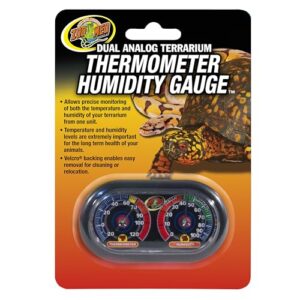
If you want something even simpler — no batteries, no app — the Zoo Med Dual Thermometer Hygrometer covers the basics in one glance.
Its analog dials show temperature and humidity side by side, and the Velcro backing lets you reposition it whenever you’re adjusting your thermal gradient. That flexibility is genuinely handy.
The catch? Analog readings can drift several degrees over time, so don’t rely on it alone for basking zones where precision actually keeps your animal healthy.
| Best For | Budget-conscious reptile or amphibian keepers who want a quick, no-fuss way to monitor both temperature and humidity at a glance. |
|---|---|
| Display Type | Analog dial |
| Measures Humidity | Yes |
| Mounting Method | Velcro pad |
| Housing Material | Plastic |
| Housing Color | Black |
| Power Source | Battery |
| Additional Features |
|
- Displays temperature and humidity on a single unit — no juggling two separate gauges
- Velcro backing makes it easy to move around and find hot or dry spots in the enclosure
- No batteries or setup needed; just stick it and read it
- Analog readings can drift over time, making it unreliable for precision-dependent basking zones
- No calibration option, so accuracy issues can’t be corrected as the gauge ages
- Build quality feels cheap, and the Velcro backing may lose its grip with repeated repositioning
3. Repti Zoo Digital Terrarium Thermometer Hygrometer
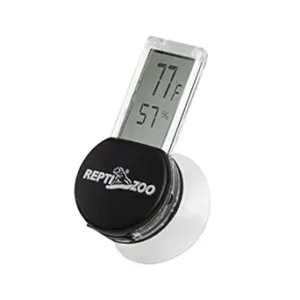
Step up to digital, and things get noticeably sharper. The Repti Zoo Digital Terrarium Thermometer Hygrometer reads both temperature and humidity on a clear LCD, so you’re not squinting at a dial or guessing where the needle lands.
At $13.99, it won’t strain your budget.
The suction cup mounts on any glass surface, and two AA batteries run it for up to a year.
That’s less fussing, more monitoring — exactly what desert setups demand.
| Best For | Reptile keepers who want a reliable, no-fuss way to track both temperature and humidity without spending a lot. |
|---|---|
| Display Type | Digital LCD |
| Measures Humidity | Yes |
| Mounting Method | Suction cup |
| Housing Material | Glass and plastic |
| Housing Color | White |
| Power Source | 2x AA battery |
| Additional Features |
|
- Clear LCD shows temp and humidity at a glance — no guessing, no squinting
- Suction cup mount is easy to reposition, and two AA batteries last up to a year
- At $13.99, it holds its own against pricier options while delivering accurate readings
- Suction cup can lose grip on acrylic or textured surfaces, so mounting may take some trial and error
- Not waterproof — splashes can cause issues if it’s not dried out quickly
- Some users report the battery compartment feeling flimsy, and a few have seen battery drain earlier than expected
4. TempPro TP49 Digital Hygrometer Thermometer
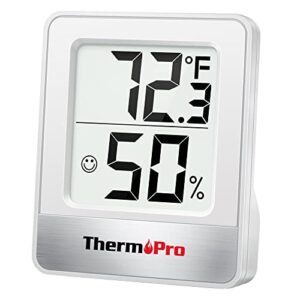
The TempPro TP49 punches above its $9.49 price tag. It reads temperature to ±1 °F and humidity to ±2–3% RH, updating every 10 seconds — fast enough to catch real conditions inside your enclosure.
The large LCD digits are readable at a glance, and three mounting options (tabletop, magnetic, hanging hook) mean it fits wherever your setup needs it. For spot-checking basking zones or cool-side temps in a bearded dragon or leopard gecko enclosure, it’s a practical, low-fuss choice.
| Best For | Budget-conscious reptile keepers who want a reliable, no-frills thermometer-hygrometer for monitoring enclosure conditions without spending much. |
|---|---|
| Display Type | Digital LCD |
| Measures Humidity | Yes |
| Mounting Method | Stand/magnet/hook |
| Housing Material | Plastic |
| Housing Color | White |
| Power Source | Battery |
| Additional Features |
|
- Accurate enough for everyday use, with readings updating every 10 seconds so you’re not working off stale data.
- Three mounting options make it easy to place anywhere in or around an enclosure — tabletop, magnetic, or hanging.
- At $9.49, it’s easy to grab two and monitor different zones at the same time.
- Accuracy can slip at humidity extremes (below 20% RH), which matters in drier setups.
- Battery life isn’t disclosed, so you won’t know when it’s about to die until it does.
- The comfort icons are built for human living spaces — they don’t mean much in a reptile context.
5. Inkbird ITH10 Digital Temperature Hygrometer Monitor
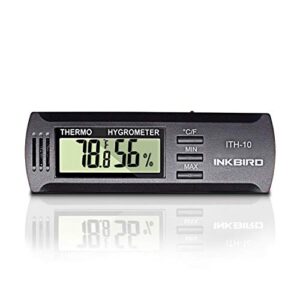
Inkbird ITH10 is almost embarrassingly thin — at just 0.39 inches, it slides into tight basking setups where bulkier units simply won’t fit.
It reads temperature to ±1.8 °F and humidity to ±3% RH, displaying both simultaneously on a clear LCD.
Min/max memory lets you catch overnight temperature swings without babysitting the enclosure.
For beginners setting up a bearded dragon or leopard gecko habitat on a budget, it’s a solid supplemental sensor at $12.99.
| Best For | Budget-conscious beginners setting up a bearded dragon or leopard gecko habitat who need a slim, no-fuss sensor for tight spaces. |
|---|---|
| Display Type | Digital LCD |
| Measures Humidity | Yes |
| Mounting Method | Velcro built-in |
| Housing Material | Plastic |
| Housing Color | Unspecified |
| Power Source | Button cell battery |
| Additional Features |
|
- Incredibly thin at 0.39 inches — fits in spots where bulkier monitors just won’t go
- Shows temperature and humidity at the same time, so you’re not toggling between screens
- Min/max memory lets you track overnight swings without hovering over the enclosure
- Can’t be manually calibrated, so you’ll need a salt test or Boveda kit to verify accuracy
- Real-world readings can drift 1–5% RH, which might push past the stated tolerances
- Minimal, unbranded packaging leaves a little to be desired when it comes to shipping protection
6. Vodolo Digital Reptile Thermometer Humidity Gauge
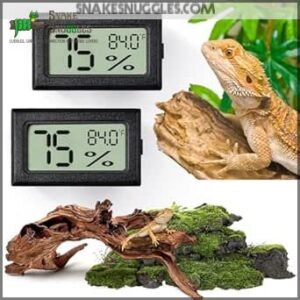
At just $5.99 for a two-pack, the Vodolo Digital Reptile Thermometer Humidity Gauge punches well above its price. Each unit reads temperature to ±0.9 °F — tight enough for bearded dragon and leopard gecko setups.
The adhesive backing mounts directly to glass or plastic without any wiring, keeping your enclosure clean.
Battery-powered and portable, you can reposition it as your thermal gradient shifts.
Use both units simultaneously to cover basking and cool zones without buying a second device.
| Best For | Reptile hobbyists who need reliable temp and humidity tracking across multiple enclosures without spending a lot. |
|---|---|
| Display Type | Digital LED |
| Measures Humidity | Yes |
| Mounting Method | Adhesive backing |
| Housing Material | Plastic |
| Housing Color | Black |
| Power Source | Replaceable battery |
| Additional Features |
|
- Two units for $5.99 is a great deal — cover both the basking spot and cool zone at once
- Adhesive mount keeps things tidy with zero wiring inside the tank
- Battery-powered means you can move it around as your setup changes
- Humidity readings can drift a bit over time and may not match a calibrated device
- The adhesive can weaken, making battery swaps a hassle
- Not waterproof — one drop into a water bowl and it’s done
7. Serundo Mini Digital Hygrometer Thermometer
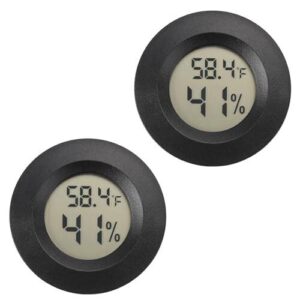
The Serundo Mini Digital Hygrometer Thermometer is a small device that earns its spot through reliability. It reads temperature from 32°F to 158°F — covering every desert species on your list — with ±1°F accuracy and humidity to ±3% RH.
Readings refresh every 10 seconds, so you’re not guessing between checks.
The compact housing fits inside tight enclosures without disrupting your layout, and adhesive mounting pads keep setup simple.
Battery life runs roughly nine months, making it a low-maintenance option for multi-zone monitoring.
| Best For | Reptile and terrarium keepers who need affordable, no-fuss humidity and temperature monitoring across multiple enclosures. |
|---|---|
| Display Type | Digital LCD |
| Measures Humidity | Yes |
| Mounting Method | Adhesive pads |
| Housing Material | Plastic |
| Housing Color | Black |
| Power Source | LR44 button cell |
| Additional Features |
|
- Updates every 10 seconds so you always have a current read without constantly checking
- Compact size and adhesive pads make it easy to mount inside tight enclosures
- Nine-month battery life keeps maintenance low, especially if you’re running several units
- The LCD can be tough to read in dim lighting
- Batteries may arrive partially drained with no pull-tab, so you might need replacements right out of the box
- Not precise enough for lab or calibration work, and readings can vary slightly between units
8. Paizoo LED Reptile Thermometer Hygrometer
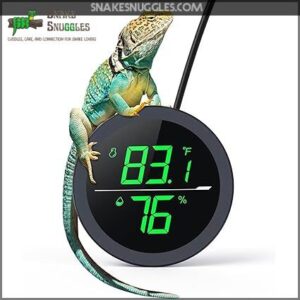
The Paizoo LED Reptile Thermometer Hygrometer is built for keepers who want visibility without constantly opening the enclosure.
Its 3-inch backlit LED display shows temperature and humidity at the same time — readable from across the room, day or night.
Accuracy sits at ±1°F for temperature and ±5% for humidity, covering the full desert range up to 140°F.
The 31.5-inch probe accommodates large tanks easily.
USB-powered with a built-in sleep mode, it’s a solid choice for bearded dragon and uromastyx setups.
| Best For | Reptile keepers who want a clear, at-a-glance view of temperature and humidity without opening the enclosure. |
|---|---|
| Display Type | HD LED backlit |
| Measures Humidity | Yes |
| Mounting Method | 3M double-sided tape |
| Housing Material | Acrylic |
| Housing Color | Black |
| Power Source | USB 5V |
| Additional Features |
|
- Big 3-inch backlit display makes it easy to check readings from across the room, day or night
- Simple to mount — just stick it on the glass, no tools needed, and the adhesive holds up in humid setups
- USB-powered with an in-line switch, so it’s easy to manage without fussing with batteries
- Humidity readings can get unreliable above 80% RH, which is a real issue for tropical species
- The USB cord can feel awkward if your setup doesn’t have a nearby outlet or your space is tight
- Some users have reported sensor or display failures over time, so long-term reliability isn’t guaranteed
Thermometer Placement in Desert Enclosures
Even the best thermometer won’t help if it’s in the wrong spot. Where you place your sensors determines whether you’re getting real data or just a number that looks fine on paper.
Here’s how to position them so every zone in your desert enclosure tells the truth.
Measuring Basking Spots Accurately
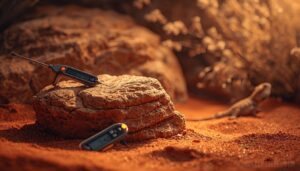
Place your digital probe directly at the contact point where your reptile actually rests — not an inch above it. That’s contact point validation in practice.
For spot-check timing, use an infrared thermometer with adjustable emissivity settings to match your substrate. Surface probe alignment and data smoothing across multiple readings make sure temperature calibration stays accurate, giving your desert species a basking spot you can genuinely trust.
Checking Substrate-level Temperatures
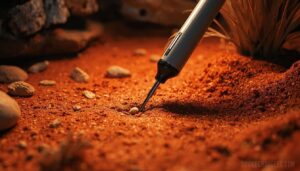
Surface temps don’t tell the whole story. Substrate-level readings reveal what your reptile actually feels underfoot — and temperature lag means ground heat trails air heat by minutes or more. Use depth profiling with a digital probe at 0.5–2 inches to catch that gap.
- Grid mapping exposes hidden hot and cold pockets
- Moisture effect alters thermal conductivity in damp substrate zones
- Keep probes away from heat mat edges to prevent skewed highs
Positioning Sensors at Reptile Height
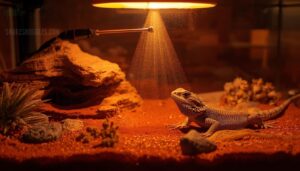
Substrate readings anchor your baseline — but reptile height is where thermal gradient management gets real. Mount probes at your animal’s eye level to capture the ambient temperature it actually experiences during normal movement.
This is Eye-Level Probe Mounting in practice: not guesswork, just repeatable Sensor Height Standardization.
| Placement Factor | Why It Matters |
|---|---|
| Eye-level height | Reflects experienced ambient temperature |
| Away from basking surface | Prevents radiant heat skewing readings |
| Near hides and perches | Captures Microclimate Zoning accurately |
| Consistent position each check | Allows Vertical Gradient Calibration |
| Clear of fans or vents | Facilitates Airflow Interference Mitigation |
Mapping Basking, Middle, and Cool Zones
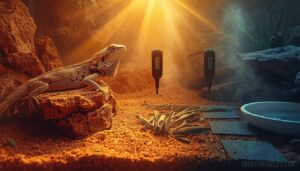
Once you’ve nailed eye-level placement, map all three zones — basking surface, middle, and cool end. Check at least three points every 5–15 minutes to catch natural daily shifts.
Multi-Zone Data Logging and Heat Map Visualization tools make Spatial Temperature Profiling straightforward. Gradient Zone Calibration confirms your thermal gradient management stays consistent, giving your desert reptile a reliable, behavior-supporting environment all day.
Avoiding False Readings From Direct Heat Exposure
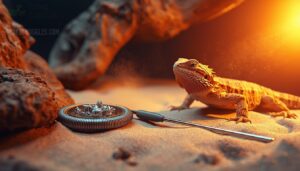
Direct heat exposure corrupts your readings fast. Keep probes at least 15 cm from basking bulbs, and use Radiant Shielding — a small foil barrier — to deflect radiant energy without trapping heat. Probe Distance and Ambient Baseline readings from shaded areas give you accuracy where it counts.
- Apply Emissivity Adjustment on infrared guns for different surface materials — tile reads differently than bark.
- Cross-check surface temperature against air temperature; the gap reveals Heat Source Control issues.
- Bias Correction monthly to catch sensor drift before it misleads you.
Using Multiple Sensors for Reliable Monitoring
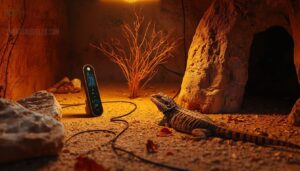
One sensor gives you a number. Multiple sensors give you the truth. Sensor Redundancy means that if a probe drifts or fails, you still have reliable data — no guesswork during a heatwave. Data Fusion cross-validates readings across zones, while Temporal Smoothing filters out short spikes that would otherwise trigger false temperature alerts.
| Zone | Sensor Type | Logging Interval |
|---|---|---|
| Basking | Infrared + probe | 30 seconds |
| Mid-zone | Smart thermometer | 60 seconds |
| Cool hide | Remote monitoring probe | 60 seconds |
Anomaly Detection and Calibration Protocols catch drift early. Data logging keeps your history clean.
Choosing The Right Desert Thermometer
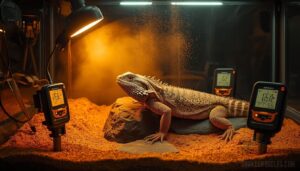
Not every thermometer earns its place in a desert setup — the right one depends on your species, enclosure size, and how hands‑on you want to be.
A few key factors will separate a reliable tool from one that costs you a sick animal. Here’s what to look for before you buy.
Accuracy Ratings and Calibration Needs
Not all thermometers are built equal — and in a desert enclosure, a 5°F drift can mean the difference between a thriving bearded dragon and a sick one. Most quality digital thermometers hold ±0.5°C accuracy, but temperature sensor accuracy degrades over time.
Calibration frequency matters: cross-check monthly against a traceable reference. Drift detection catches problems before your reptile does.
For infrared temperature measurement, emissivity adjustments guarantee accurate surface readings across different substrates.
Display Readability and Backlit Screens
When you’re squinting at a basking zone reading mid-afternoon, display quality stops being a nice-to-have. High contrast text on a full backlit display makes temperature readings instantly readable — no second-guessing. Look for OLED vs LCD panels with font size optimization, anti-glare coatings, and adjustable brightness to handle sunlit enclosures.
A clear digital interface should offer:
- Bold numerals on a high-contrast LCD screen
- Adjustable brightness from dim night mode to full daylight visibility
- Anti-glare coatings that cut reflections in direct sunlight
- A clean digital display with color-coded alerts for critical temperature zones
Probe Length, Mounting, and Enclosure Fit
Probe placement can make or break your data. Extend your probe at least 10mm past the hottest surface — longer in thick-walled enclosures, where 50–100mm of extra reach captures true microclimate conditions.
Secure mount brackets with strain relief to prevent vibration dampening issues that skew readings.
Choose IP65-rated, dust-proof seal designs, and align tips perpendicular to flat surfaces for accurate species-specific thermal requirements without radiant interference.
Battery Life and Low-maintenance Operation
Battery-powered monitors are only useful if they actually stay on. Most quality reptile thermometers offer Extended Battery Life of 12–24 months using sealed coin cell or lithium batteries inside a Sealed Power Housing that resists desert heat.
Look for these low-maintenance essentials:
- Auto Sleep Mode — dims the display between readings
- Remote Battery Alerts — flags low power before data gaps occur
- Rechargeable Power Options — cuts long-term maintenance costs
Smart Alerts, Wi‑Fi, and App Tracking
Smart thermometers for remote monitoring and alerts take the guesswork out of overnight temperature swings.
The Govee WiFi Thermometer Hygrometer, for example, lets you set Custom Thresholds and delivers a push notification the moment readings drift. Multi-User Access means your whole household stays informed.
Remote Firmware Updates keep the device current, and Data Encryption protects every wireless app alert transmitted to your phone.
Matching Features to Species and Habitat Style
Not every thermometer fits every setup. Match your choice to how your species actually lives:
- Burrow Sensor Placement suits burrowers like Uromastyx needing stable 25–28°C substrate readings via a deep-probe digital thermometer.
- Dune Basking Probes with Crevice Temperature Calibration serve bearded dragons requiring precise gradient management across basking and cool zones.
- Salt Crust Humidity and Vegetation Shade Integration demand combo units tracking both heat mat output and moisture levels simultaneously.
Frequently Asked Questions (FAQs)
What’s the best thermometer for reptiles?
The best thermometer for reptiles depends on your species-specific thermal requirements.
Digital probe models offer accuracy and ease of setup, while infrared guns handle quick spot‑checks — both beat analog every time.
Which thermometer is no longer recommended for use?
Mercury thermometers are no longer recommended. Mercury Toxicity and Environmental Hazards make them a serious risk if broken.
Regulatory Bans now push Safe Disposal through hazardous waste channels, with Alternative Technologies like digital and infrared options replacing them entirely.
What are the 4 types of thermometers?
Four types cover the basics: digital thermometers, probe thermometers, infrared thermometers (IR guns with emissivity adjustment), and liquid expansion thermometers.
Hybrid thermometer designs blend several of these features into one unit.
Can I use one thermometer for multiple enclosures?
Technically, yes — but it comes with real trade-offs. Shared probes risk contamination and drift across enclosures.
For reliable cross enclosure calibration and accurate multiple microclimates tracking, a dedicated digital thermometer per habitat is the smarter call.
Do wireless thermometers work well for desert setups?
Yes, wireless thermometers work well in desert setups.
Smart thermometers for remote monitoring and alerts let you track ambient temperature and catch heat source control issues instantly through wireless app alerts, without disturbing your reptile.
How often should I replace thermometer batteries?
Most batteries last 6–12 months with daily use. Watch for dim displays or slow power-on as low power alerts. Keep spare batteries stored cool, and replace immediately if readings seem inconsistent.
Are infrared thermometers accurate for substrate temperatures?
Infrared thermometers read surface temperature only — not what’s underneath. Emissivity matching, distance spot ratio, and ambient radiation all affect accuracy.
Always run a probe cross-check to catch surface reflection errors.
Whats the ideal nighttime temperature drop for deserts?
Desert nights are cold by design — and that’s actually a good thing. Aim for a 15–25°F drop overnight, mimicking the natural ideal Cooling Curve your desert reptile’s biology expects.
How often should desert reptile thermometers be calibrated?
Calibrate monthly at minimum. After battery swaps, relocation, or seasonal shifts, recalibrate within 24–48 hours. If drift exceeds 5°C against a reference, replace the unit.
Can one thermometer monitor multiple enclosures simultaneously?
Yes — some thermometers support multi-zone probes or wireless hub integration, letting you monitor several enclosures from one base unit.
Just watch channel capacity limits and handle cross-enclosure calibration carefully, so enclosure-specific alerts stay accurate.
Conclusion
Picture your bearded dragon stretched across its basking rock, soaking in precisely calibrated warmth—every biological process running exactly as nature intended. That image only becomes reality when you trust your data.
The right reptile thermometers for desert species aren’t accessories; they’re the foundation every thriving desert enclosure is built on. Choose with precision, place with purpose, and your animal won’t just survive the temperature game—it’ll win it.
- https://www.thebiodude.com/blogs/reptile-and-amphibian-lighting-faqs-and-help/how-to-place-thermometer-and-hygrometer-probes
- https://reptifiles.com/reptiliacare-digital-infrared-thermometer-review/
- https://airtable.com/appjvq2Cym0pschJB/pagZyw5rJ6hBSdvuG/form
- https://www.bbc.com/news/articles/cy7n6m7y6yvo
- https://www.mayoclinic.org/diseases-conditions/heat-exhaustion/symptoms-causes/syc-20373250