This site is supported by our readers. We may earn a commission, at no cost to you, if you purchase through links.
Green tree pythons coil motionlessly on branches for hours, their prehensile tails gripping bark with the precision of a living carabiner, while emerald tree boas navigate vertical mazes using heat-sensing pits that detect prey from three feet away. These snakes didn’t evolve to slither across forest floors—they’re engineered for life in the canopy, where every inch of vertical real estate becomes hunting ground, refuge, and highway.
Yet many keepers still house these arboreal specialists in horizontal tanks designed for terrestrial species, creating stress levels that manifest as reduced feeding, defensive behavior, and suppressed natural movement patterns. The right enclosure transforms captive care from mere survival into an environment where your snake exhibits the full repertoire of climbing, thermoregulating, and hunting behaviors that define its species.
From materials that withstand tropical humidity levels to ventilation systems that prevent respiratory infections, choosing snake enclosures for arboreal snakes requires understanding how vertical space, structural integrity, and climate control work together to replicate canopy conditions.
Table Of Contents
Key Features of Arboreal Snake Enclosures
When you’re setting up a habitat for arboreal snakes, you need to think vertically first and foremost, since these species spend their entire lives moving through tree canopies in the wild.
The right enclosure combines height with durable materials, proper airflow, and enough flexibility to customize the environment for your specific snake’s needs.
Understanding these core features will help you evaluate which enclosures truly support the climbing, thermoregulating, and hiding behaviors that keep arboreal species healthy and thriving.
Importance of Vertical Space and Climbing Structures
Vertical space isn’t just nice to have—it’s essential for your snake’s wellbeing. When you provide adequate climbing structures and vertical enrichment in arboreal reptile enclosures, you’re directly supporting natural climbing behavior and snake agility. Paired with proper vertical space, maintaining stable temperature and humidity also helps ensure your snake experiences smooth, complete sheds without complications.
Vertical space and climbing structures are vital for arboreal snakes, enabling natural movement and agility essential to their wellbeing
Custom enclosure design with multi-level branches creates an authentic arboreal habitat that reduces stress, encourages species-typical exploration, and ensures climbing safety while minimizing repetitive behaviors you’d see in confined heights.
By incorporating a scientific study framework into the design process, you can create a more effective and stimulating environment for your arboreal snakes.
Durable, Safe, and High-Quality Materials
Material selection determines whether your custom reptile enclosures survive humid, demanding conditions over years. Look for HDPE and reinforced PVC in luxury reptile cage construction—these resist warping, cracking, and fading while supporting high-humidity environments. When designing custom snake habitats, prioritize materials that handle both structural weight and the specific humidity needs of your species.
Safety features like non-toxic coatings, corrosion-resistant fasteners, and rounded edges protect your snake during handling.
Durable construction with tempered glass or UV-stable acrylic ensures enclosure durability exceeds a decade under proper care. Pairing this longevity with thoughtful enrichment for boa constrictors creates a habitat that supports both physical durability and long-term behavioral health.
Proper Ventilation and Humidity Control
Strong enclosures pair adjustable ventilation systems with precision humidity sensors to give you complete climate control. Target 50–70% humidity for most arboreal species using moisture-retentive substrates and vented panels that promote steady airflow management without drafts. Planning your enclosure dimensions correctly ensures your snake has adequate climbing height while maintaining the right temperature gradients—check this comprehensive guide to large snake enclosure dimensions for species-specific sizing recommendations.
Install dual hygrometers at different heights to monitor vertical moisture balance, because proper temperature regulation depends on coordinated humidity and ventilation—especially in bioactive setups demanding stable microclimates for your arboreal snake care success. Maintaining optimal snake room conditions means checking both hygrometers daily to catch any humidity swings before they stress your snake.
Enrichment and Habitat Customization Options
Beyond ventilation and humidity, your arboreal snake care thrives when you layer environmental enrichment into every vertical zone. Habitat customization means rotating climbing structures and adjustable branches to spark sensory stimulation, while bioactive setups with live plants create environmental complexity that mimics natural canopies.
Optimize vertical enrichment and microclimate control with:
- Adjustable branches dominating 60% of horizontal space
- Live plants providing at least 30% vertical cover
- Multiple height levels for thermoregulation
- Moving enrichment increasing exploration by 40%
- Custom options for species-specific needs
Choosing The Right Size and Design
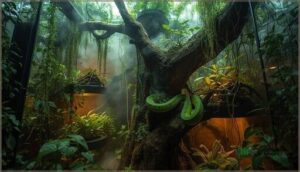
Choosing the right enclosure size isn’t just about measuring your snake from nose to tail, it’s about understanding how arboreal species use their space vertically, horizontally, and everywhere in between. Your snake’s adult size, activity level, and natural climbing behavior will dictate whether you need a towering 60-inch habitat or something more modest.
Selecting a design that accommodates future growth while offering stackable or modular options can save you time and money down the road. Let’s explore the key considerations that’ll help you match your arboreal snake with an enclosure that fosters its health, comfort, and natural behaviors.
Minimum Height Recommendations by Species
Choosing the right enclosure height isn’t guesswork—it’s about understanding your snake’s biology. Green tree pythons need at least 24 inches as juveniles, scaling up to 48 inches for adults, while Amazon tree boas require 36 inches initially and 60 inches at maturity. Costa Rican rainbow boas thrive in 18-inch enclosures as hatchlings, but you’ll want 48 inches for adults to support proper arboreal snake care and climbing structures.
Space Requirements for Active Arboreal Snakes
Active arboreal snakes demand more than minimum measurements—they need enclosures where vertical space and climbing structures support their natural drive to explore. Here’s what habitat complexity looks like in practice for proper snake behavior and reptile enclosure planning:
- Height should measure 1.5 to 2 times your snake’s total length for vigorous climbers
- Vertical space must comprise 60–70% of usable height to allow full-body movement
- Platforms and branches need spacing that prevents forced gaps exceeding body length
- Animal enclosures should accommodate several hours of daily climbing to maintain conditioning
- Snake habitat design requires regular reassessment as growth changes activity patterns
This approach to enclosure design transforms housing into vibrant arboreal snake environments.
Stackable and Modular Enclosure Designs
Modular design gives you the freedom to build upward as your collection grows, because stackable units lock together with reinforced corners that prevent tipping when housing multiple arboreal snakes.
This space efficiency transforms compact rooms into multilevel habitats, while custom configurations let you adjust ventilation, humidity zones, and climbing complexity across each stackable enclosure without redesigning your entire reptile enclosure design from scratch.
Essential Accessories for Arboreal Enclosures
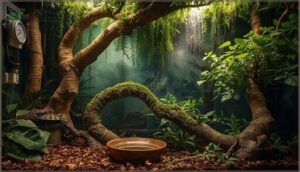
Once you’ve selected the right enclosure size and design, you’ll need to outfit the habitat with the proper accessories to support your arboreal snake’s physiological needs and natural behaviors. The right combination of substrate, climbing structures, hiding spots, and monitoring equipment creates an environment where your snake can thermoregulate effectively, maintain proper hydration, and exhibit species-typical behaviors.
Let’s examine the essential accessories that transform an empty enclosure into a thriving arboreal habitat.
Substrates for Humidity Retention
Your substrate choice directly influences humidity levels in your reptile enclosure, so selecting the right materials matters immensely. Coconut husk fiber releases moisture gradually, while sphagnum moss provides superb retention for high-humidity arboreal snakes.
Eco-friendly options like Eco-Earth maintain ideal conditions without compaction, and mixing inert substrates with vermiculite improves drainage while supporting your bioactive setup’s moisture control needs.
Climbing Branches, Vines, and Platforms
Your arboreal snakes need climbing structures that mirror their natural canopy environment, so install branches with varied diameters and natural texture to guarantee secure snake grip at multiple climbing angles. Position vines with appropriate tension to create flexible pathways between perches, and select platform sizes that accommodate your species’ full body length.
This reptile habitat design approach transforms your custom enclosure into a functional arboreal ecosystem supporting bioactive setup enrichment.
Hide Boxes and Nesting Spaces at Various Heights
You’ll want to distribute hide boxes across low, mid, and high zones in your reptile enclosure to support natural vertical retreats and reduce stress-related behaviors.
Position nesting spaces with secure entry points at multiple heights, ensuring each hide accommodates full lateral rotation without constriction.
This strategic hide placement mirrors arboreal snakes’ instinctive climbing structures and concealment patterns, supporting healthy snake behavior and psychology throughout your reptile habitat design and construction.
Thermometers, Hygrometers, and Lighting
Once your hides are in place, accurate temperature control and humidity sensors become your eyes inside the reptile habitat design and construction. Install digital thermometers at multiple heights to track thermal gradients, position hygrometers near ventilation for ambient monitoring, and set lighting cycles on timers—12:12 hours mimics natural photoperiods.
These tools transform terrariums into responsive environments, supporting environmental enrichment and precise reptile care.
Top 8 Enclosures for Arboreal Snakes
Now that you’ve gathered the essentials for your arboreal setup, it’s time to find the right enclosure that brings everything together.
The following eight options offer varying heights, ventilation designs, and materials to suit different species and keeper preferences.
Each enclosure has been selected for its ability to provide the vertical space and environmental control your arboreal snake needs to thrive.
1. Reptizoo Large Reptile Tank Enclosure
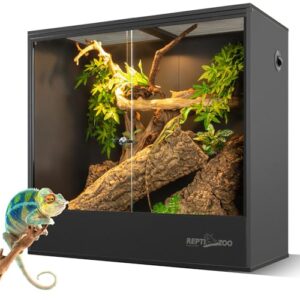
If you’re exploring reptile enclosures that balance functionality with smart snake habitat design, the Reptizoo Large Reptile Tank Enclosure stands out as a solid starting point for many juvenile arboreal snakes. Its 36-inch height offers meaningful vertical space optimization, allowing your snake to express natural climbing behaviors while you monitor health and activity.
The reinforced glass-and-metal construction prioritizes enclosure durability, and the front-opening doors simplify your daily reptile care routines. While the mesh sections support airflow, you’ll want to keep in mind UVB penetration when positioning lighting for your custom enclosures.
| Best For | Keepers of juvenile arboreal snakes or rainforest reptiles who want a tall enclosure with good visibility and easy front access for daily feeding and cleaning. |
|---|---|
| Material | PVC |
| Dimensions | 36x18x36 inches |
| Weight | 65.9 pounds |
| Ventilation | Mesh screen |
| Door Type | Sliding glass |
| Color | Black |
| Additional Features |
|
- 36-inch height gives climbing species the vertical space they need to stretch out and explore natural behaviors
- Reinforced glass-and-metal frame holds up well over time and lets you watch your snake without obstructions
- Front-opening doors make it simple to reach in for maintenance without stressing your animal
- Door openings can feel tight when working with decorations or larger snakes
- Mesh screen may block some UVB output, so you’ll need to adjust your lighting setup accordingly
- Suction cups and lock mechanisms don’t always work smoothly for everyone right out of the box
2. Waazoorep Reptile Enclosure Tank
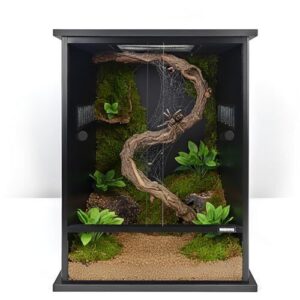
The Waazoorep Reptile Enclosure Tank offers a 18″x18″x24″ footprint, with the vertical dimension accommodating modest arboreal snakes like juvenile green tree pythons. The PVC tank materials provide enhanced humidity control compared to glass alternatives.
Its lightweight construction is paired with tempered glass sliding doors, simplifying daily reptile habitat maintenance. The metal top screen ensures essential ventilation for airflow.
You may need to adjust the door knobs for ideal front panel clearance when positioning climbing branches in your custom enclosures.
| Best For | Reptile owners seeking a vertical enclosure for arboreal species like ball pythons, juvenile green tree pythons, or chameleons who need good humidity control and easy maintenance. |
|---|---|
| Material | PVC & Glass |
| Dimensions | 18x18x24 inches |
| Weight | 25 pounds |
| Ventilation | Metal top screen |
| Door Type | Sliding glass |
| Color | Black |
| Additional Features |
|
- PVC construction holds heat and humidity better than all-glass tanks, making it easier to maintain stable conditions for tropical species
- Lightweight at 25 pounds despite the solid build, so you can move or reposition it without much hassle
- Tempered glass sliding doors and metal screen top make daily feeding and cleaning straightforward
- Front door knobs can interfere with the panels when fully opened, which might require you to remove them or use suction cups for better access
- Hasn’t been tested for water-tightness during misting sessions, so heavy misting setups might cause leakage issues
- Limited interior space for bulky decorations or large branches if you’re setting up an elaborate habitat
3. Maiyuolg Reptile Terrarium Tank
The Maiyuolg Reptile Terrarium Tank features acrylic tank materials that resist stress cracks while keeping your arboreal snakes clearly visible. Its 16″x16″x24″ dimensions provide vertical reach for species like crested geckos or young emerald tree boas, though assembly demands patience, as the instructions occasionally lack detail.
You’ll appreciate the secure front-access door for routine enclosure maintenance, yet be aware that ventilation slats may permit tiny feeders to slip through.
For keepers prioritizing lightweight terrarium design over a luxury reptile cage, this snake habitat balances affordability with functional reptile safety in your snake cage setup.
| Best For | Keepers of arboreal species like crested geckos or young tree boas who want an affordable, lightweight vertical enclosure with clear viewing and don’t mind spending extra time on assembly. |
|---|---|
| Material | Acrylic |
| Dimensions | 16x16x24 inches |
| Weight | 5 pounds |
| Ventilation | Ventilation slats |
| Door Type | Front access |
| Color | Clear |
| Additional Features |
|
- Tall 24-inch vertical design gives climbing reptiles the height they need while the clear acrylic panels let you watch your pet from every angle.
- Front-access door makes feeding and cleaning straightforward without reaching down from the top, and the lightweight build is easy to move or reposition.
- Budget-friendly option that covers the basics for arboreal setups, including decent ventilation and enough space for branches and enrichment.
- Assembly instructions can be vague or incomplete, so expect to troubleshoot during setup and possibly adjust the latch mechanism over time.
- Seals may not hold moisture perfectly out of the box, meaning you might need extra silicone if you’re aiming for higher humidity levels.
- Ventilation slats are wide enough that small feeders like fruit flies or pinhead crickets can escape, requiring mesh covers or careful monitoring.
4. Repwild Reptile Terrarium Tank Enclosure
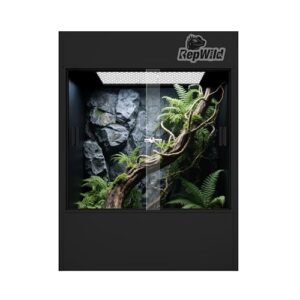
The Repwild Reptile Terrarium Tank Enclosure combines tempered glass panels with silicone-sealed corner joints, delivering a snake cage that resists impact while maintaining crystal-clear visibility for arboreal snakes. Its vertical terrarium design accommodates climbing structures at multiple heights, supporting reptile habitat creation for species requiring overhead space.
Front-access doors simplify tank maintenance and feeding routines, though you may need additional sealant to waterproof certain joints. For keepers valuing durable enclosure materials and straightforward reptile care, this reptile enclosure balances habitat lighting compatibility with practical terrarium design principles.
| Best For | Keepers of arboreal reptiles like geckos, tree frogs, and chameleons who need a tall, durable enclosure with easy access for feeding and cleaning. |
|---|---|
| Material | Acrylic |
| Dimensions | 12x12x18 inches |
| Weight | 5 pounds |
| Ventilation | Ventilation slats |
| Door Type | Front access |
| Color | Clear |
| Additional Features |
|
- Tempered glass panels with reinforced corner joints provide impact resistance and clear visibility for monitoring your pet
- Vertical design with front-access doors makes it simple to add climbing structures at multiple heights and perform routine maintenance
- Durable PVC construction creates a stable, humid environment that works well for bioactive setups
- Requires additional sealant to properly waterproof joints, as some gaps may need manual sealing
- Assembly instructions can be unclear for certain steps, which may frustrate first-time builders
- Not suitable for fully aquatic pets since it’s designed as a terrarium rather than a watertight aquarium
5. OrayuPro Reptile Terrarium Tank
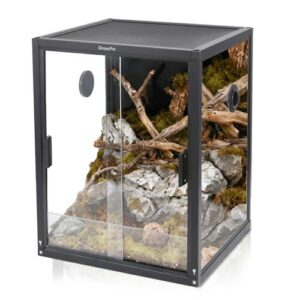
The OrayuPro Reptile Terrarium Tank delivers outstanding arboreal reptile habitat creation through its 18×18×24-inch vertical design, prioritizing climbing space for species that naturally coil among branches. Acrylic safety features and polyvinyl chloride construction resist warping while maintaining crystal-clear observation, and the ventilation systems effectively manage humidity control without compromising temperature gradients.
Though assembly challenges occasionally surface, this snake enclosure accommodates bioactive terrarium and vivarium design with modular designs that accommodate climbing structures at multiple heights, making it a practical choice for keepers invested in replicating rainforest conditions for their arboreal reptile.
| Best For | Keepers of arboreal reptiles and amphibians like tree frogs, geckos, or juvenile snakes that need vertical climbing space and a habitat mimicking rainforest conditions. |
|---|---|
| Material | PVC |
| Dimensions | 17.7×17.7×23.6 inches |
| Weight | 13.52 kg |
| Ventilation | Ventilated mesh |
| Door Type | Glass door |
| Color | Black |
| Additional Features |
|
- Vertical 18×18×24-inch design maximizes climbing space for species that naturally explore upward, with modular options for adding branches and structures at different heights.
- Crystal-clear acrylic and durable materials offer excellent visibility for observing pets while resisting warping and maintaining secure, escape-proof construction.
- Effective ventilation system balances humidity control with stable temperature zones, making it suitable for creating bioactive setups or simpler habitats.
- Assembly can be tricky for some users, requiring patience and careful attention to instructions during setup.
- Limited horizontal floor space may not work well for reptiles that prefer ground-level movement or need wider roaming areas.
- Humidity buildup requires regular monitoring and maintenance to prevent excess moisture that could affect both the enclosure and your pet’s health.
6. Toxirium Reptile Terrarium Cage
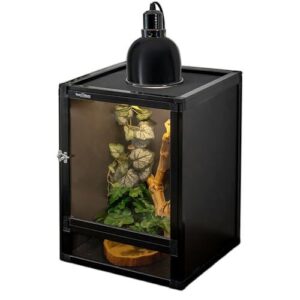
For secure reptile care and housing, the Toxirium Reptile Terrarium Cage stands out among arboreal reptile options with its refined terrarium design that balances accessibility and environmental stability.
Glass and acrylic cage materials provide unobstructed observation, while aluminum framing ensures structural integrity, and the ventilation systems position airflow ports strategically to support humidity control without creating harmful drafts.
Though not quite a luxury reptile cage, this reptile enclosure accommodates climbing features at multiple elevations, making it a dependable choice for keepers committed to proper terrarium and vivarium design that honors reptile safety.
| Best For | Reptile keepers who need a vertical enclosure for arboreal species like tree frogs, day geckos, or small climbing snakes and want a cage that’s easy to observe and move around. |
|---|---|
| Material | PVC & Glass |
| Dimensions | 18x18x24 inches |
| Weight | 22.2 pounds |
| Ventilation | Well-ventilated |
| Door Type | Glass door |
| Color | Black |
| Additional Features |
|
- Clear glass or acrylic walls give you great visibility to watch your pet without disturbing them, and the smooth surfaces make cleaning straightforward.
- Designed with vertical space in mind, so you can set up branches, vines, and hides at different heights to create a natural climbing environment.
- Ventilation ports are placed to keep air moving without blasting your reptile with drafts, and the seals help you maintain steady humidity levels.
- Some users report issues with doors not latching properly and gaps around the frame that could let small prey escape or let moisture seep out.
- Assembly instructions are often unclear, and putting the cage together can be frustrating if parts don’t line up correctly.
- Build quality seems inconsistent—some units arrive with scratches, loose panels, or components that don’t fit as snugly as they should.
7. Reptile Glass Terrarium Enclosure
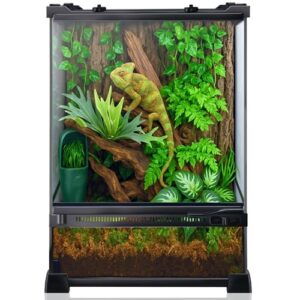
The Reptile Glass Terrarium Enclosure delivers outstanding snake visibility through tempered glass materials that resist impacts while maintaining structural clarity, which helps you monitor feeding responses, shedding cycles, and behavioral cues without disturbing your animal.
Front-opening designs improve enclosure security by reducing escape attempts during maintenance, and the hinged doors with lockable latches provide reliable reptile care and housing safeguards.
Though compact at 14 x 10 x 10 inches, this terrarium design accommodates small arboreal species needing vertical climbing space, making it a practical choice for keepers prioritizing observation and amphibian and reptile enclosures that balance accessibility with safety.
| Best For | Hobbyists looking for a compact, vertical terrarium that offers clear visibility and easy maintenance for small arboreal reptiles, amphibians, or invertebrates that thrive in humid environments. |
|---|---|
| Material | PVC & Aluminum |
| Dimensions | 12x12x18 inches |
| Weight | 7.2 pounds |
| Ventilation | Screen door option |
| Door Type | Dual doors |
| Color | Black |
| Additional Features |
|
- Tempered glass construction provides excellent visibility for monitoring your pet’s behavior, shedding, and feeding habits without causing disturbance.
- Front-opening design with lockable latches minimizes escape risk during cleaning and feeding, making it safer and more convenient than top-opening models.
- Vertical layout maximizes climbing space for arboreal species in a compact footprint that fits easily on desks, shelves, or countertops.
- Actual dimensions may be smaller than expected, and the 14 x 10 x 10-inch size limits suitability to very small species only.
- Humidity retention can be inconsistent, and ventilation holes near the bottom door may allow tiny insects or juveniles to escape.
- The top lid latch mechanism can be difficult to operate and may not provide a consistently secure closure for some users.
8. Reptile Acrylic Terrarium Enclosure Tank
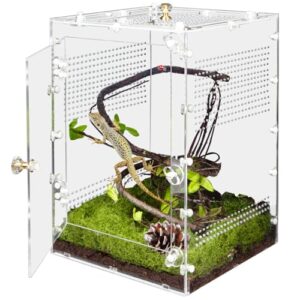
When you’re seeking lightweight durability paired with excellent visibility, acrylic material offers a compelling alternative to traditional glass snake enclosures. The TCooSo 10-gallon acrylic terrarium design features dual front and top openings at 18″H x 12″L x 12″W, providing practical vertical space for smaller arboreal species while simplifying tank maintenance through tool-free assembly.
Though ventilation holes require careful monitoring to prevent escapes, and some users report quality inconsistencies, this reptile enclosure delivers 360° observation capabilities that support attentive reptile housing and behavior tracking in amphibian and reptile enclosures.
| Best For | Reptile keepers looking for a lightweight, shatter-resistant enclosure with good visibility for smaller arboreal species like young crested geckos or tree frogs. |
|---|---|
| Material | Glass |
| Dimensions | 14x10x10 inches |
| Weight | 9 pounds |
| Ventilation | Top ventilation |
| Door Type | Front & top access |
| Color | White |
| Additional Features |
|
- Lightweight acrylic construction makes it easy to move and less likely to shatter than glass
- Dual access points (front and top doors) simplify feeding, cleaning, and handling without stressing your pet
- Tool-free assembly gets you set up quickly without hunting for screwdrivers or instructions
- Ventilation holes may be large enough for tiny reptiles to squeeze through, requiring extra mesh or modifications
- Quality control issues reported by some buyers, including cracked panels or damaged products on arrival
- Acrylic scratches more easily than glass, so you’ll need to use non-abrasive cleaners and handle carefully
Tips for Setting Up an Arboreal Snake Enclosure
Setting up an arboreal enclosure isn’t just about choosing the right tank—it’s about creating a thriving vertical habitat that sustains your snake’s natural behaviors and physiological needs.
From establishing proper temperature gradients to maintaining humidity levels that prevent respiratory issues, each element plays a vital role in your snake’s long-term health and contentment.
Let’s walk through the essential steps to transform your enclosure into a safe, enriching home where your arboreal species can truly flourish.
Creating a Safe and Stress-Free Environment
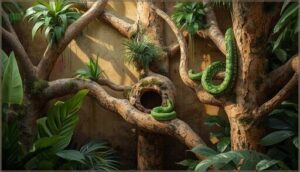
Think of your arboreal snake habitat as a sanctuary where every detail whispers ‘safety.’ You’ll want to minimize visual stress with non-reflective surfaces and quiet surroundings, while offering hiding spots at multiple heights so your snake can retreat when needed.
Environmental enrichment through varied textures and movable branches keeps stress low and promotes natural behaviors. This ensures your luxury reptile cage supports ideal reptile welfare.
Thoughtful ventilation, substrate selection, and behavioral monitoring are essential in these complex arboreal ecosystems.
Maintaining Temperature and Humidity Gradients
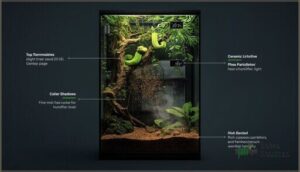
Once your snake feels at home, you’ll need to master thermal balance and humidity control across the enclosure’s vertical axis. Gradient monitoring with sensors at multiple heights confirms your climate modeling works—warm peak zones, cooler bases, and targeted ventilation systems prevent stagnation. Your substrate choice, whether cypress or coconut husk, retains moisture beautifully, while HDPE construction backs high-humidity environments without warping.
- Position heat sources at different heights to create vertical thermal gradients
- Use localized humidification near basking perches to support gradient formation
- Place temperature and humidity sensors at multiple locations for accurate monitoring
- Balance airflow patterns through proper ventilation to retain humidity without stagnation
- Adjust environmental parameters seasonally to mimic natural fluctuations
Cleaning and Maintenance Best Practices
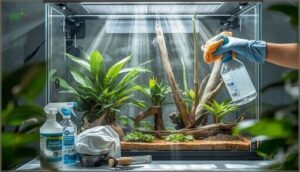
Keeping your arboreal sanctuary spotless goes hand in hand with climate control—after all, ventilation systems only work when mesh panels stay clear, and humidity control demands substrate that’s free from mold.
Wipe interior surfaces weekly with reptile-safe sanitation methods, spot-clean daily, and replace substrate every two to three months in your high-density polyethylene enclosure, which stays easy to clean without harboring bacteria or retaining odors.
Monitoring Snake Health and Behavior
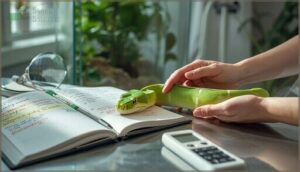
Beyond routine cleanings, your most powerful tool is observation. Watch for snake health indicators like open-mouth breathing, sunken skin, or altered feeding patterns, which signal respiratory issues or hydration management concerns.
Behavioral monitoring reveals stress or illness before symptoms escalate. Track weekly weight changes, photograph notable behaviors for veterinary care, and maintain a standardized health log that bolsters animal welfare and conservation through proactive herpetology practices.
Frequently Asked Questions (FAQs)
How often should I replace climbing branches?
Inspect your branches weekly for cracks or splinters, then plan replacements every six to twelve months depending on humidity levels, wood durability, and your snake’s activity—because climbing wear directly impacts snake safety and overall maintenance schedules.
Can arboreal snakes share an enclosure safely?
Most reptile hobbyists should avoid cohabitation risks entirely. Arboreal species usually show territorial aggression, elevated stress management challenges, and poor species compatibility.
Individual luxury reptile cages support enhanced animal welfare and ethics.
What lighting schedule works best for nocturnal species?
Nighttime navigators need a nuanced light cycle—usually 12:12 to 14:10—with dim twilight simulation supporting circadian rhythms.
Red lighting allows observation without disrupting natural behavior, while automated timers guarantee consistency in your reptile enclosure.
Do arboreal snakes need water bowls or misters?
Most arboreal species thrive with both water sources: a shallow bowl for drinking and regular misting systems to maintain proper humidity control, supporting snake hydration while creating the microclimates these climbers need for healthy shedding.
How do I prevent escape from ventilation openings?
Your enclosure’s ventilation openings can become gateways for escape if they exceed 3 mm.
Install fine mesh screens and seal every gap with reptile-safe silicone to guarantee ventilation security and proper escape prevention.
Conclusion
Your snake won’t thrive by accident—it thrives when you replicate the canopy conditions encoded in its muscles, thermoreceptors, and coiling instincts.
The right snake enclosures for arboreal snakes provide vertical highways for exploration, thermal gradients for thermoregulation, and humidity zones that mirror tropical microclimates.
You’ve studied the specifications, compared the materials, and identified the features that matter. Now transform that knowledge into a living space where your arboreal specialist doesn’t just survive—it commands its territory with the confidence of a predator born for the trees.