This site is supported by our readers. We may earn a commission, at no cost to you, if you purchase through links.

A snake’s enclosure can swing from cozy to dangerous overnight, and a curious kid won’t see it happen. Basking spots run 88 to 95°F for many species, while a cool end sits in the low 70s. One cracked battery cover or a misplaced probe can turn a fun pet into a worry.
That’s why reptile thermometers for kids need more than a number on a screen. You want rounded edges, screwed battery covers, big digits, and min/max memory that shows what changed while everyone slept.
Six tested picks, from a $7.99 Inkbird to a steady $19.99 Fluker’s, make the choice easy.
Table Of Contents
- Key Takeaways
- Six Reptile Thermometers for Kids to Compare
- Choosing Kid-Friendly Reptile Thermometer Features
- Comparing Reptile Thermometer Prices and Value
- Safe Reptile Thermometer Setup With Kids
- Teaching Kids Daily Snake Temperature Checks
- Frequently Asked Questions (FAQs)
- What is the best thermometer for reptiles?
- What is the most accurate thermometer for kids?
- What is the ideal temperature for a terrarium?
- Which thermometer and hygrometer is the most accurate?
- Which thermometer is safest for children?
- What is the most accurate thermometer for a terrarium?
- What age is best for in-ear thermometers?
- How often should reptile thermometers be replaced?
- Can reptile thermometers work for other pets?
- What temperatures are dangerous for common pet reptiles?
- Conclusion
Key Takeaways
- Choose a thermometer built for kids, with screwed battery covers, rounded edges, big readable digits, and secure mounting, because a loose coin battery or a misplaced probe is the real hazard.
- Pick one with min/max memory, like the Inkbird ITH-10 or Fluker’s, so your child can see overnight temperature swings that nobody was awake to notice.
- Place one probe at the basking spot and another at the cool end, keep gauges dry since most displays aren’t waterproof, and cross-check against a second thermometer weekly to catch drift.
- Prices are low, from about $8 to $22, so make a daily routine of reading both sides with an adult supervising and logging the numbers, so your child learns to spot trouble early.
Six Reptile Thermometers for Kids to Compare
Picking a thermometer for your child’s snake or lizard tank shouldn’t feel like a science fair project.
If you’d like help narrowing the field, this guide to reptile thermometers for kids with pet snakes explains which models are easiest for young keepers to read and trust.
Below, you’ll find six kid-friendly options that are battery-powered, easy to read, and built for humid enclosures.
Scan the list, compare what matters to your family, and pick the one that fits your setup.
1. Inkbird ITH-10 Thermometer Hygrometer
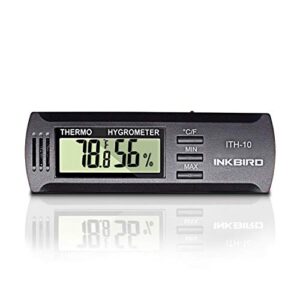
A tiny gauge with a big job, the Inkbird ITH-10 tracks both temperature and humidity in one glance. It covers 23~140°F (-5~60°C) and reads humidity from 30%RH to 90%RH, with ±1°C and ±3% accuracy.
Kids will love the max and min records, which show the day’s highs and lows. Switch between Fahrenheit and Celsius whenever you like. Velcro strips and a CR2032 battery come in the box.
The catch? No app or wireless, so you’ll check it by hand daily.
- Records max and min temperature and humidity, so you can see the highs and lows
- Switches between Fahrenheit and Celsius, and covers 23~140°F (-5~60°C)
- Compact and portable, with a CR2032 battery, Velcro strips, and manual included
- Humidity readings only cover 30%RH to 90%RH
- Temperature accuracy is ±1°C, which is a bit looser than some users may want
- No app or wireless connectivity, so you have to read it by hand
Fluker’s Digital Thermometer and Hygrometer
Want a simpler option? The Flukers Digital Thermometer and Hygrometer fits right in with Childsafe reptile care tools. Here’s what you get:
- Large easytoread displays for quick checks
- Simple onebutton controls for MAX/MIN memory
- A CR2032 battery already included
- Magic-sticker backing for tool-free mounting
For battery life optimization, wipe it gently and keep water away. Accuracy is ±1°C, not bad!
If your gauge lives in a damp basement, a well-chosen humidity gauge for basements can hold up better against moisture and keep your readings reliable between battery changes.
Zoo Med Digital Combo Gauge
Need two zones covered? The Zoo Med Digital Thermometer Humidity Gauge pairs dual sensors on 39-inch leads, so you can watch the basking spot and cool end together.
Childsafe reptile care tools should be simple. Easy to read displays switch between °F and °C, and simple onebutton controls power down with a five-second hold. Battery powered designs include an LR44.
Repti Zoo Digital Thermometer Hygrometer
Want something simpler for little hands? The Repti Zoo Digital Thermometer Hygrometer offers one button and a clear display.
Secure mounting comes from suction cups, so no tools are needed. Accuracy and reliability are solid at ±2°F and ±5% humidity, updating every 5 seconds. Educational value shines as kids watch numbers shift. Price and value for families? Spare battery included.
ThermoPro TP50 Thermometer Hygrometer
The ThermoPro Digital Hygrometer Thermometer keeps things simple. Its large LCD shows bold numbers, updates every 10 seconds, and tracks high and low readings. The comfort indicator helps kids spot dry, comfortable, or wet air fast.
That gives you educational value for kids, plus safe handling practices: adult supervision.
Weigh durability in humid environments and price and value for families.
JEDEW Mini Thermometer Hygrometer
A tiny gauge with big benefits, the JEDEW Mini measures just 1.77 by 0.6 inches. Battery-powered designs like this need no cords, and its 10-second refresh makes daily temperature checks easy. It’s no waterproof probe, so keep it dry.
Treat it as an educational science tool for kids, and follow safe handling practices:
- Stick it down.
- Read temperature.
- Read humidity.
Choosing Kid-Friendly Reptile Thermometer Features
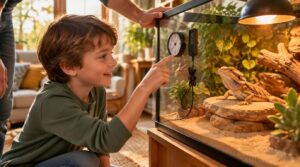
A thermometer that works for your kid and your reptile comes down to a few smart features. Below, you’ll find the key features to check before you buy, from safe design to everyday upkeep. Use them to match a gauge to your family’s setup.
Child-Safe Design
Would you hand a toddler a gadget with a loose button battery? Of course not. That’s why Child-Safe Design comes first. Look for screwed battery covers, rounded edges, and Lowvoltage safety features that keep tiny coin cells harmless.
Choose Secure mounting with sturdy suction cups, plus Waterproof probes that survive spills. Done right, it’s an Educational science tool for kids.
Readable Displays and Controls
Think of your thermometer as a car dashboard: if kids can’t read it at a glance, it’s useless. Readable Displays and Controls make that glance easy.
A thermometer is like a car dashboard: if kids can’t read it at a glance, it’s useless
Look for:
- A backlit digital display
- Fahrenheit and Celsius readouts
- Minimal buttons
- Temperature range of 14 to 122 degrees Fahrenheit and humidity range of 20 to 99
Add a sampling interval of five seconds.
Temperature Monitoring Features
Ever wonder what your snake’s enclosure did overnight? The right features tell you.
Look for min/max memory, like the Inkbird ITH-10 offers, so your kids can spot overnight dips during daily temperature checks. Pair that with temperature and humidity tracking and digital hygrometer functionality. Prefer alarms? Consider Inkbird’s ITH-13-B. Focus on proper placement and handling for monitoring for accurate readings.
Moisture Resistance and Durability
Terrariums are steamy, and electronics hate steam. Zoo Med’s waterproof probes can be submerged, but its display must stay dry. Fluker’s controls humidity well, while Inkbird’s ITH-10 has no IP rating, so keep it away from rain and moisture.
Look for moisture-resistant electronics and a durable design. Check battery-powered longevity and adhesive mounting stability since damp glass loosens sticky mounts.
Accuracy
keeps your snake safe, so check the specs. Inkbird’s ITH-10 reads within ±1°C and ±3% RH, with a temperature measuring range of 23 to 140 degrees Fahrenheit. Repti Zoo covers a humidity range of 20 to 99%, though it’s only ±5% RH.
Zoo Med’s temperature probe is waterproof, so damp hides won’t fool it. Still, try cross-checking two thermometers.
Maintenance
Keep it simple: wipe weekly with a damp cloth, no fancy tools needed.
- Clean the display and suction cup.
- Check fragile probe wires for kinks.
- Dry any fogged screen, since a screen difficult to read in humid conditions often means leaks.
- Recheck temps after new batteries.
Moisture-resistant electronics are not waterproof. Never submerge it, or you’ll get inaccurate humidity readings.
and Value
Value isn’t just the sticker price. For beginner reptile keeper tools, the JEDEW Mini under $12 covers the basics, while Fluker’s adds MAX/MIN memory for under $20.
Battery-powered designs save hassle, too. ThermoPro’s AAA lasts 12-24 months, while Fluker’s CR2032 lasts 6-12.
Check terrarium compatibility first. Then hunt for multipack family savings, since temperature monitoring for reptiles works best when tanks need one.
Comparing Reptile Thermometer Prices and Value
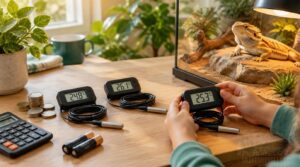
Once you know which features matter, price becomes the tie-breaker. Good news: reptile thermometers for kids don’t have to cost much.
The Inkbird ITH-10 runs $13.99 on Amazon, but it swings from $7.99 on eBay to $19.99 on the official site. Shop around.
Fluker’s holds steady at $19.99 and adds MAX/MIN memory, handy for temperature gradient tracking and spotting reptile health indicators early. Zoo Med lands between $12.64 and $21.52, and its waterproof probe earns its keep.
For beginner reptile keeper tools, any of these works. Need several gauges for warm and cool sides? Look for multipack family savings before buying singles. Compare per-unit cost, then check that batteries are included, since replacements add up. Small savings stack up fast.
Safe Reptile Thermometer Setup With Kids
You’ll get the best readings by treating placement like a safety job. Start with suction cups or adhesive mounts to hold each probe on the enclosure wall at reptile level, away from the heat source and out of curious little fingers’ reach.
Place one probe at the basking spot and another at the cool end. Magnetic clips work well on glass tanks with an outside partner magnet, so nothing slides around inside.
Check for temperature drift by comparing your readings against a second thermometer every week. Probes can shift, and a few degrees matters. Confirm your hygrometer’s humidity tolerance suits your species, since misting can wear out cheap sensors. Adults should handle every adjustment, while kids just look at the display.
Teaching Kids Daily Snake Temperature Checks

You don’t need a lab coat to turn temperature checks into a daily habit. Pick the same time each morning, grab one of the reptile thermometers for kids from your setup, and let your child lead while you supervise.
Reptile enclosure monitoring works best as a quick routine:
- Read the cool side, aiming for 75-80°F.
- Read the warm side, aiming for 87-93°F.
- Write both numbers in a logbook.
- Wash hands before and after.
Over a week, your child will spot temperature drift and notice how humidity tolerance matters for your snake. Compare readings to room temperature, and you’ve got instant environmental science lessons. If numbers stray, tell an adult right away. Celebrate each reading with a sticker on the chart.
Frequently Asked Questions (FAQs)
What is the best thermometer for reptiles?
The best pick is the Inkbird ITH-10. Among reptile thermometers for kids, it’s battery-powered, easy to read, and tracks highs and lows, giving you dependable reptile enclosure monitoring with solid humidity control accuracy every day.
What is the most accurate thermometer for kids?
ThermoPro TP50 wins on accuracy: ±1°F and ±2-3% humidity. Skip Bluetooth temperature monitoring and Realtime environmental data; daily highs and lows suit Data logging for children, and Sensor calibration methods guide Humidity and temperature correlation.
What is the ideal temperature for a terrarium?
No single number fits. Aim for a basking spot temperature of 88-110°F, with cool zone monitoring at 70-85°F. Choose a temperature range of 23-140 degrees Fahrenheit and humidity range of 20-90 for thermal regulation learning.
Which thermometer and hygrometer is the most accurate?
Like a ruler’s fine tick marks, ThermoPro TP50 is the most accurate: ±5°C. Inkbird Digital Thermometer Hygrometer Monitor, Repti Zoo Digital Thermometer Hygrometer, Zoo Med Dual Thermometer Humidity Gauge, Jedew Digital Hygrometer Thermometer all trail.
Which thermometer is safest for children?
Pick one with Velcro backing and moisture-resistant electronics, so little hands can’t knock it loose.
A face icon indicator helps kids read temps safely. Do probe stability checks, and try crosschecking two thermometers for safety.
What is the most accurate thermometer for a terrarium?
The most accurate thermometer for a terrarium is a digital model with a remote waterproof probe. Look for 1°C resolution and tight ±1°C accuracy, so your temperature monitoring for reptiles stays reliable day after day.
What age is best for in-ear thermometers?
Tiny ears are like narrow keyholes, so wait until 6 months old. A batterypowered, waterresistant ear model with a digital display reads a fever-friendly temperature range reliably then, though a humidity range never matters here.
How often should reptile thermometers be replaced?
Your gauge drifted 5°F. Replace battery-powered designs every 1 to 2 years, despite up to a year battery life, sooner for inaccurate humidity readings, fragile probe wires, or screen difficult to read in humid conditions.
Can reptile thermometers work for other pets?
Yes, they do! A digital display shows minimum and maximum temperatures for your guinea pigs or birds, and it also aids reptile enclosure humidity control, reptile terrarium maintenance, and any reptile temperature gradient setups too.
What temperatures are dangerous for common pet reptiles?
Overheating hits fast: above 32°C (90°F) for leopard geckos and corn snakes, 35°C for ball pythons, 46°C for bearded dragons. Watch your reptile nocturnal temperature drop too: geckos under 18°C and pythons under 24°C struggle.
Conclusion
Maya, age nine, wakes up, glances at the big digits on her snake’s enclosure, and spots a min reading of 68°F overnight. She tells her dad, and the lamp gets fixed by lunch.
That’s the payoff of choosing the right reptile thermometers for kids. Pick one with sturdy covers, readable numbers, and memory. Mount the probe securely, check it daily, and you’ll build confident, careful habits that keep your snake comfortable and your family calm.