This site is supported by our readers. We may earn a commission, at no cost to you, if you purchase through links.
Most corn snake owners spend serious time researching enclosure size, temperature gradients, and feeding schedules—then grab whatever bowl looks small enough to fit. That one oversight quietly causes more health problems than almost any other husbandry mistake.
Dehydration in corn snakes doesn’t announce itself until it’s already a problem: wrinkled skin, incomplete sheds, dry crumbly urates. The water dish sitting in the corner of the enclosure plays a bigger role in preventing all of that than most keepers realize.
The right reptile water dishes for corn snake owners balance material, stability, size, and cleanability—and the differences between a good pick and a bad one are worth knowing before you buy.
Table Of Contents
Key Takeaways
- The water dish is one of the most overlooked factors in corn snake health — dehydration doesn’t show up until it’s already a problem, so getting the dish right from day one matters.
- Material and shape determine how easy the dish is to keep clean; smooth, non-porous ceramic or glass resists biofilm far better than scratched plastic or unsealed stone ever will.
- Dish size should match your snake’s life stage — hatchlings need under an inch of water depth, while adults need a bowl 6–8 inches wide with no more than 2.5 inches of depth.
- Placement on the cool side of the enclosure keeps humidity stable between 40–70%, while a weighted, wide-based bowl prevents the spills that quietly leave your snake dehydrated and your substrate soaked.
Key Factors in Choosing Corn Snake Water Dishes
Not every water dish works for a corn snake — size, material, stability, and ease of cleaning all affect how well the setup actually functions.
A heavy ceramic or weighted bowl matters more than you’d think — here’s a full breakdown of corn snake water bowl size and tipping risks worth reading before you buy.
Getting these details right from the start saves you from headaches down the road.
Here’s what to look for before you buy.
Correct Size and Depth for Corn Snakes
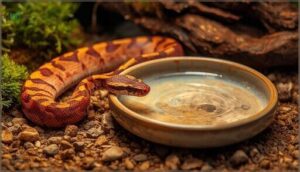
Size matters more than most new keepers realize. For adult corn snakes, aim for a dish 5 to 8 inches across and no deeper than 1 to 2 inches — enough for soaking behavior without turning it into a swim test. Hatchlings need shallower water, under 1 inch.
- Adults need an inner diameter at least 1.5x their coil width
- Keep water depth under 2.5 inches max for safe snake hydration
- Match dish size to life stage, not just enclosure size
Material Choices: Ceramic, Stone, Plastic, Glass
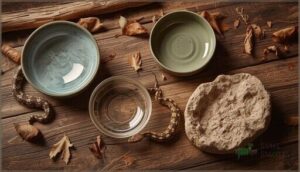
Once you’ve nailed the right dimensions, material choice becomes your next decision — and it’s not just about looks. Glazed ceramic is the ultimate choice: nonporous, easy to disinfect, and its thermal mass keeps water cooler longer.
Glass performs similarly. Plastic scores points for affordability but carries hygiene risks from scratches. Unsealed stone? Skip it — surface porosity traps bacteria and chemical safety concerns make it a hard pass.
Stability and Spill Prevention Features
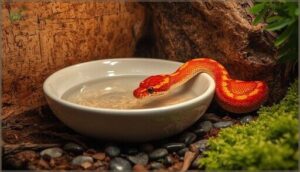
Material matters, but so does staying put. Corn snakes are surprisingly pushy explorers, and a tipped water dish means a wet enclosure and a dehydrated snake.
Wide bases and weighted designs resist that pressure. Low profiles reduce leverage. Corner bowls borrow two walls for extra support. Anchoring systems eliminate movement entirely.
Any of these features protect reptile hydration and simplify overall snake health maintenance.
Ease of Cleaning and Maintenance
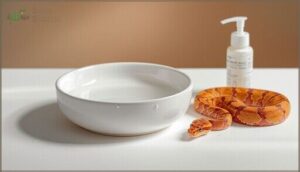
A stable dish that never gets cleaned is still a health risk. Water dish maintenance is where a lot of keepers cut corners — and snakes pay for it.
Here’s what simplifies the routine:
- Non-porous surfaces resist biofilm buildup
- Simple shapes clean faster than sculpted rock designs
- Daily rinse, weekly full wash with unscented soap
- Bleach solution disinfection kills stubborn bacteria
- A spare dish means zero downtime during cleaning
Smooth, glazed ceramic or glass wins for ease of cleaning. Biofilm control stays manageable when the bowl’s design doesn’t fight you.
Stainless steel takes this even further — as non-porous surfaces resist bacterial buildup far better than materials that trap moisture in tiny cracks.
Top 4 Reptile Water Dishes for Corn Snake Owners
Not every water dish on the market is worth your snake’s time — or yours.
These four options consistently hold up across the things that actually matter: size, material, stability, and ease of cleaning.
Here’s what makes each one worth considering.
1. Exo Terra Reptile Water Dish
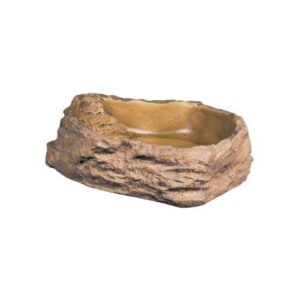
The Exo Terra Reptile Water Dish earns its place on this list for a few solid reasons. It’s built from food-grade resin with a non-porous interior, so bacteria don’t get a foothold between cleanings.
The large size — about 8.6 by 6.9 by 2 inches — gives adult corn snakes room to drink or partially soak. Molded safety steps inside help smaller snakes brace themselves without slipping. The rock texture blends naturally into most setups, and the wide base makes tipping unlikely.
| Best For | Reptile, amphibian, and insect owners who want a natural-looking water dish that’s easy to clean and safe for animals of various sizes. |
|---|---|
| Material | Plastic/Resin |
| Surface Finish | Non-porous, smooth |
| Easy Cleaning | Yes |
| Natural Look | Yes |
| Terrarium Compatible | Yes |
| Weight | 1 Kilogram |
| Additional Features |
|
- Non-porous, food-grade resin keeps bacteria from building up between cleanings
- Built-in safety steps help smaller animals brace themselves and avoid slipping
- Wide, stable base and rock-like texture blend right into most terrariums
- The large size might overwhelm smaller enclosures or tiny animals
- Can bump up humidity levels, which is a problem in desert setups
- At 1 kilogram, it’s a bit heavy and awkward to lift out for cleaning
2. Reptizoo Reptile Water Dish
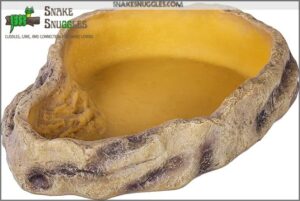
The Reptizoo water dish is a straightforward workhorse. At 11 by 8 by 2.4 inches, it gives adult corn snakes genuine soaking room without monopolizing the enclosure floor.
The resin construction is solid enough that your snake won’t shove it around mid-exploration, and the smooth interior wipes clean in seconds. No seams, no gaps, nowhere for biofilm to hide.
The natural rock finish blends into most setups without looking out of place. Backed by a 12-month warranty, it’s built to last.
| Best For | Reptile owners with adult snakes, bearded dragons, box turtles, or similar mid-to-large-sized reptiles who want a durable, easy-to-clean water dish that stays put. |
|---|---|
| Material | Stone/Resin |
| Surface Finish | Non-porous, smooth |
| Easy Cleaning | Yes |
| Natural Look | Yes |
| Terrarium Compatible | Yes |
| Weight | 454 Grams |
| Additional Features |
|
- Heavy enough that curious reptiles can’t flip or nudge it out of place
- Smooth resin interior makes cleaning quick — no rough spots for bacteria to settle into
- The natural brown finish fits right into most terrariums without looking like an eyesore
- Only comes in one color and one size, so your options are pretty limited
- It’s on the heavier side, which can make shipping costs sting a bit
- Too big for smaller reptiles or tiny amphibians — they’d struggle to use it safely
3. RunXF Reptile Food Bowl
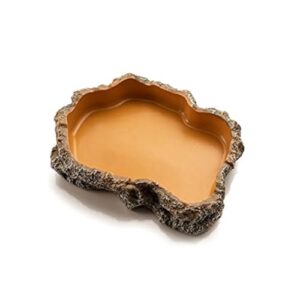
The RunXF bowl punches above its weight for the price. At 9.5 by 6 inches, it gives medium to large corn snakes real soaking room without eating half the enclosure floor.
The solid resin construction means your snake can’t shove it into the corner during its nightly patrol — the weighted base stays put. The rock texture blends naturally into most setups, and the smooth interior cleans fast.
Rinse, disinfect, refill, done. Simple setup for a snake that doesn’t care about aesthetics but needs reliable water access.
| Best For | Medium to large reptiles like corn snakes, ball pythons, and bearded dragons that need a spacious, sturdy water or food dish. |
|---|---|
| Material | Resin |
| Surface Finish | Smooth |
| Easy Cleaning | Yes |
| Natural Look | Brown natural color |
| Terrarium Compatible | Yes |
| Weight | 1.52 Kilograms |
| Additional Features |
|
- Extra large size gives bigger reptiles plenty of room to soak or eat comfortably
- Smooth interior makes cleaning quick and easy — rinse and you’re done
- Realistic rock texture blends right into a natural or desert-style habitat
- Too big for small reptiles, so it’s not a one-size-fits-all solution
- May have rough edges that could be a concern for more delicate animals
- Needs a freshwater rinse before first use to clear off any dust from manufacturing
4. Reptile Fossil Rock Food Dish
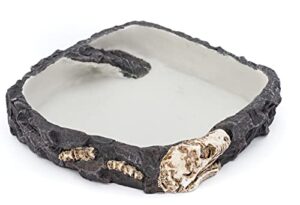
The Fossil Rock Food Dish earns its spot on this list through pure practicality. At 7 by 7 inches with a 1.5-inch rim height, adult corn snakes can slide in and out without awkward climbing.
The molded resin is non-porous, so bacteria don’t get a foothold between cleanings. That fossil texture stays on the outer walls — the interior stays smooth and easy to scrub. Wide base, low center of gravity, stable on glass or loose substrate. Hard to tip. Easy to maintain.
| Best For | Reptile owners who want a natural-looking, low-maintenance dish that works well for feeding bearded dragons, geckos, snakes, and other small reptiles or amphibians. |
|---|---|
| Material | Resin |
| Surface Finish | Smooth inside |
| Easy Cleaning | Yes |
| Natural Look | Simulated rock texture |
| Terrarium Compatible | Yes |
| Weight | 380 Grams |
| Additional Features |
|
- The non-porous resin makes it genuinely easy to clean — no hidden grooves trapping bacteria
- Stable and hard to tip, even on loose substrate
- Looks great in a terrarium without feeling out of place
- Too shallow for soaking, so it won’t replace a proper water dish for larger reptiles
- Portion sizing can be tricky depending on your pet’s appetite
- Needs regular cleaning to keep bacteria from building up over time
Maintaining Water Quality and Hygiene
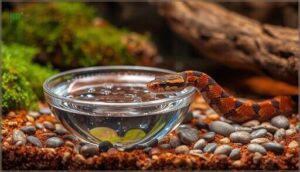
Keeping your corn snake’s water clean isn’t complicated, but it does require consistency.
A dirty dish is one of the fastest ways to introduce bacteria into an otherwise healthy setup.
Here’s what you need to stay on top of it.
Start with the five bedding factors that directly shape your hatchling’s health and hydration — they’ll make the choice a lot clearer.
Daily Water Changes and Weekly Disinfection
Fresh water every 24 hours — that’s the baseline for snake hydration and water quality. Dump it completely; don’t top it off. If your corn snake defecates or sheds in the dish, change it immediately regardless of schedule.
| Task | Frequency |
|---|---|
| Full water change | Daily |
| Deep scrub + disinfectant | Weekly |
| Extra changes during shedding | As needed |
Chlorhexidine works well for weekly disinfection. Diluted bleach (10%) is fine too — just rinse thoroughly until the smell’s completely gone.
Preventing Bacterial Growth and Biofilm
Biofilm formation starts faster than most keepers expect — bacteria attachment begins within hours. Warm water around 73–82°F speeds that process up considerably.
For proper bacterial control and microbe management, smooth ceramic or glass dishes are your best bet since rough, porous surfaces trap organic debris where bacteria hide. Daily water changes paired with weekly dish sanitizing keeps water quality solid and your snake’s hydration safe.
Monitoring Humidity and Placement in Enclosure
Where you put that water dish matters more than you’d think. On the warm side, it drives evaporation and pushes humidity past 75 percent fast.
Keep it on the cool side for steadier humidity control — ideally between 40 and 70 percent. A digital hygrometer confirms what’s actually happening inside the enclosure, so placement decisions stay rooted in real data, not guesswork.
Signs of Poor Hydration in Corn Snakes
Your hygrometer tracks the enclosure, but your snake’s body tells the real story. Watch for wrinkled, saggy skin that lacks elasticity, sunken eyes, or incomplete sheds leaving patchy leftovers.
Dehydration symptoms in corn snakes also show up as lethargy and appetite drops. Dry, crumbly urates are another red flag. Catch these signs early — reptile hydration problems snowball fast.
Lethargy, appetite loss, and crumbly urates are early warnings that reptile hydration problems snowball fast
Placement and Safety Tips for Water Dishes
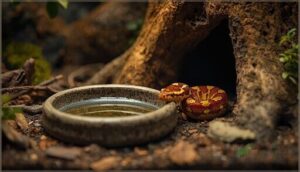
Where you put the water dish matters more than most keepers realize. Placement, stability, and dish size all shift as your corn snake grows, and getting these details wrong can cause humidity spikes, spills, or a thirsty snake.
Here’s what you need to know to keep things dialed in.
Ideal Dish Placement for Humidity Control
Where you place the water dish shapes your corn snake’s entire microclimate. Cool side placement slows evaporation rates, keeping humidity balanced between 40 and 60 percent without constant spills.
Warm side placement boosts evaporation, useful in dry homes. Avoid positioning it under a screen vent — ventilation control matters because airflow pulls moisture out fast.
Monitor thermal gradients with a digital hygrometer and adjust accordingly.
Preventing Spills and Escape Risks
Spill prevention and escape routes go hand in hand. Keep water depth at 1 to 2 inches — enough for soaking, not enough to slosh over the rim when your snake moves fast.
Bowl stability matters here too. Keep the water dish away from climbing branches and décor; corn snakes treat every elevated surface as a potential exit. Distance cuts escape risk substantially.
Choosing Tip-Resistant Bowls
Bowl design isn’t decorative — it’s functional design. A corn snake weighs under 900 grams, so a ceramic or stone dish over 1 kilogram wins every standoff. That weight distribution keeps reptile hydration consistent and bowl stability intact.
Five features that define tipping prevention:
- Wide, flat base equal to the top opening
- Low center of gravity with a thick bottom
- Rubberized or textured base texture for grip
- Outward-flaring wall design at the rim
- Irregular outer edges that resist rolling
Stable reptile accessories like these are easy-to-maintain pet bowls too — fewer spills means less cleanup.
Adjusting Water Dishes as Snakes Grow
Your corn snake moves through three distinct growth stages, and the water dish needs to keep pace. Hatchlings stay safe with a 2–3 inch dish and barely an inch of water depth.
As your snake grows, something like this 39 × 27 cm corn snake water bowl gives a mid-sized adult enough room to soak comfortably without tipping or crowding the enclosure.
Juveniles step up to 3–5 inches wide. Adults need 6–8 inches. Snake behavior tells you when to upgrade — frequent soaking before shedding is the clearest signal.
Frequently Asked Questions (FAQs)
Can corn snakes drown in their water dish?
Yes, corn snakes can drown, but it’s rare in shallow dishes. Keep water depth between 1 and 2 inches, use a bowl with sloped sides, and watch for unusual soaking behavior.
How often should I replace the water dish itself?
Replace plastic dishes every 6 to 12 months. Ceramic dish cues like cracks or crazed glaze mean retire it immediately.
Stainless steel lasts years. Trust your cleaning routine — if scrubbing stops working, swap it.
Do hatchlings need a different dish than juveniles?
Yes — like Goldilocks, size matters. A hatchling needs a shallow, 5-inch-deep dish for safe hydration and escape prevention. Juveniles can handle deeper bowls for soaking during shedding.
What water temperature is best for corn snakes?
Room temperature — around 70 to 77°F — is ideal temperature. It prevents thermal shock, promotes snake hydration, and keeps water quality stable.
Cold tap water can stress your corn snake, so let it warm up first.
Can I use tap water for my corn snake?
Tap water is generally fine for corn snake hydration, but dechlorinate it first. A few drops of reptile conditioner neutralizes chlorine and chloramine, keeping water quality safe and mineral balance intact.
Conclusion
The dish you choose matters. The water you maintain matters. The placement you get right matters. Every small decision around reptile water dishes for corn snake owners compounds into either a thriving animal or a preventable vet visit.
A stable, clean, appropriately sized bowl isn’t a minor detail—it’s infrastructure. Get that part right, and you’ve removed one of the most common silent stressors from your snake’s environment before it ever becomes a problem.