This site is supported by our readers. We may earn a commission, at no cost to you, if you purchase through links.

A retained shed isn’t bad luck—it’s a systems failure.
The skin separates cleanly only when two variables stay within tight tolerances: temperature driving the enzymatic process, and humidity keeping the outermost layer pliable long enough to slide free.
Drop the warm side below 75°F, and enzyme activity stalls mid‑cycle.
Push humidity too low during ecdysis, and the loosened skin desiccates before it clears the body.
Your snake’s temperature humidity shed cycle runs on the same logic as any controlled environment system—inputs determine outputs, and the margin for error is narrower than most keepers realize.
Table Of Contents
Key Takeaways
- Temperature and humidity aren’t just comfort settings — they’re the two variables that either drive a clean shed or guarantee a retained one, with enzyme activity stalling below 75°F and skin desiccating when humidity drops too low during ecdysis.
- Every species runs on its own tolerances: ball pythons need a 88–92°F warm side with 70% humidity at shed time, while corn snakes run cooler and drier — one-size-fits-all enclosure settings will eventually cost you.
- Thermal gradient isn’t optional; your snake needs a range to self-regulate, and a single fixed temperature removes the behavioral thermoregulation that keeps the shed cycle on schedule.
- When something goes wrong — retained eye caps, stuck skin, stalled pre-shed — the root cause is almost always a humidity or temperature drift that went unmonitored, which is why calibrated probes and data logging aren’t extras, they’re baseline equipment.
The Role of Temperature in The Shed Cycle
Temperature isn’t just background noise in your snake’s enclosure — it’s the engine driving the entire shed cycle. When temps drift out of range, the whole process can stall, stretch, or go sideways fast.
Since temperature swings affect far more than just shedding, it’s worth understanding why lethargy in pet snakes often signals something deeper before assuming the enclosure is the only culprit.
Here’s what you need to know about getting it right.
Optimal Temperature Ranges for Shedding
one-size-fits-all — species-specific heat requirements drive successful ecdysis. Corn snakes shed cleanly at 82–86°F on the warm side, while ball pythons need a basking spot temperature of 90–95°F. Both still need a cool side gradient around 75–80°F.
Thermal gradient optimization means giving your snake choices, not a single fixed temperature throughout the enclosure. For best shedding, maintain the ideal shedding temperature range.
Effects of Low or High Temperatures
Both extremes break ecdysis. Below 75°F, enzyme inhibition halts skin separation — your snake enters pre-shed with blue eyes and simply stalls there for weeks.
Above 95°F, metabolic slowdown inverts: heat stress burns compound fragmented sheds, while behavioral thermoregulation fails under chronic overheating. Retained shed risks spike at either end, making consistent temperature control non-negotiable for healthy snake shedding.
Research shows that mass-specific SMR increase rises with temperature, highlighting the metabolic impact of temperature extremes.
Temperature Gradients and Shedding Success
A single fixed temperature won’t cut it — your enclosure needs a working gradient. Ball pythons want 88–92°F on the warm side, 78–82°F on the cool side. Corn snakes run tighter: 85°F warm, 75°F cool.
These species gradients drive the metabolic impact that keeps ecdysis on schedule. Heat source placement, thermal monitoring, and regular calibration methods make the difference between a clean shed and a retained one.
How Humidity Impacts Shedding

Humidity is just as critical as temperature regarding a clean, complete shed. Get it wrong, and your snake pays the price — stuck shed, retained eye caps, or worse.
Here’s what you need to know about keeping moisture levels dialed in for your specific species.
Ideal Humidity Levels for Different Species
Not every reptile reads from the same humidity manual.
Each species has its own sweet spot, and understanding reptile humidity needs can help you create the right gradient so your animal can self-regulate.
Ball python humidity sits around 40–60% daily, climbing to 70% during ecdysis.
Corn snake humidity stays drier at 40–50%, nudging to 55–60% for shedding.
Bearded dragon humidity control means keeping things at 30–40%, while crested gecko humidity cycles between 50–80%.
Blue tongue humidity requirements are similarly low, with humid hides doing the heavy lifting.
Humidity Fluctuations During The Shed Cycle
Even a well-dialed enclosure sees day‑night swings of 10–20 percentage points — heating elements run hard during daylight hours and strip moisture fast. Misting timing matters: split your water into two or three lighter sessions rather than one heavy soak.
Watch for these behavioural humidity response signals during ecdysis:
- Prolonged soaking in the water dish
- Retreating to microclimate hides for hours
- Abandoning warm spots for cooler, damper zones
Seasonal room humidity compounds everything — winter heating drops ambient air below 30%, so your snake’s shedding environment needs active compensation.
Consequences of Improper Humidity
Get humidity wrong — in either direction — and the shedding cycle breaks down fast.
| Humidity Problem | Health Consequence |
|---|---|
| Below 50% | Retained shed, incomplete skin renewal |
| Dry air buildup | Dehydration stress, wrinkled skin |
| Poor ventilation | Skin infections, bacterial growth |
| Chronically low | Eye cap issues, reduced vision |
| Constricting shed | Limb circulation loss, tissue death |
Reptile care comes down to one rule: measure before something goes wrong.
Recognizing and Managing The Shed Cycle
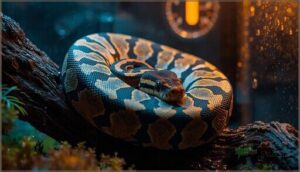
Your snake won’t send a calendar invite when a shed is coming, but it does leave clear signals if you know what to watch for.
The cycle follows a predictable pattern, and once you can read it, you’ll catch problems before they escalate. Here’s what to look for at each stage.
Signs Your Snake is Entering Shed
Your snake doesn’t announce ecdysis — it signals it. Dull skin and cloudy eyes are the clearest early indicators, as fluid builds between old and new layers. Watch for these three reliable markers:
- Behavioral changes: more hiding, reduced appetite, defensive reactions
- Increased soaking: prolonged time in the water dish
- Matte scales: glossy patterns shift chalky within 5–7 days
Humidity levels directly influence how cleanly this skin renewal progresses.
Typical Shedding Timeline
shedding cycle runs on a predictable clock. Pre-shed duration usually spans 7–14 days, with blue phase length holding steady at 3–7 days as fluid separates the skin layers.
Eyes clear, then the actual shed follows within 2–4 days.
For juvenile shed frequency, expect cycles every 4–6 weeks.
First shed timing post-hatch often lands within the first week — temperature regulation and humidity levels drive every stage.
Incomplete or Problematic Sheds
When snake shedding goes wrong, the culprit is usually dysecdysis — and it rarely happens in isolation. Low humidity levels, hydration deficiency, or parasite skin damage all compromise the old skin’s release.
Dysecdysis rarely strikes alone — low humidity, dehydration, or parasites each quietly sabotage a clean shed
Watch for retained eye caps and tail constriction; both signal restricted circulation within days.
Humidity adjustments and supervised soaks resolve mild stuck shed, but persistent ecdysis failure warrants veterinary intervention before tissue damage sets in.
Practical Moisture and Climate Control Strategies
Once you understand snake’s shed cycle, the next step is building an enclosure environment that actually helps it. Hitting the right humidity and temperature targets isn’t luck — it comes down to a few specific tools and setups.
Here’s what works.
Ventilation Systems for Humidity Regulation

Ventilation isn’t just airflow — it’s precision humidity control on a schedule that your snake depends on.
- Crossflow Vent Design places low intake and high exhaust vents on opposite sides, maintaining 60–80% humidity without stagnant pockets.
- Mesh Lid Optimization covers 50–75% of screen tops, cutting moisture loss by up to 40%.
- Active Fan Integration using 55 CFM axial fans delivers 4–8 air changes per hour — controlled, not chaotic.
Dehumidifiers and Humidifiers: When to Use Each

Once ventilation is dialed in, device selection becomes your next lever. Run a dehumidifier when enclosure humidity exceeds 60% for arid species — humidity control fails fast without clear trigger thresholds. Flip to a humidifier when levels drop below 50% pre‑shed.
| Scenario | Device | Placement Strategy |
|---|---|---|
| Humidity >70% | Compressor dehumidifier | High, away from corners |
| Humidity |
- https://blog.getreptilia.com/blog/understanding-shedding-a-comprehensive-approach-to-your-reptiles-behavior
- https://parker-vet.com/shedding-success-your-guide-to-healthy-snake-molting/
- https://healthyanimals4ever.com/blogs/news/natural-reptile-skin-care-how-to-support-healthy-shedding
- https://www.buraqpets.com/blogs/fish/how-to-maintain-proper-temperature-and-humidity-in-a-reptile-enclosure
- https://flukerfarms.com/reptile-u/blog/prepping-for-cooler-temperatures-for-your-reptile/