This site is supported by our readers. We may earn a commission, at no cost to you, if you purchase through links.

A stressed ball python almost always points to one thing: the hide. Most keepers obsess over heat gradients and humidity levels, but the hide size quietly drives more behavioral problems than any other enclosure element. A snake that refuses to eat, stays in the open, or rubs its nose against the glass is often sending a clear signal—its hide doesn’t fit.
Ball pythons regulate stress through compression, meaning they need to feel the walls of their hide touching their body to feel secure. Too much open space inside a hide triggers the same anxiety as no hide at all. This biological need for snug confinement is critical to their well-being.
Getting the size right, matched precisely to your snake’s current weight and girth, fixes most of these issues before they become serious health concerns. Properly fitted hides address the root cause of stress-related behaviors, ensuring the snake feels safe and secure in its environment.
Table Of Contents
- Key Takeaways
- Ball Python Hide Size Chart
- How to Measure The Right Fit
- Hide Placement and Quantity
- Top 5 Ball Python Hides
- Frequently Asked Questions (FAQs)
- Can I use temporary hides for my baby ball python?
- What are the advantages of using temporary hides for ball pythons?
- What should I consider when choosing hides for my ball python?
- How many hides should I provide for my ball python?
- What are some recommended hides for ball pythons?
- How big of a hide for a ball python?
- Can a snake know its owner?
- Can two ball pythons share the same hide?
- What hide materials are safest for ball pythons?
- How often should you replace a ball pythons hide?
- Conclusion
Key Takeaways
- Your ball python’s hide should match its weight and girth at every growth stage — from a snug 4×3-inch space for hatchlings under 150g, up to 8×12-inch for adults over 1,500g.
- A hide that’s too large is just as harmful as one that’s too small, since your snake needs to feel the walls against its body to feel secure and settle into normal feeding behavior.
- You need at least two hides — one on the warm side (88–92°F) and one on the cool side (76–80°F) — plus a humid hide packed with damp moss when shedding season starts.
- Watch for stress signals like restless roaming, nose-rubbing against the glass, or refused meals, as these almost always mean the hide no longer fits your snake’s current size.
Ball Python Hide Size Chart
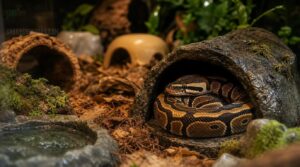
Getting the size right doesn’t have to be guesswork—it largely comes down to your snake’s weight and growth stage.
A quick look at this snake hide sizing guide by weight and growth stage takes the guessing out of the equation entirely.
The chart below maps out hide dimensions across every stage, from a tiny hatchling to a full-grown female. Use it as your starting point before picking anything off a shelf.
Hide Size by Weight and Growth Stage
Your ball python’s weight thresholds tell you more about hide sizing than age alone. As your snake moves through its growth curve, coil space and dimensional scaling both shift — so regular fit assessment matters.
| Weight Range | Interior Dimensions |
|---|---|
| Under 150 g | ~4 × 3 in |
| 150–500 g | ~5 × 4 in |
| 500–1,500 g | ~6 × 5 in |
| 1,500 g+ | ~8 × 12 in |
Hatchling Hides for Snakes Under 150 G
Hatchlings under 150 g require snug, secure spaces—prioritize cozy over roomy. A dark interior color helps them feel concealed, directly reducing stress. Use non-toxic materials with a smooth interior finish to prevent skin snags during movement.
| Weight | Interior Dimensions | Entrance Hole Diameter |
|---|---|---|
| Under 50 g | 1.5 × 1.0 in | 0.9 in |
| 50–100 g | 2.0 × 1.25 in | 1.0 in |
| 100–150 g | 2.5 × 1.5 in | 1.2 in |
| Any hatchling | 4 × 3 in interior | Snug-fit preferred |
| Growth spurt | Size up 0.5 in | Adjust accordingly |
Remember to provide at least two hides—one on the warm side and one on the cool side—to enable proper thermoregulation. Weekly spot-cleaning prevents bacterial buildup in these compact spaces.
Juvenile Hides for 150–500 G Ball Pythons
As your juvenile ball python grows from 150 to 500 g, hide sizing needs to keep pace. A snug fit still matters—too much space undermines security.
| Weight Range | Interior Dimensions | Recommended Inner Length |
|---|---|---|
| 150–250 g | 3.5 × 2.5 in | 3.5 in |
| 250–350 g | 4.0 × 3.0 in | 4.0 in |
| 350–500 g | 4.5 × 3.5 in | 4.5 in |
Follow a weight upgrade schedule every 100–150 g gained. Prioritize smooth plastic for your material choice—it facilitates a simple cleaning routine and resists bacteria. A low, rounded entrance shape encourages full entry, while a minimal ventilation strategy keeps humidity stable without moisture loss.
Sub-adult Hides for 500–1,500 G Ball Pythons
Once your ball python crosses 500 g, sizing becomes more deliberate. Use this chart to stay ahead of each growth stage:
| Weight | Interior Dimensions |
|---|---|
| 500–750 g | 5.0 × 4.0 in |
| 750–1,000 g | 5.5 × 4.5 in |
| 1,000–1,250 g | 6.0 × 5.0 in |
| 1,250–1,500 g | 6.5 × 5.5 in |
Prioritize material durability—resin withstands frequent cleaning without warping. Good ventilation design prevents moisture buildup, while security features like a snug entrance support natural thermal gradients. A properly sized humid hide benefits shedding greatly at this stage.
Adult Male and Female Hide Dimensions
Adults need precise sizing—males and females differ more than you’d think. Use this as your baseline:
| Metric | Adult Male | Adult Female |
|---|---|---|
| Length | 6–8 in | 7–9 in |
| Width | 4–5 in | 4.5–6 in |
Size proportionality matters because female width variation reflects their heavier girth. Stable base design prevents tipping, and material smoothness protects the skin. A height headroom of 3–4 inches keeps both sexes comfortable.
For best results, pair these design choices with accurate heat mat calibration—understanding how thermostats and heat mats work together helps you maintain a stable warm zone your snake will actually use.
Interior Length, Width, and Height Guidelines
Each dimension tells its own story. Interior length should match your snake’s snout-to-tail measurement, while width follows the width-girth ratio—slightly wider than the mid-body coil diameter. Height clearance requires at least 1 cm above the coil.
| Dimension | Measurement Rule |
|---|---|
| Length | Equals full body length |
| Width | 1–1.5× body girth |
| Height | Coil height + 1 cm |
| Unit | Metric conversion guide applies |
Dimension consistency checks ensure sizing remains proportional as your snake grows.
When to Size Up Your Ball Python’s Hide
Size up when you notice stress signals—restless roaming, appetite changes, or failed shedding cycles. These are your snake’s clearest cues that the current hide no longer fits.
| Trigger | What It Means | Action |
|---|---|---|
| Shedding issues | Hide too small for full coil | Upgrade immediately |
| Appetite changes | Insecurity from poor fit | Size up one stage |
| Seasonal humidity shifts | Moisture retention drops | Switch to larger humid hide |
| Growth spurt triggers | Girth exceeds hide width | Match new body measurements |
| Stress signals | Constant exposure behavior | Reassess hide dimensions |
How to Measure The Right Fit
Getting the size right comes down to a few simple checks you can do before buying anything. Each measurement ties directly to how safe and settled your ball python feels inside the hide.
Here’s what to look at.
Use The Snug-fit Rule
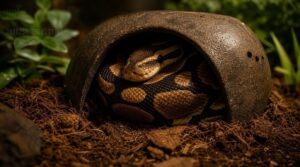
The snug-fit rule is simple: your hide’s interior should measure 1 to 1.5 times your snake’s mid-body coil diameter. This Coil Space Ratio keeps walls close enough for your python to feel secure. Add a Length Buffer of 1.25 times total body length, plus a Headroom Buffer of at least 1 cm above the coil.
Watch for stress signals like roof-tapping or hide avoidance.
Match Hide Width to Body Girth
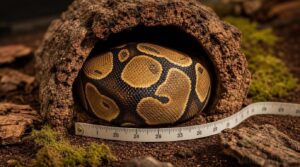
Width is where most keepers go wrong. Your girth measurement method is straightforward: use flexible tape selection—a non-elastic tape pulled snugly at the snake’s widest mid-body point. That number guides your width girth ratio directly.
Follow these five guidelines:
- Match hide width to measured girth
- Allow no more than 10–20% excess width
- Practice monthly girth monitoring during growth phases
- Adjust hide snugness as weight increases
- Replace when girth grows 15% or more
Make Sure Your Snake Can Coil Fully
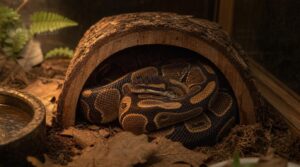
A cramped hide creates coil stress indicators—restlessness, refusal to settle, and irregular feeding. These signs signal discomfort, emphasizing the need for proper enclosure sizing. Use your snout-to-tail measurement to confirm the hide matches the snake’s total length, ensuring adequate space for natural coiling behavior.
Critical factors like Coil Clearance Height, Coil Comfort Temperature, and Coil Entry Design depend entirely on this precise fit. Regular monitoring is key: observe the snake’s posture, particularly for awkward angles after feeding, which may indicate ongoing spatial issues.
Avoid Hides That Are Too Large
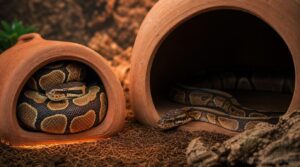
Bigger isn’t always better. An oversized hide causes Stress Amplification — your snake can’t feel walls around it, so it never truly settles. Limited Thermoregulation follows, as extra dead air space impairs Heat Dissipation from your heat mat. You’ll also increase the Escape Risk at the entrance.
An oversized hide leaves your snake unsettled, cold, and one step closer to escaping
Watch for these oversized hide problems:
- Coil Confinement fails — the snake stretches instead of curling
- Reduced contact with walls lowers the sense of security
- Heat Dissipation drops, creating cooler microclimates inside
- Appetite and stress levels shift unpredictably
- Selecting an appropriate hide size based on snake length prevents all of this
Avoid Hides That Are Too Tight
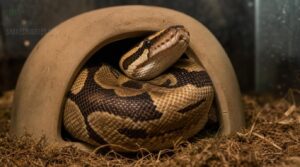
Too tight is just as problematic. When a hide squeezes your snake’s midsection, it creates Pressure Points along the ribs, restricting natural body expansion and triggering Respiratory Constraints during rest.
Over time, Stress Signals—such as awkward head positioning, Escape Attempts, and reduced appetite—indicate the fit is off. Shedding Failures also follow, as restricted movement limits how cleanly your snake peels its old skin.
Check for Roof Contact and Headroom
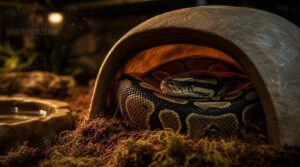
Roof contact is the overlooked half of fit. Even a correctly sized hide fails if its roof curvature presses on your snake’s head when coiled. Allow 1.5–2 inches of head clearance for hatchlings and up to 3 inches for adults.
Check material rigidity after heating cycles; warping reduces headroom fast.
Ventilation gaps shouldn’t create drafts, and growth adjustments every 2–4 weeks keep your snug-fit hide criteria accurate.
Signs Your Ball Python Dislikes The Hide
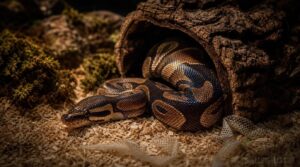
Your snake rarely lies — watch its behavior. Refusal to enter is the clearest red flag, often triggered by a hide that’s too narrow or too tall. Frequent outside resting signals discomfort inside.
Three other signs indicating the need for new hides:
- Shedding issues from poor humidity exchange
- Odor aversion causing repeated avoidance
- Wobble avoidance when the hide shifts underfoot
Hide Placement and Quantity
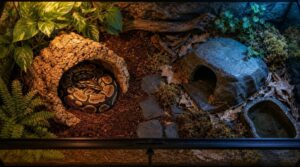
Getting the size right is only half the battle—where you put the hide matters just as much. Your ball python needs at least two hides, each placed in the right thermal zone, to truly feel secure.
Here’s how to set them up correctly.
Provide at Least Two Hides
Two hides aren’t optional — they’re the foundation of a healthy setup. One on the warm side, one on the cool side. This thermal regulation setup gives your ball python microclimate diversity and real behavioral enrichment. Without multiple hide options, stress reduction becomes impossible.
Here’s the recommended breakdown:
| Hide Type | Placement | Purpose |
|---|---|---|
| Warm-side hide | Near heat source | Digestion, warming |
| Cool-side hide | Away from heat | Resting, escape prevention |
| Humid hide | Center to warm | Shedding support |
Warm-side Hide Size and Placement
Heat source alignment is everything on the warm side. Position your hide directly over or immediately adjacent to the heat source, keeping the entrance oriented for easy access. Interior sizing should match your snake’s growth stage — 3.5 to 4.5 inches for hatchlings, up to 9 inches for adults.
Key placement priorities:
- Use a non-slip base to prevent tipping
- Keep radiant clearance around the entrance open
- Confirm interior temps hit 88–92°F with a thermometer
Cool-side Hide Size and Placement
On the opposite end of the enclosure, your cool side hide does the heavy lifting for thermal isolation. Push it as far as possible from the heat source—this Cool Zone Distance keeps floor temperatures between 76–80°F.
Match the size guidelines for ball python hides to your snake’s current weight, and confirm the snug fit hide criteria to ensure comfort. Properly sized hides reduce stress and support natural behaviors.
Shield the entrance from direct airflow to maintain Ventilation Shielding, preventing drafts while allowing adequate air circulation. This balance ensures a stable microclimate within the enclosure.
When to Add a Humid Hide
Pre‑shed cues are your signal to act—don’t wait until your ball python is actively shedding. When you notice milky eyes, dull skin, or an appetite dip, humid hide importance for shedding becomes real.
Add your humid hide immediately, positioning it on the warm side. Keep moss re‑dampening on schedule every two to three days for reliable humidity control throughout the entire shedding process.
Humid Hide Sizing for Shedding
Sizing your humid hide correctly makes or breaks a clean shed. Hatchlings under 150 g need a snug 3–4 inch interior; juveniles 150–500 g fit 4–6 inches; sub-adults and adults scale up from there.
Moisture retention depends on moss depth—pack it two-thirds full. Humidity monitoring keeps levels at 80–90%.
Material choice and ventilation design affect how long that moisture actually holds.
Use Stable, Tip-resistant Hides
A tipped hide is a failed hide. Your ball python won’t use a shelter it doesn’t trust. Choose hides with weighted base and low center-of-gravity design so your snake can’t knock them sideways while coiling. Reinforced walls prevent deformation under pressure.
A non-slippery surface keeps everything locked in place—especially important in a damp hide box packed with sphagnum moss.
Place Hides in Quiet Enclosure Areas
Corner placement matters more than most keepers realize. Tuck hides into low-traffic corners where your snake gets a single, predictable approach path and minimal visual exposure.
Sound-dampening hides made from dense plastic or ceramic help muffle equipment noise.
Keep at least 3 cm of clearance from surrounding decor, and maintain ventilation buffering so camouflaged entrances stay dry without becoming stale.
Top 5 Ball Python Hides
Once you know the right size, the next step is finding a hide that actually delivers on fit, durability, and ease of cleaning. These five options cover a range of sizes, materials, and price points, so there’s something here for every stage of your python’s growth.
Here’s what made the cut.
1. Leoterra Plastic X Large Ball Python Hide
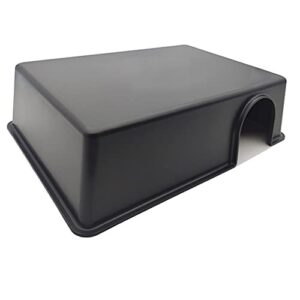
The Leoterra XL hide excels for adult ball pythons, offering ample space at 16.5 × 10.6 × 4.3 inches. This size allows snakes to coil fully without feeling exposed, ensuring comfort and security.
Its top-seal design effectively locks in humidity, making it ideal for wet hide setups during shedding cycles. Rounded edges eliminate injury risks during entry or exit, prioritizing safety.
Cleanup is straightforward—simply wipe and rinse, ensuring hassle-free maintenance.
One caveat: snakes exceeding 2.4 kg may find the space slightly restrictive.
| Best For | Adult ball pythons over 200g that need a roomy, humidity-friendly hide for everyday comfort and shedding support. |
|---|---|
| Material | Rigid plastic |
| Overall Dimensions | 16.54″ × 10.63″ × 4.33″ |
| Color/Finish | Black |
| Easy to Clean | Yes, smooth interior |
| Multi-Species Use | Snakes, reptiles |
| Weight | 14.11 oz |
| Additional Features |
|
- Holds humidity well, making it great for wet hide setups during shed cycles
- Smooth, rounded edges mean no injury risk when your snake moves in and out
- Easy to clean — just wipe it down and rinse, no fuss
- Very large snakes over 2.4 kg may find it a bit cramped
- Lightweight enough that a heavier snake can lift or shift it around
- A bit pricier than some similar plastic hides on the market
2. Amypet XXL Snake Hide
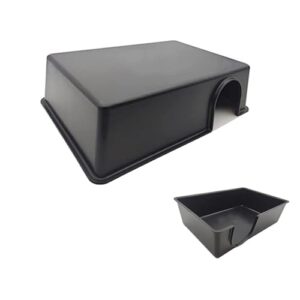
If your python is on the smaller side of adult, the Amypet XXL is worth a close look. It measures 13.25 × 8.8 × 3.1 inches—compact enough to fit a standard 20-gallon tank without dominating floor space.
The entrance opening sits at roughly 2.75 inches in width, which suits most adult ball pythons without forcing them to squeeze.
Constructed from BPA-free plastic, it ensures easy cleaning, while rounded edges prevent scale snagging.
It is lighter than the Leoterra, weighing about 9.6 ounces.
| Best For | Full-grown corn snakes, milk snakes, king snakes, and ball pythons that need a roomy hide with space to actually stretch out and feel secure. |
|---|---|
| Material | Rigid plastic |
| Overall Dimensions | 16.5″ × 10.6″ × 4.3″ |
| Color/Finish | Black |
| Easy to Clean | Yes, wipe-down surface |
| Multi-Species Use | Snakes, reptiles |
| Weight | 15.2 oz |
| Additional Features |
|
- Genuinely large at 16.5 × 10.6 × 4.3 inches, so adult-sized snakes aren’t cramped
- Super easy to clean — smooth, non-porous plastic wipes down fast and doesn’t harbor bacteria
- You can bury it, toss some moss on top, or stack rocks around it to make it look natural
- The entrance is 4.4 × 3.54 inches, so you’ll want to double-check it’s the right fit for your specific snake before buying
- At around 15 oz, it’s a bit chunky to move around if you’re working in a smaller tank
- Way too big for juvenile snakes — this one’s strictly for adults
3. FCALIVV Large Reptile Hide Box
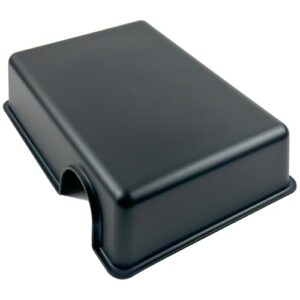
Need something a step up from the Amypet? The FCALIVV Large Reptile Hide Box comfortably accommodates sub-adult and adult snakes with its 9.45 × 6.89 × 2.17-inch frame. Its low-profile height ensures a snug fit without compromising your snake’s coiling space.
The offset single entrance minimizes stress by limiting visible open space upon entry, creating a secure environment. Rigid black plastic construction enables fast, effortless cleaning, maintaining hygiene with minimal effort.
At $9.98, this hide box offers exceptional value, allowing you to run two or three units in one setup without straining your budget.
| Best For | Budget-conscious reptile owners who need a practical, easy-to-clean hide for sub-adult or adult snakes, geckos, or other small-to-medium reptiles. |
|---|---|
| Material | Rigid plastic |
| Overall Dimensions | 9.45″ × 6.89″ × 2.17″ |
| Color/Finish | Black |
| Easy to Clean | Yes, rinse and sanitize |
| Multi-Species Use | Snakes, geckos, tarantulas |
| Weight | 5.29 oz |
| Additional Features |
|
- Super affordable at $9.98 — easy to grab a few and set up multiple hides in one tank
- Low-profile design and offset entry help your reptile feel secure and stress-free
- Smooth plastic interior wipes down in seconds, making cleanup a breeze
- Pretty plain-looking — if you want décor that actually impresses, this won’t cut it
- The single opening size needs to be checked against your specific animal before buying
- Plastic doesn’t hold heat or offer the natural texture that cork or wood hides do
4. Humid Hideout Reptile Cave
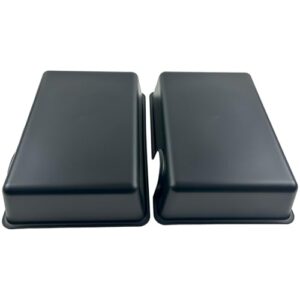
When shedding season hits, having the right humid hide makes all the difference. The Humid Hideout Reptile Cave features a 9.5 × 6.7 × 2.2-inch interior — roomy enough for most adult ball pythons to coil comfortably.
Its non-porous resin surface resists mold, and the recessed base keeps it firmly in place.
You can pack damp sphagnum moss inside to maintain the 80–90% humidity your snake needs for a clean, complete shed every time.
| Best For | Reptile owners looking for a durable, easy-to-clean hide that works for everything from hatchlings to adults — especially great for ball pythons, leopard geckos, and bearded dragons. |
|---|---|
| Material | High-density resin |
| Overall Dimensions | Large: 9.5″ × 6.7″ × 2.2″ |
| Color/Finish | Rock-textured natural |
| Easy to Clean | Yes, smooth surface |
| Multi-Species Use | Snakes, geckos, dragons |
| Weight | ~9.6 oz combined |
| Additional Features |
|
- Comes in two sizes, so one pack covers both young and grown reptiles without buying extra gear.
- Non-toxic resin holds up against biting, scratching, and climbing without cracking or breaking down.
- The rock texture looks natural and blends right into any bio-active or themed setup.
- Resin doesn’t hold moisture as well as cork or wood, so high-humidity species may need extra help keeping things damp.
- The large hide might feel too open for very small juveniles, which can make them feel exposed instead of safe.
- Fixed dimensions mean it might not fit neatly in narrow or oddly shaped enclosures.
5. Repticircle Medium Resin Reptile Hide
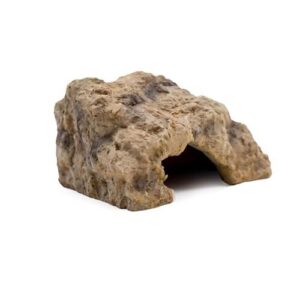
The Repticircle Medium Resin Reptile Hide works best for ball pythons in the 300–900-gram range. Its interior measures roughly 12 cm long by 6 cm wide by 5 cm high — enough room for a juvenile to coil without feeling cramped. The non-porous resin resists bacterial buildup, so cleaning is straightforward.
Note that the entrance runs wider than ideal; partially burying it in substrate helps your snake feel more secure inside.
| Best For | Small to medium reptiles like juvenile ball pythons, leopard geckos, and similarly sized amphibians who need a cozy, enclosed hideout. |
|---|---|
| Material | Non-toxic resin |
| Overall Dimensions | 2″ × 2″ × 1.99″ |
| Color/Finish | Natural rock/branch |
| Easy to Clean | Yes, finished surface |
| Multi-Species Use | Snakes, geckos, amphibians |
| Weight | 1.1 lb |
| Additional Features |
|
- Looks natural — the rock/branch texture blends nicely into most terrarium setups
- Non-toxic resin is easy to clean and holds up well in both dry and humid environments
- Fits snugly into tank corners, so it doesn’t eat up much floor space
- Runs small for the "medium" label — larger adult reptiles will likely feel cramped
- Some units arrive with rough edges that may need a quick filing before use
- Fragile in shipping; a few buyers have reported receiving it shattered right out of the box
Frequently Asked Questions (FAQs)
Can I use temporary hides for my baby ball python?
Yes, but keep it snug. A temporary hide works fine for a baby ball python as long as the interior is about 5–6 inches long, smooth, opaque, and lets your hatchling coil fully.
What are the advantages of using temporary hides for ball pythons?
Temporary hides let you test sizing before committing to permanent decor, and they’re easy to swap out as your snake grows. They’re also budget-friendly and simple to sanitize quickly.
What should I consider when choosing hides for my ball python?
As the saying goes, "measure twice, cut once." Choose hides based on your snake’s weight, girth, and growth stage.
Prioritize a snug fit and proper placement to ensure comfort and security.
Opt for easy-to-clean materials to maintain long-term health and hygiene.
How many hides should I provide for my ball python?
You’ll want at least two hides: one on the warm side and one on the cool side.
A third hide option can really help enrichment-focused setups—corn snake cage design ideas with multiple levels and climbing features show how extra cover spots encourage more natural exploration.
Add a third humid hide during shedding season to keep moisture where your snake needs it most.
What are some recommended hides for ball pythons?
Some solid picks include the Leoterra Plastic XL Hide, Amypet XXL Snake Hide, FCALIVV Large Reptile Hide Box, Humid Hideout Reptile Cave, and Repticircle Medium Resin Hide.
How big of a hide for a ball python?
Your ball python’s hide should fit snugly around its coiled body — interior length matching total body length, width matching its widest girth, and at least 1 inch of headroom above.
Can a snake know its owner?
Yes, snakes can recognize their owners through scent, touch, and routine.
Your ball python may tongue-flick more calmly around you and show less defensive behavior after consistent, gentle handling over time.
Can two ball pythons share the same hide?
Sharing a hide is like two strangers fighting over one umbrella—someone always loses. Technically possible, but most experts advise against it.
Crowding triggers stress, suppresses appetite, and raises disease risk.
Each snake needs its own hide.
What hide materials are safest for ball pythons?
Plastic, resin, and ceramic are your safest bets. They’re non-porous, easy to disinfect, and won’t trap bacteria. Cork bark works too, as long as it’s sealed.
How often should you replace a ball pythons hide?
Replace a ball python’s hide when it cracks, warps, shows mold, or no longer fits your snake’s body.
Most durable hides last 6–18 months with proper weekly cleaning and monthly deep sanitizing.
Conclusion
A hide isn’t just furniture—it’s your snake’s anchor, the one place where the outside world stops mattering. When the walls touch your snake’s body, stress drops, feeding resumes, and behavior normalizes.
Knowing what size hide for ball python setups actually works comes down to snug contact, not guesswork. Match the dimensions to your snake’s current weight, check the fit every few months as it grows, and you’ve solved the problem most keepers overlook entirely.
- https://reptifiles.com/ball-python-care-guide/ball-python-terrarium-size-lighting/
- https://www.wilbanksreptiles.com/blogs/ideal-tank-size-for-healthy-ball-pythons/what-is-the-recommended-tank-size-for-a-ball-python?srsltid=AfmBOorZGiWMXsh-ohndz_hMECYDQFFJ_vJMM4vRS0YFMiRtnaDCgnGf
- https://www.reptilerescuecenter.org/caresheets/ballpython/