This site is supported by our readers. We may earn a commission, at no cost to you, if you purchase through links.

Ball pythons live 20 to 30 years—longer than most dogs, and sometimes longer than a college student’s entire academic career.
That single fact often encourages reframing the decision for a lot of first-time owners.
This isn’t a starter pet you’ll outgrow; it’s a commitment that will follow you through apartments, relationships, and maybe even a few career changes.
The good news is that ball pythons are genuinely forgiving animals.
Their naturally shy temperament and modest adult size of around four to five feet make them one of the most manageable constrictors a beginner can own.
Getting the setup right from day one makes all the difference between a snake that thrives and one that barely tolerates its enclosure.
Table Of Contents
- Key Takeaways
- Is a Ball Python Right?
- Set Up The Enclosure
- Choose Safe Substrate
- Control Heat and Humidity
- Add Hides and Water
- Feed Your Ball Python
- Handle and Monitor Health
- Top 5 Beginner Care Items
- Frequently Asked Questions (FAQs)
- What morphs are best for beginners?
- How much do ball pythons cost initially?
- Can ball pythons live with other snakes?
- Do ball pythons need special lighting requirements?
- What vaccines or preventative care do they need?
- How do I choose a reputable ball python breeder?
- What morphs are best for first-time owners?
- How long should new arrivals be quarantined?
- What are common signs of a healthy snake?
- How often should I weigh my ball python?
- Conclusion
Key Takeaways
- Ball pythons live 20–30 years, so owning one means committing through apartments, jobs, and life changes — not just a phase.
- Getting temperature and humidity right from day one is the single biggest factor in whether your snake thrives or just survives.
- Every snake needs its own enclosure with two hides, a clean water bowl, and a clear warm-to-cool gradient — no shortcuts, no roommates.
- Frozen-thawed prey, consistent feeding schedules, and a 48-hour post-meal hands-off rule are the three feeding habits that prevent most beginner mistakes.
Is a Ball Python Right?
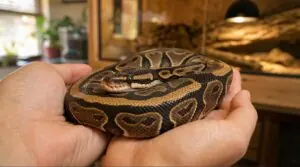
Before you bring a ball python home, it helps to know what you’re actually signing up for. They’re one of the most forgiving snakes you can own — but "forgiving" doesn’t mean "no work." Here are a few things to think through first.
Feeding is where many owners hit their first real snag, so it’s worth getting familiar with common ball python feeding problems and how to fix them before you’re staring at an untouched mouse.
Beginner-friendly Temperament
Ball pythons are genuinely one of the easiest snakes to handle as a beginner. They’re naturally shy rather than aggressive, and most calm down within minutes of being picked up.
Consistent, gentle handling builds trust over time.
That said, every snake has its own personality — some stay relaxed from day one, while others need a slower approach.
Adult Size Expectations
Size is one thing most beginners get wrong before buying. Adult ball pythons commonly reach 4 to 5 feet, with females running larger than males. Growth slows noticeably after age three or four.
- Females commonly reach 4.5–5 feet
- Males usually stay around 4–4.5 feet
- Genetics and diet influence where your snake lands in that range
Long Lifespan Commitment
Growth slows after a few years — but your commitment won’t. Ball python lifespan commonly runs 20–30 years, and some reach well beyond that with stable care.
Ball pythons outlive the enthusiasm that brought them home — plan for 20 to 30 years, minimum
| Life Stage | Approximate Age | Key Care Focus |
|---|---|---|
| Juvenile | 0–3 years | Feeding consistency |
| Young Adult | 3–10 years | Environmental stability |
| Prime Adult | 10–20 years | Veterinary care |
| Senior | 20–25 years | Stress reduction |
| Geriatric | 25–30+ years | Geriatric enrichment |
This is a long-term pet commitment — plan accordingly.
Nocturnal Activity Patterns
Your ball python won’t follow your schedule — it follows the sun’s absence. These snakes are naturally nocturnal, peaking in activity after dusk.
Some even show crepuscular behavior around twilight. Keep the warm side above 85°F at night to support temperature-driven movement.
Dim the room lights consistently — a steady lighting cycle keeps their internal clock on track.
Individual Housing Needs
Each snake needs its own dedicated ball python enclosure — no exceptions. Cohousing causes stress, competition, and fast disease transmission.
A single enclosure lets you fine-tune the temperature gradient, humidity level, and substrate to that one animal’s exact needs. It also makes quarantining a sick snake straightforward.
Think of it as giving your python its own apartment — personal, controlled, and secure.
Set Up The Enclosure
Getting the enclosure right is the foundation of everything else. Your ball python’s home needs to match its size, or you’ll run into stress and health problems fast. Here’s what to know at each stage of growth.
Hatchling Tank Size
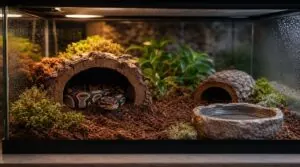
A hatchling doesn’t need a mansion — it needs a den. Start with a 10-gallon enclosure to keep your new ball python feeling secure. A hatchling requires a minimum hatchling tank size of at least 10 gallons.
Here’s what works best:
- At least 3–4 body lengths of floor space for natural movement
- Hides covering ¼ of the floor to reduce stress
- A clear warm-to-cool gradient across the tank length
Juvenile Enclosure Needs
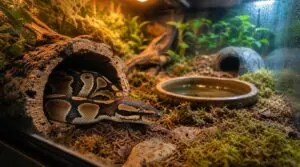
As your ball python grows past 12 inches, a 20–30 gallon enclosure becomes the right fit. Juveniles need space to move without feeling exposed.
Keep the warm side at 88–92°F, the cool side around 78–85°F, and humidity between 50–60%.
Place two snug hides on opposite ends so your snake can thermoregulate comfortably and confidently.
Adult Enclosure Size
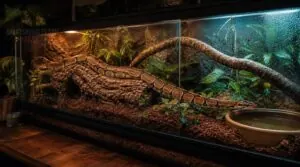
Once your python hits adulthood, cramped quarters become a real problem. Adults need at least a 40–60 gallon enclosure — roughly 4 × 2 feet of floor space — so they can stretch fully without touching the opposite wall.
- Minimum height: 12–18 inches for airflow
- Floor length: 1.5–2× the snake’s body length
- One adult per enclosure — always
- Plan for 20–30 years of use
Front-opening Tank Benefits
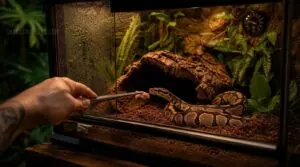
Front-opening tanks are a quiet breakthrough for new keepers. Reaching in from the front — not looming overhead — means reduced stress for your python during every interaction.
| Benefit | Why It Matters |
|---|---|
| Front Access Feeding | Tongs slide in cleanly without disturbing hides |
| Easy Cleaning | Remove substrate without dismantling heat sources |
| Secure Latch | Keeps panels locked between checks |
Escape-proof Lid Checks
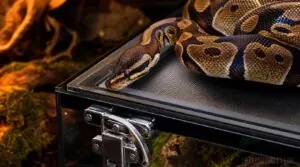
Even a calm ball python will test every weak point in its enclosure — methodically. Run these five lid checks before closing up each time:
- Lid Seal Check — press along the full perimeter for gaps
- Hinge Pin Inspection — feel for looseness or wear
- Lock Engagement Test — confirm the latch clicks fully
- Gap Prevention Methods — apply foam gasket where needed
- Ventilation Barrier Review — verify mesh is intact, not bent
Choose Safe Substrate
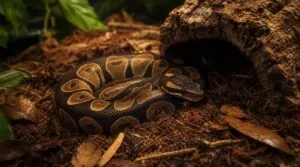
What you put on the floor of your ball python’s enclosure matters more than most beginners expect. The right substrate holds humidity, feels natural underfoot, and keeps your snake comfortable — the wrong one can cause serious health problems. Here are the best options to choose from.
Coconut Husk
Coconut husk — also called coco fiber — is one of the best substrates you can choose. It’s made from the fibrous layer between a coconut’s outer skin and hard shell, and those natural coir fibers are surprisingly strong and absorbent.
That structure makes it excellent for humidity control, keeping levels steady between 55–65% without much effort on your part.
Cypress Mulch
Cypress mulch is another solid substrate choice for your ball python enclosure. Its natural pest deterrent oils help keep unwanted insects away, and its strong moisture retention benefits make humidity control noticeably easier. It usually holds levels right in that 55–65% sweet spot.
Here’s why it works well:
- Absorbs water without becoming soggy
- Moderates enclosure temperatures at the surface level
- Decomposes slowly, so you replace it less often
- Available from suppliers following sustainable harvesting practices
Apply it at roughly 2–3 inches deep for best results.
Orchid Bark
Orchid bark brings a different texture to your setup. It’s made from chunky fir or pine bark pieces that let air move freely around the enclosure floor — a real win for preventing moisture buildup.
Stick with a coarse grade for adults.
Always soak it before use so your snake’s environment stays balanced from day one.
Bioactive Mixes
Bioactive mixes take substrate to another level. Instead of just covering the floor, you’re building a living microbial ecosystem — complete with a working nitrogen cycle that breaks down waste naturally.
Add detritivore species like springtails and isopods, and they’ll handle mold and organic matter for you. It’s a self-maintaining setup that keeps your ball python’s home cleaner, longer.
Substrates to Avoid
Not every substrate is safe — some are outright dangerous. Cedar and pine release natural oils and resins that irritate your ball python’s respiratory tract, causing wheezing and long-term damage. Fine sand or gravel risk impaction if swallowed. Clay-based cat litters raise harmful dust levels. Colored decorative substrates may carry toxic dyes.
Stick with coconut husk, coco fiber, or cypress mulch instead.
Control Heat and Humidity
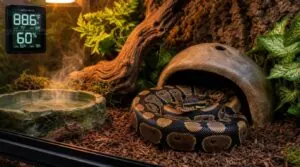
Getting the temperature and humidity right is honestly one of the most important things you’ll do for your ball python. Too hot, too cold, or too dry — any of those can cause real problems fast. Here’s exactly what you need to dial in before your snake comes home.
Warm-side Temperature Range
The warm side of your ball python’s enclosure does more than just feel cozy — it drives digestion, activity, and overall health. Your warm-side set point should land between 88–92 °F (31–33 °C), with a basking spot surface reaching up to 94 °F. That thermal gradient gives your snake the ability to self-regulate by moving between warmer and cooler zones.
- Heat source placement matters: under-tank pads or heating cables create belly-contact warmth, which ball pythons rely on most
- Always connect your heat source to a thermostat to prevent dangerous temperature swings
- Use an infrared thermometer for accurate temperature monitoring at substrate level, not air level
- Measure where the snake actually rests — surfaces can run hotter than surrounding air
Consistent thermostat calibration keeps the warm side stable day after day, so your snake digests meals properly and settles into predictable patterns.
Cool-side Temperature Range
The cool side should sit between 75–80 °F (24–27 °C) — the counterpart to your warm zone that makes real thermoregulation possible. Without that contrast, your snake has no reason to move.
| Measurement Point | Target Range |
|---|---|
| Cool-side substrate | 75–80 °F |
| Cool-side air | 76–80 °F |
| Minimum acceptable | 72 °F |
| Ideal daytime range | 78–80 °F |
| Probe placement height | Bedding level |
Measure at bedding level — that’s where your snake actually rests. Airflow from vents can skew readings, so keep probes away from drafts. Use a separate digital thermometer on each side for accurate temperature monitoring across the full gradient.
Safe Nighttime Temperatures
Nighttime doesn’t mean your snake gets a free pass on temperature. Let it drop too far, and you’re risking a sluggish, stressed reptile.
Aim for 70–75 °F on the cool side after dark — never below 72 °F.
A ceramic heat emitter keeps warmth steady without light disruption, and your thermostat manages the rest automatically.
Humidity During Shedding
Shedding is when pre‑shed moisture matters most. Once your ball python’s eyes cloud over, raise humidity to 65–75 % immediately.
A humid hide packed with damp sphagnum moss gives your snake a localized moisture zone without soaking the whole enclosure.
Without it, the fluid layer between old and new skin dries too fast — and stuck shed follows.
Thermostat and Hygrometer Use
Think of your thermostat and digital hygrometer as your enclosure’s autopilot. Your thermostat manages Thermostat Programming for both day and night cycles, so temperatures never swing dangerously.
Place sensors at your snake’s resting level, away from heat sources. Run Calibration Checks monthly. Enable Humidity Alerts to catch drops before they cause a bad shed.
Add Hides and Water
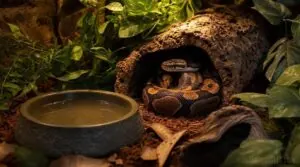
Once the temperature and humidity are dialed in, your ball python needs two more things to feel truly at home: places to hide and clean water to drink. These aren’t optional extras — they’re the difference between a stressed snake and a thriving one. Here’s what to set up inside the enclosure.
Warm-side Hide Placement
Placing your warm-side hide correctly can make or break your ball python’s comfort. Position it directly over or beside the undertank heating pad so your snake gets full access to that warm microclimate without venturing into open enclosure space.
Here’s what to get right:
- Set the hide at substrate level so your snake thermoregulates through body contact
- Keep a clear path toward the cool side for free movement
- Verify 88–92 °F inside using a probe placed at substrate level
- Choose a hide that fits snugly around your snake’s girth without restricting breathing
- Check for moisture buildup regularly, especially if you’re using damp bedding inside
Cool-side Hide Placement
The cool-side hide sits at the far end of the enclosure, away from any heat source. Verify the interior reads 72–80 °F using a probe thermometer.
Choose a snug, opaque hide at ground level so your snake stays hidden and stable. Keep it clear of drafts and decor that could snag your ball python during retreat.
Optional Humid Hide
A humid hide is optional but worth adding — especially if your ball python struggles during shedding.
Place it on the cool side to preserve moisture without overheating. Fill it with damp sphagnum moss, keeping it moist but never waterlogged.
The hide should fit snugly, and check it weekly for mold, replacing the moss as needed.
Heavy Soaking Bowl
Your ball python needs a heavy soaking bowl — one large enough for full-body immersion. Choose food-grade, BPA-free plastic or silicone that resists heat and won’t warp with repeated use. A low rim makes entry easy without tipping risk.
Place it on the warm side to encourage soaking, especially during shed cycles. Keep water depth shallow — covering only the lower body — and clean the bowl every two to three days.
Daily Water Checks
Every day, take thirty seconds to check your ball python’s water bowl. Look for cloudiness, debris, or any foul smell — replace the water immediately if something’s off.
Clean Water Routine matters more than most beginners expect.
Log each check in a water log so you can spot hydration patterns early and catch health issues before they escalate.
Feed Your Ball Python
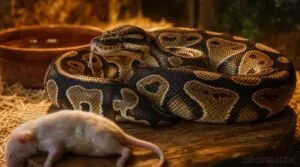
Feeding a ball python is simpler than most beginners expect, but a few key rules make all the difference. Get these right, and your snake will eat consistently and stay healthy for decades. Here’s what you need to know before your first feeding day.
Frozen-thawed Rodents Only
Live prey is off the table — full stop. Your ball python’s diet should consist entirely of frozen-thawed rodents, which are safer for your snake and far easier to manage.
Always thaw prey fully to around 36–38°C (98–100°F) before offering it. Use stainless steel tongs to present each rodent, keeping your hands clear to avoid stress or accidental strikes.
Prey Size Guidelines
Getting prey size right is one of the most critical decisions you’ll make at feeding time. A simple rule: match prey diameter to the widest point of your snake’s midsection — not the head or tail. If the meal leaves a dramatic lump or distorts the scales, it’s too large.
Target prey weight at roughly 10% of your snake’s current body weight — 15% maximum — to keep digestion stress-free.
Hatchling Feeding Schedule
Young hatchlings do best on a weekly feeding routine — offer one frozen-thawed pinky or fuzzy mouse every 5 to 7 days. Consistency matters more than exactness here.
- Skip feeding during active sheds
- Resume feeding 1–2 days after a complete shed
- Weigh weekly for growth weight tracking
- Wait 7–10 days before retrying after refusal
- Low temperatures cause feeding refusal — always verify warm-side heat first
Juvenile Feeding Schedule
Once your ball python hits the juvenile stage, its appetite picks up to match its growth rate. Aim to offer frozen-thawed mice every 7–10 days, sizing prey to match the snake’s widest girth.
| What to Track | How Often |
|---|---|
| Feeding attempts | Every 7–10 days |
| Body weight | Weekly |
Weigh your juvenile weekly — steady gains confirm your schedule is working.
Adult Feeding Schedule
Adults follow a relaxed rhythm: every 10–14 days is the sweet spot for most.
Match prey width to your snake’s thickest girth, thaw it to 98–100 °F, and offer it in the evening when your python is naturally active.
Weigh weekly — if weight creeps up, stretch to two weeks; if it drops, tighten the schedule.
Handle and Monitor Health
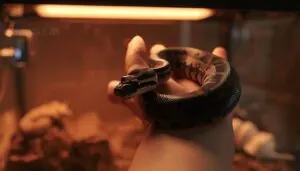
Getting the setup right is only half the job — how you interact with your ball python matters just as much for its long-term health. A few simple rules around handling and observation will help your snake settle in and thrive. Here’s what every new owner needs to know.
First-week Handling Delay
Most first-time pet owners are enthusiastic about holding their new snake right away — and that’s completely understandable. But wait at least 24–72 hours before any handling.
Your ball python needs time to settle, find its hides, and trust its new surroundings. Gentle handling sessions of just 3–5 minutes reduce stress and keep early stress indicators like rapid tongue flicking or a tight coil in check.
Post-feeding Handling Rules
Once you’ve waited out that first week, feeding introduces another pause. Wait 48 hours after every meal before handling your ball python.
Digestion needs steady warmth — keep warm-side temps at 88–92 °F. Even gentle handling too soon risks regurgitation. Use tongs to feed, note the time, then simply leave your snake alone to do its thing.
Stress Behavior Signs
Timing matters beyond meals, too. Your snake’s daily behavior tells you everything about how it’s feeling.
Watch for these top stress signals:
- Hiding for long periods — refusing to emerge even in low light and quiet conditions
- Skipping meals repeatedly — little to no strike response during feeding attempts
- Defensive posture or hissing — staying tense, head raised, striking at nearby movement
Shedding Problem Prevention
Behavioral stress signals are your early‑warning system — but shedding problems are just as telling.
When your ball python enters a shed cycle, its eyes turn bluish and its skin looks dull. That’s your cue to raise humidity to 65–75% and add damp sphagnum moss to the humid hide.
Never pull a stuck shed — soak first, reassess second.
When to Call Veterinarians
Even with perfect husbandry, emergencies happen.
Call a reptile vet immediately if your ball python shows labored or rapid breathing — a classic respiratory infection warning sign.
Other red flags include seizures, collapse, persistent vomiting, uncontrolled bleeding, or signs of toxin exposure like tremors and drooling.
Don’t wait and see. When something looks wrong, it usually is.
Top 5 Beginner Care Items
Getting your gear right from the start saves you a lot of guesswork down the road. These five items cover the essentials every new ball python owner needs before bringing their snake home. Here’s what belongs on your shopping list.
1. Stainless Steel Long Aquarium Reptile Tweezers

Feeding your ball python without stressing it out starts with having the right tool in your hand. Long stainless steel tweezers — like a 15-inch straight-and-curved set — keep your fingers safely away from a feeding strike.
The serrated tips grip prey firmly, so a thawed mouse won’t slip mid-offer.
After feeding, rinse and dry them thoroughly to prevent corrosion.
It’s a small investment that makes every feeding session calmer for both you and your snake.
| Best For | Reptile and aquatic pet owners who want a safe, reach-extending tool for feeding or tank maintenance without putting their hands at risk. |
|---|---|
| Primary Material | Stainless steel |
| Intended Use | Reptile feeding |
| Indoor Suitable | Yes |
| Portable | Yes |
| Easy to Clean | Moderate |
| Included Accessories | 2 tweezers |
| Additional Features |
|
- At 15 inches, they keep your hands well clear of feeding strikes — no more nervous moments with a hungry ball python.
- The set comes with both straight and curved tweezers, so you’re covered for feeding and aquascaping in one purchase.
- Stainless steel holds up well over time and won’t rust easily with proper care.
- The serrated tips are great for grip but a pain to clean thoroughly — bacteria can hide in those grooves.
- Not built for large prey or heavy-duty tasks, so if your animal eats big, these might not cut it.
- You’ll need to rinse and dry them after every saltwater or humid-environment use, or corrosion can sneak up on you.
2. Exo Terra Small Glass Terrarium
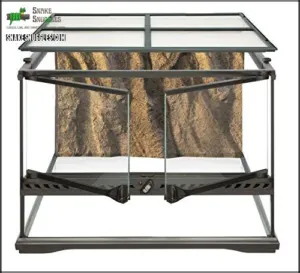
Once your tweezers are sorted, you need somewhere to actually put your snake.
The Exo Terra Small Glass Terrarium (18 × 18 × 12 in) is a solid starting point for a juvenile ball python. Its front-opening double doors make feeding and cleaning far less stressful — no reaching in from above, which can spook a shy snake.
Five closable back inlets let you run heat mats and sensors neatly. Just note: it’s a starter tank, not a forever home.
| Best For | Beginner reptile keepers housing juvenile ball pythons, leopard geckos, or small amphibians who want easy daily access and a clean setup. |
|---|---|
| Primary Material | Glass |
| Intended Use | Reptile enclosure |
| Indoor Suitable | Yes |
| Portable | No |
| Easy to Clean | Moderate |
| Included Accessories | Foam backdrop |
| Additional Features |
|
- Front-opening double doors make feeding and cleaning low-stress — no awkward reaching from above.
- Five closable back inlets keep cords and sensors tidy without breaking the enclosure seal.
- The raised bottom plate protects heater cords and makes under-tank heating a breeze to set up.
- Glass panels are fragile in shipping — damaged units on arrival are a known issue worth watching for.
- The included foam backdrop is thin and can trap small animals, so most keepers remove it right away.
- No built-in lamp fixture means you’ll need to budget for an external stand or bracket separately.
3. Inkbird Portable Thermometer Hygrometer

You can’t manage what you can’t measure. The Inkbird Portable Thermometer Hygrometer gives you real-time temperature and humidity readings in one compact unit — small enough to mount inside the enclosure using the included Velcro strips.
It reads 55–65% humidity and warm-side temps accurately within ±1 °C and ±3% RH.
During shed cycles, a quick glance tells you whether to mist. Powered by a single CR2032 battery, it’s low-maintenance and beginner-friendly.
| Best For | Beginners and hobbyists who need a simple, affordable way to keep tabs on temperature and humidity in small enclosures like reptile tanks, humidors, or instrument cases. |
|---|---|
| Primary Material | Plastic |
| Intended Use | Reptile monitoring |
| Indoor Suitable | Yes |
| Portable | Yes |
| Easy to Clean | Easy |
| Included Accessories | CR2032 battery, Velcro strips, manual |
| Additional Features |
|
- Compact and easy to mount — the Velcro strips make setup a breeze inside almost any enclosure
- Shows both temperature and humidity at once, plus tracks max/min values so you catch fluctuations you might have missed
- Runs on a single CR2032 battery, so day-to-day maintenance is basically zero
- The ±3% RH accuracy isn’t tight enough for premium cigar storage or other precision-sensitive setups
- Not water-resistant, so misting near it requires a little extra care
- Calibration support is pretty bare-bones — you may need to hunt down your own resources if something seems off
4. Etekcity Infrared Surface Thermometer

The Inkbird tells you what the air feels like — but the Etekcity Infrared Thermometer tells you what your snake actually feels.
Point it at the basking spot, pull the trigger, and you get a surface reading in under 500 ms. That’s the number that matters.
It measures from -58 °F to 1022 °F, so your 90–94 °F basking zone is well within range.
Just don’t aim it at your snake — it reads surfaces only, not living tissue.
| Best For | Reptile keepers and hobbyists who need fast, accurate surface temperature readings for basking spots, heating mats, or enclosure hot zones. |
|---|---|
| Primary Material | Plastic |
| Intended Use | Reptile temperature check |
| Indoor Suitable | Yes |
| Portable | Yes |
| Easy to Clean | Easy |
| Included Accessories | Battery |
| Additional Features |
|
- Instant readings in under 500 ms — point, pull, done
- Massive temperature range (-58 °F to 1022 °F) covers any vivarium setup you can think of
- Backlit display makes it easy to use during a late-night enclosure check
- Only reads surfaces, so don’t bother pointing it at your snake — it won’t tell you anything useful
- Reflective or shiny surfaces can throw off accuracy
- Battery type isn’t specified, so you might be scrambling for the right one when it dies
5. Ruff Ruff Aspen Snake Bedding
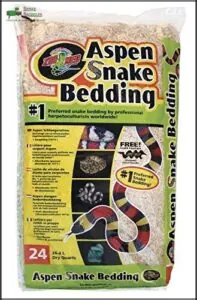
Your substrate completes the setup. Ruff Ruff Aspen Bedding is shredded aspen wood — no cedar, no pine, no toxic oils that could harm your ball python’s respiratory system.
It’s rated 99.9% dust-free and absorbs 191% of its volume in moisture, so wet spots stay contained and cleanup stays simple.
Spot-clean daily and do full changes as needed.
Just sift it before use — a few users report minor residual dust straight from the bag.
| Best For | Reptile owners keeping ball pythons, lizards, turtles, or tarantulas who want a natural, non-toxic substrate that supports burrowing behavior and makes cleanup easy. |
|---|---|
| Primary Material | Aspen wood |
| Intended Use | Reptile substrate |
| Indoor Suitable | Yes |
| Portable | No |
| Easy to Clean | Easy |
| Included Accessories | None listed |
| Additional Features |
|
- Made from renewable aspen wood with no cedar or pine — totally safe for your reptile’s respiratory system
- Absorbs nearly twice its volume in moisture, so wet spots stay localized and you’re not doing full changes constantly
- Naturally odorless and non-toxic, making it a solid pick for a wide range of reptile and amphibian species
- Some bags have residual dust, so sifting before use is a good habit rather than an optional step
- Large enclosures can burn through it fast, which adds up in cost and trips to the store
- There’s a reported ingestion warning worth following up on with the manufacturer, especially for species known to swallow substrate
Frequently Asked Questions (FAQs)
What morphs are best for beginners?
For beginners, pastel and spider morphs are your best starting point. They’re affordable, widely available, and come from stable genetic lines. Mojave and yellowbelly are solid second choices.
How much do ball pythons cost initially?
A normal ball python runs $40–$ Popular morphs like pastel or spider jump to $150–$ Budget $300–$800 for the full setup — enclosure, heating, and accessories cost more than the snake itself.
Can ball pythons live with other snakes?
Ball pythons are solitary animals — they do better alone. Cohabitation causes stress, territorial fights, and disease risk. Keep each snake in its own enclosure for safety and peace of mind.
Do ball pythons need special lighting requirements?
No, they don’t. Ambient room light is enough. Skip the spotlight — just keep a 12-hour light/dark cycle and focus your energy on nailing temperature gradients instead.
What vaccines or preventative care do they need?
Unlike dogs or cats, no routine vaccines exist for ball pythons. Prevention comes down to quarantine, hygiene, and vet checkups. A fecal test to screen for parasites is your first move after bringing one home.
How do I choose a reputable ball python breeder?
Choose a breeder who provides lineage records, offers a 30-day health guarantee, and feeds hatchlings frozen-thawed prey before sale. Ask for vet references and avoid anyone who can’t answer basic husbandry questions.
What morphs are best for first-time owners?
For beginners, normal and pastel morphs are hard to beat. They’re affordable ($50–$400), widely available, and genetically straightforward — no surprises in care or temperament.
How long should new arrivals be quarantined?
Quarantine for 30–45 days minimum. Extend it if your snake shows wheezing, loose stool, or feeding refusal. Only move it to the main enclosure once it’s eating well and testing clean.
What are common signs of a healthy snake?
A healthy snake has firm, even muscle tone, clear eyes, and sheds in one clean piece. It eats consistently, moves with coordination, and shows no swelling, discharge, or open sores anywhere on its body.
How often should I weigh my ball python?
Weigh hatchlings every 1–2 weeks, juveniles monthly, and adults monthly during steady feeding. During fasts or breeding season, shift adults to every 2–3 weeks. Always log in grams.
Conclusion
Like Atticus Finch once said, you never really understand something until you climb inside it—and ball python beginner care is no different. Every hide you place, every temperature gradient you dial in, every feeding routine you build becomes second nature faster than you’d expect.
Your snake won’t demand much, but it will notice everything you do right. Set the foundation carefully now, and you’ll share decades with one of the most quietly rewarding animals you’ll ever keep.