This site is supported by our readers. We may earn a commission, at no cost to you, if you purchase through links.
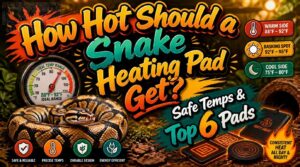
A snake can’t tell you when it’s too hot. It’ll sit on a burning surface, absorb the damage, and by the time you notice something’s wrong, a painful blister has already formed beneath its scales. That’s the hidden danger most new keepers miss: snakes don’t flinch away from heat the way we do.
The fix isn’t complicated, but it has to be precise. Safe heating pad surface temperatures fall between 88°F and 92°F for most common species, and crossing that line by even a few degrees puts your animal at real risk. Unregulated pads can quietly climb to 120°F or beyond.
Getting this right comes down to thermostat setup, probe placement, and knowing your species’ exact needs.
Table Of Contents
- Key Takeaways
- Safe Snake Heating Pad Temperature Range
- Ball Python and Corn Snake Temperatures
- Set Up Heating Pads Safely
- Troubleshoot Heating Pad Temperature Problems
- Top 6 Heating Pads for Snakes
- Frequently Asked Questions (FAQs)
- Do snakes require heating pads?
- How do snake heating pads work?
- How can you safely heat a snake terrarium?
- How do you heat a snake enclosure?
- How long can a snake go without a heating pad?
- What degree is too hot for snakes?
- Can heating pads be used with wooden enclosures?
- How long should a heating pad run daily?
- Do heating pads work well for nocturnal snakes?
- Should heating pads stay on during snake feeding?
- Conclusion
Key Takeaways
- Snakes can’t detect dangerous surface heat and won’t pull away from it, so burns develop silently before you ever notice a problem.
- A safe heating pad surface runs between 88°F and 92°F for most species, and crossing 95°F puts your snake into burn territory.
- A thermostat with a correctly positioned probe isn’t optional — without one, a heat mat can quietly climb past 120°F and become a serious hazard.
- Building a proper temperature gradient across the enclosure lets your snake move between warm and cool zones to regulate its own body temperature, which supports digestion, immunity, and overall health.
Safe Snake Heating Pad Temperature Range

Because snakes can’t generate their own heat, the warm-zone surface temperature carries real stakes. Get it wrong and you’re not just dealing with a cold reptile. You’re risking a burn.
Hot rocks are among the worst offenders—learn why heat sources that cause surface temperature spikes put your snake at serious burn risk.
For snakes, the wrong surface temperature isn’t just discomfort—it’s a burn waiting to happen
A safe heating pad holds the contact surface between 88°F and 92°F. That’s where digestion runs efficiently and reptile thermoregulation kicks in the way it should. Push past 95°F and you’ve crossed into injury territory.
Thermostat calibration is what keeps those numbers honest. Heat mat safety depends on it. Without a thermostat, a heat mat runs like an open tap, driving surfaces dangerously high before you notice. Dial it in, place your probe correctly, and the temperature gradient does exactly what it’s supposed to.
Ball Python and Corn Snake Temperatures

Ball pythons and corn snakes share a family but not a thermostat setting. Your Ball Python Warm Hide needs to hit 88–92°F on the heat mat surface. Corn snakes prefer a gentler Corn Snake Warm Side, sitting at 85–90°F. Small difference, real consequences.
A strong thermal gradient setup gives each animal real control. They move toward heat, retreat when they’ve had enough. That’s thermoregulation working as designed.
Here’s what getting these numbers right protects:
- Digestion that completes cleanly without stalling mid-meal
- A nervous system that stays calm instead of stress-cycling
- Immune function that holds up when it counts
- Muscle tone and appetite that signal a thriving animal
Keep your temperature probe in the warm zone. That reading matters most.
Set Up Heating Pads Safely
Setting up your heating pad correctly comes down to three things done right. Thermostat placement, surface verification, and gradient design each play a distinct role in keeping your snake safe and comfortable. Here’s how to nail all three.
If you want to see how these elements work together in a complete build, this snake heating pad buyer’s guide walks through pad sizing, thermostat selection, and placement in one place.
Thermostat and Probe Placement
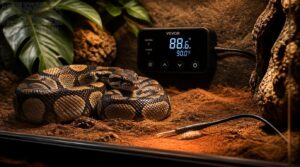
Because your probe placement strategy directly shapes every reading your thermostat takes, position the probe 0.5–1.0 inch from the warm surface, perpendicular to the mat.
| Component | Placement Rule |
|---|---|
| Thermostat unit | Midline under enclosure |
| Probe | 0.5–1.0 inch from warm surface |
| Sensing lead | Where snake rests most |
Good thermostat setup keeps the unit at midline, away from mat edges, blocking false highs.
Surface Temperature Checks
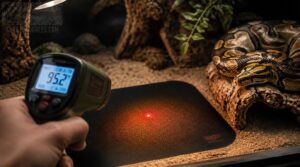
Once probe placement is locked in, verify with an infrared thermometer directly on the surface. Your thermostat reading alone isn’t enough.
- Scan the heat mat center
- Check 2 cm from center
- Check 6 cm from center
- Repeat every 2 hours for 24 hours
Thermostat calibration confirms your target surface temperature holds within ±2°C over a full day.
Warm Zone and Gradient
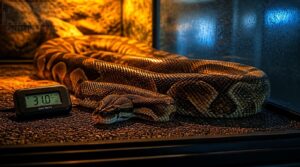
When your heat mat creates the right temperature gradient, your snake gets to choose its own comfort. Aim for a warm zone surface temperature of 29-32°C, with the cool side sitting 6-8°C lower.
Set your thermostat to hold that range and check it with a temp gun. Make the warm zone broad enough for your snake to stretch out fully.
A reptile infrared temperature gun lets you spot-check surface temps across the warm zone in seconds, without disturbing your snake.
Troubleshoot Heating Pad Temperature Problems

Something off with your temperatures? Start with the obvious: where’s your thermostat probe sitting? Probe placement errors cause more problems than faulty equipment ever does. If it’s measuring a cool corner, the pad runs unchecked until your warm zone becomes a danger zone.
Heat pad overheating usually has two culprits: a misplaced probe or thick substrate blocking heat transfer. Lift the substrate and take a direct surface reading with an IR gun. If temps are climbing past target, reposition the probe closer to the pad.
Temperature fluctuations that seem random often signal thermostat malfunction. Swap it out and retest. Solid thermal gradient management means your snake gets the range it needs, and you stop second-guessing your setup.
Top 6 Heating Pads for Snakes
Not every heating pad earns a spot in a well-run setup. The six options below cover a range of sizes, wattages, and control features worth knowing before you buy. Pick the one that matches your enclosure and your snake’s needs.
A thermostat-controlled reptile heating pad takes the guesswork out of temperature management, keeping your snake’s belly heat dialed in safely.
1. iPower Terrarium Heating Pad with Digital Thermostat
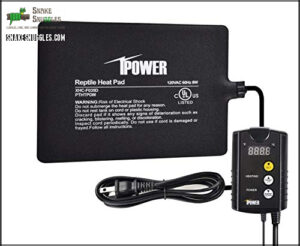
The iPower Terrarium Heating Pad with Digital Thermostat gives you built-in precision and control. Use it correctly with these four steps:
- Apply a smart heat pad placement strategy: center it under the warm zone
- Tuck your temperature probe under substrate, not against glass
- Complete thermostat calibration before your snake moves in
- Keep your overheat cutoff threshold locked firmly at 100°F
2. Zacro Adjustable Reptile Heating Pad
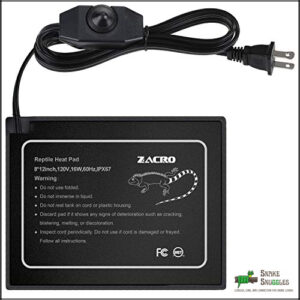
The Zacro Adjustable Reptile Heating Pad gives you dial control, but a dial alone isn’t a true guarantee. You need a temperature probe for real accuracy and solid thermostat calibration before your snake settles in. Factor in substrate thickness too. Thicker bedding insulates the mat’s output, which means your heat pad wattage selection matters more than most new keepers expect.
| Variable | Setting | Effect |
|---|---|---|
| Wattage | 4-8W per enclosure size | Controls max heat output |
| Substrate depth | 1-2 inches | Buffers surface temperature |
| Thermostat probe | Centered on warm zone | Locks in accurate readings |
3. VIVOSUN Reptile Under Tank Heating Pad
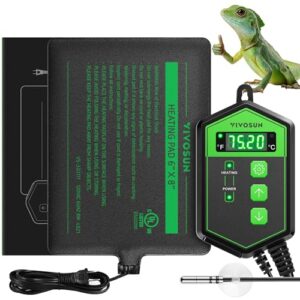
Quiet, reliable, and affordable. The VIVOSUN undertank heater fits multiple tub sizes without fuss. Its adhesive-backed design holds the heat mat flush under substrate, minimizing uneven hot spots.
Don’t skip the thermostat. This pad runs warm unchecked. Monitor surface temps closely, since substrate thickness directly shifts your temperature gradient and can push your warm zone out of the safe range.
4. Zoo Med Reptitherm Undertank Heater
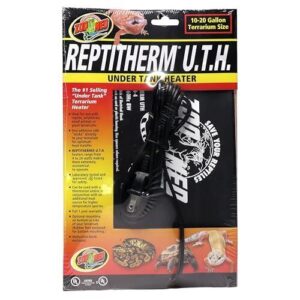
A classic for good reason. The Zoo Med Reptitherm fits 10 to 20 gallon terrariums and keeps setup simple with its adhesive-backed plastic design.
The catch? It has no built-in thermostat, and unregulated, it can hit 120 to 130°F, which is dangerous for any snake. Pair it with an external thermostat, probe centered at the warm zone, and cap the surface at 90°F.
Watch the adhesion on glass over time; it can loosen.
- Simple adhesive-backed design makes installation quick and hassle-free
- Works well for popular pets like leopard geckos, ball pythons, and hermit crabs
- Compact and lightweight, fitting neatly under smaller terrariums
- No built-in thermostat means it can reach dangerous temperatures without external regulation
- Adhesive backing tends to loosen over time, especially on glass surfaces
- Not suitable as a primary heat source for larger enclosures
5. Zilla Black Terrarium Heat Mat 24W
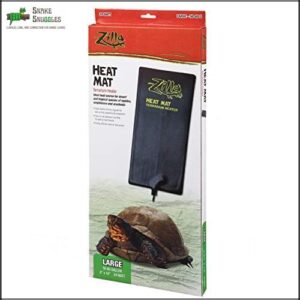
The Zilla Black Terrarium Heat Mat 24W suits 20 to 40 gallon tanks. Thermostat-controlled heating keeps its target surface temperature between 80 and 100°F. Without a thermostat, you’re risking burns.
Substrate thickness calibration matters: thick bedding cuts heat transfer, so verify surface readings after 30 minutes. Keep it flat on clean glass to extend heat pad lifespan and prevent hotspots.
6. Fluker’s Medium Reptile Heat Mat
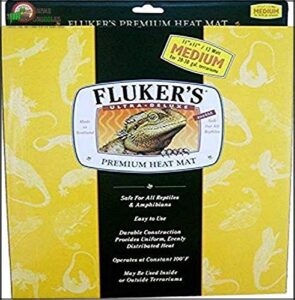
Fluker’s Medium Reptile Heat Mat suits mid-sized enclosures well. Like the Zilla, it needs thermostat-controlled heating to stay safe, running in the low-to-mid 30s°C at the surface.
Nail heat mat sizing first, covering roughly one-third of the enclosure floor to build a real temperature gradient.
Check substrate temperature daily with a contact thermometer. Your snake depends on that accuracy.
Frequently Asked Questions (FAQs)
Do snakes require heating pads?
Most snakes can’t regulate body heat internally. Without a reliable heat source, they can’t digest food, fight illness, or stay active. A heating pad fixes that.
How do snake heating pads work?
Heat mats single-handedly transform a cold enclosure into a life-sustaining thermal haven. They deliver warmth through contact, building a temperature gradient your snake self-regulates by moving. A thermostat and probe lock surface temps in safely.
How can you safely heat a snake terrarium?
Use a thermostat-controlled heat mat under one side, targeting 28–32°C on the warm end. Keep the cool side around 22–26°C for a proper temperature gradient. Place the probe under the pad’s center for reliable control.
How do you heat a snake enclosure?
Think of it like a heated blanket with a smart timer: a heat mat controlled by a thermostat delivers steady warmth. Nail your probe placement, build the right temperature gradient, and your snake will thrive.
How long can a snake go without a heating pad?
Your snake’s survival window depends entirely on ambient room temperature. In a warm room, a few hours may be fine. In a cool room, thermal stress sets in fast.
What degree is too hot for snakes?
Surprise, your snake isn’t ordering a hot tub. Above 85°F surface temperature triggers thermal burns. Keep your warm zone capped at the low-to-mid 80s°F.
Can heating pads be used with wooden enclosures?
Yes, but carefully. Wood retains heat differently than glass does. Always use thermostat-controlled heating and monitor with a contact thermometer. Without proper control, wood can overheat, creating dangerous hot spots your snake simply can’t escape.
How long should a heating pad run daily?
Aim for 12–14 hours of daytime heat, then let temps drop at night. A good thermostat controls the rest, keeping your heating pad’s duty cycle steady and your snake safe.
Do heating pads work well for nocturnal snakes?
Even night owls need warmth." Nocturnal snakes still need warm belly contact to digest and move around properly. A nocturnal temperature drop won’t stop them if your pad consistently holds a safe, reliable warm zone.
Should heating pads stay on during snake feeding?
Keep the heating pad on during feeding. Your snake can’t digest efficiently without consistent warm-zone temperatures. Cutting heat mid-feed disrupts reptile metabolism and forces it to hunt for warmth instead of properly processing its meal.
Conclusion
Picture a thermometer pressed flat against the substrate: that single reading holds the whole answer.
How hot should a snake heating pad get? Between 88°F and 92°F, without exception. Use a thermostat and position the probe directly under the pad. Check it every single week.
Your snake can’t feel the danger building beneath it, but you can catch it before damage is done. That’s what separates a nervous beginner from a keeper who truly knows.
- https://www.reddit.com/r/snakes/comments/sf7744/reptile_heat_pad_temperature
- https://www.facebook.com/BamaReptileRanch/posts/stop-installing-snake-heat-pads-incorrectlyone-of-the-biggest-mistakes-i-see-in-/122170692194783505
- https://reptifiles.com/corn-snake-care-guide/corn-snake-temperatures-humidity