This site is supported by our readers. We may earn a commission, at no cost to you, if you purchase through links.

Your corn snake circles the dish, drapes half its body over the rim, and gives up. That’s not pickiness. It’s one of the clearest signs your snake water dish is too small, and it’s costing your snake proper hydration and safe shedding.
An undersized bowl forces awkward entry, empties fast, and turns cloudy within hours. Dehydration and stuck shed follow quietly. You can catch every warning sign with your own eyes, no equipment needed.
Below, you’ll find five concrete signals, from rim-probing behavior to a dish that rocks under your snake’s weight, plus fixes for each.
Table Of Contents
- Key Takeaways
- Your Snake Cannot Fit or Soak Comfortably
- Drinking and Entering The Water Dish Look Difficult
- The Water Dish Empties Within 24 Hours
- The Water Becomes Dirty Soon After Refilling
- The Water Dish Slides, Rocks, or Tips During Use
- Frequently Asked Questions (FAQs)
- How big should my snakes water bowl be?
- How do I know when to size up my snakes food?
- How often should you change your snakes water bowl?
- How do I know if I fed my snake too big of a meal?
- How big does a snakes water dish need to be?
- How do I know if my snakes tank is too small?
- How do I know if I’m underfeeding my snake?
- Where should the water dish be placed?
- Which bowl materials are safest for snakes?
- How often should snake water be changed?
- Conclusion
Key Takeaways
- A water dish is too small if your snake can’t fully submerge and spread its coils—aim for a bowl 1.5–2 times your snake’s girth with shallow depth (about one-third of body height).
- Behavioral red flags include rim-probing, awkward head stretching to drink, and repeated failed entry attempts—during shedding, an undersized bowl directly causes dehydration and stuck shed.
- Water that empties within 24 hours or turns cloudy within 6–12 hours of refilling signals a capacity problem, since small volumes concentrate waste and can’t dilute contamination.
- Choose a heavy, wide, shallow dish made of non-porous ceramic or stainless steel with a weighted or tip-resistant base, placed on the cool side, and change the water daily.
Your Snake Cannot Fit or Soak Comfortably
Three clear signs tell you the water bowl size is wrong before your snake shows stress. If your snake cannot fit or soak comfortably, it’ll coil only partially in the dish, leaving its body draped over the rim. Full submersion requires water depth at least 2.5 to 3 cm beyond the body length, and the dish must offer 1.5 to 2 times the snake’s girth in clearance for coils to spread naturally.
Getting the depth right matters just as much as the width, since a dish that’s too deep can stress your snake and invite bacterial buildup—this snake water dish depth guide walks through finding the sweet spot for your species. Pairing the right depth with a proper post-shed soak routine—like the one in this guide to bathing your snake after shedding—helps loosen stubborn skin without added stress.
A snake that can’t fully submerge and spread its coils comfortably is telling you its water bowl is too small
A dish that’s too small forces awkward posture. You’ll notice your snake repeatedly probing the rim with its neck or tail, searching for space that isn’t there. During shedding cycles, water bowl size matters most, since snakes need deeper, wider soaks to soften retained skin and stay hydrated.
Low humidity often compounds the problem during a shed, so fixing your ball python’s humidity alongside the bowl size gives the best results.
Drinking and Entering The Water Dish Look Difficult

Beyond poor soaking posture, you’ll see difficulty the moment your snake tries to drink or enter. A snake water dish that’s too small forces awkward head and neck extension, making your snake stretch uncomfortably downward just to reach the surface. Instead of a smooth, fluid approach, you’ll notice erratic head movements, repeated probing, and hesitation at the rim.
Getting the dimensions right matters more than most keepers realize, and this guide to proper corn snake water dish size breaks down exactly what fits your snake.
Snake drinking posture should look natural. When water bowl size is wrong, your snake’s snout contacts the rim before its tongue reaches the water, forcing it to compress or twist its midsection to fit inside.
Watch a corn snake attempt entry more than twice without settling in. That repeated effort signals the dish is undersized and needs to be replaced right away.
The Water Dish Empties Within 24 Hours

If your snake struggles to drink comfortably, it may compensate by visiting the dish more often, draining it faster than expected. A dish that empties within 24 hours signals a water dish capacity problem, not just high activity.
Upgrading to a larger dish usually solves it, and our guide on how often to change snake water covers sizing and refill routines in detail.
Small dishes hold less water, so evaporation rate alone can account for significant daily loss, especially in warmer enclosures or during shedding cycles. Your snake’s thermoregulation needs also peak at these times, meaning it’s drinking and soaking more frequently.
Don’t keep refilling a too-small dish hoping it’s enough. Hydration management starts with matching dish size to your snake’s body length. A proper bowl holds enough water to last at least 48 hours with regular drinking, giving you a reliable baseline to monitor.
The Water Becomes Dirty Soon After Refilling
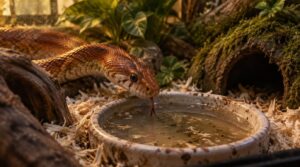
Fast cloudiness is a size problem, not just a hygiene problem. Water contamination happens quicker in small dishes because your snake’s drinking, tongue-scooped food bits, and shedding debris concentrate in a shallow volume. Soiled water within 6–12 hours of refilling means the bowl is too small to dilute waste. Ball pythons in particular do best with a roomy, low-profile dish, as outlined in this ball python care guide.
For stubborn buildup that a simple rinse won’t fix, a proper deep clean with a disinfectant like our guide to cleaning a snake’s water bowl will keep things hygienic.
Watch the timeline. Clear water turning cloudy overnight signals biofilm formation on rough or porous surfaces, compounded by low volume. Larger dishes dilute organics and stay clearer longer.
Upgrade to a dish with greater water dish capacity and a smooth, nonporous surface like ceramic or stainless steel. Scrub daily with hot water and reptile-safe soap, rinse fully, and air-dry. Replace water every 12–24 hours. Consistent water quality maintenance depends on matching bowl size to your snake.
The Water Dish Slides, Rocks, or Tips During Use

When your snake leans in to drink, watch the bowl. If it slides, rocks, or tips, you’ve got a stability problem, and it’s fixable.
Here’s what causes it:
- Snake pressure on a shallow rim shifts the center of mass off-center.
- A glazed ceramic or slick plastic base offers almost no grip.
- A water film on the rim kills traction during movement.
- Sloped sides let the body slide outward as your snake exits.
Fix it with a weighted base or a non-slip mat underneath. A rock or decor touching the dish’s edge anchors it. Choose a wide, deep bowl that fits your snake’s girth. That’s bowl tip prevention in one step. A weighted reptile water bowl solves this on its own, since the heavy base stays put even when your snake leans in hard.
Frequently Asked Questions (FAQs)
How big should my snakes water bowl be?
Water is your snake’s lifeline, so size it right. Hatchling safety demands a 6–8 cm bowl; adults need 10–15 cm. Keep water depth shallow, roughly one-third body height, so soaking stays easy and drowning risk stays low.
How do I know when to size up my snakes food?
Picture your snake coiled in a shallow puddle, rim pressed against its scales. Size up when soaking fails, drinking looks awkward, or the bowl tips. Aim for one-third body height in water depth, prioritizing hatchling safety.
How often should you change your snakes water bowl?
Imagine murky soup in a bowl you drink from daily. Change the water every day, or sooner if it’s soiled. If your snake empties the dish within 24 hours, refill it then.
How do I know if I fed my snake too big of a meal?
Worried your snake’s meal was oversized? Check for a visible bulge lasting over 48 hours, regurgitation, or sluggish behavior. Prey should match your snake’s widest body point, roughly 10% of body weight.
How big does a snakes water dish need to be?
Size your dish to 5–2 times your snake’s girth so it can soak comfortably fully coiled. Hatchlings need 1–2 inches deep, adults 2– Choose heavy, non-porous ceramic with a tip-resistant design.
How do I know if my snakes tank is too small?
Over 60% of captive snake health issues trace back to improper husbandry. Measure your enclosure: length plus width should exceed your snake’s body length. Check substrate depth, temperature gradient, ventilation, humidity, and hydration signs like wrinkled skin.
How do I know if I’m underfeeding my snake?
Track your snake’s weight monthly. Watch for weight loss, decreased appetite, frequent shedding, and lethargy. Do a hydration check: pinch the skin; slow snap-back means poor snake hydration. Fix enclosure humidity and water bowl size.
Where should the water dish be placed?
Placement matters more than you think. Cool side placement protects your thermal gradient and slows algae growth. Set the water bowl placement on flat, stable substrate near a travel path, away from heat and sunlight, with ventilation clearance to prevent spills and drowning.
Which bowl materials are safest for snakes?
Plastic seems fine, but porous or scratched surfaces harbor bacteria.
Choose non-porous ceramic bowls, stainless steel, sealed stone, BPA-free plastic, or food-grade silicone.
These nontoxic materials sanitize easily and support water bowl hygiene.
How often should snake water be changed?
Change your snake’s water daily, minimum. Ball pythons often defecate in their bowls, so replace it immediately after feeding. Scrub away slimy biofilm with hot water, skip soap, and use dechlorinated water to slow bacterial growth. A large water bowl can also help maintain proper humidity levels for ball pythons.
Conclusion
Funny how the cheapest item in your snake’s setup causes the most expensive problems. Every one of these signs your snake water dish is too small shows up before dehydration does. Rim-probing, fast emptying, cloudy water, tipping bowls. Your snake tells you daily.
Fix it with one purchase: a heavy, wide, shallow dish your snake can coil into fully. Watch shedding improve within one cycle. Hydration isn’t luck. It’s bowl geometry.