This site is supported by our readers. We may earn a commission, at no cost to you, if you purchase through links.

A classroom reptile habitat can look perfect and still run dry by noon. One HVAC cycle, one heat lamp, and the air shifts enough to turn a healthy shed into stuck skin, dehydration, or a stressed snake hiding off feed.
That’s why humidity gauges for classroom reptile habitats do more than fill a checklist; they catch the small changes that students won’t see until something goes wrong.
Bearded dragons, ball pythons, corn snakes, and crested geckos all read the room differently. The gauge helps you track those differences, place sensors wisely, and choose equipment that holds up through the week.
Table Of Contents
- Key Takeaways
- Why Classroom Habitat Humidity Matters
- Species-specific Humidity Targets for Common Classroom Reptiles
- Desert, Semi-arid, and Tropical Enclosure Differences
- How Humidity Affects Shedding, Hydration, and Stress
- Health Risks From Low Humidity in School Habitats
- Problems Caused by Excessive Moisture and Poor Ventilation
- Why Classroom HVAC Can Disrupt Enclosure Humidity
- Choosing a Classroom Humidity Gauge
- Digital Vs Analog Gauges for Classroom Reptile Habitats
- Why Accuracy Tolerance Matters for Reptile Health
- Easy-to-read Displays for Quick Student-safe Checks
- Dual-sensor Vs Single-sensor Monitoring
- Mounting Options for Glass and Terrarium Walls
- Battery-powered Vs USB-powered Gauge Setups
- Data Logging and Alert Features for Teachers
- Durability for Busy Classroom Environments
- Placing Gauges for Accurate Readings
- Best Sensor Height Inside Reptile Enclosures
- Keeping Gauges Away From Lamps and Water Bowls
- Monitoring Humidity Gradients Across Habitat Zones
- When to Use Multiple Gauges in One Enclosure
- Securing Probes and Cables in Classrooms
- Daily Reading Routines for School-day Consistency
- Common Placement Mistakes That Skew Humidity Readings
- 9 Top Classroom Humidity Gauges
- 1. REPTI ZOO Terrarium Thermometer Hygrometer
- 2. JEDEW Digital Hygrometer Thermometer
- 3. PAIZOO LED Digital Reptile Thermometer Hygrometer
- 4. Serundo Digital Terrarium Thermometer Humidity Gauge
- 5. QZQ Reptile Thermometer Humidity Gauge
- 6. Flukers Digital Thermometer Hygrometer
- 7. Zoo Med Dual Thermometer Humidity Gauge
- 8. REPTI ZOO Digital Terrarium Thermometer Hygrometer
- 9. TempPro TP49 Digital Hygrometer Thermometer
- Maintaining Reliable Daily Humidity Data
- How Often to Check Classroom Habitat Humidity
- Calibrating Gauges to Prevent Sensor Drift
- Cleaning and Protecting Sensors From Misting Damage
- Replacing Batteries Before Readings Fail
- Tracking Min and Max Humidity Over Time
- Using Humidity Trends to Adjust Misting and Ventilation
- Signs Your Gauge is No Longer Reliable
- Frequently Asked Questions (FAQs)
- Conclusion
Key Takeaways
- Humidity is a core health factor in classroom reptile habitats because even small swings from HVAC, heat lamps, or room activity can quickly cause shedding problems, dehydration, stress, and breathing issues.
- You need species-specific targets and enclosure-specific monitoring, since desert reptiles like bearded dragons need much drier air than tropical species like crested geckos or ball pythons.
- A good classroom gauge should be easy to read, reasonably accurate, durable, and placed correctly away from lamps, water bowls, vents, and misting, so it reflects the conditions the reptile actually experiences.
- Reliable care depends on routine checks, calibration, clean sensors, fresh batteries or stable power, and trend tracking over time, so you can adjust misting and ventilation before small problems become health risks.
Why Classroom Habitat Humidity Matters
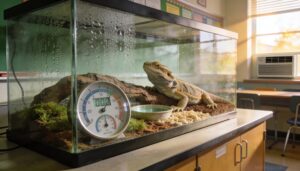
Humidity isn’t a small detail in a classroom habitat because the wrong moisture level can affect shedding, hydration, stress, and overall health. Different reptiles need very different conditions, and school heating or air conditioning can throw those conditions off faster than you might expect.
A quick guide to reptile humidity needs and healthy habitat setup can help you catch problems before they harm your animal.
In classroom habitats, even small humidity swings can quickly harm a reptile’s health, hydration, and shedding
With that in mind, the gauges below can help you keep a closer watch on the habitat your animals actually live in.
Species-specific Humidity Targets for Common Classroom Reptiles
Although classrooms feel stable, species-specific humidity shifts by animal, so reptile humidity gauges protect bearded dragons and crested geckos, and show why each enclosure needs its own safe target for healthy shedding and hydration.
- Bearded Dragon Humidity 30–40%
- Leopard Gecko Humidity 30–40%
- Ball Python Humidity 50–80%
- Corn Snake Humidity 40–60%, 70% shedding
- Crested Gecko Humidity 70–80%, with a humidity gradient
Maintaining the proper target humidity range is essential for healthy shedding.
Desert, Semi-arid, and Tropical Enclosure Differences
Match enclosure to species. Desert tanks use low Substrate Moisture Retention, stronger Ventilation Strategies, Lighting Intensity Levels, and Temperature Diurnal Swings.
Tropical tanks use foliage; Plant Selection Impact is larger.
These effects of desert vs tropical habitats on humidity needs directly change humidity requirements, guide creating humidity gradients in terrariums, and raise humidity gauge accuracy demands for reptile humidity gauges.
How Humidity Affects Shedding, Hydration, and Stress
Once enclosure style fits the species, humidity levels start shaping daily function. Proper Skin Moisture aids normal shedding cycles and steadier Shedding Frequency, while good Hydration Balance limits water loss.
Sudden humidity fluctuations often show up first as Stress Indicators, like pacing or appetite dips. That’s why humidity gauge accuracy matters for reptile health monitoring, Respiratory Health, and behavior.
Health Risks From Low Humidity in School Habitats
That same stress signal can be your warning that dry air is doing harm. Low humidity drives Mucous membrane dryness, dehydration risk, respiratory infections, and Asthma flare risk. It also causes Allergy trigger amplification, Static dust resuspension, and Student comfort loss.
reliable humidity gauge helps you catch humidity mismanagement before the health consequences of improper humidity levels spread widely.
Problems Caused by Excessive Moisture and Poor Ventilation
Because stale, wet air snowballs fast, Condensation Issues can become Mold Growth, Air Quality Decline, and Substrate Deterioration within days. You may also see Material Corrosion on hinges and fixtures.
A humidity gauge and well-placed humidity sensor help you catch humidity mismanagement, track humidity fluctuation, and improve ventilation before damp glass, soggy substrate, and bacterial buildup start harming reptiles directly.
Why Classroom HVAC Can Disrupt Enclosure Humidity
Although classrooms feel stable, HVAC shifts can quietly upset enclosure humidity control. Watch for:
- HVAC Air Exchange causing humidity fluctuations.
- Setpoint Conflicts creating humidity drift.
- Pressure Drafts near vents.
- Equipment Interaction with misters and dehumidifiers.
- Seasonal Occupancy changing room moisture.
That’s the real Impact of HVAC on enclosure humidity, especially during start-up, shutdown, and crowded school days for sensitive species.
Choosing a Classroom Humidity Gauge
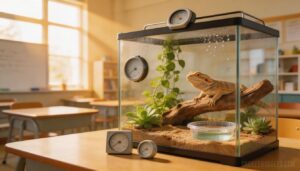
The right humidity gauge should be easy to read, accurate enough to trust, and sturdy enough for a busy classroom. Small features like sensor placement, power source, and alerts can make daily care simpler and safer for your reptile.
The options below will help you compare what matters most before you choose one for your habitat.
Digital Vs Analog Gauges for Classroom Reptile Habitats
Choose carefully: a digital hygrometer gives precise numbers, calibration flexibility, and stronger reptile humidity management. An analog hygrometer shines for visual trend interpretation, maintenance simplicity, and quick classroom checks.
| Type | Best |
|---|---|
| Digital | Cost analysis |
| Analog | Power source reliability |
Digital vs analog hygrometer comparison helps you match each humidity gauge to daily teaching needs without adding student confusion or extra upkeep.
Why Accuracy Tolerance Matters for Reptile Health
A small reading error can quietly shift reptile health off course, especially near narrow species margin limits.
- Tolerance thresholds guide safe monitoring moisture levels.
- Error impact distorts misting, hydration, and shedding.
- Symptom correlation links bad reads to retained shed.
- Health trend analysis depends on hygrometer accuracy, calibration, and the importance of accurate humidity readings for reptile health in classrooms every day.
Easy-to-read Displays for Quick Student-safe Checks
In a busy classroom, one glance should tell you if the reptile enclosure is safe. Large Numeral Displays, Color-Coded Alerts, and Iconic Humidity Indicators on a digital hygrometer cut confusion fast.
Backlit Night Visibility and an LED display enable checks during dim conditions, while quick updates ensure timely monitoring.
A color-coded display and Durable Shatter-Resistant Screens withstand daily student traffic without distraction.
Dual-sensor Vs Single-sensor Monitoring
What happens when one probe drifts during class?
With dual sensor vs single sensor devices, dual sensor devices give you a clear Redundancy Advantage, stronger False Alarm Reduction, better Microclimate Mapping, earlier Drift Detection, and steadier Data Consistency.
A dual gauge humidity gauge improves Reptile Enclosure Humidity Monitoring, especially when misting, HVAC airflow, or student activity briefly disturbs readings nearby.
Mounting Options for Glass and Terrarium Walls
After comparing probe layouts, secure placement protects accuracy and your peace of mind:
- Suction Cup Mounts and a suction cup fit clean glass, but check weekly.
- Magnetic Mounting Systems add mounting flexibility.
- Frame Rail Mounts, Clamp-On Front Panels, and Adhesive Bonded Panels steady larger walls.
- stickymount installation or Velcro backing expands mounting options for terrarium sensors without drilling classroom glass.
Battery-powered Vs USB-powered Gauge Setups
After mounting, think power.
In battery vs USB power for terrarium meters, a battery powered reptile humidity gauge gives Portability Flexibility, but Battery Longevity and Voltage Drop Impact matter as cells weaken.
A USB-powered humidity gauge offers USB Power Stability, though placement depends on outlets.
If you can, choose Dual Power Options, so readings stay steady when classroom conditions shift.
Data Logging and Alert Features for Teachers
With power handled, choose a humidity gauge that does more than flash numbers:
- Data logging enables real-time monitoring.
- Alert Threshold Settings and Battery Status Alerts catch trouble fast.
- Historical Humidity Charts reveal reptile enclosure patterns for microclimate monitoring.
- A Multi Enclosure Dashboard with Cloud Data Sync lets you compare habitats before stress shows during class checks.
Durability for Busy Classroom Environments
After alerts, look at build quality. In classrooms, durability and precision in reptile hygrometers depend on Reinforced casings, Impact-resistant mounts, and UV-protected materials.
Tool-free maintenance and Modular component swaps save time during checks. A long warranty helps, even with budgetfriendly humidity gauge options. Keep a regular maintenance schedule for reptile hygrometers so readings stay trustworthy under daily student traffic indoors.
Placing Gauges for Accurate Readings
Where you place a humidity gauge matters just as much as the gauge itself. A sensor in the wrong spot can give you a false reading and lead to poor habitat decisions.
The next points show where to place gauges so your classroom enclosure readings stay useful and consistent.
Best Sensor Height Inside Reptile Enclosures
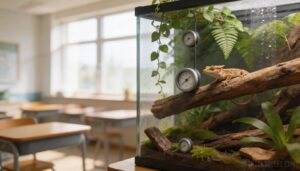
sensor height as your humidity gauge truth teller.
Place a Mid-level sensor where the reptile actually lives, then add an Upper canopy sensor or Lower substrate sensor for microclimate monitoring in terrariums.
Height standardization improves Classroom visibility height, follows sensor placement best practices, prevents sensor placement errors, and strengthens humidity sensor reliability for consistent student observations each day.
Keeping Gauges Away From Lamps and Water Bowls
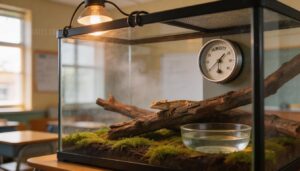
Positioning your humidity gauge well keeps readings honest.
- Heat Lamp Separation: stay 12 inches out.
- Water Bowl Clearance: keep 6 inches above, 6 away.
- Misting Bias Prevention protects terrarium moisture monitoring.
- Cable Heat Isolation helps Thermal Interference Avoidance.
- Calibration and sensor placement best practices prevent sensor placement errors in reptile enclosure humidity control for students.
Monitoring Humidity Gradients Across Habitat Zones
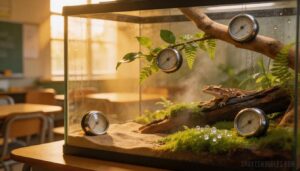
Because classroom habitats never stay uniform, understanding humidity gradients within enclosures starts with Cross-Zone Humidity in various zones. Vertical Gradient Mapping reveals each Airflow-Induced Gradient, while Zone Comparison Metrics guide a Gradient-Driven Misting Schedule for microclimate monitoring in terrariums.
Even when using multiple hygrometers for large enclosures, budget-friendly humidity gauge options can still track 10 to 25 percent shifts daily.
When to Use Multiple Gauges in One Enclosure
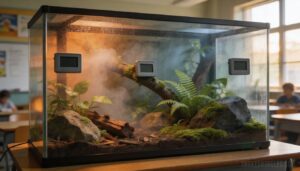
- Use dual sensors for Gradient Mapping.
- Add a cool-side gauge to Cross-Check Readings.
- Keep a backup unit for Backup Sensor Strategy and Dual-Readout Validation.
- Using multiple hygrometers for large enclosures facilitates Understanding humidity gradients within enclosures, microclimate monitoring in terrariums, and Zone-specific Alerts for school habitats.
Securing Probes and Cables in Classrooms
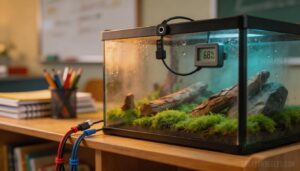
Loose cables are accidents waiting to happen. For secure digital hygrometer setups, apply Cable Routing Strategies with magnetic clips and cable channels, favoring Magnetic Clip Usage, Strain Relief Implementation, and weatherproof grommets.
Pair remote probes with Probe Shielding Techniques, Color-Coded Labeling, and mounting options.
Keep any USB power source separate from data lines, following Calibration and sensor placement best practices.
Daily Reading Routines for School-day Consistency
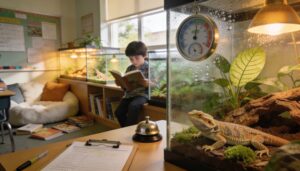
Consistency protects reptiles. Follow this humidity tracking schedule:
- Pre‑class Power Check.
- Morning Reading Window with Bell‑Based Timing.
- Student Log Rotation records each humidity gauge.
- Compare digital hygrometers, noting reading frequency and response time considerations.
- Evening Wrap Up updates the regular maintenance schedule for reptile hygrometers.
This keeps conditions stable, logs are trustworthy, and students attentive every school day, all day long.
Common Placement Mistakes That Skew Humidity Readings
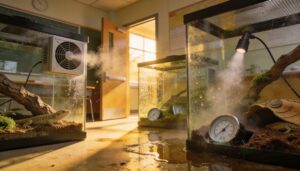
Good logs won’t help if the gauge sits in the wrong spot. Near Air Vents, Doorway Airflow Interference, Misting Nozzle Proximity, and Direct Substrate Contact all distort ambient humidity and hide the true microclimate.
Obstructed Airflow Path, poor mounting options, or a clogged vented sensor can also cause sensor drift, delayed response, and misleading daily readings for your reptiles.
9 Top Classroom Humidity Gauges
Now that you know where to place a gauge, the next step is choosing one that fits your enclosure and your daily routine. The gauges below were selected with classroom use in mind, including visibility, reliability, and ease of setup.
Use this list to compare your options before you pick the best match for your reptiles.
1. REPTI ZOO Terrarium Thermometer Hygrometer
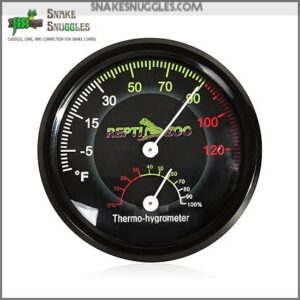
A straightforward pick, the REPTI ZOO Terrarium Thermometer Hygrometer, suits classrooms that need quick visual checks without batteries or apps. Its dual analog dials show temperature and humidity at a glance, and the color-coded face helps students read conditions fast. Adhesive backing sticks to glass or smooth plastic, so setup is simple.
Still, treat it as a basic monitor. Analog humidity readings can be less precise than digital units, especially for species that need tight moisture control every day.
| Best For | Classrooms, beginner reptile keepers, and other low-tech setups that need a simple, battery-free way to check terrarium temperature and humidity at a glance. |
|---|---|
| Measurements | Temp + humidity |
| Display | Analog dual gauge |
| Power | Battery-free |
| Placement | Adhesive backing |
| Habitat Use | Terrariums and vivariums |
| Monitoring | Continuous reading |
| Additional Features |
|
- Dual analog dials show both temperature and humidity at the same time for quick visual checks.
- Battery-free design keeps maintenance low and makes it easy to use in classrooms or basic enclosures.
- Adhesive backing makes installation simple on glass, plastic, and other smooth surfaces.
- Analog humidity readings may be less precise than digital meters, especially for species needing tight moisture control.
- Adhesive can lose grip in very humid enclosures or get knocked loose by active animals.
- Larger-than-expected size and fixed adhesive mounting can make placement and repositioning harder in small setups.
2. JEDEW Digital Hygrometer Thermometer
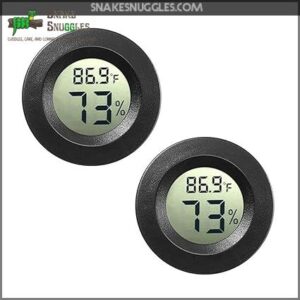
If you want more precision than an analog dial can offer, the JEDEW Digital Hygrometer Thermometer is a sensible classroom upgrade. Its LCD screen shows temperature and humidity together, updates every 10 seconds, and reads 10 to 99 percent relative humidity with about plus or minus 3 percent accuracy.
That gives you faster checks in small enclosures, humidors, or specimen tubs.
The compact two-pack is affordable, though you’ll need to watch battery life and handle the buttons carefully during class.
| Best For | Teachers, hobbyists, and anyone who needs an affordable, easy-to-read digital thermometer and hygrometer for small spaces like classroom enclosures, terrariums, humidors, or storage containers. |
|---|---|
| Measurements | Temp + humidity |
| Display | Digital LCD |
| Power | LR44 battery |
| Placement | Compact placement |
| Habitat Use | Terrariums and small habitats |
| Monitoring | 10-second refresh |
| Additional Features |
|
- Displays both temperature and humidity on a clear LCD screen for quick, easy checks.
- Updates every 10 seconds and offers better precision than a basic analog dial.
- Compact, affordable 2-pack works well for monitoring multiple small spaces at once.
- Accuracy is solid for everyday use, but not ideal for lab-grade or highly sensitive environments.
- Battery issues can happen out of the box, and LR44 cells will need replacing over time.
- Buttons can be easy to bump accidentally, which may change units or turn the device off.
3. PAIZOO LED Digital Reptile Thermometer Hygrometer
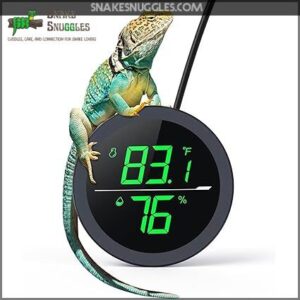
If the JEDEW feels a bit small for a busy classroom, the PAIZOO gives you a larger, brighter readout. Its 3‑inch green LED screen is easy to check day or night, and the dual thermometer‑hygrometer display helps students see both values at once.
USB power means no routine battery swaps, which is handy for daily school use.
Still, watch its limits: some units under‑read above 80 percent humidity, and a few users report temperature offsets or display failure over time.
| Best For | Classrooms, school reptile habitats, or terrarium setups that need a larger, easy-to-read display with constant USB-powered temperature and humidity monitoring. |
|---|---|
| Measurements | Temp + humidity |
| Display | Digital LED |
| Power | USB powered |
| Placement | Adhesive backing |
| Habitat Use | Reptile enclosures |
| Monitoring | Continuous reading |
| Additional Features |
|
- Large 3-inch green LED display is bright and easy to read from across the room, day or night.
- Shows both temperature and humidity at the same time, making quick checks simple.
- USB power helps avoid regular battery changes, which is convenient for everyday use.
- Humidity readings may run low when levels get above about 80 percent RH.
- Some units can be off by roughly 2 to 3 °F on temperature readings.
- A few users report display reliability issues over time, and the cord may still be short for larger enclosures.
4. Serundo Digital Terrarium Thermometer Humidity Gauge
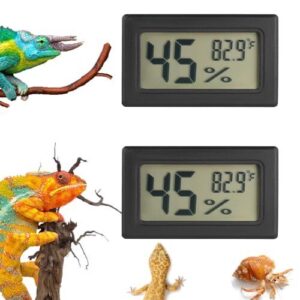
As a low-cost classroom option, the Serundo works best when you need simple spot checks in more than one tank zone. This two-pack reads temperature and humidity on a small LCD, updates in about 10 seconds, and sticks neatly to glass with adhesive backing.
Accuracy is modest, about ±1 °F and ±5 percent RH, so it suits routine husbandry better than precision tracking. Keep it away from frequent misting, because the display is small and the adhesive may weaken there.
| Best For | Budget-minded reptile keepers, classrooms, or anyone who wants simple temperature and humidity spot checks across multiple tank zones without spending much. |
|---|---|
| Measurements | Temp + humidity |
| Display | Digital LCD |
| Power | Battery powered |
| Placement | Adhesive tape |
| Habitat Use | Reptile terrariums |
| Monitoring | 10-second response |
| Additional Features |
|
- Affordable two-pack makes it easy to monitor more than one area of an enclosure.
- Measures both temperature and humidity, with quick readings and a clean, low-profile adhesive design.
- Simple to install and includes spare batteries, which helps reduce downtime.
- Small LCD can be hard to read, especially in dim or shadowed tanks.
- Adhesive may not hold up well in setups with frequent misting or heavy moisture.
- Accuracy is fine for routine care, but not ideal for precise tracking or highly sensitive setups.
5. QZQ Reptile Thermometer Humidity Gauge
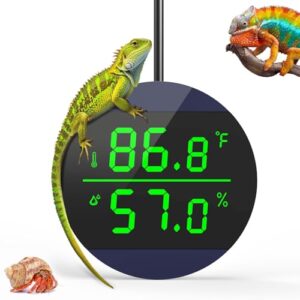
The QZQ is a practical classroom gauge when you need one clear display for both temperature and humidity. Its large LED numbers are easy to check across the room, and the unit covers useful ranges: 32 to 140 °F and 5 to 99 percent RH.
Accuracy is moderate, about ±1.8 °F and ±5 percent RH, so it works best for daily husbandry, not calibration. Use its adhesive mount carefully, and remember that USB power means operation, but no backup.
| Best For | Reptile and amphibian keepers who want an easy USB-powered gauge with one bright display for everyday temperature and humidity checks in medium to large enclosures. |
|---|---|
| Measurements | Temp + humidity |
| Display | Digital LED |
| Power | USB powered |
| Placement | Adhesive backing |
| Habitat Use | Reptile enclosures |
| Monitoring | Continuous reading |
| Additional Features |
|
- Large LED display makes temperature and humidity easy to read at a glance, including in low-light setups.
- USB power provides continuous operation without the hassle of replacing batteries.
- Simple adhesive mounting makes installation quick on most glass or plastic terrarium surfaces.
- Accuracy is only moderate, so it is better for routine monitoring than precise calibration.
- No battery backup means it stops working if the USB power source is disconnected.
- The full unit has to sit inside the enclosure, and the adhesive may leave residue when removed.
6. Flukers Digital Thermometer Hygrometer
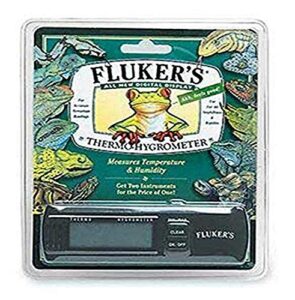
A solid middle-ground option, Fluker’s Digital Thermometer Hygrometer gives you temperature and humidity on one compact LCD screen, with MAX/MIN memory that helps you spot classroom swings after hours. Its 32 to 122 °F range and 0 to 100 percent RH coverage suit most school enclosures.
The adhesive mount is convenient, but place it carefully, because strong backing or a fall could injure small animals.
Still, reported humidity drift and ±5 to 10 percent variance mean it’s for daily checks.
| Best For | School labs, classrooms, and reptile or amphibian keepers who want an easy, budget-friendlier way to monitor both ambient temperature and humidity in one enclosure. |
|---|---|
| Measurements | Temp + humidity |
| Display | Digital LCD |
| Power | Battery powered |
| Placement | Adhesive or Velcro |
| Habitat Use | Terrariums and vivariums |
| Monitoring | Continuous reading |
| Additional Features |
|
- Combines temperature and humidity readings on one simple LCD screen, so daily checks are quick and easy.
- Compact, lightweight design with adhesive backing makes it easy to place inside terrariums, vivariums, and snake cages.
- A lower-cost alternative to probe-based systems, and it can be moved as enclosure layouts change.
- Reported accuracy can vary, with humidity drifting by about ±5 to 10 percent and temperature by about ±3 degrees.
- The adhesive mount can be too strong or fail unexpectedly, which may create a safety risk for small animals.
- It only measures ambient conditions and depends on replaceable batteries, so it is not ideal for precise spot monitoring.
7. Zoo Med Dual Thermometer Humidity Gauge
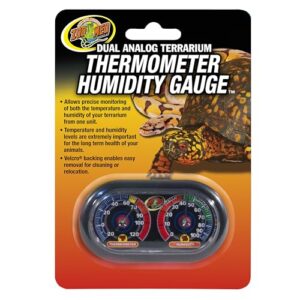
Need a simple backup gauge for student enclosures? The Zoo Med Dual Thermometer Humidity Gauge is easy to mount, easy to move, and easy to read during quick classroom checks.
Its analog dial combines temperature and humidity in one compact unit, and the Velcro backing lets you remove it for cleaning without tools.
The tradeoff is precision.
Like most budget analog gauges, it can drift beyond tolerances, so use it for spot checks, not for species that need tight control.
| Best For | Classrooms, beginner keepers, and anyone who wants a simple, low-cost backup gauge for quick temperature and humidity checks in animal or plant enclosures. |
|---|---|
| Measurements | Temp + humidity |
| Display | Analog dial |
| Power | Battery-free |
| Placement | Velcro backing |
| Habitat Use | Reptile and plant habitats |
| Monitoring | Continuous reading |
| Additional Features |
|
- Combines temperature and humidity readings in one compact, battery-free unit.
- Velcro backing makes it easy to mount, remove, and reposition during cleaning or enclosure changes.
- Affordable enough to use as a backup gauge or place one in multiple enclosures.
- Analog accuracy is limited, so it is better for spot checks than precise environmental control.
- Small dial can be harder to read from across the room or in dim lighting.
- Velcro mounting may loosen or shift if active animals climb on it.
8. REPTI ZOO Digital Terrarium Thermometer Hygrometer
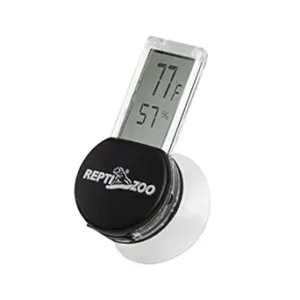
Want a classroom gauge you can move without peeling adhesive? The REPTI ZOO Digital Terrarium Thermometer Hygrometer uses a suction cup, so you can place it on the front or side glass and shift it to compare warm and cool zones.
Its LCD shows temperature and humidity together, with readings updating about every five seconds.
You also get long battery life, a spare AA battery, and a one-year guarantee.
Just keep it away from direct misting, because it isn’t waterproof.
| Best For | Classroom keepers, reptile hobbyists, or teachers who want a simple gauge they can move around the enclosure without dealing with sticky adhesive. |
|---|---|
| Measurements | Temp + humidity |
| Display | Digital LCD |
| Power | AA batteries |
| Placement | Suction cup |
| Habitat Use | Terrariums and vivariums |
| Monitoring | Continuous reading |
| Additional Features |
|
- Suction-cup mount is easy to reposition on the front or side glass to check different temperature and humidity zones.
- LCD screen shows both temperature and humidity at a glance with a clear numeric readout.
- Comes with long battery life, a spare AA battery, and a 12-month support guarantee for added peace of mind.
- Suction cup may not stick well on every surface and sometimes needs repositioning or extra support.
- Not waterproof, so direct misting or heavy moisture can cause temporary issues.
- Screen can be harder to read in low light or against dark, reflective backgrounds.
9. TempPro TP49 Digital Hygrometer Thermometer
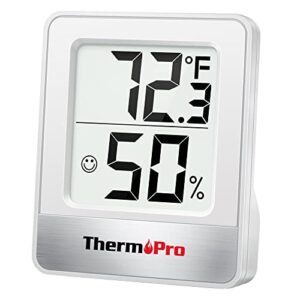
Small gauges can still do useful work. The TempPro TP49 gives you fast, simple checks with a large LCD, bold numbers, and dry, comfort, and wet icons that students can understand at a glance.
It refreshes every 10 seconds and offers temperature accuracy around ±1°F and humidity accuracy near ±2 to 3 percent RH.
Three mounting options—magnetic, tabletop, or hanging—make placement easy.
Still, keep it away from direct misting and recalibrate if readings begin to drift over time.
| Best For | People who want an affordable, easy-to-read thermometer and hygrometer for nurseries, pet spaces, bedrooms, greenhouses, instruments, or other indoor rooms where quick comfort checks matter. |
|---|---|
| Measurements | Temp + humidity |
| Display | Digital LCD |
| Power | AA battery |
| Placement | Stand/magnet/hang |
| Habitat Use | Reptile enclosures |
| Monitoring | 10-second refresh |
| Additional Features |
|
- Large LCD with bold numbers and dry/comfort/wet face icons makes it very easy to read at a glance.
- Refreshes every 10 seconds and offers solid everyday accuracy at about ±1°F and ±2% to 3% RH.
- Flexible placement with a tabletop stand, magnetic back, and hanging option.
- Humidity readings can vary by unit and may need recalibration if they start to drift.
- Accuracy is fine for everyday use but not ideal for highly precise or scientific monitoring.
- Built mainly for indoor use, and at least one user reported early failure after the return window.
Maintaining Reliable Daily Humidity Data
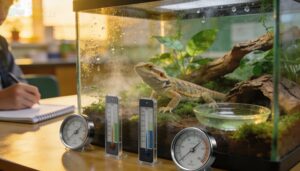
Good humidity data doesn’t happen by accident, especially in a busy classroom.
You need a gauge that stays accurate, a routine that catches small changes, and simple upkeep that prevents bad readings. The next points show what to check each day so your habitat data stays useful and your reptile stays safe.
How Often to Check Classroom Habitat Humidity
Usually, schedule Morning Checks before class, Midday Checks after lunch, and Evening Checks when possible. This rhythm keeps your humidity gauge useful for Trend Analysis, protects humidity accuracy, and facilitates data logging.
Use digital hygrometers on a Regular maintenance schedule for reptile hygrometers, with Seasonal Adjustments during HVAC shifts, new enclosure setups, or frequent misting in tropical habitats at school.
Calibrating Gauges to Prevent Sensor Drift
Those daily checks mean more when your humidity gauge starts from a known baseline. Practice hygrometer calibration at term start, after enclosure moves, and on a set Calibration Frequency. Use Reference Standards, enable Temperature Compensation, and keep Calibration Documentation.
Drift Monitoring with a second gauge helps catch sensor drift early, protecting hygrometer accuracy in digital hygrometers before readings quietly wander.
Cleaning and Protecting Sensors From Misting Damage
Calibration only holds if your humidity gauge stays clean in a moist environment:
- Handle Surface Cleaning with alcohol-damp microfiber, then air-dry.
- Use Shield Installation and Mist Deflection to protect water-resistant sensors from misting systems.
- Follow a Cleaning Schedule with Seal Checks, then confirm humidity calibration after wiping. Angle clear covers so droplets run off, and never spray sensor openings directly.
Replacing Batteries Before Readings Fail
Once the sensor is clean, watch Battery Health Indicators closely.
In a classroom battery-operated hygrometer, Low Voltage Alerts and sudden drift often signal poor battery life.
Follow Replacement Timing, match Type Compatibility exactly, and change all cells together in your reptile humidity gauge or humidity gauge.
Battery-powered reptile monitoring solutions stay trustworthy in class only after careful Post-Replacement Calibration.
Tracking Min and Max Humidity Over Time
Although classroom readings can look stable at a glance, tracking humidity over time tells the real story.
Use digital hygrometers and a reliable hygrometer with data logging and dual sensor benefits for Daily range visualization, Seasonal min/max patterns, and Student data analysis.
Record each humidity range, add Confidence interval notes, and follow Data backup procedures so tracking humidity stays trustworthy.
Using Humidity Trends to Adjust Misting and Ventilation
Because trends reveal drift early, track humidity and tune humidity regulation with:
- Trend-driven misting
- Adaptive ventilation control
- Real-time humidity alerts
- Seasonal misting schedules
Gradient-based airflow with misting systems, selecting reliable humidity gauges for reptile enclosures, even budget-friendly humidity gauge options, lets you follow classroom spikes and drops, and then open fans slowly across zones without sharp swings.
Signs Your Gauge is No Longer Reliable
While a gauge may still light up, Pointer jitter, Reading spikes, Probe fraying, Scale misalignment, Data gaps, and frequent inaccurate readings mean daily trouble. Check for accuracy variance over 5 percent, repeated sensor calibration, or values that fail to detect harmful drops.
The Effects of humidity drift on reptile physiology show up fast, especially in shedding, hydration, stress, and breathing.
Frequently Asked Questions (FAQs)
Can one gauge monitor multiple stacked enclosures?
Yes, humidity gauges support Stacked enclosure monitoring when digital hygrometers use Channel multiplexing, Data labeling, Cable management, and Cross-talk mitigation.
For Microclimate monitoring in terrariums, Data logging and dual sensor benefits favor reptile enclosure probes.
What should teachers do during weekend absences?
Test the theory: a clear Weekend Checklist, Misting Schedule, Emergency Contact, Access Instructions, and Weather Note prevent weekend lapses.
digital hygrometers, humidity gauges, data logging, humidity maintenance, and budget-friendly humidity gauge options keep care visible.
Are wireless humidity gauges safe around students?
Generally, wireless digital hygrometers are compact electronic devices with low RF Emission Levels, within EMF Exposure Guidelines, minimal Sensor Heat Generation, and safe USB‑powered/battery‑powered battery‑operated hygrometer use under Battery‑Safety Protocols and Data‑Privacy Practices.
How long do reptile hygrometer sensors usually last?
Most reptile hygrometer sensors last 1 to 3 years; digital hygrometer models often stretch Sensor Lifespan with Battery Longevity and durability.
Environmental Stress shortens battery life, so watch Warranty Period, hygrometer warranty, and Replacement Timing.
Are replacement probes available for damaged units?
Many damaged units accept replacement sensors and probes if Compatibility Charts confirm fit.
Check Price Ranges, Universal Kits, Warranty Policies, and Lead Times.
After installation, calibration protects Humidity Gauge accuracy and durability across compatible models.
Conclusion
Ironically, the best humidity gauges for classroom reptile habitats do their job best when you hardly notice them. Yet, their impact is undeniable — a healthy bearded dragon thriving, a stress‑free snake feeding normally.
By choosing the right gauge and using it wisely, you safeguard your students’ scaled friends.
With these tools, humidity gauges for classroom reptile habitats become more than just equipment; they’re guardians of a delicate ecosystem, ensuring a safe, educational experience for all.
- https://www.cambridge.org/core/journals/animal-welfare/article/laying-the-groundwork-for-reptile-welfare-assessment-in-zoos-and-private-keeping-a-literaturebased-proposal/EBE290DC55250F5E8FACCB5666E3B9FF
- https://www.merckvetmanual.com/exotic-and-laboratory-animals/reptiles/management-and-husbandry-of-reptiles
- https://www.petplace.com/article/reptiles/general/reptile-health-knowing-what-is-normal