This site is supported by our readers. We may earn a commission, at no cost to you, if you purchase through links.
Most snake keepers obsess over temperature gradients and humidity levels, but light—specifically the type of light—often gets treated as an afterthought.
That’s a costly oversight.
Snakes perceive ultraviolet light in ways that directly shape their appetite, bone density, and daily behavior, yet the two main UV bands, UVA and UVB, do completely different jobs inside their bodies.
Confusing them, or ignoring one entirely, can quietly undermine an otherwise well-managed enclosure.
Understanding the difference between UVA and UVB for snakes isn’t just academic—it’s the missing piece that separates a snake that survives from one that genuinely thrives.
Table Of Contents
- Key Takeaways
- UVA Vs UVB for Snakes
- What UVA Does for Snakes
- What UVB Does for Snakes
- How Much UV Do Snakes Need
- Choosing Safe UV Lighting
- Frequently Asked Questions (FAQs)
- What is the difference between UVA and UVB?
- How does UVA light affect reptiles?
- Do reptiles and amphibians need both UVB and UVA light?
- Why do Reptiles need a UV meter?
- Do reptiles need both UVA and UVB?
- What color light is best for snakes?
- Can snakes overdose on vitamin D3 naturally?
- Do UV needs change as snakes age?
- How does shedding affect UV absorption in snakes?
- Does brumation or hibernation alter UV requirements?
- Conclusion
Key Takeaways
- UVA shapes your snake’s behavior, appetite, and vision, while UVB drives vitamin D3 production and calcium absorption — they do completely different jobs, so you need both.
- Glass and plastic block UVB, meaning bulb placement and an open mesh top aren’t optional — they’re what make the whole lighting setup actually work.
- Deficiency symptoms like reduced appetite, hiding, and sluggish movement are easy to miss early, but they signal that calcium metabolism is already failing under the surface.
- UV needs depend on species, age, and activity pattern — a nocturnal ball python and a diurnal colubrid aren’t on the same lighting schedule, and treating them the same is a quiet mistake.
UVA Vs UVB for Snakes
UVA and UVB aren’t just two letters on a bulb’s label — they work very differently inside your snake’s body and brain.
UVA drives behavior and mood while UVB triggers vitamin D3 synthesis — and getting both right starts with choosing the correct UVB bulb for your snake’s enclosure.
Understanding those differences helps you make smarter choices about lighting, placement, and your snake’s daily routine.
Here’s what you need to know about how each type of UV light functions and why both matter.
UVA and UVB Wavelength Differences
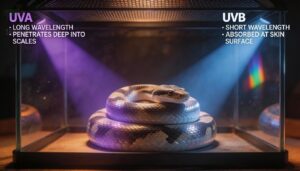
Think of UV light as a spectrum with two distinct neighborhoods. UVA runs from 315 to 400 nanometers — longer wavelengths, lower photon energy ratio, deeper tissue penetration depth. UVB sits from 280 to 315 nanometers — shorter, higher-energy, absorbed closer to the skin surface. There’s even slight UV spectrum overlap near 315 nm where both bands meet.
| Feature | UVA | UVB |
|---|---|---|
| Wavelength Range | 315–400 nm | 280–315 nm |
| Tissue Penetration Depth | Deeper layers | Outer skin only |
| Enclosure Material Filtering | Passes through glass | Blocked by glass/plastic |
Spectral bandwidth variation between these two bands directly shapes how UVA and UVB lighting behave inside your snake’s enclosure — and why the differences between UVA and UVB matter more than most keepers realize.
Why UVB Has More Energy
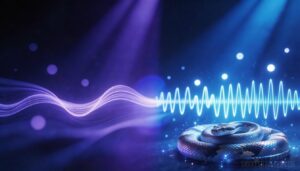
The Photon Energy Equation — E = hc/λ — makes this straightforward: shorter wavelength means higher energy per photon. That’s the Wavelength Energy Inverse relationship in action.
UVB’s range (280–315 nm) sits below UVA’s, so each photon hits with more force.
That High-Energy Photon Impact drives Vitamin D3 synthesis, triggers the DNA Damage Mechanism, and explains the Ozone Absorption Effect — ozone filters UVB aggressively precisely because of its UVB energy levels.
UVA makes up most surface UV accounts for about 95 % of the radiation that reaches the ground.
| Property | UVB |
|---|---|
| Energy per photon | Higher than UVA |
| Primary biological role | Vitamin D3 synthesis |
How UVA and UVB Reach Snakes Differently
Energy level tells only half the story. How each wavelength actually gets to your snake matters just as much.
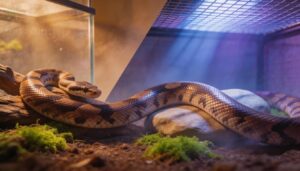
UVA rays travel through glass, plastic, and ambient room light — Airborne UV Transmission means UVA is almost always present in your snake enclosure. UVB rays? Glass blocks UVB almost completely, so placement and Mesh Permeability Impact are non‑negotiable.
| Factor | UVA | UVB |
|---|---|---|
| Passes through glass | Yes | No |
| Enclosure Geometry Influence | Low | High |
| UVA deep skin penetration effects | Reaches deeper tissues | Surface absorption only |
| Substrate UV Reflection | Minimal role | Meaningful near basking zones |
Thermal‑UV Coupling also matters — snakes bask where heat and UVB overlap, so your lamp positioning drives both. UVB rays require a direct, unobstructed line of sight.
Key Functional Differences in Snake Care
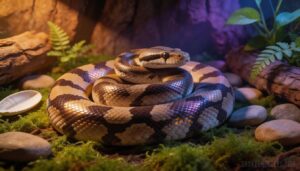
UVA and UVB aren’t interchangeable — they run completely separate jobs inside your snake enclosure.
| Function | UVA | UVB |
|---|---|---|
| Behavior & vision | Facilitates activity, appetite | Minimal direct role |
| vitamin D3 production | None | Primary driver |
| calcium absorption & metabolic bone disease prevention | Indirect | Direct |
Thermal Gradient Integration, Enclosure Material Selection, Health Monitoring Protocols, Nutrient Supplementation Strategies, and Behavioral Enrichment Techniques all depend on understanding which light does what.
Recognizing subtle shifts in behavior, like reduced appetite, can help you catch early signs of mouth rot in snakes before they escalate into serious health concerns.
What UVA Does for Snakes
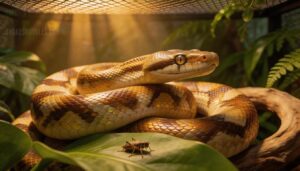
UVA does more for your snake than most keepers realize. It shapes how they see their world, when they eat, and how they behave day-to-day.
Here’s a closer look at what UVA actually controls.
Vision and Color Perception
Snakes don’t see the world the way you do.
Their spectral vision extends into the UV spectrum, including the UVA, UVB, and UVC range, with UV sensitivity allowing them to detect patterns and contrasts invisible to human eyes.
Through cone diversity and color learning, they distinguish prey, read social cues, and navigate their environment — all driven by UVA’s role in reptile behavior and vision.
Appetite and Feeding Response
Without adequate UVA, your snake’s appetite doesn’t just dip — it stalls.
UVA drives prey scent detection by sharpening sensory alertness, so a well-lit enclosure actually prepares the feeding response before prey is even offered.
It also facilitates feeding rhythm timing and energy balance regulation, helping your snake cycle naturally between hunger and satiety hormone signaling — the biological cue that says "I’m ready to eat.
Activity Levels and Basking Behavior
When access to UVA improves, your snake moves more — it’s that straightforward. Reptile behavior influenced by UVA shifts from sluggish to engaged, with snakes showing stronger movement patterns and more deliberate use of their space.
They don’t sit under one lamp all day. Instead, they navigate UV preference zones naturally:
- Partial basking — brief, targeted exposure under brighter areas
- Cryptic basking — staying half-hidden while still catching light
- Thermal gradient use — cycling between warm and cooler zones
Behavioral enrichment through UVA lighting keeps snakes active and exploratory.
Circadian Rhythms and Daylight Cues
Your snake’s internal clock runs on light — specifically, the timing and quality of UVA throughout the day. Morning light exposure advances their cycle, while evening light phase shifts push activity later.
day/night lighting cycles for reptiles drive circadian entrainment strategies that regulate feeding, movement, and rest. Without photoperiod adjustment, that rhythm drifts.
Blue light timing in the morning hours matters most for keeping behavior predictable and stable.
Behavioral Effects of Low UVA
Cut UVA too low, and you’ll notice the behavioral consequences of insufficient UVA exposure almost immediately.
Exploratory timing shifts — your snake stops crossing open floor areas and retreats to dimmer corners. Microhabitat preference changes, thermal stimulation loses its pull even when temperatures stay the same, and contrast perception dims.
Social defensives slow down. What looks like laziness is actually a light-driven behavioral cascade.
What UVB Does for Snakes
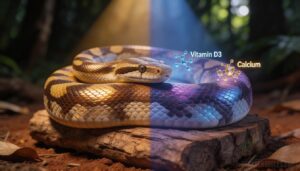
UVB does something UVA simply can’t — it triggers vitamin D3 production inside your snake’s skin. That one process sets off a chain reaction affecting bones, calcium, and long-term health.
UVB alone triggers the vitamin D3 chain reaction that governs your snake’s bones, calcium, and long-term health
Here’s what’s actually happening, and what goes wrong when UVB is missing or overdone.
Vitamin D3 Production
Here’s where UVB earns its place in your enclosure. When light in the 290–315 nm range hits your snake’s skin, it triggers the skin conversion pathway — converting 7-dehydrocholesterol into previtamin D3.
The liver then completes liver hydroxylation, producing 25-hydroxyvitamin D3, the marker vets measure.
UVB vitamin D3 conversion is species-specific synthesis, so matching UVB dose threshold to your snake’s needs matters.
Calcium Absorption and Bone Health
Once that vitamin D3 is active, it drives intestinal calcium transport — pulling calcium from food into the bloodstream. Without it, calcium absorption efficiency drops to around 15–20%.
Your snake’s parathyroid hormone regulation kicks in to compensate, pulling calcium from bone instead. That’s blood calcium regulation working against your animal.
The bone mineralization process suffers quietly, long before symptoms appear.
Metabolic Bone Disease Prevention
Bone loss doesn’t announce itself — it builds quietly when calcium regulation fails. Metabolic bone disease prevention in reptiles comes down to consistency: correct UVB irradiance monitoring, heat gradient stability, a consistent feeding schedule, and proper calcium supplement timing, all working together.
UVB and UVA roles in vitamin D production matter, but so does everything around them.
- UVB output verified regularly — output degrades before the bulb burns out.
- vitamin D3 dosing with UVB exposure, not instead of it.
- heat gradients so your snake actually basks and uses that light.
- calcium supplements around feeding to support UVB contribution to calcium absorption.
Signs of UVB Deficiency
When UVB deficiency symptoms start showing, they’re easy to miss at first. Appetite loss often comes before anything visible.
Then reduced activity follows — your snake hides more, basks less, moves awkwardly.
Body weakness and movement issues signal that calcium absorption is failing.
Severe signs include tremors and inability to move normally.
That’s metabolic bone disease progressing — and it demands immediate UVB lighting for reptile care correction.
Risks of Excess UVB Exposure
Too little UVB is dangerous — but so is too much. Overexposure carries real consequences:
- Photokeratitis risk — eye inflammation that causes pain and vision impairment
- Cataract formation — lens clouding from cumulative dose buildup over time
- DNA damage — direct UVB surface tissue impact on skin cells
- Skin cancer risk — repeated UVB surface damage raises long-term risk
- Lethargy and lesions — signs your snake’s UVB exposure limits have been exceeded
Monitor output regularly.
How Much UV Do Snakes Need
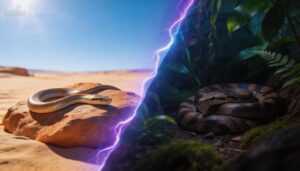
Not every snake needs the same amount of UV light — it really comes down to species, lifestyle, and where they’d naturally live. A desert-dwelling day-active snake has very different needs than a nocturnal ball python curled up in a burrow.
Here’s a breakdown of what those differences like in practice.
Low, Moderate, and Minimal UV Species
Not every snake needs the same UV diet. Species UV Classification breaks snakes into three groups: minimal (under 2% UV exposure), low (under 5%), and moderate (5–15%).
Habitat UV Patterns from the wild drive these distinctions.
| Category | UV Range |
|---|---|
| Minimal | Under 2% |
| Low | Under 5% |
| Moderate | 5–15% |
Match your UVA and UVB lighting to your snake’s category — UV Exposure Monitoring and Health Indicators confirm you’ve got it right.
Diurnal Vs Nocturnal Snake Needs
When a snake is active, it shapes everything — its feeding schedule, thermoregulation timing, and how much UV it actually uses.
Diurnal snakes benefit from stronger UVA and UVB exposure during their peak activity patterns, supporting circadian rhythm regulation and vitamin D production.
Nocturnal snakes still need a proper light cycle preference and shade utilization, but lower UVB dose monitoring applies.
Match lighting to their clock, not yours.
Ball Pythons, Corn Snakes, and Boas
These three species sit in the lower UV categories, but that doesn’t mean zero.
Ball pythons, corn snakes, and boas all benefit from low-level UVA and UVB lighting — supporting calcium absorption, discouraging metabolic bone disease, and sharpening feeding response.
Factor in enclosure size, humidity management to prevent shedding issues, and each species’ defensive behavior when adjusting feeding frequency alongside any lighting changes.
Creating a Safe UV Gradient
A good UV gradient isn’t just about placing a bulb and hoping for the best. UV gradient mapping — measuring UVB levels at multiple enclosure points — tells you what your snake actually experiences.
Factor in screen transmission rates, since mesh cuts UVB output noticeably.
Integrate your heat gradient so basking zones align with peak UVB.
bulb age, use enclosure reflectors to direct light downward, and verify UV safety distance at the basking surface.
Shade and Self-Regulation in Enclosures
Shade isn’t optional — it’s half the system. Thermal gradient design only works when shade placement strategy gives your snake real behavioral choice zones.
Put hides in both warm and cool areas, and zone your lighting so UV exposure guidelines are met at the basking spot without flooding the whole enclosure.
Light zoning balance, UV shielding, and hide distribution let your snake self-regulate naturally.
Choosing Safe UV Lighting
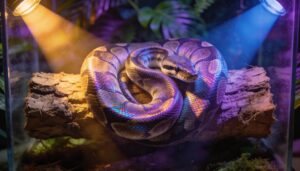
lighting right comes down to more than just picking any UV bulb off the shelf. key factors — bulb type, placement, and daily timing — determine whether your snake actually benefits from the light you’re providing.
what to get right.
Best Bulb Types for UVA and UVB
Not all reptile lighting is created equal — and picking the wrong bulb can quietly undermine your snake’s health. Here’s what actually works:
- T5 HO Fluorescent bulbs deliver strong, even UVB lighting across the enclosure.
- Mercury Vapor Lamps combine UVA lighting, UVB, and heat in one fixture.
- Compact Fluorescent UVB bulbs fit standard sockets but cover a smaller area.
- LED UVB Systems offer efficiency, while Blacklight UVA Fixtures only support behavior — not vitamin D3.
Replace your UVB bulb every 6–12 months.
Proper Lamp Distance and Placement
Getting the bulb right is only half the job — where you put it matters just as much. Lamp Height Optimization and Basking Zone Positioning work together to nail your UVB dosage. Too far, and UVB intensity drops before it reaches your snake. Too close, and Heat UV Balance gets dangerous.
Use this placement guide:
| Bulb Type | Recommended Height | Target UVI |
|---|---|---|
| T5 HO 10% | 12–18 in | 3.0–4.0 |
| T5 HO 12% | 15–24 in | 4.0–6.0 |
| Mercury Vapor | 18–24 in | 3.0–5.0 |
| Compact Fluorescent | 6–10 in | 1.0–3.0 |
| LED UVB | Per manufacturer | 2.0–4.0 |
Reflector Angle Adjustment and Lamp Angle Tuning help direct UV toward the basking spot — not an empty corner. Always re-check UVB dose monitoring for health whenever you adjust lamp height for temperature, since both UVB and UVA roles in vitamin D production and UVB and UVA contributions to skeletal development depend on consistent, measurable delivery at the basking surface.
Why Glass and Plastic Block UVB
Even a perfectly placed bulb fails if there’s a barrier in the way. Glass and plastic are the silent UVB killers in most setups.
Spectral Blocking Mechanics explain why: UVB’s short wavelength makes it easy for materials to absorb it before it reaches your snake.
Watch for these common blockers:
- Glass lids – Glass Composition Effects mean standard glass blocks virtually all UVB, while still passing visible light
- Plastic tops – Polymer UVB Attenuation varies by material, but most cut UVB considerably
- Window pane setups – Surface Coating Impact worsens this; tinted or treated glass stops even more
- Lamp covers – Material Transmission Rates drop quickly, gutting UVB and UVA contributions to skeletal development
UVB deficiency quietly sets in while the enclosure looks perfectly bright.
Photoperiod and Daily Lighting Cycles
Once your bulbs are placed correctly, Light Cycle Timing becomes the next piece. Photoperiod management in terrariums is simpler than it sounds — most snakes thrive on 12 hours on, 12 hours off. Timer Automation removes the guesswork entirely.
Add a 30–60‑minute Twilight Transitions period at dusk and dawn to ease the shift. Night Blackout keeps circadian rhythm stable. Seasonal Photoperiod adjustments — slightly longer day‑night lighting cycles for reptiles in summer — can also nudge natural feeding and breeding cues.
| Species | Day Length | Seasonal Adjustment |
|---|---|---|
| Ball Python | 12 hours | Minimal |
| Corn Snake | 12 hours | Moderate |
| Boa Constrictor | 12–13 hours | Moderate |
Protecting Snake Eye and Skin Health
Lighting cycles protect behavior — but Enclosure Hygiene, Humidity Management, and Substrate Selection protect the body.
Keep humidity between 50–70% to support clean sheds and prevent retained eye caps.
Avoid cedar or pine substrates; abrasion invites infection.
Inspect every molt, especially around the eyes.
Watch for Early Red Flags: cloudiness, swelling, or discharge signal photokeratitis before it worsens.
Frequently Asked Questions (FAQs)
What is the difference between UVA and UVB?
UVA spans 315–400 nm; UVB runs 280–315 nm. Shorter wavelength means higher photon energy — so UVB hits harder, drives vitamin D3 synthesis, and shapes completely different photochemical pathways than UVA does.
How does UVA light affect reptiles?
For snakes, UVA light acts as a sensory trigger — sharpening vision, cueing circadian rhythms, and driving behaviors like mating displays and territorial marking.
It’s environmental enrichment built into your lighting setup.
Do reptiles and amphibians need both UVB and UVA light?
Yes — most reptiles and amphibians benefit from both.
UVA drives UVA drives circadian rhythm regulation, while UVB powers vitamin D synthesis. Together, their synergistic effects support immune function, hormonal regulation, and overall habitat replication.
Why do Reptiles need a UV meter?
A UV meter removes the guesswork. Bulbs fade quietly, materials block UVB silently, and distance shifts output fast. Without UV dose verification, you’re guessing at your snake’s health.
Do reptiles need both UVA and UVB?
Reptiles need both.
UVA provides behavioral enrichment, stress reduction, and thermoregulation synergy, while UVB drives vitamin D3 synthesis and calcium metabolism — together preventing metabolic bone disease and supporting immune function and reproductive success.
What color light is best for snakes?
Think of light like a meal — your snake needs the full plate.
A natural daylight mimic with full-spectrum hue, warm white balance, and UVA lighting covers most of what snakes need daily.
Can snakes overdose on vitamin D3 naturally?
Technically, yes — but it’s rare through UV alone.
The bigger risk comes from combining UVB-driven vitamin D3 synthesis with supplemental prey dusting, which can push blood calcium into dangerous hypercalcemia territory.
Do UV needs change as snakes age?
Ironically, the snake that’s been thriving for years often more attention to UV, not less.
As snakes age, basking habits shift, senescent skin absorption slows, and age-related UVB decline becomes a real risk.
How does shedding affect UV absorption in snakes?
Shedding skin opacity temporarily reduces how much UVB rays reach your snake’s dermis layer. Old keratin UV blocking can cut transmission to around 5%.
Post-ecdysis UV uptake improves once fresh skin is exposed.
Does brumation or hibernation alter UV requirements?
It’s no accident that brumation slows everything—including UVB requirements. A minimal UVB schedule maintains calcium turnover and Vitamin D3 synthesis, preventing metabolic bone disease.
After dormancy, gradual UV reintroduction helps restore circadian rhythms and post‑brumation cues.
Conclusion
Ironically, the most overlooked aspect of snake care can be the brightest: light. You’ve invested in temperature gradients and humidity levels, but neglecting UVA and UVB can quietly undermine your snake’s health.
Understanding the difference between UVA and UVB for snakes isn’t just a nicety—it’s a necessity.
By harnessing both, you’ll achieve a thriving, vibrant pet.
Make informed choices, and your snake will thank you with a long, healthy life.