This site is supported by our readers. We may earn a commission, at no cost to you, if you purchase through links.

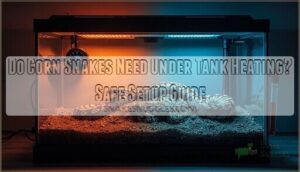
Corn snakes are remarkably forgiving pets—until temperature becomes the problem. Unlike mammals that generate their own body heat, corn snakes depend entirely on their environment to regulate digestion, immune response, and basic movement.
Drop the temperature too low, and a snake that seemed healthy last week starts refusing meals, moving sluggishly, and struggling to shed. So whether a corn snake can live without a heating pad isn’t a simple yes or no—it depends on the snake’s age, your home’s ambient temperature, and how long "without heat" actually means.
Getting this right protects your snake from conditions that develop quietly before becoming serious.
Table Of Contents
- Key Takeaways
- Can Corn Snakes Live Without a Heating Pad?
- Corn Snake Temperature Requirements
- Signs Your Snake is Too Cold
- Heating Alternatives Besides Pads
- Safe Setup and Emergency Backup
- Frequently Asked Questions (FAQs)
- Do corn snakes need heat pads?
- How long can corn snakes survive without heat?
- Do corn snakes like heat lamps?
- How do you heat a corn snake?
- Does a corn snake need a heating pad?
- What can I use instead of a heat lamp for reptiles?
- How often should corn snake enclosures be spot-cleaned?
- Do corn snakes need UVB lighting in their enclosure?
- Conclusion
Key Takeaways
- Adult corn snakes can handle brief periods without a heating pad, but only if room temps stay between 75–80°F—drop below that, and health problems start stacking up fast.
- Hatchlings and juveniles can’t afford that flexibility; they need steady, reliable warmth to support digestion, immune development, and proper shedding.
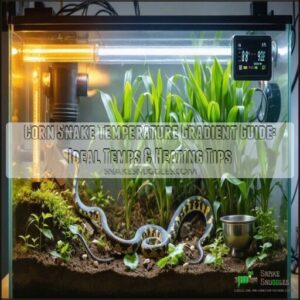
- A temperature gradient—warm side around 85–88°F, cool side at 75–79°F—isn’t a luxury; it’s how your snake self-regulates and stays healthy every single day.
- Whatever heat source you choose (pad, lamp, or ceramic emitter), pairing it with a thermostat and a digital thermometer is non-negotiable for keeping your snake safe.
Can Corn Snakes Live Without a Heating Pad?
The short answer is yes — but only under the right conditions, and not indefinitely.
A few key factors determine whether skipping the heat pad puts your snake at real risk.
Your snake’s behavior around the warm zone is one of the biggest clues, so understanding ideal snake heating pad temperatures helps you spot when something’s off before it becomes a real problem.
Here’s what you need to know.
When a Healthy Adult Can Tolerate Short Periods Without One
A healthy adult corn snake can handle short heat pad interruptions — but only when room temperatures stay reasonably stable and the gradient recovers the same day. Through behavioral thermoregulation, your snake naturally seeks warmer zones, keeping stress hormone levels in check.
Cold stress becomes the real threat when temperature tolerance is pushed too long, disrupting metabolic recovery rate and shrinking your safe feeding timing window.
Why Hatchlings and Juveniles Need Consistent Heat
Young corn snakes are a different story. A baby corn snake can’t afford the same flexibility adults have — their metabolic rate, immune development, and growth efficiency all depend on steady, reliable warmth.
Here’s what consistent heat actually provides in juveniles:
- Metabolic Rate — keeps digestion running at a functional pace
- Immune Development — reduces cold‑stress vulnerability
- Growth Efficiency — allocates energy toward tissue building
- Skin Renewal — provides clean, complete shedding cycles
- Thermoregulatory Behavior — allows predictable movement between temperature gradient zones
Research shows that temperature fluctuations cause stress in young reptiles, emphasizing the need for stable heat sources.
Without a heat pad holding that warm side steady, your snake’s thermoregulation simply can’t work as intended.
How Long Room Temperature Alone is Safe
So how long can a corn snake actually manage on room temperature alone? For adults, you’re looking at a narrow window — maybe a few hours if your ambient temperature holds steady between 75–80°F. Drop below that, and thermal inertia effects kick in fast, pulling your snake out of its thermal comfort zone.
Consistent temperature monitoring is the only way to know where you actually stand.
When “no Pad” Becomes a Health Risk
A few cool hours might seem harmless, but without a pad, risks stack up quickly. Cold spot detection becomes critical here — corners and hides can stay well below what your thermometer shows.
Watch for these warning signs:
- Metabolic slowdown affecting digestion and gut motility issues
- Immune suppression leaving your snake vulnerable to infections
- Stress hormone elevation from repeated temperature instability
- Symptoms of inadequate heating like lethargy and regurgitation
- Signs of hypothermia including refused meals and poor sheds
Corn Snake Temperature Requirements

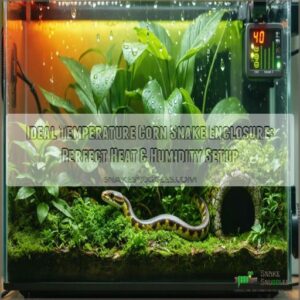
Getting the temperature right in your corn snake’s enclosure isn’t guesswork — it’s the foundation of keeping them healthy. There are a few specific numbers worth knowing before you set anything up.
This guide to corn snake temperature control breaks down exactly which zones to aim for and why the gradient matters so much.
Here’s what your enclosure actually needs to hit.
Warm Side Target Range for The Enclosure
The warm side of your corn snake’s enclosure should stay between 85°F and 88°F at the surface — that’s where your snake actually lies, not just the ambient air. Surface Temperature Mapping across the warm end, combined with Probe Placement Consistency, confirms your thermal gradient holds steady.
A reliable thermostat keeps that Temperature Bandwidth tight, so Gradient Stability and Heat Retention Materials do their job around the clock.
Cool Side Target Range for Healthy Thermoregulation
cool side temperature should sit between 75°F and 79°F (24–26°C) — enough of a Gradient Margin to support healthy thermoregulation without dragging down your snake’s Digestion Rate.
This range keeps Activity Zones functional, letting your snake self-regulate its Metabolic Health throughout the day.
Monitor it with a digital probe thermometer, and account for Seasonal Adjustments when ambient room temperatures shift.
Ideal Basking Spot Temperature
basking spot temperature—your snake’s personal thermostat dial—should land between 80°F and 85°F for Ideal Basking Heat. Thermometer Probe Placement matters here: press the probe directly onto the surface, not the air above it.
- Measure the contact surface, not ambient air
- Target 80°F–85°F consistently throughout active hours
- Adjust Heat Source Positioning if readings drift outside range
- Use Temperature Stability Monitoring after any bulb or setup changes
- Apply Seasonal Gradient Tuning as room temperatures shift
Safe Nighttime Temperature Drops
Nights don’t need to stay as warm as the day — and that’s actually fine. Once you turn off the basking lamp, Gradual Night Cooling takes over naturally. Room Temperature Influence determines how far temperatures drop, so Temperature Monitoring Frequency matters: check both sides after lights-out.
| Condition | Safe Range |
|---|---|
| Nighttime cool side | ~75°F |
| Minimum overnight | 70°F |
Keep your Thermostat Probe Placement consistent — same spot, every night — so overnight heating only kicks in when temperatures actually need it.
Why a Temperature Gradient Matters
A temperature gradient isn’t just a comfort feature — it’s how your corn snake stays healthy.
Through behavioral thermoregulation, your snake self-regulates by moving between zones, enabling metabolic fine-tuning on demand.
This enhances digestion efficiency after meals and provides immune support by keeping body temps in the ideal range.
Thermal gradient design also acts as stress buffering, protecting your corn snake when ambient conditions shift unexpectedly.
Signs Your Snake is Too Cold
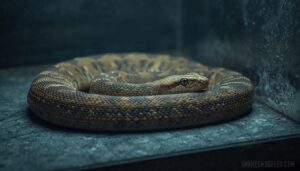
A cold corn snake won’t always look dramatically sick — the signs tend to creep in quietly, and it’s easy to mistake them for normal behavior.
But snake’s body is always sending signals when something’s off with its environment.
Here are the key warning signs to watch for.
Reduced Appetite and Skipped Meals
One of the clearest symptoms of inadequate heating in corn snakes is a sudden disinterest in food. When the temperature gradient drops too low, metabolic slowdown kicks in, and your snake’s digestive system basically stalls.
Missed meals pile up fast, and without a feeding schedule optimization plan, nutritional deficiency risk grows quietly. Weight tracking over several weeks often reveals the real damage before anything looks obviously wrong.
Lethargy and Sluggish Movement
A skipped meal often comes with a second warning: your snake barely moves. Metabolic slowdown hits reptile metabolism hard — cold stress leaves your corn snake parked in one spot, slow to respond, and uninterested in exploring.
Poor enclosure heat distribution and sensor placement errors can mask this.
Post-feeding lethargy and stress-induced lethargy both signal a failing temperature gradient before bigger problems surface.
Regurgitation After Feeding
Sluggish behavior is often the last warning before your corn snake brings a meal back up. When the temperature gradient drops too low, digestive enzyme efficiency tanks — and regurgitation follows.
Air swallowing issues and feeding size impact this too, but without adequate heat pad warmth, even a small meal overwhelms the digestive system.
Post-feeding position matters, yet metabolic rate changes from a cold enclosure remain the core problem.
Poor Shedding and Stuck Eye Caps
Regurgitation isn’t the only red flag — poor shedding tells the same story.
Without a stable temperature gradient and solid humidity control, the shedding process breaks down fast.
Dry skin clings rather than releases, and stuck eye caps follow.
moist hide placement and eye cap softening techniques help, but if retention continues, veterinary intervention is your safest next step.
Higher Risk of Respiratory Problems
Cold stress doesn’t stop at digestion — it hits the immune system just as hard, leaving your corn snake wide open to respiratory infections.
- Wet bedding traps moisture and keeps conditions cool, irritating the airway.
- Dust accumulation from poor substrate choices inflames sensitive respiratory tissue.
- Poor ventilation lets irritants build up fast.
- Humidity fluctuations stress airways more than steady high humidity.
- A failing temperature gradient means the snake can’t dry out or warm up properly.
Heating Alternatives Besides Pads

Heating pads aren’t your only option, and for some setups, they’re not even the best one. A few different heat sources can work well for corn snakes depending on your enclosure style and daily routine.
Here’s a look at what’s available and how each one fits into a solid heating setup.
Heat Lamps for Daytime Warming
A heat lamp is one of the most effective daytime heat source options for corn snakes. Choose a 40–60W bulb with a built-in reflector for focused heat distribution uniformity across the basking zone.
Bulb type choice matters — daytime bulbs support your snake’s day/night cycle naturally.
Position the reflector carefully; improper heat source placement risks overheating. Always pair with a thermostat for safe wattage selection.
Ceramic Heat Emitters for Nighttime Use
When the lights go out, your snake still needs warmth — and ceramic heat emitters deliver exactly that. They produce infrared heat benefits without any visible light, so your corn snake’s day/night rhythm stays intact.
Their moisture-resistant design manages terrarium humidity well, and their long lifespan durability means fewer replacements.
Pair one with a thermostat for reliable quiet nighttime operation and consistent thermal gradient maintenance.
Under-tank Heat Sources and Placement Basics
Under-tank heating mats are a reliable foundation for your corn snake’s thermal gradient — but placement makes or breaks performance. Follow these basics to get it right:
- Probe Positioning: Secure the thermostat probe on the substrate surface directly above the mat’s warmest area.
- Mat Contact: Make sure full, flat contact beneath the enclosure — no gaps, no air pockets.
- Clearance Management: Route cables so nothing gets pinched under the heat pad.
- Warm Zone Sizing: Cover roughly one-third of the floor to support natural thermoregulation.
- Temperature Calibration: Verify readings with an independent digital thermometer after setup.
A heat mat with thermostat control keeps surface temps accurate and prevents dangerous hot spots.
Which Option Suits Your Enclosure Setup
Your best heat source comes down to a few practical factors: space constraints, ventilation needs, budget considerations, and aesthetic preference.
Under‑tank heating mats work well in compact setups where power availability is limited to one outlet.
Radiant heat panels suit taller enclosures with strong ventilation needs.
Whatever you choose, heat source selection and placement determine whether your temperature gradient actually holds — so match the tool to your specific setup.
Why Thermostats Are Non-negotiable
A thermostat isn’t optional — it’s the difference between a safe enclosure and a dangerous one. Without precise temperature setpoint control, your heat pad runs unchecked, creating overheating incidents that can burn your snake.
A thermostat isn’t optional — without one, your heat pad runs unchecked and your snake pays the price
Thermostat auto-compensation manages room temperature shifts automatically, maintaining cycle stability assurance around the clock. Consistent metabolic support depends on steady temperature control, so connect every reptile heating device to a reliable thermostat and verify readings with a digital thermometer.
Safe Setup and Emergency Backup
Getting the setup right is what separates a thriving corn snake from one that’s just getting by.
Beyond choosing a heat source, a few key details make the difference between a safe enclosure and a risky one.
Here’s what you need to cover to protect your snake day-to-day and when things go wrong.
Using Digital Thermometers to Verify Temperatures
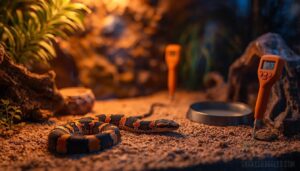
A single thermometer tells you almost nothing. Multi-Point Verification — one probe on the warm side, one on the cool — gives you the full picture of your temperature range.
Follow a calibration routine monthly and run battery health checks when readings seem off. Allow reading stabilization time after repositioning probes. Smart probe placement strategy and consistent temperature monitoring catch dangerous temperature fluctuations before your snake feels them.
Preventing Burns With Correct Heat Placement
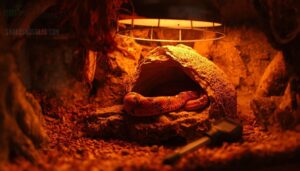
Knowing your temps is only half the equation — placement decides whether your snake stays safe or gets burned. Always use a metal lamp guard over heat lamps to block direct contact.
Under tank heating mats need a heat pad barrier between the pad and substrate to manage hot‑spot monitoring. Your hide placement strategy keeps your snake warming safely, not cooking.
Best Substrate Choices Around Heat Sources
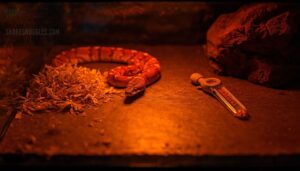
Substrate choice quietly shapes how well your heat source performs. Tile conductivity and slate heat transfer give you the most consistent warm zones — heat moves up evenly and stays predictable.
Coco fiber insulation, aspen shavings, and sand as substrate all slow that transfer, so your snake feels less warmth than your thermometer shows.
A washable top layer paired with moisture evaporation control keeps temperatures stable and readings honest.
Backup Heat During Power Outages

Power outages are where all your careful setup gets tested. Have a plan before the grid fails.
- Wrap the enclosure in blankets to slow heat loss immediately
- Use cloth-wrapped hand warmers as short-term emergency heating strategies for reptile enclosures
- Run a battery-powered heater using Battery Runtime Calculation: watts × hours needed = watt-hours required
- Generator Capacity Planning ensures your electric heat source runs fully during longer outages
- Fuel Heater Ventilation rules apply strictly — never run propane indoors without airflow
When to Get Urgent Reptile Care
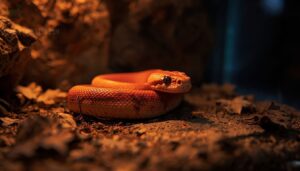
Even with a solid backup plan, some situations can’t wait. If your corn snake shows open mouth breathing, cloacal prolapse, seizure activity, or severe bleeding, get to a reptile vet the same day.
| Symptom | Likely Cause | Action |
|---|---|---|
| Open mouth breathing | Respiratory infection | Same-day vet visit |
| Cloacal prolapse | Heat stress or illness | Immediate care |
| Seizure activity | Severe metabolic crisis | Emergency vet now |
Sudden weight loss and heat source failure together signal serious reptile health risks fast.
Frequently Asked Questions (FAQs)
Do corn snakes need heat pads?
Corn snakes don’t strictly require a heat pad, but they do need a reliable temperature gradient for behavioral thermoregulation, metabolic rate influence, and immune function support.
How you deliver that heat is what actually matters.
How long can corn snakes survive without heat?
Without a heat pad, an adult corn snake survives roughly a few days — only if the room stays near 70–75°F. Hatchlings? A few hours. Below 65°F, that timeline collapses fast.
Do corn snakes like heat lamps?
Yes — corn snakes do well with heat lamps. They naturally seek out basking spots, and a properly positioned lamp mimics that warm overhead sunlight they’d find in the wild.
How do you heat a corn snake?
You heat a corn snake by building a thermal gradient — a warm side around 88–90°F and a cool side near 72–75°F — using a heat pad, heat lamp, or ceramic emitter controlled by a thermostat.
Does a corn snake need a heating pad?
A heating pad isn’t strictly required, but your corn snake needs a reliable temperature gradient. Whatever heat source you choose, it must maintain a warm side of 88–90°F consistently.
What can I use instead of a heat lamp for reptiles?
Radiant heat panels, ceramic heat emitters, infrared heating pads, and under tank heating mats all work well as heat lamp alternatives.
Each delivers steady warmth without bright light disrupting your snake’s environment.
How often should corn snake enclosures be spot-cleaned?
Spot-clean your corn snake’s enclosure daily. Daily waste removal keeps bacteria from building up fast. Focus on feces, urates, and any soiled substrate — quick, consistent checks make all the difference.
Do corn snakes need UVB lighting in their enclosure?
Corn snakes don’t need UVB lighting to survive. They get vitamin D3 from prey, supporting calcium metabolism without it.
Think of UVB enrichment benefits as a helpful upgrade, not a requirement.
Conclusion
What’s the cost of getting it wrong? For a corn snake, it’s slow decline disguised as normal behavior—missed meals, failed sheds, a compromised immune system working quietly against them.
Can corn snakes live without a heating pad in a warm home briefly? Sometimes.
But consistent, monitored heat isn’t optional equipment—it’s the foundation of their health. Nail the temperatures, verify with a thermometer, and your snake won’t just survive. It’ll thrive.
- https://completecalculators.com/calculators/reptile-keeping/reptile-temperature-gradient-calculator
- https://aboutkidsgi.org/upper-gi/infant-regurgitation/
- https://pmc.ncbi.nlm.nih.gov/articles/PMC2796655/
- https://my.clevelandclinic.org/health/diseases/17981-rumination-syndrome
- https://medlineplus.gov/refluxininfants.html