This site is supported by our readers. We may earn a commission, at no cost to you, if you purchase through links.

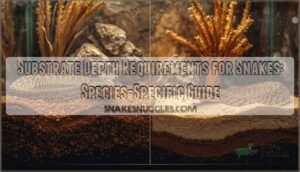
Most snake keepers obsess over heat lamps and feeding schedules—but the thing sitting under their snake gets measured once and forgotten. Bedding depth isn’t a minor detail. Get it wrong, and you’re looking at failed sheds, chronic stress, or a burrowing species spending its life on the surface because the substrate collapses beneath it.
The right depth depends on species, enclosure size, and the material you’re working with. A ball python needs different conditions than a sand boa or a green tree python—sometimes dramatically different.
Nail the depth, and everything else in the enclosure becomes easier to manage.
Table Of Contents
- Key Takeaways
- How Deep Should Snake Bedding Be?
- Species-Specific Substrate Depth Recommendations
- Best Substrate Materials for Proper Depth
- How Substrate Depth Affects Temperature and Humidity
- Preventing Health Risks From Improper Bedding Depth
- How to Maintain The Right Substrate Depth Over Time
- Signs Your Snake’s Bedding Depth Needs Adjusting
- Frequently Asked Questions (FAQs)
- How much Aspen snake bedding should I use?
- What kind of bedding does a snake need?
- Do snakes need a hide box?
- What is a good substrate for snakes?
- How deep for snake bedding?
- Can snakes hear you coming?
- Where do snakes go in October?
- Can substrate depth affect a snakes feeding response?
- How does bedding depth change after a snake sheds?
- How deep should bedding be in quarantine enclosures?
- Conclusion
Key Takeaways
- one-size-fits-all number — burrowing species like ball pythons and sand boas need 4–6 inches, while arboreal snakes only require 1–2 inches for humidity retention.
- Getting depth wrong doesn’t just limit natural behavior — it drives chronic stress, failed sheds, and immune decline, all of which are directly tied to inadequate substrate thickness.
- Your substrate material matters as much as the depth: coconut fiber holds 60–80% humidity for tropical setups, aspen keeps desert enclosures dry, and both cedar and pine are toxic and must be avoided entirely.
- Watch your snake’s behavior — surface scratching, collapsed burrows, feeding hesitation, and incomplete sheds are all signals that your bedding depth needs adjusting before health problems develop.
How Deep Should Snake Bedding Be?
Substrate depth isn’t one-size-fits-all — it depends on your snake’s species, size, and behavior. Get it wrong, and you’re either restricting natural instincts or creating a moisture trap.
A good starting point is matching depth to your snake’s burrowing habits — this guide on ideal snake substrate depth breaks it down by species so you’re not just guessing.
Here’s what the right depth looks like across different snake types and setups.
General Depth Guidelines by Snake Type
Substrate depth isn’t one-size-fits-all — your snake’s lifestyle dictates the number.
Non-burrowing terrestrial species do well with 2–3 inches, enough to form a reliable temperature buffer layer without trapping excess moisture. Arboreal species need just 1–2 inches for humidity retention. Burrowing behavior demands 4–6 inches minimum.
Enclosure depth scaling matters too: larger tanks support deeper beds without compromising heating clearance.
A three‑inch coconut fiber bed creates a moisture gradient that mimics natural soil conditions, and deeper substrate reduces misting.
Minimum Depth for Hatchlings Vs. Adults
Age matters as much as species when sizing up bedding depth.
Hatchlings need at least 2–3 inches — enough for a secure hatchling burrow size without trapping them from the surface. Adults require 5–6 inches to support a proper adult thermal buffer and full-body movement.
Follow growth stage scaling as your snake develops:
- Start hatchlings at 2–3 inches of loose substrate
- Increase depth incrementally every few months
- Reach 4–6 inches by juvenile stage
- Shift adults to 5–6 inches using species size ratio as your guide
- Apply species-specific substrate depth guidelines throughout each life stage
Depth Recommendations for Large Enclosures (75+ Gallons)
Bigger enclosures change the math. In a 75-gallon setup or larger, 5–6 inches of substrate works well for most species — supporting thermal gradient depth and humidity-depth balance without sacrificing heat source clearance.
Enclosure size scaling matters here: more floor space means better ventilation, impact distribution, and reduced substrate compaction management challenges.
Species-specific substrate depth guidelines still apply — don’t let the extra room tempt you into guessing.
Species-Specific Substrate Depth Recommendations
Not every snake needs the same depth — and getting it wrong can cause real stress or health problems. The right bedding depth depends heavily on your snake’s species and natural behavior.
Here’s what you need to know for the most common types.
Bedding Depth for Ball Pythons
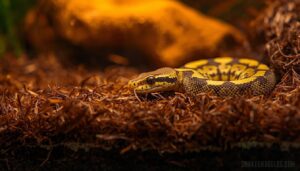
Ball pythons are natural burrowers — thin bedding simply doesn’t cut it. Aim for 3 to 4 inches minimum, increasing to 4 to 6 inches for active diggers.
Skimping on depth stresses your snake out fast — check out common pet snake health issues to see exactly what poor husbandry can lead to.
Proper species-specific substrate depth guidelines support burrow enrichment, moisture buffering, and thermoregulation. Loose coconut fiber at this depth lets your snake displace material freely, aiding humidity control and giving heat source positioning room to maintain a stable gradient.
Depth Requirements for Desert-Dwelling Snakes
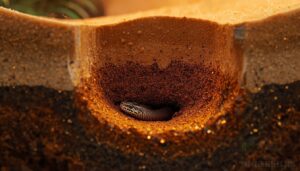
Desert-dwelling snakes aren’t just hiding — they’re engineering survival. Their burrow architecture creates microclimate stability, cutting temperature swings by 10–20°F between day and night.
For most desert species, substrate depth of 4–6 inches enables effective thermoregulation and humidity control. Sand boas need 5–6 inches to fully submerge.
Give desert species what they’re wired for:
- Heat shielding depth that blocks surface spikes
- Prey access depth mimicking natural rodent tunnels
- Seasonal depth variation as temperatures shift
- Burrowing behavior expression that reduces stress hormones
Arboreal Vs. Terrestrial Snake Depth Needs
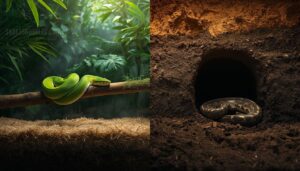
Where a snake lives in the wild tells you exactly what it needs underfoot.
Arboreal snakes need just 1–2 inches — enough for humidity retention, not a burrow zone.
Terrestrial and burrowing species demand 4–6 inches for proper burrow zone allocation and stress reduction.
Your habitat zoning strategy should match each snake’s depth preference variation, integrating vertical space for climbers and deep substrate for diggers.
Best Substrate Materials for Proper Depth
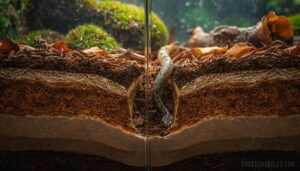
Not all substrates hold depth the same way—and that difference matters more than most keepers realize. The material you choose determines how well your snake can burrow, how stable your humidity stays, and how safely you can maintain the right thickness long-term.
Here’s how the most common options stack up.
Coconut Fiber, Aspen, and Cypress Mulch Compared
Not all substrates pull equal weight.
Coconut fiber leads on moisture retention — holding 60–80% humidity with minimal dust production, making it ideal for tropical setups.
Aspen shavings keep things dry and light, offering solid cost efficiency for desert species.
Cypress mulch resists compaction, supporting deeper substrate depth and natural burrowing texture.
Match your material to species-specific substrate depth guidelines, and you’re halfway there.
Substrates to Avoid and Why
Some choices look harmless — until your snake starts wheezing.
Avoid these substrates entirely:
- Cedar or pine shavings — Aromatic wood toxicity from resin vapors causes respiratory health damage quickly
- Sand and calcium sand — Sharp particle injuries, dustborne particulates, and serious impaction risk during feeding
- Chemically treated bedding — Chemical additive irritation and moisture retention overload destabilize humidity and trigger inflammation
Avoiding toxic substrates like cedar and pine isn’t optional — it’s baseline care.
When to Use Paper Towel or Butcher Paper
Both paper towel and butcher paper serve as reliable quarantine bedding and medical recovery substrates — not permanent solutions, but smart ones. When a snake is sick, newly arrived, or still a hatchling, paper-based bedding eliminates impaction risk entirely and makes cleaning efficient.
Feeding platforms work best alongside these materials. Neither retains moisture, so humidity regulation requires extra attention during use.
How Substrate Depth Affects Temperature and Humidity
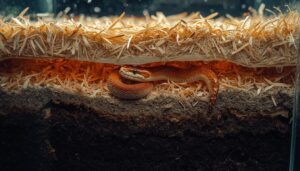
Substrate depth does more than give your snake somewhere to dig — it actively shapes the temperature and humidity inside the enclosure. Get the depth wrong, and even a perfect heating setup can fall apart.
Here’s how depth influences three key environmental factors you need to manage.
Creating a Thermal Gradient With Deep Bedding
Deep bedding does more than cushion — it builds a livable vertical heat gradient, your snake actually uses.
Layered temperature zones form naturally through vertical heat distribution, with warmer layers near the surface and cooler retreats below.
Species-specific substrate depth guidelines recommend at least 4 inches in the warm zone for effective thermal gradient mapping.
Smart heat source placement and basic insulation strategies support burrowing behavior and stable gradients throughout.
Retaining Humidity for Tropical Species
Tropical species like the arboreal green tree python need more than just misting frequency — they need substrate that holds moisture between sessions. Moisture retentive substrates such as coconut fiber, at 3–4 inches depth, create reliable humidity buffers that sustain 60–80% overnight.
Paired with ventilation control and damp microclimate zones, substrate moisture balance keeps humidity retention steady without soaking the bedding.
Keeping Humidity Low for Desert Species
Desert-dwelling species flip the script entirely. Where tropical setups chase moisture retention, your goal here is rapid evaporation and consistent air exchange rate.
Keep bedding at 1–2 inches — deeper beds trap humidity and invite scale rot fast.
Three practices that make the difference:
- Use an open lid design with high ventilation
- Choose a dry substrate choice like aspen or coarse sand
- Manage surface moisture management by spot-removing damp patches daily
Preventing Health Risks From Improper Bedding Depth
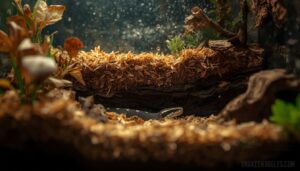
Getting the depth wrong isn’t just an inconvenience — it can make your snake genuinely sick. The risks range from digestive blockages to respiratory infections, and most of them are preventable.
Here’s what you need to watch for.
Impaction Risks From Granular Substrates
Granular substrates — sand, gravel, and crushed materials — carry a real impaction risk that no substrate depth fix can solve alone. Particle shape matters: angular grains irritate gut lining, while moisture clumping turns loose bedding into compact, indigestible masses. Size distribution amplifies this — mixed fine and coarse particles pack tighter.
Even species-specific substrate depth guidelines can’t offset the gut irritation caused by repeatedly swallowed substrate dust.
Mold and Bacterial Growth From Excessive Depth
Impaction isn’t the only danger lurking under your snake’s feet. Excessive substrate depth creates ideal conditions for mold spore proliferation and bacterial colonization — and it happens faster than most keepers expect.
Here’s what goes wrong when bedding runs too deep:
- Moisture retention traps water in lower layers, where oxygen depletion shifts microbial activity toward harmful anaerobic bacteria.
- Biofilm formation develops on saturated substrate surfaces, making bacterial colonies resistant to spot-cleaning.
- Nutrient accumulation from buried waste and shed skin accelerates microbial decomposition deep inside the bedding mass.
- Poor humidity control combined with warm enclosure temps keeps those deeper layers persistently wet — the exact environment mold needs to spread.
Feeding Practices That Protect Against Substrate Ingestion
Even with ideal substrate depth and smart substrate choice, feeding habits can make or break your impaction risk.
Use a separate feeding surface — a smooth plastic lid or shallow dish placement works well — and keep prey size controlled so your snake strikes cleanly.
A consistent feeding schedule reduces frantic foraging.
Hydration provision aids gut function, helping pass any accidental bits.
How to Maintain The Right Substrate Depth Over Time
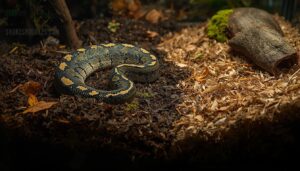
Getting the depth right is only half the job — keeping it there what actually protects your snake long‑term. Substrate compresses, dries out, and accumulates waste faster than most keepers expect.
Here’s how to stay on top of it.
Daily Spot-Cleaning and Weekly Aeration
Daily spot cleaning removes feces, shed skin, and leftover prey — keeping microbial growth control consistent without disrupting burrow integrity. Use a small scoop or tongs, targeting only soiled areas.
Weekly aeration then loosens compacted zones, restoring airflow and supporting odor reduction. Together, they form the backbone of any solid maintenance schedule for snake enclosures — protecting species-specific substrate depth without a full reset.
Measuring Depth at Warm and Cool Ends
After spot-cleaning, take a moment to measure — this is where consistency actually matters. Use the Ruler Technique or Probe Calibration method: insert a straight tool vertically at both the warm and cool ends, recording each reading in a Depth Log.
This tracks Temperature Correlation across thermal gradient zones over time, ensuring species-specific substrate depth stays within target range across changing enclosure size and heat source effects.
When and How to Fully Replace Substrate
Full substrate changes aren’t optional — they’re a reset your enclosure genuinely needs. Replacement timing matters: swap bedding every 3–6 months, or sooner if mold, persistent odor, or compaction appears.
For stress minimization, schedule changes outside of shed cycles.
Clean the enclosure fully, let surfaces dry, then restore burrowing depth immediately.
Humidity rebalancing and heat stabilization should come before the snake goes back in.
Signs Your Snake’s Bedding Depth Needs Adjusting
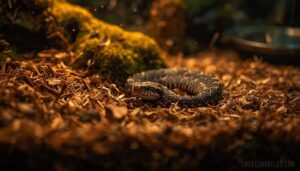
Your snake can’t tell you when something’s off — but it will show you. The signs are usually subtle at first, easy to dismiss as quirky behavior rather than a red flag.
Here’s what to watch for.
Behavioral Clues Like Surface Scratching or Collapsed Burrows
Your snake’s behavior is the clearest feedback you’ll get.
High scratch frequency — especially near the enclosure floor — signals bedding that’s too shallow to support stable tunnels. Burrow collapse signs like caved-in passages and displaced substrate indicate insufficient depth or poor material.
Watch for burrow bursting behavior: sudden, explosive digging. Entrance grooming patterns and elevated surface activity trigger often confirm the same problem.
Stress Indicators Linked to Inadequate Burrowing Depth
stress runs deeper than behavior alone. When substrate depth can’t support natural burrowing behavior, cortisol levels climb — and the signs show up fast.
Watch for increased pacing, reduced hide utilization, and feeding hesitation at mealtime.
These aren’t quirks; they’re stress indicators tied directly to environment.
Chronic cortisol elevation leads to immune function decline, making species-specific substrate depth guidelines non-negotiable for long-term reptile health.
Chronic stress from improper substrate depth suppresses immunity, making correct bedding depth essential to reptile health
Monitoring Shedding and Humidity as Depth Indicators
Shedding tells you more than you’d think. When humidity drops below 40 percent, incomplete sheds and stuck ventral skin are your depth shedding alerts — the substrate isn’t holding enough moisture.
Place a digital hygrometer near the bedding surface for accurate hygrometer placement strategy results.
Humidity gradient tracking and moisture diffusion mapping across depths reveal whether your species-specific substrate depth guidelines are actually working.
Frequently Asked Questions (FAQs)
How much Aspen snake bedding should I use?
For most setups, 2–3 inches of aspen shavings hit the sweet spot.
It facilitates burrowing behavior, suits species-specific substrate depth guidelines, and balances scent retention with ease of replacement — without overloading your budget considerations or decor compatibility.
What kind of bedding does a snake need?
Your snake needs a substrate that balances burrowing behavior, humidity control, and thermal conductivity.
Coconut fiber, aspen shavings, and cypress mulch are the preferred options — safe, eco-friendly materials that meet species-specific substrate depth guidelines.
Do snakes need a hide box?
Yes. Hides give snakes a secure retreat, reducing stress and supporting natural behavior.
Place one on the warm side, one on the cool side — that covers both temperature options and feeding security.
What is a good substrate for snakes?
Think of substrate as your snake’s snake’s foundation — it sets the tone for everything else.
Coconut fiber, aspen, and cypress mulch are reliable, low-dust, chemical-free substrates that support burrowing behavior and respiratory health affordably.
How deep for snake bedding?
Most snakes do well with 2–4 inches of substrate depth — enough to support burrow stability factors, regulate moisture evaporation rate, and meet species-specific substrate depth guidelines without risking substrate compaction effects.
Can snakes hear you coming?
Not exactly — but they do sense you.
Through skull vibration and airborne sound sensitivity, species-specific hearing picks up low-frequency cues. Vibration detection from your footsteps triggers behavioral sound response before you’re even visible.
Where do snakes go in October?
In October, wild snakes migrate toward sheltered dens — rock piles, burrows, and crevices — as nighttime temperatures drop below 60°F, triggering brumation.
Elevation and regional climate determine exactly when this seasonal shelter migration begins.
Can substrate depth affect a snakes feeding response?
Yes — substrate depth directly affects feeding response. Deeper bedding facilitates burrow ambush spots, sharpens prey detection, and improves striking success.
It also aids energy conservation, which influences feeding frequency and overall appetite stability.
How does bedding depth change after a snake sheds?
After skin shedding, post-shed activity spikes — burrow reestablishment, microclimate stabilization, recovery stress relief, all drive brief depth adjustment timing.
Maintain or slightly increase substrate depth to support moisture retention and healthy humidity levels.
How deep should bedding be in quarantine enclosures?
Keep quarantine substrate shallow — paper towel works best.
It facilitates visibility for monitoring, simplifies quarantine waste management, and eliminates burrowing behavior concerns entirely while maintaining uniform bedding thickness for consistent spot-clean depth impact.
Conclusion
The devil is in the details—and knowing how deep snake bedding should be is exactly the kind of detail that separates a surviving enclosure from a thriving one. Depth isn’t decoration; it drives thermoregulation, humidity stability, and natural behavior.
Match it to your species, measure it consistently, and adjust when your snake tells you something’s off. Get this right, and you’ve built an environment where your snake doesn’t just tolerate captivity—it lives well inside it.