This site is supported by our readers. We may earn a commission, at no cost to you, if you purchase through links.

A gravid female corn snake in egg-binding crisis, straining against a clutch her body can’t safely pass, remains one of the most preventable emergencies in reptile husbandry.
Breeders who rushed the pairing, tempted by a plump-looking yearling, often trace the problem straight back to timing. Corn snake breeding programs have leaned on age three as the standard since hobbyist husbandry standardized in the 1990s, yet calendar years alone won’t tell you whether a female’s bones, fat reserves, and follicles are actually ready.
Weight, shed cycles, and muscle tone carry more weight than a birthdate ever could, and knowing how to read them separates a thriving clutch from a costly mistake.
Table Of Contents
- Key Takeaways
- Breed Corn Snakes at Three Years
- Check Size Before Breeding
- Know Readiness Signs
- Avoid Breeding Too Young
- Prepare First Breeding Safely
- Frequently Asked Questions (FAQs)
- Is corn one of the oldest crops?
- How many eggs does a corn snake lay?
- What morphs can corn snakes safely produce?
- How long does corn snake incubation take?
- What temperature is best for incubating eggs?
- How do you care for corn snake hatchlings?
- How many clutches can a female produce yearly?
- How long does corn snake incubation typically last?
- Can breeding pairs be housed together permanently?
- What signs indicate a failed breeding attempt?
- Conclusion
Key Takeaways
- Three years old is the general benchmark for breeding corn snakes, but true readiness depends on body condition rather than age alone, since females especially need full physical maturation—stable weight, fat reserves, and bone density—before their bodies can safely support egg production.
- Weight, muscle tone, feeding response, and regular 6-8 week shed cycles are more reliable readiness indicators than a birthdate, so hands-on checks and consistent record-keeping matter more than counting years.
- Breeding immature or underweight females significantly raises the risk of egg binding, poor egg quality, stunted growth, and weak hatchlings, making early pairing a genuine health gamble rather than a shortcut.
- Safe breeding preparation requires a full vet health check, accurate long-term weight tracking, a stable feeding schedule, lineage review to avoid inbreeding, and a carefully managed brumation period before pairing snakes.
Breed Corn Snakes at Three Years
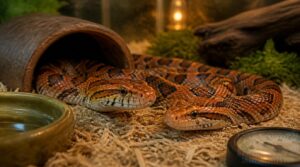
Three years old is the number breeders point to most often, but that figure hides some real variation between males and females. Age alone won’t tell you everything you need to know before pairing up your snakes. Here’s what actually shapes that timeline.
Since growth rates shift once maturity hits, it’s worth checking how ball python size and lifespan expectations can guide your enclosure choices early on.
Minimum Safe Breeding Age
How old is old enough? For corn snakes, the answer is three years—the point when full maturity and reproductive readiness align. Breeding before this window raises real risks tied to sexual maturity timing and hormonal development.
Age alone isn’t a green light, though; it works best when paired with body condition checks confirming a snake’s true readiness for the demands of reproduction.
Females Need More Time
Three years marks the finish line, not the starting gun, for females specifically. Egg production demands full physical maturation—developed fat reserves, stable bone density, and a reproductive tract ready for the strain of ovulation.
Nutritional recovery time matters too: females need consistent weight gain across multiple growth cycles before their bodies can support egg-laying without draining critical reserves needed for their own survival.
Males May Mature Earlier
Males don’t wait around for their third birthday. Testosterone surges during puberty push some lineages toward breeding readiness sooner, driving earlier territorial behavior and courtship attempts.
Watch for:
- Earlier weight milestones than females
- Mating-driven activity before females mature
- Faster growth tied to nutrition
Even so, "earlier" isn’t "ready"—size and condition still decide the outcome.
Age is Only One Factor
A calendar tells you nothing about the snake in front of you. Health stability, feeding consistency, and body condition matter more than a birthdate.
Frequent shedding in young ball pythons is usually just rapid growth at work, but knowing the signs of a healthy ball python shedding cycle helps you tell normal development from something worth watching.
| Factor | Why It Matters |
|---|---|
| Weight/condition | Predicts breeding success |
| Health history | Flags hidden risks |
Reproductive readiness hinges on all these together—not age alone. Two three-year-olds can have very different outcomes.
Check Size Before Breeding
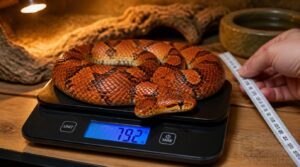
Age on a calendar only tells you so much. Your snake’s body gives you the real answer, and that means looking past the birthdate. Here’s what to check before you commit to breeding.
Female Weight Matters Most
Scale time trumps calendar time here. Weight drives ovarian cycle timing, and females carrying ideal fat reserves ovulate more reliably than lean ones.
Alongside steady weight gain, keeping an eye on consistent feeding response as a health indicator helps confirm your female is on track for reliable ovulation.
Heavier, well-conditioned females show a strong clutch size correlation—bigger, healthier eggs. Keep feeding steady, though; sudden weight fluctuation stress disrupts reproduction and slows recovery afterward, so consistency matters more than rushing the scale.
Healthy Body Condition
Run your hands along her body before you ever think about pairing her up. Muscle symmetry on both sides, a smooth subcutaneous fat layer over the tail base, and glossy scale quality all signal she’s ready.
Check these four:
- Firm, even muscle tone
- Good hydration status (skin snaps back)
- Strong digestive health, no regurgitation
- Complete recent sheds
Length as Secondary Guide
How much does a snake’s length actually tell you? Less than you’d think. A five-foot female can still lack the fat reserves needed for egg production, so pair length with weight and feeding history.
| Length Signal | What It Means |
|---|---|
| Steady growth, two molts | Stable, reliable indicator |
| Length up, weight flat | Possible metabolic stress |
| Stalled length, good health | Reassess later, not urgent |
| Proportional growth | Healthy development |
Avoid Underweight Breeders
Skinny snakes make risky breeders. Nutritional reserve requirements matter far more than a date on the calendar—thin females often produce smaller clutches and face higher egg-binding odds.
Lineage history helps predict growth trajectories, so weigh past clutches and family growth patterns before pairing.
- Prior underweight offspring in the lineage
- Weight below species targets
- Poor recovery after last shed
Consistent records support safer, healthier litters.
Know Readiness Signs

Age and size only tell part of the story, so you’ll want to watch your snake’s actual behavior before pairing it up. A truly ready corn snake shows it through daily habits, not just a number on the scale. Here are the signs that tell you your snake is genuinely prepared to breed.
Watching for these behavioral cues alongside a full breakdown of signs your snakes are ready to breed helps you time the pairing with confidence.
Strong Feeding Response
Watch how fast your snake strikes—that tells you everything. A breeding-ready corn snake shows quick, confident feeding, reacting to prey scent within seconds rather than sniffing cautiously. This reflects strong hunger cue recognition and healthy metabolic readiness.
Consistent appetite, tied to palatability and nutritional uptake efficiency, signals her body’s prepared for the energy demands of egg production. Hesitant or picky eaters usually aren’t ready yet.
Regular Shed Cycles
A snake’s shed cycle tells its own growth story, tied to the same biological traits driving domestication in crops like maize. Breeding-ready females settle into predictable 6 to 8 week cycles, unlike juveniles shedding every 4 to 6 weeks.
- Consistent intervals across cycles
- Clear eye opacity before shedding
- No stuck skin along tail
- Proper humidity supporting completion
- Absence of retained eye caps
Normal Activity Levels
Beyond shedding, energy patterns reveal readiness too. Healthy breeders show morning bursts of exploring, calm midday rest, then a shorter evening window of movement.
| Time | Behavior |
|---|---|
| Morning | Brisk exploring, alert |
| Midday | Restful, stable temperature |
| Evening | Light activity, settling |
This rhythm reflects sound gene expression and biological ancestry—steady phenotypic variation, not lethargy, signals a body ready to breed.
Good Muscle Tone
Run your hands along the body: firmness, not flab, signals muscle stability ready for breeding.
- Even coiling strength
- Quick righting reflex
- Firm mid-body grip
- Smooth locomotion
- No sagging skin
Good tone aids joint support and postural alignment, aiding movement readiness during courtship and egg-laying exertion ahead.
No Recent Illness
Muscle tone means little if her body’s fighting something underneath. Before pairing her up, run through a five-system check: breathing, digestion, skin, parasites, and overall vitality. Watch her thermoregulation closely too, since rejecting cool hides and seeking extra heat can signal an underlying infection, a pattern explained in this guide to reptile heat-seeking behavior and behavioral fever.
| System | Healthy Sign |
|---|---|
| Respiratory | No wheezing, clicking, or bubbles |
| Digestive | Regular feces, no regurgitation |
| Skin | Clean sheds, no retained pieces |
| Systemic | Stable weight, normal appetite |
Any red flags here? Postpone breeding until she’s cleared.
Avoid Breeding Too Young
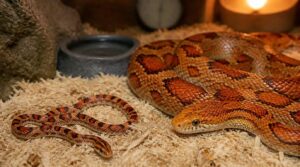
Rushing a young female into her first clutch isn’t a shortcut, it’s a gamble with her health. The risks show up in specific, predictable ways once you know what to look for. Here’s what can go wrong when you breed too early.
Egg Binding Risk
Picture an egg lodged mid-passage, unable to exit—that’s egg binding, and immature females face it far more often.
Calcium deficiency weakens uterine contractions needed for expulsion, while excess fat around the pelvic region physically crowds the oviduct. Add hormonal imbalances from premature breeding cycles, plus poor temperature regulation impairing muscle function, and you’ve got a genuinely life-threatening combination for underdeveloped snakes.
Poor Egg Quality
Quantity isn’t the problem—quality is. Young females often produce clutches with higher rates of chromosomal abnormalities, since egg maturation depends on hormonal signaling balance that’s still stabilizing.
Add unmet mitochondrial energy needs and cellular maturation defects, and you get inconsistent embryo development. Chronic inflammation risks from breeding stress compound this, meaning even fertile-looking eggs may carry weak developmental odds.
Stress and Appetite Loss
Breeding too young taxes a female’s body in ways that ripple beyond the clutch itself. Elevated cortisol from reproductive stress can suppress appetite, while gut-brain signaling gets scrambled, making hunger cues harder to read.
Add blood flow redirection away from digestion and stress-induced nausea, and you’ve got a snake refusing meals right when she needs energy most—compounding the very deficits fueling poor egg quality.
Stunted Female Growth
Think of a young female’s body as a budget already stretched thin—egg production simply overdraws it. Diverting calories toward follicle development stalls linear growth, while diverted resources compromise skeletal maturation.
A young female’s body is a budget already stretched thin, and egg production simply overdraws it
- Stunted length that never catches up
- Weakened bone density from disrupted mineralization
- Hormonal imbalances delaying future maturation
- Compromised immunity inviting chronic illness
Micronutrient deficiencies and toxin exposure compound this, permanently limiting her adult size.
Weak Hatchling Outcomes
Here’s the sting in the tail: even if a young female survives the clutch, her offspring often don’t thrive. Underage mating risks show up as smaller, weaker hatchlings with reduced yolk reserves—meaning less stored energy to fuel those critical first days. Survival rates in the first 30 days drop noticeably, and surviving hatchlings show slower early growth velocity, a disadvantage that can linger for months.
Prepare First Breeding Safely
Once age, size, and readiness signs line up, the real preparation begins. Breeding success comes down to groundwork you complete weeks before pairing your snakes. Here’s what that groundwork actually looks like.
Vet Health Check
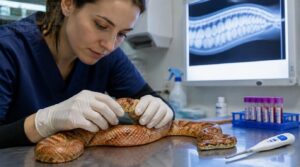
A pre-breeding exam catches problems no scale count ever will. Your vet checks cloacal temperature, palpates the coelomic cavity for retained eggs, and listens for wheezes signaling respiratory trouble.
Bloodwork screens organ function; fecal PCR rules out parasites; radiographs confirm follicle development. Cloacal swabs catch bacterial threats early.
Ask about anesthesia readiness too, since emergencies happen. This full workup, not just a glance, tells you she’s truly fit to breed.
Accurate Weight Records

A single scale reading tells you nothing; weekly average trends do. Calibrate before every session, keep her on a hard, level surface, and log grams alongside date and room temperature.
That documentation standard catches subtle weight fluctuation tracking issues—early follicle swelling, sudden loss—long before they become emergencies. Data integrity matters here: sloppy records hide the very patterns that tell you she’s ready.
Review Feeding Schedule

Weekly weight logs mean little if her gut isn’t cooperating. Confirm she’s holding a 10 to 14 day adult interval, taking appropriately sized prey without regurgitation, and shedding on schedule.
Breeding season demands more calories, so watch for appetite dips as ovulation nears. A female refusing two meals running needs a vet check, not a breeding pen.
Check Lineage History

Good appetite means little if you’re pairing siblings unknowingly. Pull records on both snakes’ ancestry documentation before breeding.
Look for:
- Breeder-issued parentage certificates with hatch dates
- Registration numbers tracing prior generations
- Notes on hereditary health issues
This isn’t paperwork for its own sake — it’s how corn snake keepers apply the same genetic diversity principles that plant breeders use to prevent inbreeding depression.
Plan Safe Brumation

Once the paperwork checks out, brumation is the last hurdle before pairing. Cool the enclosure gradually to 65°F, then down to 50–60°F for several weeks, using a thermostat to avoid spikes.
Monitor weight stability weekly and check hydration through skin-tent tests. Keep the setup dark, dry, and quiet — and have an emergency protocol ready to wake her if distress appears.
Frequently Asked Questions (FAQs)
Is corn one of the oldest crops?
You’d think it’s a modern staple, but corn’s roots run deep: teosinte became Zea mays through Mesoamerican domestication roughly 9,000 years ago, making it one of the Americas’ oldest cultivated crops—far older than the reptile it now shares a name with.
How many eggs does a corn snake lay?
Expect 10 to 30 eggs per clutch, with healthy females averaging 12 to Well-fed adults may lay up to 34, while underconditioned snakes produce as few as 6, since age, size, and health drive clutch size variations.
What morphs can corn snakes safely produce?
Five proven pairings stand out: amelanistic color stability, lavender morph viability, snow pattern contrast, motley pattern genetics, and hypo pigment reduction. Each maintains healthy clutches across generations when paired with compatible lines, giving breeders reliable, vibrant results without added genetic risk.
Successful breeders must also master corn snake breeding techniques such as managing thermal gradients and humidity.
How long does corn snake incubation take?
Incubation runs 55 to 65 days at 82–86°F, with stable humidity (85–90%) in vermiculite or perlite. Temperature swings, egg fertility, and medium moisture all affect timing, so watch for pipping and cracks as hatching nears.
What temperature is best for incubating eggs?
Aim for 5°F (5°C) in forced-air incubators, with humidity near 50%. Stability matters more than being exact—calibrate thermometers regularly, since swings above 100°F speed metabolism and dehydrate embryos, while cooler temps stall yolk absorption and slow growth.
How do you care for corn snake hatchlings?
Picture a clutch of hatchlings emerging in individual 10-gallon tanks: a warm-to-cool gradient, humidity near 40-50%, thawed pinkies every 5-7 days after first shed, gentle handling, and weekly shed checks keep them thriving.
How many clutches can a female produce yearly?
Well-conditioned females can produce one to two clutches yearly, depending on recovery time between layings. Brumation cycle timing, nutritional support, and environmental stability all influence frequency—rushing recovery risks depleting reserves needed for consistent, healthy egg production.
How long does corn snake incubation typically last?
Good things come to those who wait: incubation duration runs 55–90 days near 82–86°F, shaped by temperatures impact, humidity control, fertility factors, and subtle hatching signs like pipping signaling your clutch’s readiness.
Can breeding pairs be housed together permanently?
Yes, but only with ample space, multiple hiding spots, and daily aggression monitoring to catch dominance or resource competition early. Watch feeding, shed cycles, and welfare closely—separate temporarily if stress signs appear, protecting both breeders long term.
What signs indicate a failed breeding attempt?
Watch for poor mating behavior, failed sperm transfer, or shortened copulation.
Afterward, check for abnormal egg development, reproductive tract inflammation, or hormonal imbalance signs like unusual discharge—these point toward a failed attempt requiring veterinary evaluation before your next breeding cycle.
Conclusion
Isn’t a healthy clutch worth more than a rushed birthday? Knowing how old to breed corn snakes means reading her body, not her calendar. A female who’s hit solid weight, steady sheds, and calm muscle tone tells you far more than three candles ever could. Rush her, and you risk egg binding, weak hatchlings, stunted growth. Wait for true readiness, and you’ll breed with confidence, not luck. That patience is the whole craft.