This site is supported by our readers. We may earn a commission, at no cost to you, if you purchase through links.

Keeping a snake in an apartment means solving a puzzle most pet guides skip entirely: where do you store the food, how do you keep it from smelling up the freezer, and what size mouse does your ball python actually need?
Frozen feeder mice solve the live-prey problem cleanly—no escapes, no bites, no last-minute pet store runs.
But not all frozen mice are packaged or sized the same, and a bad buy wastes money and freezer space you can’t afford to lose. These nine options are worth knowing if you want reliable nutrition, odor-controlled storage, and sizes that match your snake.
Table Of Contents
- Key Takeaways
- Top 9 Frozen Feeder Mice
- 1. STRIKE Medium Frozen Feeder Mice
- 2. MiceDirect Frozen Fuzzy Mice Snake Food
- 3. MiceDirect Frozen Adult Feeder Mice
- 4. MiceDirect Frozen Pinkie Snake Food
- 5. MiceDirect Frozen Feeder Mice
- 6. RodentPro Frozen White Large Mice
- 7. Strike Large Frozen Feeder Mice
- 8. MiceDirect Frozen Adult Mouse Feeders
- 9. Strike Frozen Feeder Mice for Reptiles
- Choosing Apartment-Friendly Feeder Mice
- Mouse Sizes by Snake Type
- Storage and Thawing Safety
- Cost, Sourcing, and Ethics
- Frequently Asked Questions (FAQs)
- Conclusion
Key Takeaways
- Match the mouse size to your snake’s mid-body girth every time—too small leaves it hungry, too large risks dangerous regurgitation.
- Resealable, aluminum-laminated bags and a freezer held at exactly 0°F (-18°C) are your two best tools for preventing freezer burn and odor in a small apartment.
- Buying in 50-count bulk packs cuts your per-unit cost by 30–40% and slashes how often you are scrambling to reorder.
- Always thaw in the fridge for 12–24 hours, finish in 95–100°F water, and feed within two hours—skip any step and you are risking bacterial growth or feeding refusal.
Top 9 Frozen Feeder Mice
Finding the right frozen feeder mouse makes a bigger difference than most people think.
Whether you’re just starting out or switching suppliers, this ball python feeding guide breaks down what to look for and where to buy.
The nine options below cover everything from tiny pinkies for hatchlings to jumbo mice for large constrictors, with choices from trusted brands like STRIKE, MiceDirect, and RodentPro. Here’s what’s worth your attention.
1. STRIKE Medium Frozen Feeder Mice
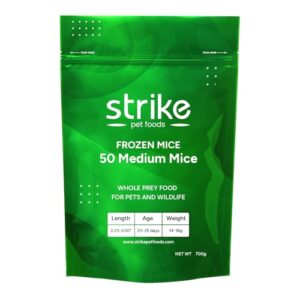
Strike Medium Frozen Mice are a smart pick for snakes in the juvenile-to-subadult window. Each mouse weighs 14 to 18 grams and measures about 2.25 to 3 inches long, making them right-sized for juvenile ball pythons, adult king snakes, and rosy boas.
The mice are hand-raised on a controlled diet, then frozen at packaging to lock in freshness. This process ensures nutritional quality and longevity.
The resealable aluminum bags minimize freezer burn and maintain a clean freezer environment. Each bag contains fifty mice, simplifying bulk storage and reducing restocking frequency.
| Best For | Reptile owners feeding juvenile ball pythons, adult king snakes, rosy boas, or large carnivorous lizards who want a convenient, nutrition-complete frozen prey option. |
|---|---|
| Quantity | 50 mice |
| Freeze Method | Frozen in resealable bags |
| Diet Quality | Nutritionally balanced diet |
| Mouse Size | 14–18 g, 2.25–3 in |
| Target Species | Juvenile ball pythons, king snakes |
| Storage Requirement | Keep frozen until use |
| Additional Features |
|
- Whole-prey nutrition means your reptile gets everything it needs — bones, organs, and all — with no artificial additives
- Resealable aluminum bags keep freezer burn at bay and make bulk storage way less of a hassle
- 50 mice per box means fewer reorders and more consistent feeding routines
- You have to thaw them properly every time — rush it or skip steps and you’re risking bacterial growth
- The 14–18 g size is on the smaller side, so larger snakes will quickly outgrow these
- Frozen shipping can be tricky — delays or temperature swings during transit can affect the product before it even arrives
2. MiceDirect Frozen Fuzzy Mice Snake Food
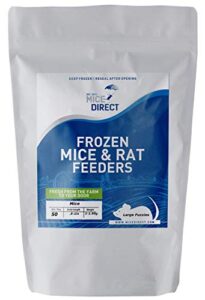
MiceDirect Frozen Fuzzy Mice are ideal for younger snakes, with each fuzzy weighing 4 to 7 grams and measuring 1.25 to 1.5 inches—perfect for juvenile corn snakes, hognose, and small ball pythons.
The 50-count pack (model 50MLF) ships on dry ice, double-bagged, and arrives within about a week of processing.
Raised in Cleveland, GA on Mazuri zoo-grade feed with no artificial ingredients, these mice ensure high-quality nutrition.
Consistent sizing reduces feeding refusals and simplifies mealtime decisions.
| Best For | Snake keepers raising juvenile corn snakes, hognose, or similarly sized reptiles who want a reliable, ethically sourced frozen feeder. |
|---|---|
| Quantity | 50 mice |
| Freeze Method | Frozen on dry ice |
| Diet Quality | Mazuri zoological-grade diet |
| Mouse Size | 1.25–1.5 in fuzzy |
| Target Species | Juvenile hognose/corn snakes |
| Storage Requirement | Keep frozen until use |
| Additional Features |
|
- Raised on Mazuri zoo-grade feed with no artificial ingredients, so you’re giving your snake clean, quality nutrition
- Ships frozen on dry ice, double-bagged, and arrives fresh—usually within a week of processing
- Consistent 1.25–1.5 inch sizing takes the guesswork out of feeding juveniles
- Pricier per mouse than bulk or live alternatives, which adds up over time
- Some buyers find the fuzzies smaller than expected, so double-check sizing before ordering
- Dry ice shipping can be restricted in some areas or come with extra handling fees
3. MiceDirect Frozen Adult Feeder Mice
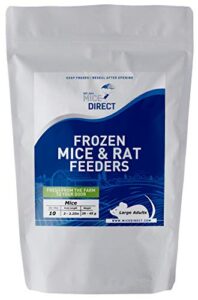
When your snake is past the juvenile stage, it’s time to size up. MiceDirect Frozen Adult Feeder Mice are designed for this transition, offering the ideal size and nutrition for maturing reptiles.
These feeders weigh 26 to 45 grams each and measure 3 to 3.25 inches, making them a perfect fit for adult ball pythons, juvenile red-tail boas, and similarly sized species. Each batch guarantees minimum 44% crude protein, ensuring your snake receives real nutritional value per meal.
They are ship flash-frozen on dry ice, arriving within a week for freshness. Storage is hassle-free, as they come in resealable bags for convenience.
| Best For | Reptile owners with adult ball pythons, juvenile red-tail boas, or similarly sized species who want a convenient, ready-to-use frozen feeder without the hassle of maintaining live mice. |
|---|---|
| Quantity | 10 mice |
| Freeze Method | Frozen on dry ice |
| Diet Quality | Zoological-grade feed |
| Mouse Size | Large adult |
| Target Species | Adult ball pythons, monitors |
| Storage Requirement | Keep frozen until use |
| Additional Features |
|
- Shipped fresh and frozen on dry ice, usually arriving within a week — so you’re not feeding your snake something that’s been sitting in a warehouse for months.
- Raised on zoological-grade feed and claimed disease-free, which takes a lot of the guesswork out of what your reptile is actually eating.
- No live colony to manage — just thaw and feed, with way less biosecurity risk and stress for you.
- Some batches have shown up with fecal contamination, sores, or off smells, which can put picky snakes right off their meal.
- If your reptile is set on live prey, frozen mice may get flat-out rejected — no guarantees there.
- You’ll need to handle dry ice safely and make sure you’ve got freezer space ready to go when the shipment lands.
4. MiceDirect Frozen Pinkie Snake Food
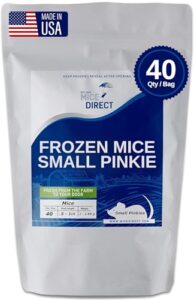
MiceDirect Frozen Pinkie Snake Food is ideal for the youngest reptiles in your care. Each pinkie weighs 0.5 to 0.9 grams and measures 1.5 to 2 inches long—perfect for hatchling corn snakes and newborn milk snakes to consume comfortably.
They are flash-frozen, Mazuri-fed, and packaged in resealable bags designed for tight freezer spaces.
If your hatchling refuses food, a pinkie often serves as the ideal starting point to trigger that first feeding response.
| Best For | Reptile owners feeding hatchling corn snakes, milk snakes, or other small reptiles that need appropriately sized, high-quality prey to get started eating. |
|---|---|
| Quantity | 40 mice |
| Freeze Method | Frozen on dry ice |
| Diet Quality | Mazuri premium feed |
| Mouse Size | 0.5–1 in pinkie |
| Target Species | Small pythons, corn snakes |
| Storage Requirement | Keep frozen until use |
| Additional Features |
|
- Fed on Mazuri premium feed, so your reptile is getting solid nutrition from the source
- Humanely processed and flash-frozen, which cuts down on disease risk compared to imported or lab-surplus mice
- Ships directly from the farm packed in dry ice, so freshness holds up well in transit
- The zip-lock bags can fail at the seams, which makes handling a little messy
- Costs more per unit than bulk feeder mice, so it adds up if you’re feeding frequently
- Needs freezer space and careful dry-ice handling—and won’t work at all for larger snakes that need bigger prey
5. MiceDirect Frozen Feeder Mice
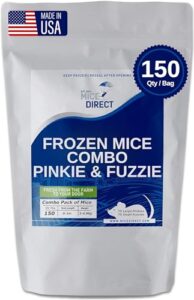
MiceDirect’s Frozen Feeder Mice bundle simplifies bulk buying with 150 rodents—100 pinkies and 50 small fuzzies—shipped in one insulated order directly from the farm via FedEx. This reduces restocking efforts, giving you more time to watch your snake thrive.
For safe thawing tips and storage guidance, trusted frozen snake food brands and handling practices help you get the most out of every bulk order.
Each mouse is CO₂-euthanized, fed a zoo-grade diet, and flash-frozen within about a week of delivery. Maintain storage at -18 °C for months of consistent, worry-free feeding.
| Best For | Reptile owners who feed snakes or other predatory reptiles regularly and want a reliable bulk supply without the hassle of sourcing live feeders. |
|---|---|
| Quantity | 150 mice |
| Freeze Method | Frozen on dry ice |
| Diet Quality | Zoological-grade diet |
| Mouse Size | Pinkie + small fuzzy mix |
| Target Species | Snakes and reptiles |
| Storage Requirement | Keep frozen at -18°C |
| Additional Features |
|
- 150 rodents in one shipment means fewer reorders and a stocked freezer for months
- CO₂-euthanized and zoo-grade diet means you’re feeding your reptile clean, nutritious prey
- Ships directly from the farm on dry ice, so it arrives fresh with minimal handling in between
- You’ll need solid freezer space—150 rodents take up room, and they have to stay at -18 °C
- Only pinkies and small fuzzies, so if your snake needs larger prey, this bundle won’t cut it
- Limited reviews make it tough to gauge long-term reliability from other customers’ experience
6. RodentPro Frozen White Large Mice
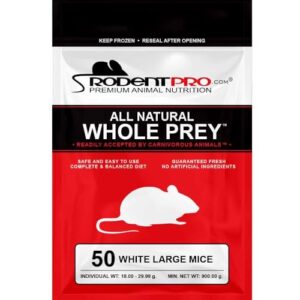
RodentPro’s Frozen White Large Mice come 50 per resealable bag at $78.21—a solid pick if your snake is past the juvenile stage.
Each mouse weighs between 18 and 30 grams, individually frozen to prevent clumping, ensuring fast and clean portioning.
They are raised on a formulated diet and irradiated for pathogen reduction, prioritizing safety and nutrition.
The product is shipped with dry ice nationwide and maintains freshness for months when stored at -18 °C.
| Best For | Snake owners with adult or sub-adult snakes who want a safe, consistent, and convenient bulk prey option without the hassle of live feeders. |
|---|---|
| Quantity | 50 mice |
| Freeze Method | Frozen in zip-lock bag |
| Diet Quality | Scientifically formulated diet |
| Mouse Size | Large adult |
| Target Species | Adult snakes, birds of prey |
| Storage Requirement | Keep frozen at -20°C |
| Additional Features |
|
- Comes 50 per bag at $78.21, so you’re not reordering every other week
- Irradiated and raised on a formulated diet, which means cleaner feeding with less disease risk
- Individually frozen so they don’t clump together—easy to grab and thaw what you need
- The "large" size won’t work for hatchlings or smaller snake species
- You’ll need solid freezer space at around -18 °C to keep them fresh long-term
- Shipping on dry ice can get dicey in extreme weather, so freshness on arrival isn’t always guaranteed
7. Strike Large Frozen Feeder Mice
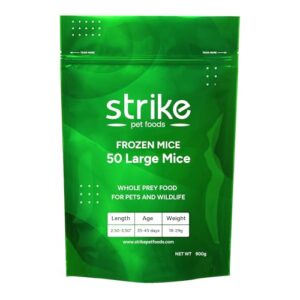
Strike Large Frozen Feeder Mice are built for heavier-hitting reptiles in your collection. Each mouse weighs 18 to 29 grams and measures 2.5 to 3.5 inches—a solid match for adult ball pythons, king snakes, and rosy boas.
You receive 50 mice per order at $114.99, packed in resealable aluminum-laminated bags designed to prevent freezer burn and maintain freshness.
The mice are pre-euthanized and flash-frozen to lock in nutrition. Simply thaw, warm, and feed—no additional preparation required.
| Best For | Reptile owners feeding adult ball pythons, king snakes, rosy boas, or large carnivorous lizards who want a reliable, bulk-friendly prey option. |
|---|---|
| Quantity | 50 mice |
| Freeze Method | Frozen in resealable bags |
| Diet Quality | Nutritionally balanced diet |
| Mouse Size | 18–29 g, 2.5–3.5 in |
| Target Species | Adult ball pythons, king snakes |
| Storage Requirement | Keep frozen until use |
| Additional Features |
|
- 50 mice per order at $114.99 makes bulk feeding much cheaper than buying from a pet store every week
- Resealable aluminum-laminated bags help prevent freezer burn and keep mice fresh longer
- Consistent size (18–29g) takes the guesswork out of feeding and supports steady nutrition for your reptile
- You’ll need decent freezer space to store a 50-count order
- Mice have to be thawed and warmed before feeding—skip this step and you risk stressing or injuring your reptile
- Too large for juveniles or smaller species, so you need to size-match carefully before ordering
8. MiceDirect Frozen Adult Mouse Feeders
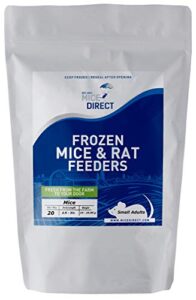
MiceDirect Frozen Adult Mouse Feeders simplify feeding for mid-to-large snake owners. Each pack contains 20 adult mice measuring 3 to 4 inches, raised in climate-controlled facilities on a zoo-grade Mazuri diet.
They’re irradiated before packaging to reduce Salmonella risk—a critical advantage for regular handler safety. The resealable opaque bags prevent freezer burn and simplify portion tracking.
With 44% crude protein and 17% fat per mouse, these feeders deliver consistent, reliable nutrition for reptiles like ball pythons or juvenile boas.
| Best For | Snake owners feeding mid-sized reptiles like ball pythons, juvenile red-tail boas, or adult sand boas who want a consistent, humane feeder option delivered to their door. |
|---|---|
| Quantity | 20 mice |
| Freeze Method | Frozen on dry ice |
| Diet Quality | Mazuri zoological-grade feed |
| Mouse Size | 2.5–3 in adult |
| Target Species | Ball pythons, red-tail boas |
| Storage Requirement | Keep frozen until use |
| Additional Features |
|
- Humanely raised and euthanized, so you’re not stressing about where your feeder mice are coming from
- Fed a zoo-grade Mazuri diet, which means your snake gets solid, balanced nutrition with every meal
- Comes frozen and shipped with dry ice, making it easy to stock up and feed on your own schedule
- The 2.5–3 inch size won’t work for very small juveniles or larger adult snakes that need bigger prey
- Mice need to be properly thawed before feeding, so there’s a little prep work involved each time
- Dry-ice shipping can come with extra fees or restrictions depending on where you live
9. Strike Frozen Feeder Mice for Reptiles
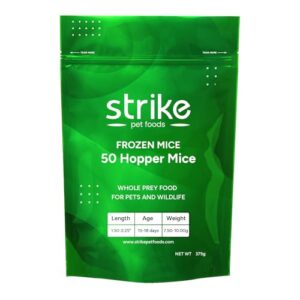
Strike Frozen Feeder Mice come in multiple sizes—medium, large, and jumbo—so you can scale up as your snake grows without switching brands.
They ship in resealable, clearly labeled bags with batch numbers, making inventory rotation easy.
Each mouse is frozen fresh and sized from 1.5 to 2.0 inches for juveniles, with larger options for adult snakes.
For apartment keepers who want one reliable brand for the long haul, Strike delivers.
| Best For | Reptile keepers with juvenile ball pythons, king snakes, rosy boas, or small carnivorous lizards who need a consistent, whole-prey frozen feeder in a smaller size. |
|---|---|
| Quantity | 50 mice |
| Freeze Method | Frozen in resealable bags |
| Diet Quality | Nutritionally balanced diet |
| Mouse Size | 7.5–10 g, 1.5–2.25 in |
| Target Species | Juvenile ball pythons, king snakes |
| Storage Requirement | Keep frozen until use |
| Additional Features |
|
- Raised in a USDA-certified facility, so you know exactly what your reptile is eating
- Resealable, foil-lined bags keep mice fresh and make storage easy between feedings
- Whole-mouse nutrition covers everything—bone, muscle, skin—no supplements needed
- Fixed at 7.5–10 g, so adult or larger snakes will quickly outgrow this size
- Needs proper thawing before every feeding, which adds a step to your routine
- Shipping condensation or meltwater can be an issue if dry-ice cooling falls short in transit
Choosing Apartment-Friendly Feeder Mice
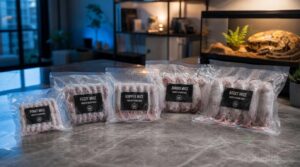
Living in an apartment doesn’t mean you have to compromise on feeding your snake well. You just need to know what to look for before you buy.
Here are five things that matter most when picking frozen feeder mice for a smaller living space.
Freezer Space Needs
You don’t need a dedicated chest freezer to make this work. A compact 4–6 cubic foot upright with adjustable shelves accommodates bulk quantity frozen mice packs without crowding.
Use space-saving bins for vertical shelf utilization, and keep a batch labeling system so you’re not digging around.
Smart temperature alerts catch any drift before freezer burn becomes a problem. Door opening minimization keeps temperatures stable.
Ensuring proper ventilation space around the unit helps the compressor run efficiently and prevents temperature drift.
Odor-sealed Packaging
Good freezer organization only goes so far if your packaging leaks odors. That’s where vacuum seal integrity and multi-layer barriers do the real work.
- Activated carbon lining absorbs escaping scent molecules
- Tamper-evident seals confirm no air has entered
- Cryovac packaging and resealable aluminum-laminated bags lock in scent retention of frozen prey
- Odor indicator sensors signal when seal integrity weakens
Small-batch Buying
Odor control matters, but so does how often you restock.
Small-batch buying lets you lock in prices with reputable suppliers while keeping your freezer from overflowing. Order frequency is easy to manage when you choose lower quantity frozen packs — usually 10 to 25 mice.
| Batch Size | Price Range | Best For |
|---|---|---|
| 10-pack | $18.90–$22.90 | Weekly rotation |
| 25-pack | $18.75–$27.25 | Bi-weekly restocking |
| 50-pack | $25.00–$42.50 | Monthly inventory |
Delivery Reliability
Restocking on schedule only works if your order actually shows up on time. Carrier redundancy and real-time tracking make a critical difference in achieving this reliability.
Reputable suppliers ensure quality by shipping from USDA-certified facilities using temperature-controlled storage and dry ice, maintaining the cold chain from warehouse to door. This rigorous process safeguards product integrity during transit.
Alert notifications proactively flag delays, while order sync accuracy guarantees that what you ordered is exactly what arrives—eliminating discrepancies and streamlining operations.
Pest-free Storage
Store your vacuum-sealed packs in sealed storage bins inside a freezer held at −18°C. Freezing kills parasites, so you’re already ahead.
A weekly seal inspection and smart trap placement near the storage area catch problems before they start.
- Clear, airtight bins block odors and pests without extra effort
- Sterile loading practices prevent cross-contamination between different mice sizes
- Cold chain stability depends on consistent temperature, so check your freezer thermometer regularly
Mouse Sizes by Snake Type

Getting the mouse size right isn’t optional — it’s one of the most important feeding decisions you’ll make for your snake.
Too small, and your snake stays hungry; too large, and you risk regurgitation.
Here’s a simple breakdown by snake type so you can match the right prey every time.
Pinkies for Hatchlings
Pinkies are the right initial feeding size for most hatchlings. These Day-Old Pinky Mice and Regular Pinky Mice weigh just 1 to 3 grams, and their soft body texture makes swallowing easy on tiny throats. That soft build also facilitates metabolic energy support during early growth.
Think of it as a gentle introduction to frozen prey — Small Weaned Mice come next as your hatchlings hit early growth metrics.
Fuzzies for Juveniles
Fuzzies are the natural next step for juvenile snakes, with Normal Fuzzy Mice weighing 4 to 7 grams—ideal for juvenile ball pythons and young corn snakes.
Prey Size Shift matters here: match size to mid-body girth for Stress Reduction.
Use thawing safety tips, track Growth Monitoring signals, and adjust Feeding Frequency as Weight Calibration guides prey size adjustments.
Hoppers for Corn Snakes
Most corn snakes hit their stride on hopper mice somewhere between the juvenile and subadult stage. Hoppers weigh 7 to 12 grams and run about 2 inches long — right-sized for Prey Size Calibration without overwhelming a mid-sized snake.
Feed every 7 to 10 days following Feeding Frequency Guidelines, and track Hopper Growth Curves to catch size shifts early.
Warm them to 95–100°F for better Meal Acceptance Rates.
Adults for Pythons
Adult pythons have real caloric requirements—don’t underestimate them. Frozen Large Adult Feeder Mice, commonly 14–25 grams, provide solid gape matching for ball pythons and similar constrictors.
Follow snake feeding guidelines and feed every 7–14 days, adjusting based on weight monitoring and body condition.
Smart prey size selection, combined with strong prey nutrient retention from flash-frozen adult mice, ensures your python stays healthy and maintains optimal feeding frequency.
Jumbo Mice for Boas
Boas need more than adult mice can offer. Jumbo mice — weighing 25 to 50 grams — represent the natural next step when your boa outgrows large frozen mice.
Adhere to weight guidelines: use 25–40 grams for smaller boas. Jumbo mice have higher fat content than adult mice, so maintain a feeding frequency of every 10–14 days to avoid overfeeding. Consistent growth monitoring ensures prey size remains appropriate.
Storage and Thawing Safety
Storing and thawing frozen feeder mice the right way isn’t complicated, but a few small mistakes can ruin a meal or worse, making your snake sick. Temperature, timing, and handling all matter more than most people realize.
Here’s what you need to know before feeding day.
Freezer Temperature Targets

Keep your freezer at exactly 0°F (-18°C) — that’s the sweet spot for temperature controlled storage. Target calibration matters more than you’d think.
- Data Logging every 15 minutes catches drift before it damages stock
- Defrost Practices favor manual-defrost models for better temperature stability
- Ambient impact from seasonal room changes affects cold chain logistics
Check your thermometer monthly and adjust for any drift.
Airtight Pack Handling

Once your freezer hits 0°F, vacuum-sealed, resealable aluminum-laminated bags take over. These bags, constructed from multilayer barrier films—polyethylene, foil, and nylon—lock out moisture and odor.
During production, seal integrity checks and vacuum level monitoring ensure residual air remains near zero. Desiccant management controls internal humidity, while temperature fluctuation mitigation safeguards the contents.
The packaging further resists transport vibration and maintains integrity throughout cold chain logistics, protecting every pack from external stresses.
Refrigerator Thawing
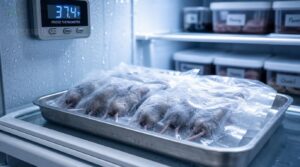
Refrigerator thawing is your safest next step once vacuum-sealed packs leave the freezer. Set your fridge at or below 40°F and plan 12–24 hours ahead—scheduling ensures safety.
Place mice on a tray to prevent cross-contamination, maintaining packaging integrity throughout thawing. Conduct quick safety inspections before feeding to verify quality.
Skip room temperature thawing entirely, and never use a heat lamp, as these methods compromise food safety.
Warm-water Finishing

Once your mouse feels pliable from refrigerator thawing, warm-water finishing gets it feed-ready fast. Fill a dedicated plastic tub with 95–100°F water and submerge the sealed bag for 5–10 minutes. Temperature control matters here—too hot softens tissue.
Good sanitation protocols mean wiping your equipment setup down after each batch. Odor mitigation stays simple when you drain immediately and label each batch clearly.
Two-hour Feeding Window

Once your mouse hits that 95–100°F sweet spot, you’ve got two hours. That’s your feeding window—don’t exceed this timeframe. Ideal timing reduces stress for your snake and promotes safe feeding.
Log each session in your feeding schedule to track prey readiness patterns.
Consistent temperature control and smart thawing techniques for feeder rodents protect nutrient retention and make every meal count.
Cost, Sourcing, and Ethics

Price matters, but so does knowing where your feeder mice come from. The good news is that buying smart doesn’t mean spending more — it means buying in bulk, factoring in shipping, and choosing suppliers who do things right.
Here’s what to look at before you order.
Bulk Pack Savings
Buying in bulk is one of the smartest ways to cut annual feeding costs. Tiered discount structures reward larger orders: 10 percent off at 10 packs, 20 percent at 20 or more. Volume pricing benefits drop your per-unit price by 30–40 percent in 50-count packs.
Consolidated shipping savings and reduced packaging waste make bulk purchasing discounts genuinely cost-effective. These operational efficiencies further enhance the value of larger orders.
Inventory forecast accuracy ensures your freezer remains stocked without surprises, maintaining seamless supply chain continuity.
Shipping Cost Math
Shipping adds about $30 per box — and that number climbs fast with zone pricing, fuel surcharges, and dimensional weight rules. The cost is influenced by several factors:
- Zone distance directly affects your final price
- Bulk purchasing discounts offset insurance fees
- Larger orders reduce per-box shipping cost
- Dry ice and packaging are already included
Cold chain shipping with dry ice isn’t cheap, but splitting costs across a bulk order softens the hit.
Humane Euthanasia Standards
Every reputable supplier follows strict humane euthanasia methods — and that matters for your snake’s health. CO2 euthanasia is the AVMA-approved standard, designed for minimal pain and rapid unconsciousness.
Species-specific protocols guide the process, and staff training ensures ethical compliance at every step.
Humane handling before death confirmation rounds out the animal welfare standards expected from any domestic feeder supplier.
Nutritional Quality Checks
Proximate analysis confirms real protein content, fat levels, and moisture — ensuring you know the nutritional value of feeder mice matches what’s promised. Label verification cross-checks declared values against lab results, guaranteeing transparency and accuracy.
Contaminant screening catches heavy metals and pesticides, eliminating hidden risks to your snake’s health. This rigorous process ensures safety beyond basic nutritional claims.
Amino acid profiling and fatty acid profiling provide a balanced diet with solid nutrient density, directly supporting your snake’s long-term health and vitality.
Domestic Supplier Standards
Domestic suppliers aren’t just convenient — they’re accountable. When you buy from a USDA-certified facility, you get real regulatory compliance with USDA-enforced standards, plus full traceability documentation from farm to your freezer.
Domestic suppliers are accountable — USDA-certified facilities offer real compliance, ethical standards, and full traceability from farm to freezer
Reputable suppliers back that up with:
- Worker safety audits and anti-corruption policies
- Carbon footprint reporting and recyclable packaging
- Health certifications confirming humane handling practices
Frequently Asked Questions (FAQs)
Are frozen mice good for snakes?
Frozen mice are safer, cleaner, and just as nutritious as live prey.
Proper thawing techniques for feeder rodents promote digestive efficiency and strong nutrient retention for long-term pet snake health.
How often should apartment snakes be fed?
Feeding frequency depends on age and species. Hatchlings eat every 5–7 days. Juveniles need meals every 7–10 days. Adults do well on 10–14 day intervals. Keep a feeding log to track patterns.
Can frozen mice trigger feeding strikes in snakes?
Frozen mice absolutely can trigger feeding strikes. With the right prey thawing technique, temperature cueing, and movement simulation using tongs, your snake’s feeding response stays strong and consistent every time.
What signs indicate a mouse is fully thawed?
Ironically, the simplest check is also the most overlooked. Press the belly —
If it’s soft and pliable, with uniform temperature, no ice pockets, flexible limbs, and a fresh aroma, it’s ready.
Should feeders be offered with or without tongs?
Use tongs. They cut bite risk, improve feeding precision, and support solid hygiene protocols. Keep hands clear, snake stress low, and prey handling safety high. It’s just smart snake husbandry.
Do frozen mice need vitamin supplements added?
Most frozen mice don’t need supplements. Gut-loading before freezing preserves over 95% of nutrients. That said, species-specific needs vary — large boas may benefit from targeted vitamin A injection dosing.
Conclusion
It’s no coincidence that apartment snake keepers who nail their feeding routine also stress less about their pet overall. When you’ve got the right frozen feeder mice properly stocked and stored, feeding day becomes routine, not chaos.
The size matches your snake, the packaging controls odors, and the supplier delivers reliably. That’s not luck—that’s a system you built on purpose.