This site is supported by our readers. We may earn a commission, at no cost to you, if you purchase through links.
Most snakes kept in captivity never see a single photon of UVB light—and for decades, that was considered perfectly acceptable.
New research on wild snake behavior tells a different story: species once labeled shade-dwellers regularly emerge to bask in filtered sunlight, absorbing UVB that drives vitamin D3 synthesis and influences everything from immune function to feeding response.
Setting up UV lighting in a snake enclosure isn’t a luxury upgrade anymore; it’s a gap between what we assumed and what the science now confirms.
Get the bulb type, mounting distance, and exposure zone right, and you’re building an enclosure that works with your snake’s biology rather than against it.
Table Of Contents
- Key Takeaways
- Choose The Right Snake UVB Bulb
- Check Your Snake’s UVB Needs
- Plan The UVB Exposure Zone
- Measure Safe Mounting Distances
- Install Fixtures Securely
- Coordinate UVB With Heat
- Set a Healthy Light Schedule
- Monitor UV Index Levels
- Prevent Burns and Eye Damage
- Maintain Your UVB Setup
- Frequently Asked Questions (FAQs)
- Conclusion
Key Takeaways
- Match UVB bulb type and mounting distance to your snake’s species and Ferguson zone — a T5 HO at 12–15 inches works for most crepuscular snakes, but desert species need higher output closer to UVI 2.0–3.5.
- Cover one-third of the enclosure with UVB and always include a UV‑free retreat, so your snake can self‑regulate exposure instead of absorbing radiation with every move.
- replace T5s yearly, T8s every six months, and verify actual intensity at basking height with a UVB meter, not the bulb’s label.
- Your snake’s behavior — hiding during light hours, avoiding the basking spot, sluggish feeding — is a more reliable signal of UVB problems than any label or timer setting.
Choose The Right Snake UVB Bulb
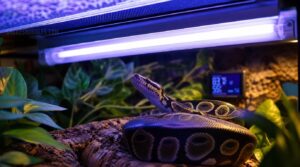
Not all UVB bulbs work the same way, and picking the wrong one is one of the most common mistakes snake keepers make. The type you choose directly affects how much UV your snake actually receives, how you’ll mount it, and how far it needs to sit from the basking surface.
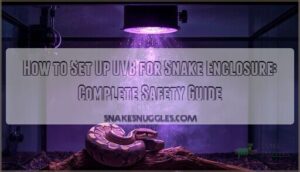
Getting these details right from the start makes a real difference, so it’s worth walking through the full UVB setup process for snake enclosures before you buy anything.
Here’s a breakdown of the main options worth knowing.
T5 HO UVB Tubes
T5 HO tubes are the industry standard for snake UVB setups, and for good reason. Their phosphor coating converts UV radiation into a spectrum that directly promotes bone health and skin function.
Rated at 5.0 or 10.0 percent UVB, they deliver consistent output within 6–18 inches—but only when paired with a compatible T5 HO ballast and a reflective fixture.
It delivers twice the UVB intensity of standard ReptiSun 10.0 lamps, making it ideal for larger enclosures.
T8 UVB Tubes
T8 fluorescent tubes are the budget‑friendly alternative, though they come with real trade‑offs. Their UVB output spectrum spans 290–320 nm, which covers reptile calcium metabolism, but intensity drops off faster with distance.
In a snake enclosure, your T8 fixture placement needs to sit 6–8 inches from the basking spot—closer than T5s’ demand. Factor in T8 UVB degradation and replace every six months.
Mercury Vapor Bulbs
If T8s feel underpowered for your setup, mercury vapor bulbs are a serious upgrade — combining strong UVB output with heat in a single lamp.
They require ballast compatibility and a 12–24 inch clearance depending on wattage.
Expect a 4–7 minute warm-up duration before full output.
Their mercury content means careful disposal as hazardous waste when they finally burn out.
Avoid Coil Bulbs
Skip compact fluorescent coils entirely — they don’t belong in a snake enclosure. Their coil design concentrates heat unevenly, creating hot zones that can irritate your snake’s eyes or scorch nearby décor.
Glass jacket breakage is a real risk if enclosure furnishings shift.
Add a shortened bulb lifespan under constant reptile-use conditions, and you’re replacing them more often than any T5 or T8 alternative.
Match Bulb to Species
Matching the right bulb to your snake’s species isn’t optional — it’s the foundation of a functional UV setup. Use a T5 HO 6% tube for corn snakes and boas, a T8 for lower-demand setups, and a mercury vapor bulb for desert baskers needing UVI 2.0–3.5.
- T5 HO: crepuscular and tropical species
- T8: mid-range UVB needs
- Mercury vapor: desert, high-basking species
- UVB meter: verify intensity at basking zone
Check Your Snake’s UVB Needs
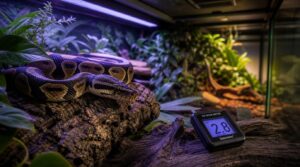
Not every snake needs the same UVB setup, and getting this part wrong is one of the most common mistakes keepers make. Your snake’s species, activity pattern, and age all shape exactly how much UV exposure it actually needs. Here’s what to look at before you position a single bulb.
Ferguson Zone Basics
Think of Ferguson Zones as a spectrum—not a guessing game. They classify reptiles by daily UV index needs, ranging from UVI 0.4 in deep shade all the way to UVI 2.6–3.5+ for midday sun‑seekers.
Rather than relying on bulb labels alone, you match your snake’s natural habitat to a specific zone, then use a UVB meter to confirm your basking zone hits that target.
Crepuscular Snake Needs
Corn snakes, king snakes, and boas are all crepuscular—most active around dawn and dusk, not midday. That shifts their UVB needs considerably. They fall into Ferguson Zone 2, where a background UVI of 1.0 is the target, not the high-intensity basking beam a desert lizard would need.
- Keep UVB exposure gradients across one-third of the enclosure
- Use a UVB meter to confirm basking zone intensity
- Time feeding to the dusk activity window
- Maintain a thermal gradient so they can self-regulate
- Consistent UVB reduces metabolic bone disease risk by up to 90%
Desert Species Needs
Desert snakes — rattlesnakes, bull snakes, hognose — sit firmly in Ferguson Zone 3–4, requiring a basking zone UVI between 2.0 and 3.5. That’s a meaningful step up from crepuscular species.
A T5 HO tube at 12% UVB output, mounted 10–12 inches from the basking surface, usually hits that range reliably. Verify it with a Solarmeter 6.5.
Arboreal Species Needs
Arboreal species — green tree pythons, emerald tree boas — sit in Ferguson Zone 2, requiring a localized UVI of 1.0–2.0.
That’s modest intensity, but placement matters more here than with ground-dwellers.
Mount your T5 HO tube to align with vertical branch arrangement, so the UV zone meets your snake where it actually basks — up high, not on the floor.
Juvenile Snake Considerations
Juveniles sit in a UVB sensitivity window that adults don’t share — their smaller bodies absorb proportionally more radiation, and their rapid Growth Rate Adjustments mean any deficiency shows up faster. A ball python hatchling needs the same Ferguson Zone 2 target as an adult, but mount your T5 HO tube at 15 inches minimum, not 12.
Basking Behavior Shifts complicate this further. Juveniles cycle between warm spots and hides constantly, so UVB intensity must stay low enough that brief, repeated exposure doesn’t accumulate into overexposure. Keep output at 6% UVB, prioritize correct basking temperatures first — a juvenile that won’t bask because the heat is wrong won’t benefit from any UVB present — then monitor retreat time as your primary Health Monitoring Protocol.
Plan The UVB Exposure Zone
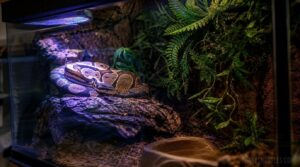
Getting the UVB zone right isn’t just about picking a bulb and calling it done — it’s about where that light lands inside the enclosure. Your snake needs options, not a tank flooded wall-to-wall with UV. Here’s how to structure the exposure zone so it actually works.
Cover One-third Enclosure
One simple rule shapes the entire UVB setup: cover exactly one-third of the enclosure footprint.
Mount a UV-stable HDPE or acrylic panel on the side opposite your UVB tube, aligned with the snake’s preferred basking level.
Include a small ventilation gap along the bottom edge. Make the panel height-adjustable so you can fine-tune coverage as your snake grows.
Create Light and Shade
Think of your enclosure as a miniature landscape — one side bright, the other dim. The light and shade method works by positioning your UVB tube over one‑third of the floor space, letting the opposite end stay naturally shadowed.
Your snake moves between zones, self‑regulating UVB intensity the same way it would outdoors.
Include UV-free Retreats
Every bright zone needs a dark counterpart. Build a UV-free alcove using blackout curtains or opaque screens to block stray UVB intensity completely.
Use non-UV materials — wood, stone, textile — and pair the space with stable temperature control to keep conditions comfortable.
Clear retreat signage removes guesswork. Your snake decides when enough UVB exposure is enough.
Avoid Full-tank Exposure
Giving your snake a UV-free retreat means nothing if UVB bleeds across the entire enclosure. Limit UVB to one defined basking zone — roughly one-third of the tank — so your snake isn’t passively absorbing radiation during every movement.
Full-tank exposure removes behavioral choice entirely, turning a voluntary process into an unavoidable one.
Support Self-regulation
A well-designed enclosure gives your snake genuine behavioral escape routes — not just the illusion of choice. Structure the choice gradient by positioning your T5 HO tube so UVB output drops measurably as your snake moves away from the basking zone, letting it self-select its daily UVB dosage through simple repositioning:
- Place the shaded retreat directly opposite the basking zone
- Keep movement paths clear so avoidance isn’t blocked by clutter
- Use a visual signal — brighter light over the basking spot, dim everywhere else
- Confirm the UVI drops below 1.0 at retreat level using a Solarmeter reading
- Make incremental mounting distance changes and watch repositioning patterns as responsive adjustment feedback
Measure Safe Mounting Distances
Getting the distance right between your UVB bulb and your snake isn’t guesswork — it’s one of the few things where a few inches actually matter. The bulb type you’re using determines how close or far it needs to sit, and ignoring that gap can mean too little UV or, worse, too much. Here’s how the numbers break down for each setup.
T5 Distance Guidelines
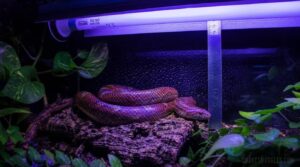
Distance is where most T5 setups quietly go wrong. For a standard T5 HO tube, mount the fixture 12 to 15 inches above the basking surface — that’s your baseline Ideal Mounting Height for crepuscular species like corn snakes.
Higher-output bulbs need 16 to 24 inches to avoid overexposure.
Always measure from the bulb face to your animal’s head at peak basking, not to the floor.
T8 Distance Guidelines
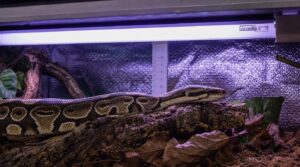
T8 tubes put out less UVB than T5s, so ideal T8 placement sits closer — aim for 12 to 18 inches between the bulb face and your animal’s head at peak basking height.
Crepuscular species tolerate 16 to 18 inches; desert and juvenile snakes need 12 to 14 inches.
Add a reflective surface and you gain roughly 20 percent more intensity at the same distance.
Mercury Vapor Clearance
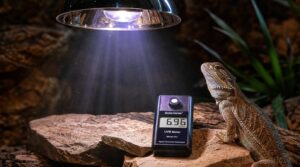
Mercury vapor bulbs don’t follow the same clean distance rules as fluorescent tubes.
Ideal clearance range sits between 12 and 24 inches, but your actual safe distance depends heavily on wattage, reflector design, and enclosure geometry.
Always verify with a UVB meter at basking surface height — distance alone won’t confirm your snake is getting the right exposure.
Screen-top Adjustments
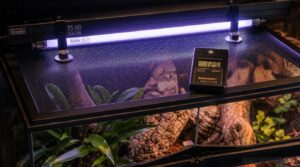
Screen tops cut UVB transmission by 30–60%, so your standard mounting distances no longer apply. A T5 HO tube that works at 15 inches over open glass needs to drop to 8–10 inches above a mesh top.
Use rubber grommets to reduce vibration and make sure load-bearing frames handle up to 5 kilograms without bending. Always verify output with a UVB meter — don’t guess.
Basking Surface Height
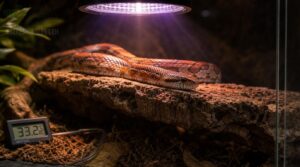
The basking surface itself changes everything about your mounting distance calculations. For small to medium snakes, keep the surface 8–12 inches above the substrate; larger species need 12–18 inches.
That vertical gap directly affects the distance between the lamp and your animal’s head, shifting your basking spot temperature by 1–3°C with even minor adjustments.
Always use a non-slip, heat-resistant surface.
Install Fixtures Securely
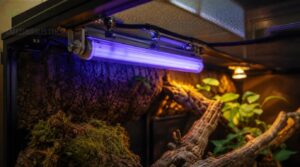
Getting the fixture physically secured is where good intentions either hold up or fall apart. How you mount it depends entirely on your enclosure type, and each setup comes with its own non-negotiable rules. Here’s what to know for the most common situations.
Ceiling-mounted Fixtures
Ceiling-mounted fixtures are your most stable option for a clean, snake-safe UVB setup.
Mount the fixture flush to the ceiling plane using a secure bracket and route all cables through clips or sealed channels — never let cords cross areas your snake can reach.
Aim for 12 to 18 inches above the basking zone to hit the right UVB output without overexposure.
Reflector Fixture Benefits
Once your fixture is locked in place, the reflector it uses matters more than most keepers realize. A quality internal reflector can boost effective UVB output by up to 40 percent without adding a single watt — just better optical management directing light where it belongs.
Here’s what reflector fixtures actually do for your setup:
- Enhanced Light Distribution pushes UVB evenly across the basking zone, eliminating the patchy dead spots that leave your snake underexposed
- Energy Efficiency Gains mean you’re cutting wasted light spill by up to 30 percent, so your bulb works smarter, not harder
- Heat Concentration Control keeps warmth focused on the basking surface and away from hide areas, protecting stable microclimates
- Durability Protection comes built in — sealed housings shield bulbs from humidity, debris, and accidental contact during maintenance
- Aesthetic Uniform Lighting gives the enclosure a cleaner, more natural look, with consistent brightness and no harsh glare at viewing angles
PVC Enclosure Mounting
PVC enclosures give you an advantage most keepers overlook: ceiling mounting inside the tank eliminates screen filtering entirely, preserving full UVB transmission to your snake.
Mount the fixture directly to the interior ceiling using corrosion-resistant screws aligned with predrilled holes, and run wiring through sealed pass-throughs to keep the environment secure and escape-proof.
Screen-top Placement
Screen tops work fine for UVB lighting, but the math changes.
Mesh blocks 30–60% of UVB output, so you’ll need to compensate with closer mounting — commonly 8–12 inches from basking surface to bulb.
Use adjustable brackets to dial in that distance precisely, and confirm your reflector is aimed straight down for clean UVB diffusion rather than scatter.
Escape-proof Cord Routing
Cords are an escape vector snakes exploit more often than you’d expect. Route every wire through a sealed cord passthrough, using metallic brackets and fire-resistant fixings to keep UVB lighting cables flush against the enclosure wall.
Keep routing distance short and direct — less exposed cable means fewer gaps. Confirm maintenance access remains clear without compromising the seal.
Coordinate UVB With Heat
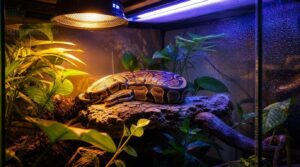
UVB and heat aren’t two separate problems to solve — they’re one system to balance. Get the overlap wrong, and your snake either cooks under a lamp or basks in warmth without getting any UV benefit at all. Here’s what to sort out before you call the setup done.
Overlap Basking Areas
Think of the basking spot as a single zone doing two jobs at once.
Position your UVB lighting so it overlaps directly with the warm zone, keeping the distance between your basking zone and your lamps at 8–12 inches.
This Dual Basking Zone setup lets your snake absorb UVB and regulate temperature without relocating — efficient, low‑stress, and closer to how it would behave in the wild.
Maintain Thermal Gradients
A stable thermal gradient doesn’t happen by accident — it requires deliberate setup. Use a Gradient Plate or Dual Zone Heating mat to hold a 6–12°C difference across the enclosure length.
Track substrate temperatures with calibrated digital probes at multiple points, confirming readings stay within 2–3°C of your targets. Insulate the cool end to prevent heat bleed during nighttime hours.
Avoid Overheating Risks
Overheating is the silent threat that even well-planned setups miss. When UVB lamp types combine with ambient heat, temperatures at the basking surface can climb faster than expected:
- Place a digital probe at the basking surface
- Recheck temperatures after every fixture adjustment
- Confirm the cooling retreat stays genuinely cool
- Test thermostat response before leaving it unattended
Separate Heat Sources
Running a single heat source under your UVB setup is asking for a single point of failure. Separate heating elements — a ceramic heat emitter for ambient warmth and a radiant heat panel for the basking zone — create dual heat zones that you can dial in independently. Each gets its own thermostat, so adjusting one doesn’t throw the other off.
Heat source redundancy isn’t overkill; it’s insurance.
Monitor Basking Temperatures
Your basking surface is the thermal anchor of the whole setup. Use an infrared thermometer to measure the exact surface temperature at the center of the basking spot daily — not ambient air, the actual contact surface.
Log those readings. A stable temperature gradient doesn’t manage itself; small drifts in heat output compound quickly, and your records will catch them before your snake does.
Set a Healthy Light Schedule
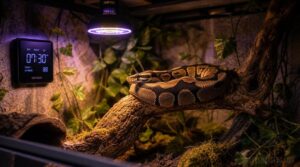
Getting the light schedule right is one of those things that looks simple but quietly makes a big difference in how your snake behaves and stays healthy. It’s not just about turning a light on — it’s about giving your snake a rhythm it can actually rely on. Here’s what that schedule needs to cover.
Twelve-hour Daily Cycle
A 12-hour daily cycle — lights on, lights off, same time every day — gives your snake the clearest possible signal that its enclosure behaves like the real world.
UVB on duration and visible light should run together across that same 12-hour window, because splitting them creates conflicting cues that your snake can’t reconcile.
The dark period matters just as much; a full 12 hours without UVB preserves the contrast that keeps basking rhythm predictable and hormone regulation on track.
Use Automatic Timers
A 12-hour cycle only holds if something actually enforces it.
Automatic timers do exactly that — program your UVB fixture once, and the lighting schedule runs itself, down to the minute, every day without exception.
Digital models store multiple daily programs and hold settings through brief power outages, making independent UVB control reliable rather than routine.
Match Visible Lighting
Once your timer is running, visible light deserves the same attention as UVB output. Your snake perceives its environment through light quality, not just duration, so full-spectrum lighting matters.
- Target 5000–6500 Kelvin color temperature for accurate daytime signals
- Use bulbs with a Color Rendering Index of 90+
- Choose fixtures with a continuous spectrum and minimal flicker
- Sync visible light with your UVB schedule via photoperiod scheduling
- Support daytime activity and feeding cues through consistent light intensity
Provide Nighttime Darkness
Syncing your UVB and visible light onto the same timer manages the daytime side automatically — but nighttime darkness is equally non-negotiable.
Your snake’s circadian rhythm depends on a reliable, uninterrupted dark period of at least eight hours. Stray light from room lamps or phone screens is enough to disrupt that. For nighttime checks, use dim red lighting only.
Seasonal Light Adjustments
Seasons shift, and your snake’s lighting schedule should shift with them. Adjust your photoperiod gradually — from 13 hours in summer down to 11 in winter — rather than flipping abruptly.
Winter daylight hours drop 2–3 hours naturally, so recalibrate timers accordingly.
Also check UVB output with a meter each season, since bulb performance and basking behavior both change.
Monitor UV Index Levels
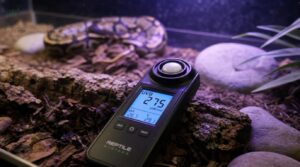
Setting up the light is only half the job—knowing what it’s actually delivering is where things get real. A good UVB meter takes the guesswork out completely, giving you hard numbers instead of hopeful estimates. Here’s what to check and track to keep your snake’s UV exposure dialed in.
Use UVB Meters
A UVB intensity meter is the only tool that tells you what your snake is actually receiving, not what the bulb claims to output. Place the sensor at basking surface height, pointed directly at the bulb.
Meter calibration matters — an uncalibrated meter gives false confidence.
Log each reading with the date and lamp age to catch declining UVB output before it becomes a problem.
Measure Basking Zones
Take your UVB meter — ideally a Solarmeter 6.5 — and measure directly at the basking surface, positioning the sensor at the exact height of your snake’s head. That distance between the lamp and your animal’s head is what determines actual UVI exposure, not the bulb’s rating.
Measure at three points across the basking zone:
- The hottest thermal spot, where surface heat calibration confirms peak UVB overlap
- The gradient edge, roughly 30–45 cm from center, where UVI drops and heat gradient mapping reveals the change zone
- The shaded boundary, confirming UV index falls to near zero before the retreat
Log every UVI reading with lamp age and date.
Check Shaded Retreats
Once you’ve mapped your basking zone, shift the Solarmeter to your shaded retreat areas and confirm UVI drops to near zero inside each one.
A good retreat blocks direct UVB entirely while maintaining ambient warmth — usually 75–80 °F — without becoming a cold trap.
Position multiple retreats across different microclimates, keep entrances clear, and guarantee each one is removable for routine cleaning.
Record UVI Readings
Once you’ve verified the retreat drops to near zero, start keeping a proper record.
Log daily UVI at 15‑minute intervals during the photoperiod using a Solarmeter 6.5 or equivalent UV index meter.
Store everything in a CSV data storage file — date, time, UVI value, sensor ID — and run trend analysis weekly to catch gradual lamp degradation before it affects your snake.
Adjust Lamp Height
Once your UVI data reveals a drop below target, raise or lower the lamp in 1-inch increments until your Solarmeter reads the species-correct value at the basking surface. For most crepuscular snakes, that means UVI 1.0 at 12–15 inches.
Recheck immediately after any perch or substrate change — even a 2-inch height shift can meaningfully alter UVB exposure depth.
Prevent Burns and Eye Damage
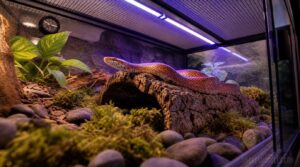
UVB done wrong doesn’t just underperform — it can genuinely hurt your snake. Burns and eye damage are real risks when placement, materials, or intensity aren’t dialed in. Here’s what to watch and fix before it becomes a problem.
Avoid Glass Barriers
Glass blocks UVB entirely — place a glass pane between your bulb and your snake, and you’ve effectively turned off the light.
- Use alternative materials like mesh or screen
- Install protective film only on non-UV-facing surfaces
- Create a UV shield using enclosure positioning, not glass
- Provide opaque barriers for retreat zones instead
- Seal enclosure gaps without glass inserts
Avoid Plastic Covers
Plastic covers have the same problem as glass — they filter out the UVB your snake actually needs. Even clear plastic blocks key wavelengths before they reach the basking spot, making your UVB transmission efficiency drop noticeably.
Swap any cover for a breathable metal mesh lid instead, which lets UVB pass through cleanly while keeping your snake secure.
Maintain Safe Clearance
Keep a minimum of 4–6 inches of clearance between your UVB fixture and any surface your snake can physically reach. That distance between the lamp and your animal’s head matters more than most keepers realize — too close, and UV radiation intensity spikes well beyond safe UVB exposure thresholds.
- Mount T5 HO tubes 12–15 inches from substrate
- Adjust mercury vapor bulbs to 12–24 inches clearance
- Recheck UVB path integrity after any enclosure rearrangement
Watch Avoidance Behavior
Your snake’s behavior is the most honest feedback your UVB setup will ever give you.
Your snake’s behavior is the most honest report card your UVB setup will ever produce
A ball python that repeatedly retreats to dim edges, stays coiled during peak light hours, or presses against cooler surfaces instead of basking is signaling UVB stressor discomfort — not shyness.
Watch for timed avoidance patterns: if hiding aligns consistently with lights‑on, the distance between the lamp and your animal’s head needs increasing.
Reduce Excessive Exposure
Once avoidance behavior confirms overexposure, the fix starts with lamp-to-head distance — raise the fixture incrementally, verify with a UVB meter at basking height, and target your species’ UVI range rather than guessing.
Reflective enclosure materials and water features can scatter UVB unpredictably, inflating output.
Keep UVB output percentage matched to zone requirements and recheck readings after any adjustment.
Maintain Your UVB Setup
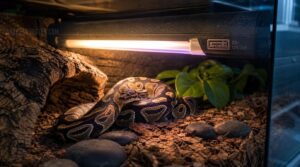
Getting your UVB setup right is only half the job — keeping it working is the other half. Bulbs degrade silently, reflectors collect grime, and behavioral shifts in your snake can tell you more than any meter. Here’s what to stay on top of.
Replace T5 Bulbs Yearly
A T5 HO tube that still glows isn’t necessarily still working — UV output decline happens long before the light visibly dims. Within six months, your bulb may have lost up to 40% of its UVB output, and spectrum shift effects quietly push emissions toward longer wavelengths that don’t synthesize vitamin D3.
Following an annual replacement schedule is the most reliable way to protect your snake:
- Mark the installation date on the end cap the day you install it — no guessing, no excuses
- Schedule a midpoint UVI reading at six months to catch early output drops before they affect your snake’s calcium metabolism
- Factor in cost efficiency savings: one replacement bulb costs far less than treating metabolic bone disease
- Practice safe bulb handling — power off the fixture, use clean hands or gloves, and dispose of old tubes according to local fluorescent waste guidelines
Replacing your T5 HO tube on a yearly basis keeps your UVB output percentage within the range your snake actually needs, rather than what the still-lit fixture leads you to assume.
Replace T8 Bulbs Sooner
T8 bulbs degrade faster than most keepers expect — UVB output declines measurably within six months, well before the tube shows any visible dimming.
Unlike T5 HO fixtures rated for annual replacement, T8 bulb lifespan demands a shorter cycle, commonly every six months, to keep UVB output percentage within a biologically useful range for your snake.
Date Each Bulb
Write the installation date directly on the end cap of every bulb — a permanent marker takes two seconds and removes all guesswork. Your aging log becomes useless without it.
Most keepers track UVB bulb lifespan as a range, replacing every 6 to 12 months depending on bulb type, but that window only means something when you know exactly when the clock started.
Clean Fixture Reflectors
A dirty reflector is a hidden efficiency thief — dust alone can cut UVB output by 20% before the bulb even ages out.
Clean your fixture reflectors using these steps:
- Power off completely and remove bulbs to access the surface safely.
- Wipe with a microfiber cloth dampened with a non-ammonia cleaner, then dry thoroughly.
- Inspect for pitting or coating damage — replace heavily degraded reflectors immediately.
Aim to clean every 12–24 months, or annually in dusty setups.
Log Behavior Changes
Your snake’s behavior is the most honest report card your UVB setup will ever produce. Log daily observations in a simple notebook or app — note basking duration, hide use, and feeding response.
When you adjust lamp height or replace a bulb, document UVB adjustments immediately alongside the date. Behavioral changes rarely lie.
Frequently Asked Questions (FAQs)
Can UVB lighting affect a snakes shedding cycle?
Yes, UVB lighting directly affects shedding. It drives Vitamin D3 Synthesis, supporting Calcium Metabolism essential for clean skin shedding. Poor UVB exposure often causes incomplete sheds, while a proper UVB Gradient keeps shedding cycles consistent.
Do snakes need UVB if they eat whole prey?
Whole prey does supply dietary D3, but the amount varies. For a ball python, UVB supplementation adds a reliable safety net that captive diet alone can’t always guarantee.
How does UVB interact with enclosure humidity levels?
Humidity is the uninvited guest that quietly dims your UVB radiation. At 60–80%, moisture dampening impact is real — air scattering reduction slightly lowers UVB penetration before it reaches your snake.
Conclusion
Your snake can’t tell you when something’s wrong—but signs are already there if you know where to look: the refusal to bask, the sluggish feeding response, the slow fade that looks like temperament but reads like deficiency.
Setting up UV lighting in a snake enclosure correctly closes that gap before it becomes a health crisis.
Get the bulb, the distance right, and your enclosure stops being a guess and starts being a system that works.