This site is supported by our readers. We may earn a commission, at no cost to you, if you purchase through links.

A snake found pressed motionless against its mat, unable to move away, is already in serious trouble—and it happens more often than most keepers realize. Heating mats aren’t dangerous by design, but an unregulated mat can hit 120 °F within minutes, turning a thermoregulation tool into a burn risk. The line between a safe warm zone and a tissue-damaging hot spot comes down to setup, not the product itself.
Knowing whether heating mats are safe for snakes means understanding what they actually do inside an enclosure—and what goes wrong when the details get skipped.
Table Of Contents
Key Takeaways
- A heating mat without a thermostat can hit 120°F in minutes, turning a basic setup tool into a serious burn risk for your snake.
- Snakes can’t feel heat building beneath them the way we do, so deep tissue damage often happens silently before you spot any warning signs.
- Keeping the mat under one-third of the enclosure floor is what creates the thermal gradient your snake needs to self‑regulate — shrink that cool side, and you’ve taken away its only escape.
- Species-specific temperature targets matter: ball pythons need 88°F–92°F on the warm side, corn snakes run cooler at 85°F–90°F, and boas sit best between 82°F–88°F — one setup doesn’t fit all.
What Snake Heating Mats Do

Snake heating mats work by warming the floor of the enclosure from underneath, giving your snake the belly heat it needs to digest food and regulate its body temperature. Before you plug anything in, it helps to understand exactly what these mats do — and what they don’t. Here’s what you need to know about how they function inside your snake’s setup.
If you’re still figuring out placement and setup, this guide on snake enclosure heating systems walks through how to position mats correctly to build that thermal gradient your snake depends on.
Under-tank Heat Support
An under-tank heater works by warming the enclosure floor directly beneath the mat. Heat transfers upward through the substrate, creating a localized warm zone on one side.
Your snake can move between this warmer area and the cooler floor. Keeping the mat under one section only maintains that essential gradient — giving your snake real control over its own body temperature.
Using an under‑tank heater provides consistent bottom heat, which helps maintain a stable temperature gradient.
Belly Heat Versus Ambient Heat
Belly heat and ambient heat aren’t the same thing. A snake heat mat warms only the ventral surface — IR-C radiation that barely reaches past your snake’s scales.
Ambient temperature warms the entire air volume, letting your snake absorb heat through movement and respiration.
That difference matters more than most keepers realize.
Warm-side Temperature Zones
Your snake heat mat heats only part of the floor — usually one-third of the enclosure — creating a deliberate thermal gradient. The warm side stays between 88 °F–92 °F, while the cool side rests at 70 °F–75 °F. That gap gives your snake real thermoregulation choice.
Measure surface temperatures at substrate level, not the air. Heat mats warm by conduction, so substrate thermal buffering matters — thicker bedding softens hot-spot formation. Check your warm side weekly; gradient stability monitoring catches temperature drift before your snake does.
Species-specific Heating Needs
Not every snake shares the same thermal blueprint.
Ball pythons need 88 °F–92 °F on the warm side, while corn snakes run slightly cooler, and boa constrictors function best between 82 °F–88 °F.
Tropical species need consistent warmth; temperate species tolerate wider swings.
Juveniles often require the higher end of the warm-side range to support digestion and growth.
Yes, With Thermostats and Monitoring
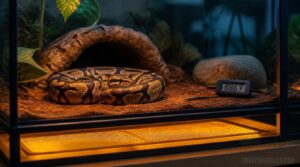
Heating mats are safe for snakes — but only when you pair them with the right controls. Without a thermostat and regular monitoring, even a basic mat can become a serious hazard within minutes. Here’s what you need to have in place before your snake ever touches that warm side.
Always Use a Thermostat
A heat mat without a thermostat is like a car with no brakes — it won’t stop until something goes wrong. Unregulated heat mats can climb past 120°F within minutes, and your snake can’t escape what it can’t feel building beneath it.
A heat mat without a thermostat won’t stop climbing until your snake is already burned
That’s why a reptile-grade thermostat isn’t optional equipment — it’s the foundation of safe heating.
Here’s what to look for when choosing one:
- Pulse thermostats regulate heat by rapidly pulsing power, giving you tighter accuracy than basic on/off models.
- On/off thermostats are affordable but create temperature swings of several degrees as the mat cycles fully off and on.
- Thermostat wattage limits matter — exceeding the rated capacity causes overheating or failure.
- Probe placement accuracy is critical; position your probe at snake level, not floating in air.
- Redundant monitoring systems — pairing your thermostat with an independent thermometer — catch thermostat malfunction early.
Calibration verification is simple: place a separate thermometer at the exact probe location and compare readings. If they differ by more than 3°F, inspect immediately. Temperature control devices only protect your snake when they’re working correctly.
For setups using ceiling-mounted infrared heat lamps for apartment living, positioning your verification thermometer directly beneath the lamp gives you the most accurate baseline reading.
Set Safe Temperature Limits
Once your thermostat is in place, the next step is dialing in the right numbers.
For ball pythons, set your thermostat to 88°F–92°F on the warm side. Corn snakes run slightly cooler — target 80–85°F. Boa constrictors sit comfortably at 82°F–88°F.
At night, drop temperatures roughly 10°F, but never below 75°F.
Check Warm-side Surfaces
Your thermostat controls the mat, but only an infrared thermometer tells you what the snake actually feels. Surface temperature and air temperature aren’t the same — the warm-side floor can run 10°F hotter than the air above it.
- Aim your infrared gun directly at the warm-side surface
- Tape a small piece of painter’s tape on the glass to improve accuracy
- Use the Min/Max tracking function to catch overnight spikes
- Spot-check daily, targeting 87°F–89°F maximum
Maintain a Cool Retreat
Your snake needs a place to cool down just as much as it needs warmth. Cool side air should stay between 75°F–78°F — a stable retreat where your snake can self-regulate.
Place a separate thermometer there and check it daily. During winter, ambient room temperature can drift upward unexpectedly, quietly shrinking the thermal gradient your snake depends on.
Avoid Unregulated Heat Mats
An unregulated heat mat is basically a live wire with no off switch. Without a thermostat, the surface can hit 120°F within minutes — well past burn threshold.
General purpose mats aren’t designed for reptile enclosures and can spike unpredictably. Electrical fault hazards multiply when wattage doesn’t match your thermostat’s load rating. Always use a thermostatically controlled heat mat.
How Heating Mats Burn Snakes

Heat mats don’t have to fail dramatically to hurt your snake — sometimes all it takes is an unregulated surface or a thin layer of substrate. Burns can happen quietly, with no obvious sign until real damage is already done. Here’s how it actually happens.
Dangerous Hot Spots
Hot spots don’t announce themselves — they quietly build to dangerous levels while your snake sits directly above them. Uneven mat edges run up to 130°F, while center areas stay 5–10°F cooler.
That temperature gap triggers micro-hotspot formation along corners. Thermal spike cycles push surfaces 10–15°F above set temperatures. Excessive mat coverage past 25% makes this worse.
Direct Contact Burns
Burns don’t always start with a cry of pain — snakes can’t tell you when something hurts.
Brief contact under 2 minutes at 35°C usually causes first-degree reddening. Longer exposure produces blistering and scale discoloration.
Metal mat surfaces transfer heat faster than plastic, making burns more severe at identical temperatures.
Always use substrate as a thermal buffer between mat and skin.
Deep Tissue Injuries
What makes deep tissue injuries so dangerous is that the skin looks fine at first. The burn is already happening underneath — in subcutaneous tissue where heat accumulates silently.
Here’s how silent thermal injury progresses:
- Heat penetrates without visible surface damage
- Subcutaneous tissue begins breaking down
- Necrosis develops, sometimes forming blackened eschar
- Skin eventually opens, revealing a deeper wound
- Infection risk rises sharply at this stage
Overheated Substrate Risks
Substrate doesn’t just sit there — it acts like insulation, trapping heat between the mat and your snake. Even with a thermostat, substrate thermal mass can push surface temperatures above 100 °F.
Bioactive setups are especially risky; thick organic layers prevent accurate probe readings entirely. In extreme cases, scorched substrate has ignited enclosure materials below.
Emergency Burn Warning Signs
When an overheated substrate hides the damage, your snake may already be injured before you notice anything wrong.
Watch for unusual skin discoloration — red, white, or charred patches signal a thermal burn.
Visible blistering means skin layers are breaking down.
Ruptured blisters leak fluid, raising infection risk fast.
Lethargy or unusual stillness are key snake behavior signs of overheating.
Safe Heat Mat Setup Steps
Getting the setup right is what separates a safe enclosure from a dangerous one. Each step below targets a specific risk — burns, hot spots, electrical hazards — so skipping even one can compromise your snake’s safety. Here’s exactly what to do.
Install Outside The Enclosure
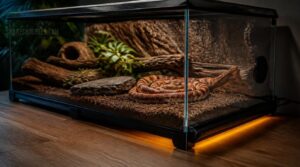
The mat goes outside the enclosure — never inside. For glass tanks, press it flat against the exterior bottom panel on the warm side.
Glass conducts heat well; PVC doesn’t — its air pockets act as insulation.
If using PVC, mount the mat vertically on a side wall instead.
Always leave clearance underneath for airflow.
Cover One-third Maximum
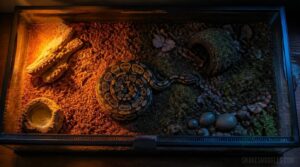
The snake heat mat should cover no more than one-third of your enclosure’s floor. This preserves the thermal gradient your snake depends on — a distinct warm zone and a cool retreat.
- A 20-gallon tank needs roughly a 6×8 inch mat
- Cool zones must occupy at least two-thirds of the floor
- Proper coverage reduces burn risk by roughly 40%
Place Probes at Snake Level
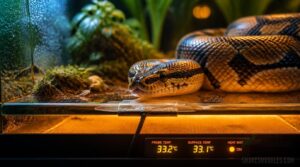
Your thermostat probe must sit at snake belly level — not hovering mid‑air. Position it on the warm side where your snake naturally rests.
Tape the probe firmly between the heat mat and enclosure glass using foil tape, preventing dislodgement. This gives you accurate surface readings, not ambient air temperatures, so your thermostat actually controls what matters.
Use Substrate Heat Buffering
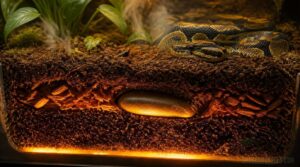
Substrate is your heat mat’s silent partner — get the layering wrong, and you’re either burning your snake or leaving it cold.
Maintain 1–2 inches of substrate directly over the mat. Thinner than 0.5 inches risks surface temperatures spiking dangerously. Deeper than 3 inches blocks heat transfer efficiency, leaving the mat overheating below while your snake stays cold above.
Here’s a reliable layered system:
- Bottom layer — coconut fiber: Its thermal conductivity of 0.221 W/m·K slows heat transfer, preventing spikes while retaining warmth gradually.
- Middle layer — cypress mulch: Maintains humidity and adds moderate substrate insulation above the coconut fiber base.
- Stone placement: Position thermal mass stone 1 inch above the mat; soapstone or limestone stores heat and releases it slowly, extending warmth overnight.
- Depth target: Keep total substrate depth between 2.5–4 inches for ball pythons; this range balances heat diffusion without blocking mat output.
- Temperature check: Verify snake-level surface temps stay within 88°F–92°F — multi-layer setups hold fluctuations within ±3°F longer than single-layer arrangements.
That stone layer especially earns its place. It mimics natural basking conditions while acting as a thermal buffer, smoothing out the sharp heat spikes that unprotected mats produce.
Keep Cords Protected
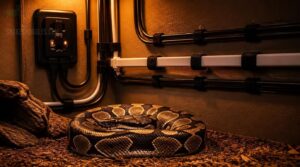
Every cord around your snake’s enclosure is a potential hazard — moisture, heat, and curious snakes make a dangerous combination.
Route cords through silicone sleeves or rigid cable covers along the enclosure’s back wall, away from substrate and heat zones. Use Velcro ties to manage excess slack. Apply a bitterant spray to exposed sections as a chew deterrent, and always plug into a GFCI-protected outlet.
Safer Heating Choices by Species
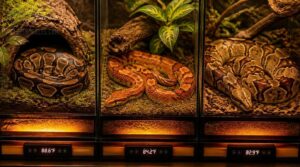
Not every snake thrives under the same heat source, and getting this wrong can cost you more than comfort. Species like ball pythons, corn snakes, and boas each have distinct temperature needs that shape which heating method actually works. Here’s what you need to know for each one.
Ball Python Heat Needs
Ball pythons are one of the most temperature-sensitive snakes you’ll keep. Their hot spot must stay between 88°F and 92°F — drop below that, and digestion slows noticeably.
The warm side ambient should hold 80°F–85°F, with a cool retreat at 76°F–80°F.
Never let enclosure air exceed 95°F.
A thermostat on your snake heat mat isn’t optional — it’s the foundation of safe reptile husbandry.
Corn Snake Temperature Range
Corn snakes run cooler than ball pythons. Warm side temperatures of 85°F–90°F support digestion, while the cool side stays between 75°F–82°F. Your snake heat mat should never push surfaces past 92°F.
Key signs your gradient is working:
- Snake feeds without hesitation
- No restless pacing between zones
- Consistent post-meal warm-side settling
- Hatchlings staying above 80°F at night
Boa Constrictor Requirements
Boas run warmer and larger than corn snakes, so your heating setup needs to match that scale. Warm side temperatures should sit between 82°F–88°F, with a basking spot of 88°F–93°F . Keep the cool side at 75°F–80°F.
| Zone | Target Temperature |
|---|---|
| Basking Spot | 88°F–93°F |
| Warm Side Ambient | 82°F–88°F |
| Cool Side | 75°F–80°F |
Your snake heat mat should cover no more than 30% of the floor. Ideal humidity levels of 60°F–70°F support healthy skin, rising to 80% during shedding cycle support periods. Use cypress mulch for substrate moisture retention, and feed adults every 10–14 days following feeding frequency guidelines. Because boas are semi-arboreal, vertical climbing space of at least 24 inches matters too — heat mat placement alone won’t satisfy their full environmental needs.
Radiant Panels and Lamps
Radiant panels and heat lamps offer a reliable alternative when belly heat alone isn’t enough.
Ceiling-mounted radiant panels emit long-wave infrared waves, warming your snake and its environment directly. Surface temperatures stay manageable, reducing burn risk greatly.
A 40W panel covers up to 2×4 ft evenly. Pair any lamp or panel with a digital thermostat to maintain control within ±0.5°F.
When to Avoid Heat Mats
Heat mats aren’t the right fit for every setup. Arboreal species like green tree pythons and Amazon tree boas need overhead radiant heat — not belly contact warmth.
If your room stays below 70°F, a mat can’t raise cool-side air to the required 75°F minimum. Substrate deeper than 2 inches traps dangerous heat.
Wooden enclosures risk igniting at 120°F. Switch to overhead heating instead.
Frequently Asked Questions (FAQs)
Are heat mats for reptiles safe?
What happens when a heat source runs without limits? Heat mats are safe for reptiles — but only when paired with a thermostat and proper monitoring. Without both, burn risk rises fast.
Can I put a heat mat under reptile carpet?
Yes, you can — but carpet insulates heat, which can cause uneven surface temperatures. Always verify the warm-side surface with a thermometer at snake level, and keep your thermostat probe positioned correctly.
How often should heat mats be replaced?
Replace your heat mat every 2–3 years. Sooner if you spot cracking, uneven heating, unusual smells, or swelling. High-humidity enclosures accelerate wear. When in doubt, swap it out — your snake’s safety depends on it.
Can heat mats cause fires in snake enclosures?
Yes, they can. Unregulated mats can hit 120°F, igniting wood enclosures. Thermal blocks from hides or deep substrate trap heat further. Always pair mats with a thermostat and GFCI outlet.
What backup heating works during power outages?
When the power dies, your snake’s survival clock starts ticking. Battery-powered heating pads buy you 6–8 hours. For longer outages, a propane heater with ventilation and a CO detector keeps temperatures stable and safe.
How do you calibrate a thermostat probe accurately?
Start by identifying your probe type — thermistor, RTD, or thermocouple. Place a calibrated reference thermometer beside it, allow 5–15 minutes to stabilize, apply any offset, then document the result.
Conclusion
Heating mats can warm a snake beautifully or burn it badly—the difference lives entirely in your setup. Are heating mats safe for snakes? Yes, when a thermostat holds surface temps below 95 °F, substrate buffers the heat, and a cool side stays accessible.
Skip any one of those steps, and the mat becomes a liability. Your snake can’t move away from pain it doesn’t recognize.
You’re the safeguard. Build the enclosure like it matters, because it does.
- https://www.evolutionreptiles.co.uk/blog/wooden-vivarium-heat-mat
- https://www.justanswer.com/pet-reptile/i5wzl-ball-python-severe-burns-its-belly-heat.html
- https://www.thebiodude.com/blogs/reptile-and-amphibian-lighting-faqs-and-help/here-s-why-you-shouldn-t-be-using-a-heat-mat-for-your-reptile
- https://apexreptile.com/blogs/apex-reptile-blog/complete-guide-to-heating-and-lighting-your-pvc-reptile-enclosure
- https://beanfarm.com/blogs/reptile-ramblings/how-to-properly-heat-reptile-enclosure