This site is supported by our readers. We may earn a commission, at no cost to you, if you purchase through links.
I’ve had owners bring in bearded dragons with corneal damage from lamps left on around the clock, convinced more heat meant better care. It doesn’t. Reptiles evolved under a rhythm of light and dark, and that cycle does as much for their health as the temperature itself.
Get the timing wrong, and you’re not just risking a chilly snake, you’re disrupting digestion, shedding, even immune function. Get it right, and your enclosure starts running itself.
Below, I’ll walk through exactly how long to leave heat lamp on for your species, how to handle nighttime drops safely, and which timer and thermostat setups actually hold up under daily use.
Table Of Contents
- Key Takeaways
- Leave Snake Heat Lamps on 10–12 Hours
- Turn Off Visible Heat Lamps Overnight
- Maintain a Safe Temperature Gradient
- Control Heat With Thermostats and Timers
- Adjust Runtime by Heat Source
- Prevent Overheating and Fire Hazards
- Frequently Asked Questions (FAQs)
- Is it okay to leave a heat lamp on all day?
- Do heat lamps burn a lot of electricity?
- Are heat lamps safe indoors?
- How much heat will a heat lamp put out?
- How long can a heat lamp run continuously?
- Is it safe to use heat lamps for chicks 24/7?
- How often should heat lamp bulbs be replaced?
- Can heat lamps stay on for physical therapy sessions?
- How long should bathroom heat lamps stay on?
- Conclusion
Key Takeaways
- Most reptiles need 10-12 hours of heat lamp light a day on a consistent timer, mimicking natural sunlight to keep their internal clock and digestion, shedding, and immune function on track.
- Turn off visible heat lamps at night and use lightless options like ceramic heat emitters instead, since even red bulbs can disrupt sleep cycles and mask dangerous temperature drops.
- A safe enclosure needs a full temperature gradient, not just one number, so you can measure the warm basking side, the cooler retreat side, and nighttime lows separately with a calibrated thermometer.
- Fire safety matters as much as temperature control, so secure your fixtures properly, use ceramic sockets, keep flammable materials at least 18-24 inches away, and pair any lamp with a thermostat.
Leave Snake Heat Lamps on 10–12 Hours
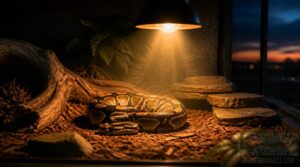
Most snake species do best with their heat lamp running 10 to 12 hours a day, mimicking the natural rise and fall of sunlight. That kind of consistency helps your snake’s internal clock stay on track, which matters more than owners often realize. Here’s how to build that schedule the right way.
A timer-controlled setup takes the guesswork out of this routine, and pairing your heat lamp with the right gear from a snake cage accessories checklist makes it easy to keep everything running on schedule.
Follow a Daylight Schedule
Around sunrise, your snake’s lamp should click on, mimicking morning light exposure that anchors circadian rhythm alignment. Keep the daylight schedule consistent, roughly 10-12 hours of daytime light quality, then dim toward evening light management as dusk falls.
This safe operating time helps natural thermoregulation, and seasonal daylight adjustments matter too, since shorter winter days may need slight timing shifts.
Use a Consistent Timer
That kind of consistency doesn’t happen by memory alone. A programmable digital timer with daily repeat settings locks in the same on-off times, and battery backup prevents schedule loss during outages.
Test a full 24-hour cycle before trusting it, log any changes, and keep the timer’s light contained so it doesn’t spill into the room or disturb sleep.
Consider Species-Specific Needs
No two species read the same clock. Thermoregulatory behavior varies by heritage:
- Corn snakes: 80–85°F warm side
- Ball pythons: 88–92°F basking zone
- Desert species: low humidity, loose substrate
- Arboreal types: vertical gradients, dry hides
- UVB-dependent lizards: consistent daytime exposure
Match duration and gradient to your snake’s natural basking behavior, not a generic template.
Environmental conditions like temperature and humidity greatly affect reptile health and behavior, making proper housing design essential for their well-being Microenvironment considerations
Adjust for Seasonal Daylight
Species aside, the calendar itself shifts your snake’s needs. Summer sun stretches daylight 2–5 hours longer than winter, so seasonal timers paired with light sensors should trim runtime gradually, never abruptly, protecting circadian rhythms.
| Season | Photoperiod Adjustment |
|---|---|
| Summer | Shorter artificial cycle |
| Winter | Extended, gradual ramp |
| Shift period | 1–2 week shift |
Turn Off Visible Heat Lamps Overnight
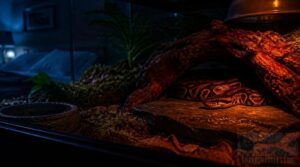
Once the sun goes down, your snake doesn’t need to see a glowing bulb to stay warm. In fact, that visible light can throw off its natural rhythm just as much as skipping heat altogether would. Here’s what to check before you flip the switch off for the night.
Check Minimum Night Temperatures
What’s a safe low for your snake at 2 a.m.? Don’t guess—measure it.
- Corn snakes: 21–24°C
- Leopard geckos: 20–22°C
- Ball pythons: not below 23°C
- King snakes: 22–24°C
- Juveniles: 1–2°C warmer
Place a calibrated thermometer away from direct heat, log minimums each morning, and watch for drafty windows or thin insulation stealing warmth overnight.
If nighttime lows keep creeping down despite your thermostat settings, this guide to fixing common reptile habitat temperature swings can help you pinpoint exactly where the heat is escaping.
Use Lightless Nighttime Heating
Once the lamp’s off, your snake still needs warmth—just not the glow. Ceramic heat emitters solve this, radiating infrared without light, so nocturnal heating won’t disrupt sleep cycles.
Pair one with a thermostat and probe for steady temperature regulation, and add a heat mat for redundancy. Keep ventilation balanced so humidity doesn’t spike.
That’s safe heat lamp operation after dark.
Avoid Red Night Bulbs
Reach for a red bulb at your own risk—it’s not the blackout solution it appears to be. Red light still penetrates glass, causing night vision impairment and masking temperature drops your snake relies on for thermoregulation.
Shallow beam angles create uneven glare, triggering behavioral stress indicators. Skip it entirely; light leakage prevention matters more than color when protecting safe heat lamp operation overnight.
Protect Natural Sleep Cycles
Darkness does more than hide light—it triggers melatonin production that governs your snake’s rest-activity rhythm. A consistent light cycle, bright by day and truly dark by night, keeps that internal clock accurate.
Darkness isn’t just the absence of light—it triggers the melatonin production that keeps a snake’s internal clock accurate
Disrupted light exposure or lingering warmth confuses natural sleep cycles, leading to erratic basking and poor thermoregulation. Protecting nighttime darkness safeguards both sleep hygiene and healthy temperature regulation.
Maintain a Safe Temperature Gradient
Runtime only tells half the story, since how long a lamp stays on matters less if the enclosure never reaches the right temperatures in the first place.
Your goal isn’t just heat, it’s a proper gradient your reptile can move through to regulate its own body temperature.
Here’s what to check to make sure that gradient actually works.
Measure The Warm Side
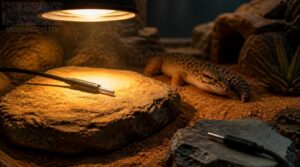
Guesswork has no place under the basking spot. Place your probe directly on the basking surface, centered in the warm zone, and let the enclosure sit for 30 minutes before trusting the reading.
Check two points to confirm uniformity, since hot spots skew results. Leopard geckos need 32–34°C, corn snakes 29–32°C — log daily to catch gradient drift early.
Monitor The Cool Side
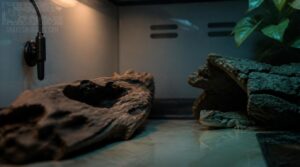
A retreat that’s too warm ruins its purpose. Keep the cool side between 24 and 28°C, thermometer placed at lighting height, away from stray infrared. Maintain the gradient with:
- Reflective flooring to cut daytime heat gain
- Shade for a stable retreat
- Nightly low checks against species minimums
Ventilation matters too — stagnant air narrows your gradient and undermines safe heat lamp operation.
Check Basking Surface Temperatures
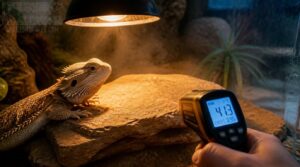
Ambient readings won’t tell you what’s happening where your reptile actually basks. Aim an infrared thermometer directly at the platform after the lamp’s run 15 minutes, letting temps stabilize. Most species need 85–95°F at the surface; bearded dragons run hotter, 100–110°F. Check multiple points, log readings daily, and calibrate your thermometer periodically — drift skews everything downstream.
Provide a Cool Retreat
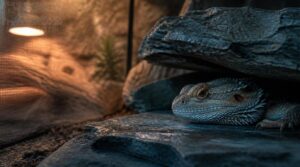
Once you know the basking surface, give equal thought to the opposite end. Your reptile needs a cool retreat with shade, airflow, and a surface that won’t hold heat—slate or damp substrate works well.
Good ventilation prevents warm air pooling, letting your pet self-regulate away from constant heat lamp exposure whenever thermoregulation calls for it.
Follow Species Temperature Requirements

No two enclosures run alike, since species temperature requirements vary widely by natural range. A desert species and a rainforest species won’t share a basking zone target.
- Bearded dragons: 95–110°F basking
- Ball pythons: 88–92°F warm side
- Leopard geckos: 88–92°F basking
- Crested geckos: 78–82°F, cooler-tolerant
- Green iguanas: 95–100°F basking
Match your heat lamp duration and gradient to these species temperature gradients, not generic assumptions.
Control Heat With Thermostats and Timers
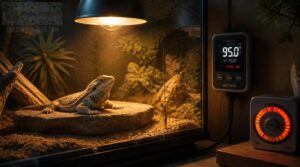
Once you’ve got your gradient mapped out, the real work is keeping it there day after day, and that’s where equipment does the heavy lifting. A good thermostat paired with the right timer takes the guesswork out of thermoregulation, catching swings before they become problems. Here’s what you need to get that setup right.
Choose a Dimming Thermostat
A dimming thermostat beats a simple on/off switch because it modulates wattage gradually, smoothing temperature swings instead of cycling. Match load capacity (many handle up to 1000 watts) to your bulb, and confirm certification standards before purchase.
| Feature | Why It Matters |
|---|---|
| Dual probe | Tracks ambient and surface temps |
| Programmable setpoints | Automates day-night gradient |
| Overtemp shutoff | Prevents runaway heat lamp duration |
Position The Probe Correctly
Where you put that probe matters as much as the thermostat itself. Set it 1 to 2 inches above the basking surface, angled slightly downward, never directly under the beam, where radiant heat inflates readings. Keep it clear of water or substrate pockets. Check placement after any rearranging, and remember desert species often need hotspots between 36°C and 40°C.
Verify With Digital Thermometers
A thermostat’s dial only tells part of the story, so back it up with a separate digital thermometer for independent reading validation. Check accuracy through ice water at 0°C, a reliable reference standard.
Position the probe near the basking spot, avoiding drafts or thermal mass interference, and log readings periodically to catch drift before it compromises thermoregulation.
Test Settings Before Use
A dry run before your reptile ever meets the lamp catches problems early. Confirm the heat lamp timer cycles correctly, check thermostat calibration, verify enclosure layout, and inspect safety devices for secure mounting, proper ventilation and airflow, and safe proximity to combustible materials.
Log initial temperature readings as your baseline before trusting the setup unsupervised.
Monitor Temperatures Daily
A thermostat isn’t a "set it and forget it" tool—your eyes still do the real work. Keep temperature logs with morning checks and evening readings, tracking the gradient across basking, middle, and cool zones.
- Note hot spot temp
- Note cool zone temp
- Record overnight low
- Flag sensor placement shifts
- Compare against species range
Monitor regularly, since drift happens quietly before it becomes dangerous.
Adjust Runtime by Heat Source
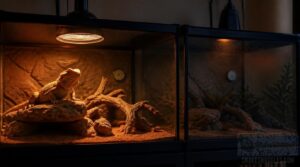
Not every heat source behaves the same way once it’s inside your enclosure, so the safe runtime really depends on what you’re using. Some bulbs handle round-the-clock duty just fine, while others need real breaks to avoid overheating your reptile or burning out early. Here’s how each common option stacks up.
Incandescent Basking Lamps
Incandescent basking lamps remain the workhorse for reptile keepers, casting visible light and infrared warmth together. Choose 40 to 150 watts based on enclosure size, then focus that heat beam onto one basking spot, adjusting height to dial in surface temperature.
Use ceramic sockets only, expect 2,000 to 5,000 hours of bulb life, and remember: no UVB comes from these, so supplement separately.
Halogen Heat Bulbs
Quartz envelopes let halogen bulbs run hotter and closer than standard incandescents, so heat safety distance matters more here. Keep runtime short: 4-6 hours daily suits most terrariums.
- Inspect quartz for hairline cracks
- Use only ceramic sockets
- Never touch bulbs with bare skin
Oils from fingertips create weak spots—a real lamp explosion risk under sustained heat.
Ceramic Heat Emitters
Unlike halogen bulbs, ceramic heat emitters run without any visible light, so nocturnal species aren’t disturbed. Their design permits continuous heat lamp use, since ceramic housings tolerate sustained high temperatures without socket failure—provided you’re using ceramic sockets, not standard ones.
Match wattage (100-250W typical) to enclosure size, pair with a thermostat, and expect roughly 1,500 hours of reliable lifespan with proper reflective mounting.
Deep Heat Projectors
If your ceramic emitter feels too intense for a species needing gentler warmth, a Deep Heat Projector offers an alternative: 50–80 watts producing infrared A and B for deep tissue heating, no visible light.
Reflectors distribute heat evenly, cutting hotspots. Pair with a dimming thermostat, mount off-center from basking sites, and you’ll maintain your temperature gradient efficiently, often replacing multiple lamps in modest enclosures.
Heat Lamps Versus UVB
Deep heat projectors handle warmth, but they won’t touch vitamin D synthesis — that’s a UVB lamp’s job. Run UVB on the same schedule as your basking zone setup, mounted at species-appropriate distance, replaced every 6–12 months regardless of visible output.
Heat lamp duration and UVB exposure duration aren’t interchangeable; your reptile needs both working together, not one substituting for the other.
Prevent Overheating and Fire Hazards
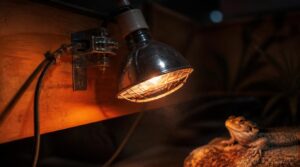
Runtime and temperature control only get you so far if the setup around the lamp isn’t safe. Fire risk comes down to physical details you can check with your own hands, not just numbers on a thermostat. Here’s what to look at before you plug that lamp in again.
Secure Every Lamp Fixture
A falling lamp is a real fire risk, not a hypothetical one. Anchor mounting hardware into studs or joists rather than drywall alone, rated for 2–8 pounds of pull force.
Route cords through clip-on channels with strain relief at the fixture, keeping cables off walkways. Tighten screws to spec, and verify wiring sits inside a covered junction box.
Use Heat-Safe Ceramic Sockets
That socket behind your bulb matters as much as the bulb itself. Standard sockets can warp under sustained heat; ceramic sockets resist deformation up to high temperatures, insulate live contacts safely, and resist corrosion over years of use.
Choose porcelain E26/E27 models rated for your wattage, and inspect for glaze cracks before each installation — a proactive habit that meaningfully lowers fire risk.
Keep Combustibles Safely Away
Because bulbs radiate heat well beyond their glass surface, keep a minimum clearance of 18 to 24 inches from bedding, paper, and curtains.
- Store spare substrate or paper products in closed bins
- Keep the area dry, since damp materials heat unevenly
- Designate a clear safety zone around the fixture
Never stack supplies near an unattended lamp — combustible storage habits matter as much as the bulb itself.
Maintain Enclosure Ventilation
Stagnant heat builds fast around any bulb left running for long stretches, so vent placement strategy matters: intakes low, exhaust up top, positioned opposite each other for cross airflow. Keep grilles clear and filters on a maintenance schedule — check monthly.
Monitor airflow and humidity daily near basking and cool zones. Good ventilation lets extended heat lamp duration stay safe, not risky.
Inspect Cords and Fixtures
A frayed cord is often the first sign of trouble, and it’s one you can catch early with a habitual glance before each use.
- Cracked insulation near the plug
- Scorch marks or discoloration on housings
- Loose sockets or bent prongs
Check cord strain relief, route cords away from moisture, and keep three inches of clearance from hot surfaces for lasting electrical safety.
Frequently Asked Questions (FAQs)
Is it okay to leave a heat lamp on all day?
Not really. Constant runtime disrupts temperature gradients, strains wattage and energy costs, and raises fire safety risks near flammables. Pair your heat lamp with a timer or thermostat instead, cycling heat to protect natural behavior and thermoregulation.
Do heat lamps burn a lot of electricity?
Watts add up fast, pun intended. A 150-to-250-watt lamp run 8 hours draws roughly 2–0 kWh daily. Pair it with a thermostat to cut wasted runtime, since efficiency, not brute wattage, keeps both your reptile and your bill comfortable.
Are heat lamps safe indoors?
Yes, when installed correctly: certified fixtures, ceramic sockets, secure mounting, adequate clearance from combustibles, and proper ventilation. Pair with a thermostat for temperature monitoring, and inspect cords regularly. Skipping these steps is where fire risk creeps in.
How much heat will a heat lamp put out?
More wattage, more warmth, more risk: a 100-watt incandescent lamp or ceramic emitter radiates roughly 80-95% of its power as infrared heat, with output depending heavily on reflector design and distance from the basking surface.
How long can a heat lamp run continuously?
Most reptile setups tolerate 10-12 hours safely, provided you’re using a thermostat to prevent overheating. Ceramic emitters handle continuous use best. Watch for scorched basking spots, check wattage against enclosure size, and never skip daily temperature monitoring.
Is it safe to use heat lamps for chicks 24/7?
For newly hatched chicks, continuous heat lamp use for the first week is appropriate under veterinary guidance, provided you’re using a thermostat, proper chick brooder safety measures, and gradual temperature reduction toward 90°F by week two.
How often should heat lamp bulbs be replaced?
Most bulbs need swapping every 6 to 12 months, depending on wattage and type. Watch for filament fatigue, dimming, or UV decline, and always follow manufacturer instructions rather than waiting for total failure.
For clarity, UVA versus UVB lighting for snakes explains why fading UV output matters before a bulb burns out.
Can heat lamps stay on for physical therapy sessions?
Yes, but only for 10 to 20 minutes per area, staying within safety temperature limits and following APTA-documented protocols, with a qualified therapist monitoring skin color, comfort, and equipment placement standards throughout the session.
How long should bathroom heat lamps stay on?
For safe, comfortable warmth, run bathroom heat lamps 5 to 10 minutes per use, pairing a heat lamp timer with proper ventilation to manage ambient temperature, cut energy consumption, and keep bathing sessions cozy without overheating skin or fixtures.
Conclusion
Think of the sun as an old, reliable clockmaker, never rushing, never overheating the gears, just steady light followed by honest darkness. That rhythm is the real medicine.
Knowing how long to leave a heat lamp on matters less than respecting the pattern behind it: warmth by day, retreat by night, gradients your pet can choose from.
Get the cycle right, and thermoregulation stops being guesswork. Your enclosure becomes a small, well-run habitat, and your reptile simply thrives.