This site is supported by our readers. We may earn a commission, at no cost to you, if you purchase through links.

Tape a thermometer to the glass, and you’ll get a reading that’s lying to you. Glass conducts ambient room temperature, not the surface your snake actually presses its belly against. That single mistake sends countless keepers chasing the wrong numbers for months, wondering why their ectotherm won’t bask or won’t stop hiding.
Temperature drives everything for a snake, digestion, immune function, even shedding success, so guessing at placement isn’t an option. The best spot for terrarium thermometer placement depends on what you’re measuring and why, not just where there’s room on the wall.
Get the gradient right, from basking rock to cool hide, and your snake tells you through its behavior that you’ve nailed it.
Table Of Contents
- Key Takeaways
- Top 5 Terrarium Thermometer Placement Spots
- Match Placement to Snake Habitat
- Place Thermostat Probes Correctly
- Mount Thermometers Without False Readings
- Verify and Adjust Temperature Gradients
- Frequently Asked Questions (FAQs)
- Where is the most accurate place to put a thermometer?
- Where to place a thermostat probe in a vivarium?
- Do you put a thermometer in the hide or basking spot?
- Where to position a thermometer in a tank?
- How many thermometers does a terrarium actually need?
- Can I use a single thermometer for accuracy?
- Whats the ideal accuracy range for reptile thermometers?
- How do digital and analog thermometers compare in reliability?
- Where should thermometers be avoided in bioactive setups?
- Conclusion
Key Takeaways
- Never tape a thermometer straight to the glass, since it reads room temperature instead of the actual surface your snake is resting on, sending you chasing the wrong numbers for months.
- Cover the full gradient with multiple sensors, basking surface, cool zone substrate, mid-enclosure air, and both warm and cool hides, since one thermometer only tells part of the story.
- Match your probe placement to your snake’s lifestyle, whether that means vertical zones for climbers, depth checks for burrowers, or surface contact just above (never touching) a heat mat.
- Keep checking your work by comparing warm and cool readings daily, calibrating sensors at least once a year, and watching your snake’s own behavior for signs the gradient still needs adjusting.
Top 5 Terrarium Thermometer Placement Spots
Since your snake is ectothermic, it relies entirely on the gradient you build to regulate its body temperature. That means where you place your thermometers matters just as much as the equipment itself. Here are the five spots you need to check to keep that gradient honest.
Getting the gradient wrong doesn’t just chill your snake—it can quietly trigger issues like recognizing the early signs of dehydration in snakes, so accurate readings matter more than you’d think.
Warm-side Basking Surface
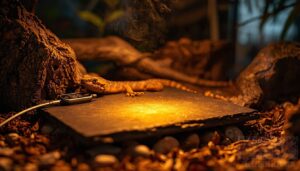
Start where your snake starts its day: the Basking Surface. Aim for 26-34°C on a ceramic tile or slate slab, elevated slightly for heat distribution. Keep it unobstructed, barrier-protected from wiring, and test multiple points, since uneven readings often mean your Warm Hide Temperature and Substrate Level nearby need adjusting too.
Cool-side Substrate Level
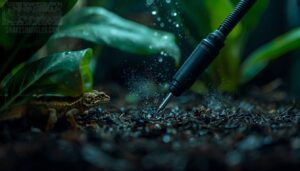
Once your basking spot reads true, head to the opposite end: the Cool Zone substrate. Sand cools unevenly; coconut fiber and moist mixes retain evaporative cooling better, dropping temps faster.
- Place probe on substrate surface, away from misters
- Check daily for drift
- Watch for bunching near heat (sign it’s too cool)
- Note substrate depth effects on speed
- Compare against ambient readings
Mid-enclosure Ambient Zone

Between those two extremes sits your temperature stabilization area, the enclosure thermal center that keeps the whole gradient honest.
- Place mid-way, away from glass and airflow
- Expect 70–85°F ambient air temperature
- Avoid direct heat exposure
- Watch plants or rocks for micro gradients
- Run daily checks alongside basking and substrate readings
Warm Hide Interior
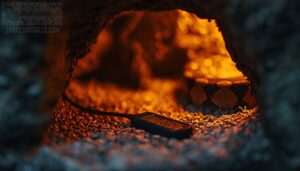
Once you’ve mapped the open gradient, check inside the hide itself. Warm hide interior readings often run cooler than expected, since the thermal insulation layer traps warmth unevenly.
Place a probe near substrate level, away from the entry hole, to confirm your snake gets genuine access and privacy without overheating.
Cool Hide Interior
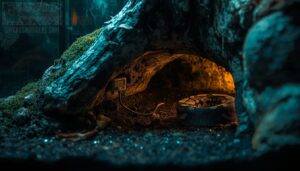
Since ectothermic reptiles rely on retreat spots to escape heat entirely, your Cool Hide Interior deserves its own probe. Cool hide design usually holds temperatures for hours after nearby heaters shut off, so check readings at substrate level.
Watch for these factors:
- Hide humidity control (40-60%)
- Substrate cooling buffer
- Hide safety materials
- Observation access features
Consistent Monitoring and Adjustment here protects your snake’s thermoregulation.
Regularly checking temperature gradients with a reliable thermometer helps you catch issues early, especially since needs vary across popular pet snake species.
Match Placement to Snake Habitat
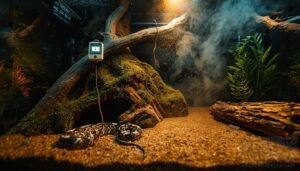
No two snake enclosures heat up quite the same way, since layout, climbing habits, and burrowing behavior all shift where warmth actually collects.
Getting placement right means matching your thermometers to your species’ natural habits, not just guessing at the middle of the tank.
Here’s how to position your gear across five common setups, from ground-dwellers to climbers to heat-mat systems.
Terrestrial Enclosure Layouts
A flat, matte floor stops glare and slippage, letting you place probes securely across the Basking Zone and Cool Zone.
Set substrate depth zones between 5-15cm, mount corner-accessible hides for easy checks, and add drainage under loose substrate. For the loose substrate drainage layer, try LECA pebbles or mesh barrier liners built for breeder tubs to keep moisture flowing without fouling the zone below.
Track Substrate Temperature near hide entrances, since accessible corners simplify daily Probe Placement and cleaning without disturbing your snake’s gradient.
Arboreal Vertical Gradients
Climbing species like arboreal snakes live by height, so your Thermometer Placement must follow suit.
- Top: under basking light (28C+)
- Mid: on a perch, Mid-Level Airflow zone (22-26C)
- Bottom: near substrate, Lower Canopy Cooling (18-22C)
- Space each probe 6-8 inches apart
This Canopy Heat Mapping tracks Arboreal Species Movement, letting you verify true Basking Zone and Cool Zone temperatures across Arboreal Vertical Gradients.
Burrowing Snake Substrate Temperatures
Underground doesn’t mean uniform. A burrowing snake reads substrate temperature at different depths, so probe placement matters more than surface checks alone.
Try substrate depth monitoring: shallow, mid, and deep readings map the true thermal gradient. Watch moisture-temperature interaction, since damp substrate conducts heat differently. Match readings to species-specific range targeting (often 21-27C), adjusting depth seasonally as your snake’s burrowing behavior shifts with temperature needs. Recommended substrate depth requirements vary by species, so probe deeper for larger burrowers to capture an accurate gradient reading.
Heat Mat Setups
A heat mat works from below, so your thermometer strategy needs to flip too.
Place the probe on the substrate directly above the mat, never touching the mat itself, to catch true surface temperature.
Check thermostat calibration monthly, and don’t cover mats beyond manufacturer limits.
Substrate thermal mass affects how fast warm hide temperature stabilizes, so patience pays off.
Overhead Heating Setups
Gravity works in your favor here, since heat falls naturally from above onto your basking spot.
Whether you’re running a radiant panel, ceramic emitter, or heat lamp, probe placement matters most: put it on the surface directly beneath the fixture.
- Confirm panel height adjustment yields 90-110°F
- Verify lamp guard installation and reflector aim
- Check emitter wattage matches enclosure size
Place Thermostat Probes Correctly
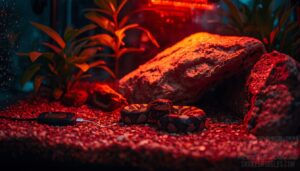
Your thermostat’s only as smart as the probe telling it what’s happening. Get that placement wrong, and you’re either cooking your snake or leaving it cold without knowing why. Here’s exactly where that probe needs to sit to keep your readings honest.
A thermostat is only as smart as the probe telling it what’s happening
Hottest Accessible Surface
Since your snake seeks out the hottest available spot to regulate its body heat, your probe belongs right there, on the basking rock or platform, not floating nearby.
Surface texture affects grip, but it also holds heat differently, so test with infrared thermometers for accuracy. Expect readings 10-15 degrees above ambient, and always avoid direct sunlamp exposure spiking past 95°F.
Beneath Overhead Heat Sources
Overhead heat lamps create a radiant gradient, so your probe needs placement along that vertical path, not just on the surface below.
Mount it on branches or backdrops 2-5 degrees cooler than basking spots. Ceramic backdrops offer thermal mass, buffering swings within 1-2 degrees. This mapping shows exactly how heat dissipates as your snake climbs away from the source.
Heat Mat Probe Positioning
Radiant heat travels upward, but heat mats work through direct contact, so Probe Placement here demands full surface contact with substrate.
- Lay the probe flat for consistent readings
- Center it for Center Placement Accuracy, avoiding Edge Temperature Variation
- Maintain Probe Depth Consistency at a shallow level
- Route cables safely away from climbing paths
Confirm Substrate Contact Integrity regularly, this protects your Temperature Gradient’s accuracy.
Prevent Direct Heater Contact
Full contact with the mat is one thing, but touching the heater itself is another matter entirely. Keep at least 3 to 4 inches clearance in all directions, and consider a shielded heat barrier for extra insurance.
Nonconductive shields with 2 inches of clearance stop radiant transfer cold, protecting probe accuracy without blocking airflow your gradient depends on.
Secure Against Snake Movement
A curious snake will nudge, coil, or drag anything loose, so probe displacement deterrence matters as much as placement itself. Secure cables with zip ties, filed smooth to avoid injury, and route wires through clips for tight wire management.
Rounded panels and tight lids block escape routes and climbing attempts, keeping probes undisturbed and readings trustworthy.
Mount Thermometers Without False Readings

Where you mount a thermometer matters just as much as where you place it. A poorly secured unit or one pressed against the wrong surface can quietly feed you bad numbers for weeks. Here’s what to get right before you trust that reading.
Avoid Direct Glass Contact
Glass radiates whatever heat or cold hits it, skewing readings fast. Rely on Non-Glass Clip Attachment to frame edges, or Magnetic Frame Mounting on non-glass sections.
Add Silicone Spacer Protection or Foam Sleeve Shielding around probe tips, and practice smart Wire Routing Avoidance so cables stay clear too, keeping your Thermometer Placement honest and your Temperature Gradients trustworthy.
Avoid Misters and Water
Since evaporative cooling drops readings artificially, keep every sensor clear of misters, foggers, and spray zones. Favor Waterless Humidification Methods like fogging beads instead.
Pair Moisture-Resistant Substrate with a Sealed Enclosure Design to stabilize humidity, and run Humidity Sensor Calibration monthly so your Thermometer Placement reflects true Temperature Gradients, not soggy sensor exposure.
Secure Suction Cup Mounts
A wobbly thermometer gives you lying data, so suction cup strength matters as much as placement. Prep the spot with alcohol, then press firm.
- Wipe with lint-free cloth
- Check the vacuum release valve
- Try a dual cup arrangement
- Test-pull after mounting
- Inspect rims for longevity
Use Humidity-resistant Adhesives
Humidity eats weak adhesives alive, especially in a tank running 60-80% ambient moisture. Pick humidity-resistant adhesives with proven bond strength retention above 80%.
| Adhesive Type | Cure Time | Humidity Cycle Rating |
|---|---|---|
| Epoxy capsule | 24 hrs | Excellent |
| Marine adhesive | 12 hrs | High |
| Standard mount | 6 hrs | Poor |
Prep surfaces dry for real sensor stability.
Conceal and Secure Wires
A dangling wire is an invitation for your snake to snag, chew, or drag its sensor out of place. Route cords through embedded grooves or cork hides, then secure with zip ties or magnetic clips.
- Wire routing channels (12-16 mm grooves)
- Moisture-resistant conduit sleeves
- Adjustable wire management with velcro wraps
- Secure wire fastening via stainless zip ties
- Concealment inside hollow cork blocks
Verify and Adjust Temperature Gradients
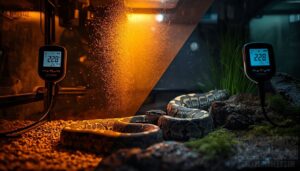
Getting your thermometers placed right is only half the job, since even perfect placement won’t help if you never check the numbers. Your snake’s enclosure changes with the seasons, the weather, and its own habits, so your monitoring routine needs to keep pace. Here’s what to watch for once those thermometers are mounted and running.
Compare Warm and Cool Readings
Compare warm hide temperature against cool side temperature to catch heat source bias before it skews your gradient mapping accuracy. Grab spot temperature measurements on both ends daily.
If warm reading consistently outpaces cool by more than expected, factor in your snake’s behavioral thermal response, does it favor one zone unusually? That pattern often reveals probe placement issues worth investigating.
Calibrate Thermometers Regularly
Even accurate-looking gradients lie if your sensors drift. Calibrate thermometers regularly, at least annually:
- Run an Ice Point Method check (0°C slurry, wait 3-5 minutes)
- Try a Boiling Point Check for high-range accuracy
- Match Calibration Frequency to drift patterns
- Apply Sensor Type Calibration rules
- Use a Master Reference thermometer when possible
Log every correction factor.
Check Probe Placement Daily
Calibration means nothing if the probe itself has shifted. Check probe placement daily, at the same time each day, confirming it’s still on the basking surface or substrate, not buried or dangling loose. Compare morning versus afternoon readings for sudden shifts.
Route cables away from heat sources, and log adjustment dates alongside your daily temperature readings for a reliable gradient history.
Watch Your Snake’s Behavior
Your logs mean little without watching the snake itself. Behavioral thermoregulation tells the real story: constant basking suggests a cold basking spot, while hiding on the cool side may signal an overheated warm zone.
Watch tongue flicking, too. Slow, steady flicks indicate comfort, while agitated movement or flattening against glass often points to stress from a poorly balanced gradient.
Adjust for Seasonal Changes
As seasons turn, your snake’s enclosure needs to turn with them. Bump winter heating 2-4°F and keep it running overnight to prevent chilling.
Summer calls for the opposite: drop basking zones 6-10°F below winter setpoints. Shift day length cycles gradually, adjust humidity 5-15%, and recheck your thermostat more often during these transitional months.
Frequently Asked Questions (FAQs)
Where is the most accurate place to put a thermometer?
Think of your enclosure as a patchwork quilt of microclimates. Accuracy lives in numbers, not one: basking surface probe, cool zone substrate, mid-level ambient, plus warm and cool hide sensors, each capturing its own true spot temperature.
Where to place a thermostat probe in a vivarium?
Set your thermostat probe on the warmest basking surface, just above substrate level, keeping slight distance from the heat element itself. This spot captures true peak warmth, letting your gradient stay accurate for reliable, safe thermoregulation.
Do you put a thermometer in the hide or basking spot?
Both, actually. A probe on the basking surface tracks critical heat, while one inside the warm hide confirms safe retreat temps. This gradient check keeps your snake comfortable, since hide readings should always run cooler than basking spots.
Where to position a thermometer in a tank?
Spread sensors across five zones for full temperature gradient coverage: basking zone surface, cool zone substrate, mid enclosure air, warm hide interior, and cool hide interior.
This layout gives you accurate probe placement and reliable temperature monitoring throughout your enclosure setup.
How many thermometers does a terrarium actually need?
One thermometer rarely tells the whole story. Most enclosures need three to four sensors across basking, cool, and mid zones, though small tanks under 18 inches can rely on a single dual-probe unit for gradient monitoring.
Can I use a single thermometer for accuracy?
A single thermometer only gives you one spot temperature measurement, missing the broader gradient. Sensor placement bias skews readings, so accuracy suffers without range.
Track microclimates properly, calibrate often, and trust probe accuracy across multiple zones instead.
Whats the ideal accuracy range for reptile thermometers?
Like a rotary-phone dial needing precision, aim for plus or minus 5 to 1 degree Celsius. Digital probes hit that range reliably; infrared units run looser, so reserve them for quick spot checks, not your basking zone.
How do digital and analog thermometers compare in reliability?
Digital thermometers win on accuracy comparison and readout speed, staying calibrated via firmware.
Analog units drift over time, need re-zeroing, and suffer parallax error.
Digital’s environmental sensitivity to batteries is analog’s durability advantage though, since glass needs no power at all.
Where should thermometers be avoided in bioactive setups?
Skip glass walls where vents skew airflow, mister zones, water bowls, and tight crevices trapping false heat. Avoid resting coils too, since movement disturbs probes there, throwing off the accurate gradient readings your snake depends on.
Conclusion
Picture a Victorian naturalist squinting at a mercury tube nailed to glass. He’d have gotten it as wrong as you did before reading this.
The best spot for terrarium thermometer placement isn’t one single point, it’s a system of checkpoints working together. Trust the basking surface, trust the cool hide, and trust your snake’s own behavior above any gadget. Get the gradient right, and your enclosure practically runs itself.
- https://www.thebiodude.com/blogs/reptile-and-amphibian-lighting-faqs-and-help/how-to-place-thermometer-and-hygrometer-probes
- https://www.reptiles.swelluk.com/help-guides/reptile-thermostat-setup-where-to-put-the-thermostat-probe-in-your-vivarium
- https://www.evolutionreptiles.co.uk/blog/vivarium-thermometer