This site is supported by our readers. We may earn a commission, at no cost to you, if you purchase through links.

Most snake bites during handling happen not from aggression, but from rushed movements that startle an otherwise calm animal. A hook, used correctly, removes that risk almost entirely by giving your snake a predictable, non-threatening cue before contact ever happens. That predictability is everything: reptiles don’t read intent, they read patterns.
Learning how to train a snake to hooks means teaching your snake that the tool signals safety, not danger. Get the sequence wrong and you’ll spend months undoing defensive habits. Get it right, and you’ll build a handling routine your snake trusts every single time.
Table Of Contents
Key Takeaways
- Picking a hook that’s the right size, balanced, smooth-edged, and used only for handling (never feeding) sets the foundation for trust from day one.
- A consistent cue sequence—slow enclosure opening, gentle midbody touch, a pause to check stress, then a careful lift—teaches your snake that the hook means safety, not danger.
- Reading body language matters more than following a script: calm tongue flicks and loose movement mean you’re good to continue, while hissing, musking, or a tight S-curve strike posture mean you need to stop immediately.
- Building trust takes patience—start with five-minute sessions, wait 48 hours after feeding, repeat the same routine every time, and expect full reliability to take one to two months depending on the species.
Choose The Right Snake Hook

Your hook is the first tool your snake learns to trust, so picking the right one matters more than most handlers realize. A hook that’s poorly sized or roughly finished can undo weeks of training in a single bad interaction. Here’s what to check before you buy.
If you’re just getting started, this step-by-step ball python hook training guide walks you through building that trust from day one.
Match Hook to Snake Size
Size matters more than most handlers realize. A properly sized hook matches your snake’s length and girth: 12 to 18 inches for medium snakes, 20-plus for larger constrictors, with tip width around one-third body girth. Wrong sizing means poor power and stress on ribs.
As a general rule, hook length should match snake length to help guarantee good control and safety during handling.
Follow these hook sizing guidelines through each size progression stage as your snake grows.
Check Balance and Grip
Getting the length right is only half the job. Pick up the hook and feel its balance point, it should sit close to your hand, not the tip, or midbody lifts turn clumsy fast.
Rubberized, textured grips keep control when scales get slick, while proper weight distribution prevents tipping during support and lifts.
Use Smooth Rounded Edges
Balance means nothing if the edge bites back. Rounded contact points, roughly a 2mm radius, prevent scale snagging and mucous membrane irritation during midbody touches.
Why edges matter:
- Reduces tail injuries during close contact
- Protects sensitive scale types
- Minimizes startle response
- Lowers your grip fatigue
Deburred, polished steel or chrome resists corrosion while staying gentle against skin.
Reserve Hook for Handling
Rounded edges only work if the hook stays clean. One hook, one job: handling only, never feeding.
| Practice | Why It Matters | Routine |
|---|---|---|
| Proper Hook Grip | Prevents slips | Every session |
| Hook Cleaning Routine | Stops scent cross-contamination | After each use |
| Hook Storage Practices | Prevents contamination | Dedicated kit |
Consistent use builds trust fast.
Train With Consistent Hook Cues

Once you’ve got the right hook in hand, consistency becomes your real training tool. Every session needs to follow the same sequence, because your snake learns the pattern, not the reasoning behind it. Here’s the exact order that builds that reliable signal.
If you’re still nailing down that foundation, this beginner-friendly snake training guide breaks down each step so you never lose the thread.
Open The Enclosure Smoothly
Every cue starts before the hook even enters the enclosure. Approach slowly from the side, keeping your shadow off the glass, then open the lid over two to three seconds. Consistency matters more than speed here.
Three habits build reliability:
- Reduce vibration on the latch
- Keep motion predictable, no jerks
- Pause briefly after opening
That rhythm becomes your snake’s first signal.
Touch The Midbody Gently
Slide the rounded tip under the snake’s middle third, never the neck or tail base, and make contact with the lightest possible pressure. This gentle hook placement should last one to two seconds, just enough scale-friendly touch to register awareness without startling.
Keep the rhythm slow and even. That slow contact rhythm beats quick taps every time for preventing defensive strikes.
Pause After Hook Contact
Hold still for one to two seconds after that hook tap. This pause after hook contact isn’t wasted time, it’s your window for checking snake state and stress level monitoring before moving on.
Watch for muscle relaxation timing here. Loosening coils and slower tongue flicks confirm defensive response reduction, meaning your predictable routine is working and this handling session can safely continue.
Guide The Head Away
Once your snake settles, use the hook’s side for gentle head redirection, guiding it toward the enclosure opening rather than toward your hands. Approach slowly from the side, never head-on.
Keep several inches of safe head distance throughout. This head positioning technique reduces strike risk while you guide the tail toward you, maintaining head and tail avoidance until posture stays loose and calm.
Lift Slowly With Support
Timing makes or breaks the lift. Wait roughly sixty seconds after hook contact, then lift slowly and confidently, keeping the snake close to your torso.
- Support the midbody with your palm
- Guide with smooth, continuous motion
- Coordinate hand and hook together
- Use two-hook support for larger bodies
- Watch body language throughout the lift
Even weight distribution prevents spinal stress and builds lasting trust.
Read Your Snake’s Body Language
Once the hook cue is locked in, your snake starts telling you exactly how it’s feeling before you ever lift it. That information shows up in small, specific signals you can read in seconds. Here’s what to watch for every time you reach for the hook.
Calm Tongue Flicks
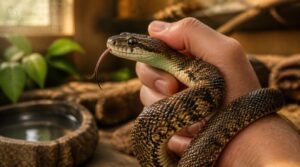
Watch the tongue, not the body, for your first read on trust. Calm tongue flicks are slow, controlled sweeps, your snake’s version of chemical cue detection rather than alarm. Frequent, steady flicking during a handling session signals calm sampling behavior and growing handling trust signals.
Species flick variations exist too; colubrids flick faster than heavier constrictors, both reflecting genuine stress reduction.
Loose Body Movement
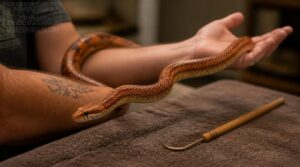
Beyond the tongue, look at how the body itself moves. Loose body movement shows up as slow, deliberate glides rather than jerky bursts, with relaxed muscle tone letting the snake drape naturally over your arm.
Fluid motion patterns and gentle exploration cues during a handling session, paired with consistent use of your hook cue, confirm real stress reduction rather than frozen stillness.
Feeding Posture
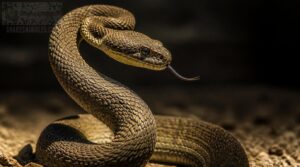
That looseness disappears fast once feeding drive kicks in. Feeding posture pulls the body into a tight S curve, neck retraction angle sharp, front half lifted for a strike.
- Racing heartbeat watching a coiled predator lock onto motion
- Gut-drop realizing your hand looks like dinner
- Tension reading strike curve pressure building in the neck
- Relief spotting head tracking before it’s too late
Skip the hook tap here.
Defensive Warning Signs

Feeding posture is a hunt cue. Defense is a threat response, and it looks different: tight coiling, raised head with forward tilt, hissing growls or pop sounds, arching to push away, brief fang gape, tail vibrating against substrate.
| Signal | Meaning | Your Move |
|---|---|---|
| Hiss/pop | Warning | Back off |
| Musking | Stress | Pause session |
| Fang gape | Threat | Stop contact |
When to Stop Handling

Every warning sign in the table means the same thing: stop now. Hissing, musking, or an escape attempt all call for immediate cessation, not a wait-and-see approach.
Sluggish movement signals fatigue or temperature stress, common outside 75-80°F. Keep first sessions to five minutes, respecting time of day and post-feeding waits, then build duration gradually as calm behavior becomes the norm.
Build Trust Through Short Sessions
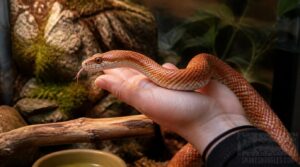
Trust doesn’t build overnight, and pushing too fast undoes the progress you just made reading your snake’s signals. The fix is simple: shorter sessions, repeated consistently, until calm becomes the default response. Here’s how to structure that timeline from your first five minutes to full reliability.
Start With Five Minutes
Trust isn’t built in a single afternoon, it’s built in minutes. Start with five-minute sessions for any new or nervous snake. That short window gives you a real behavioral observation window without pushing your animal past its comfort zone.
Only after consistent calm, over one to two weeks, should you consider gradual time increase. Rushing this stage undermines everything hook training is meant to establish.
Handle Between Feeding Days
Timing matters as much as technique. Wait a full 48 hours after feeding before any hook session, since digestion overlaps with feeding response and risks regurgitation.
Watch for post-meal stress signals like lethargy or bulging before resuming.
Safe handling intervals look like this:
- Feed
- Wait 48 hours
- Begin handling mode
Repeat The Same Routine
Sameness is the whole engine here. Snakes learn through associative learning, not reasoning, so every session needs identical cue order, body positioning, and duration to cement the pattern.
Snakes learn through associative repetition, not reasoning, so every session must repeat the same cues to build trust
| Element | Stays the Same | Why |
|---|---|---|
| Cue | Hook shown first | Signals handling, not food |
| Contact | Midbody touch | Predictable, low stress |
| Duration | Fixed length | Prevents escalating anxiety |
Increase Time When Calm
Watch the body, not the clock. Calm body language, loose muscle tone, slow tongue flicks, tells you when to stretch the next session by 30 seconds.
Only bump duration after three straight calm sessions at the current length. Keep movement consistency: same pace, same approach from the side, same unhurried hands. That gradual duration increase builds real trust over several weeks.
Progress Over Several Weeks
Real progress reads like a calendar, not a stopwatch. Expect Week 1 hook acceptance, Week 2 reduced lunging, then voluntary movement by week 3.
- Calmer tongue flicks
- Looser muscles
- Steady approach
- Genuine trust
Week 4 handling association solidifies, and by Week 6 calm approach becomes routine, capping several weeks of honest, incremental work.
Keep Hook Training Safe

Good technique only gets you so far if you skip the safety rules that keep both you and your snake protected. A few habits separate confident handlers from ones headed for a bite or a stalled training program. Here’s what you need to lock in before you pick up the hook again.
Never Pin Your Snake
A hook guides, it never traps. Avoiding force matters most here: pinning triggers panic and defensive strikes, undoing weeks of trust.
Stick to gentle hook contact and controlled guidance along the midbody. For lifting, use proper support under the body, not restraint. That’s safe lifting practices in action, calm and pressure-free.
Avoid Handling After Feeding
Timing matters as much as technique. Handling too soon confuses feeding response with handling cues, undermining your training.
Wait out the 48-hour rest period minimum, longer for large meals:
- Small meals: 48-72 hours
- Large meals: up to 14 days
- Watch for stomach bulge
- Note feeding stress signs
- Track digestive recovery weekly
Wash Away Prey Scents
Once the rest period ends, scent removal keeps your cues clean. Wipe surfaces with enzyme-based cleaning solutions that break down prey proteins, then follow with a water rinse to dilute residue on hides and tools. Air drying lets volatile compounds disperse fully.
Sanitize tools weekly, since leftover scent near an enclosure opening can trigger a feeding strike instead of a calm hook tap.
Clean and Store Hooks
Your hook needs the same care you give the snake. Wash it with warm water and mild soap after every session, dry it fully to prevent rust, and check the tip for burrs. Smooth rough spots with emery cloth, wipe with an antiseptic, then store it dry and ventilated, away from moisture and sunlight.
Adjust for Different Species
A clean, dry hook still needs the right touch for the snake in front of you. Head shape and jaw width dictate hook thickness, while slick scales demand a lighter grip than rough-textured bodies.
Arboreal species want short bursts near branches; venomous snakes need extra tool distance.
Loose-skinned species may roll, so angle the hook accordingly during handling and relocation.
Frequently Asked Questions (FAQs)
How long does hook training take to work?
Expect one to two months for full reliability, though corn snakes often settle in around two weeks while ball pythons take eight to ten weeks.
Start with five-minute sessions and track progress by watching strike responses shrink week over week.
Can hook training work on already-aggressive snakes?
Yes, but with limits. Consistent hook timing interrupts aggressive response triggers and builds habituation, yet strong biters may still need extra caution, species-specific adaptation, and closer stress signal monitoring before full trust building replaces defensive behavior.
What if my snake ignores the hook entirely?
Switch to a paper towel roll or folding hook for gradual desensitization. Food-motivated species like blood pythons often ignore standard cues; slow the habituation process, avoid feeding windows, and watch for the behavioral shift before trying again.
Do all snake species respond to hook training?
Not every scaly student takes to the lesson equally. Species differences matter: ball pythons and corn snakes adapt fast, while food-driven or defensive species resist, and juveniles often outpace set-in-their-ways adults.
Is hook training necessary for tame, docile snakes?
Not strictly, if honest temperament assessment shows real calm. But even docile snakes benefit: hook cues build routine, support stress reduction, and keep handler safety consistent so defensive behavior never resurfaces later.
Conclusion
A trained snake reads a hook like a driver reads a green light, calm and automatic. That’s the real goal behind learning how to train a snake to hooks: replacing panic with predictability.
Every gentle touch, every paused breath, every slow lift builds a routine your snake stops questioning. Skip steps and you’ll fight defensive strikes for months. Follow them and you’ll earn something rarer than obedience: genuine trust, the foundation every future handling session stands on.