This site is supported by our readers. We may earn a commission, at no cost to you, if you purchase through links.

A ball python doesn’t pant, sweat, or shiver to tell you something’s wrong. It just stops eating, or refuses to shed clean, and by the time you notice, the damage is already done. That’s the guesswork trap analog dial gauges leave you in, often off by 5°F or more with zero warning.
Digital terrarium thermometers for ball pythons close that gap fast, delivering readings accurate within ±1°F to ±1.8°F and updating every 10 seconds or less. For an ectothermic species that depends entirely on external heat to digest, move, and regulate its own body, that precision isn’t a luxury. It’s the difference between a thriving snake and a silently stressed one.
Table Of Contents
- Key Takeaways
- Top 4 Digital Thermometers for Ball Pythons
- Why Accurate Monitoring Protects Ball Pythons
- Compare Essential Digital Thermometer Features
- Track Ideal Ball Python Temperatures
- Place Thermometers for Reliable Readings
- Install, Calibrate, and Maintain Thermometers
- Choose Your Best Thermometer Setup
- Frequently Asked Questions (FAQs)
- Conclusion
Key Takeaways
- Since ball pythons can’t show obvious signs of temperature stress, digital thermometers with ±1°F to ±1.8°F accuracy catch dangerous drift that analog dial gauges (often off by 5°F or more) simply miss.
- A proper thermal gradient needs two monitored zones—88-92°F on the warm side and 70-78°F on the cool side—with at least 8-12°F separating them so your snake can regulate its own body heat.
- Where you place the probe matters as much as the thermometer itself: keep it at substrate level, shielded from direct radiant heat, and mounted on silicone or plastic rather than glass or metal to avoid skewed readings.
- Regular upkeep—calibrating every three months, cross-checking against a second thermometer, and replacing batteries before they die—keeps your readings trustworthy and prevents silent problems like stalled digestion or bad sheds.
Top 4 Digital Thermometers for Ball Pythons
Guesswork has no place in a ball python enclosure, where a few degrees mean the difference between healthy digestion and a silent health decline.
A reliable thermal gradient depends on the right equipment and setup choices, which this guide to ball python care essentials walks through in practical detail.
The right thermometer takes that uncertainty off the table, giving you precise, dual-zone readings you can actually trust.
Here are four digital options worth your consideration, each suited to different setups and monitoring needs.
1. Black Reptile Thermometer Hygrometer LCD Digital
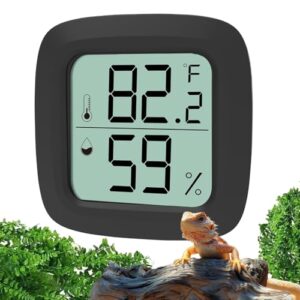
A ball python’s enclosure hides small, dangerous discrepancies, and the Black Reptile Thermometer Hygrometer LCD Digital exists to catch them. Its sensor delivers ±1.8°F accuracy and ±5%RH humidity readings, tight enough to flag drift before it disrupts digestion.
The high-contrast LCD toggles °F/°C with a double-tap, no guesswork required. A single CR2032 battery runs up to twelve months, and adhesive backing mounts it to glass or hides without tools, discreet enough for tropical, desert, or bioactive setups alike.
| Best For | Reptile owners keeping bearded dragons, ball pythons, crested geckos, tortoises, frogs, or axolotls who need reliable temperature and humidity tracking in a single enclosure zone. |
|---|---|
| Temperature Accuracy | ±1.8°F |
| Humidity Accuracy | ±5%RH |
| Display Type | LCD |
| Mounting Method | Adhesive backing |
| Power Source | CR2032 battery |
| Unit Count | 1 |
| Additional Features |
|
- High-precision sensor with ±1.8°F/±1°C temperature accuracy and ±5%RH humidity accuracy
- Easy tool-free installation with included adhesive backing, plus a battery that lasts up to 12 months
- Compact, low-profile black design that blends into desert, tropical, and bioactive setups
- Not waterproof, so it must be kept away from mist, splashes, and water bowls
- Only monitors a single zone, which limits its usefulness for enclosures needing multiple readings
- Some users report delayed humidity readings or unit failure after a few weeks of use
2. Reptile Thermometer Humidity Gauge 2 Pack
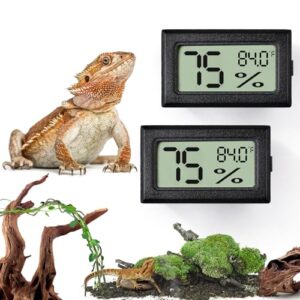
Single-zone readings leave you guessing about half your enclosure. The Reptile Thermometer Humidity Gauge 2 Pack solves that by giving you two independent sensors, each accurate to about ±1°C and ±5% RH, so you can map warm and cool zones simultaneously instead of shuttling one probe back and forth.
Probes stay inside the enclosure while displays mount outside for quick checks. Some users note calibration drift of a few degrees between units, so cross-checking on setup is worth the extra minute.
| Best For | Reptile owners who need to track temperature and humidity in more than one spot of an enclosure, such as those keeping bearded dragons, leopard geckos, crested geckos, hermit crabs, or ball pythons. |
|---|---|
| Temperature Accuracy | N/A |
| Humidity Accuracy | N/A |
| Display Type | LCD |
| Mounting Method | Acrylic dot adhesives |
| Power Source | AG13 battery |
| Unit Count | 2 |
| Additional Features |
|
- Combines a thermometer and hygrometer in one compact display for easy at-a-glance readings
- Comes as a 2-piece set, letting you monitor multiple zones (like warm and cool sides) at once
- Wide temperature (-58°F to 158°F) and humidity (10%RH to 99%RH) range with readings updated every 10 seconds
- Adhesive dots may lose their grip over time, particularly in humid conditions or if repositioned often
- Some users have noticed calibration differences of several degrees between the two units
- Durability can suffer with constant moisture exposure, such as regular misting
3. Magnetic Reptile Thermometer Hygrometer
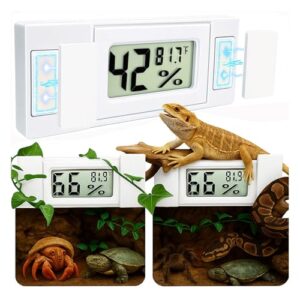
Cross-checking two units is one fix for drift. Skipping the mounting hassle entirely is another, which is where a magnetic reptile thermometer hygrometer comes in.
A neodymium magnet holds the probe against metal or magnet-friendly surfaces, no drilling, no adhesive failure. That stability cuts vibration-related reading errors common with dot-glue mounts.
You can reposition it in seconds to test warm and cool zones, keeping the sensor right at substrate level near the basking area for readings that actually reflect what your python feels.
| Best For | Reptile and invertebrate keepers who want to track temperature and humidity across multiple terrarium zones or enclosures without dealing with complicated mounting. |
|---|---|
| Temperature Accuracy | ±1°F |
| Humidity Accuracy | ±5% |
| Display Type | Dual LCD |
| Mounting Method | Adhesive backing |
| Power Source | Button cell battery |
| Unit Count | 2 |
| Additional Features |
|
- Front-mount magnetic design attaches securely to glass or plastic surfaces up to 0.28in thick
- Clear LCD display shows readings day or night, even in low light
- Two-unit kit lets you monitor separate zones or enclosures at the same time
- Magnets can detach if pets bump or interact with the unit
- Adhesive bonding between the magnet and housing may weaken over time, causing separation
- Continuous vibration nearby (like from equipment) can cause the unit to slide down vertical surfaces
4. Reptile Thermometer Hygrometer Dual Display
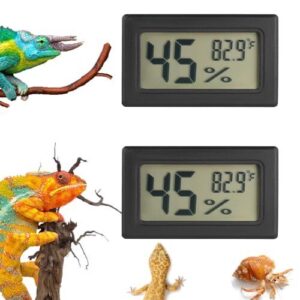
Magnets solve placement, but some keepers just want one screen showing both numbers at a glance. That’s the appeal of a dual display hygrometer thermometer: temperature and humidity update together, often within seconds, so you catch a humidity drop before it triggers a bad shed.
Look for ±1°F accuracy and a memory function tracking daily highs and lows. It won’t replace dual-zone probes, but as a quick-check tool near the cool side, it earns its spot in the enclosure.
| Best For | Reptile owners who want a simple, no-wires way to keep an eye on both temperature and humidity in a terrarium at a glance. |
|---|---|
| Temperature Accuracy | N/A |
| Humidity Accuracy | N/A |
| Display Type | LCD |
| Mounting Method | Magnetic mount |
| Power Source | Dual batteries |
| Unit Count | 2 |
| Additional Features |
|
- Reads temperature and humidity together in about 10 seconds, so you can catch a humidity drop early
- Compact 1.42 x 0.6 inch display tucks into an enclosure without blocking the view
- Comes with two spare batteries per unit, plus a battery life of around 4 months
- Some users find the display harder to read than expected
- The double-sided tape doesn’t always hold well on glass or vertical surfaces
- Isn’t waterproof, so it needs to come out before misting
Why Accurate Monitoring Protects Ball Pythons
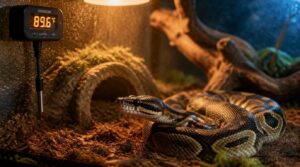
Your ball python can’t regulate its own body heat, so it depends entirely on the numbers your thermometer gives you—get those wrong by even a few degrees, and the consequences show up fast.
If your python seems restless once the lights dim, checking common signs of nighttime activity in ball pythons can help you tell normal dusk behavior from a temperature problem.
Digestion stalls, immune function weakens, and stress silently builds long before you notice a problem.
Here’s exactly what accurate monitoring protects against, and why it matters more than most keepers realize.
Supporting Digestion and Metabolism
Digestion in ball pythons runs entirely on borrowed heat. Enzyme activity slows dramatically when the basking spot drops below 88°F, delaying nutrient absorption and straining reptile metabolism.
Consistent thermal stability keeps digestive timing on schedule, usually 24 to 72 hours per meal. A stable temperature gradient aids digestion and metabolic regulation, preventing the sluggish, incomplete processing that leads to nutritional deficiencies.
Preventing Respiratory Health Issues
Stagnant, humid air is a silent trigger for respiratory infections. Keep humidity at 50-60%, make sure ventilation gaps prevent condensation, and watch for wheezing or open-mouth breathing.
Catch symptoms early: check your temperature controller and humidity gauge immediately, raise warmth by 2-3°F, and reduce moisture if excessive. Correct placement helps this response, preventing guesswork during treatment and recovery. For reference, native habitat data suggests daytime humidity should range between 60-80%, rising higher at night.
Encouraging Feeding and Shedding
Refusal to eat often traces back to an unstable thermal gradient, not stubbornness. A verified basking spot near 90°F triggers natural feeding cues, while accurate humidity readings (60-70%) ease molting. Weigh prey at 1-2% body weight and skip handling during shedding.
- Confirm basking zone accuracy before feeding
- Use scent aids during picky periods
- Check humidity gauge pre-shed
- Avoid handling post-feeding or mid-molt
Avoiding Heat Stress
95°F isn’t a warning, it’s a threshold. Past that mark, ball pythons risk dehydration and dangerous heat stress, especially without shade or water access. Watch for restlessness or excessive time spent off the basking spot: both signal trouble.
Improve ventilation, offer a shaded retreat, and pair your setup with a reliable temperature controller to prevent spikes. Proper probe placement catches problems before they escalate.
Maintaining Effective Thermal Gradients
A gradient isn’t a suggestion, it’s biology in action: your ball python needs 10 to 15 degrees of separation between zones to thermoregulate at all.
A thermal gradient isn’t optional—ball pythons need a 10 to 15 degree split between zones to thermoregulate
Dual-zone monitoring catches drift before it stalls digestion:
- Warm side collapsing toward the cool side
- Basking spot losing its edge
- Substrate thermal contact going cold
- Heat source positioning drifting off target
Calibration keeps probe placement honest.
Compare Essential Digital Thermometer Features
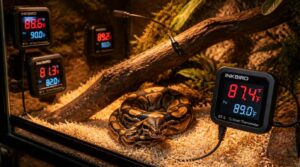
Not all digital thermometers are built the same, and the gap between a reliable unit and a guesswork gadget comes down to a handful of specs. Accuracy ratings, probe placement, and display type each affect whether you’re managing your python’s enclosure with confidence or flying blind.
Here’s what actually separates a trustworthy thermometer from one that’ll leave you second-guessing your temps.
Digital Versus Analog Accuracy
A dial gauge reacts instantly, but that speed comes with hidden noise, electromagnetic interference and substrate moisture skew readings you can’t see.
Digital thermometers filter that static internally, delivering stable, repeatable accuracy for your ball python’s thermal gradient.
Where analog drifts with age and needs physical recalibration, digital units hold factory tolerances longer, giving your temperature controller cleaner data to work from.
Temperature Probe Precision
A clean digital readout means little if the probe feeding it is sloppy. Probe accuracy range should sit between ±0.5°F and ±2.0°F, with fast sensor response time (1-2 seconds) catching swings before they harm your python.
- Slender 1.0mm tips cut thermal mass, sharpening precision
- Calibration drift limits stay under 0.2°C across six months
- Shielding blocks radiant heat skew
- Placement determines real-world accuracy
Temperature and Humidity Displays
A precise probe still needs a display you can trust at a glance. Look for temperature accuracy within 1°C and humidity within 5% RH, bold digits covering 60% of screen space, and readable contrast in dim enclosures.
Position the display at eye level, away from lamps, so your ball python’s dual-zone readings stay legible and accurate every time you check.
Update Speed and Memory
A screen means little if it lags behind what’s happening inside the enclosure. Look for updates every ten seconds or faster, plus minmax memory for realtime data logging. Devices tracking 16–256 KB of history reveal slow drifts affecting digestion. Faster polling drains batteries quicker, so weigh update frequency against runtime before choosing your setup.
- Fast refresh catches feeding-cycle spikes
- Logged data exposes gradual thermal drift
- Memory tradeoffs affect alarm reliability
Battery and Alert Features
Battery life ranges from six months to two years, so check for low battery warnings before drift ruins your data. Audible alerts plus push alerts catch dangerous swings fast. Power saving modes extend runtime between charges.
| Feature | Why It Matters |
|---|---|
| Alert customization | Sets ball python-specific thresholds |
| Bluetooth vs WiFi | allows realtime alerts remotely |
| Data logging | Tracks battery and drift trends |
| Auto sleep mode | Conserves power, maintains memory |
Track Ideal Ball Python Temperatures
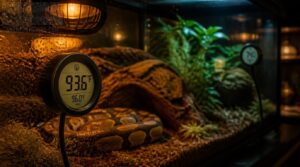
Your ball python doesn’t just need heat—it needs the right heat, in the right zones, at the right times. Get one number wrong, and you’re looking at digestion problems, stress, or worse. Here’s exactly what your thermometer readings should show across every zone and time of day.
Warm Side Temperature Range
Ball pythons bask to digest, not to relax, so warm zone accuracy matters as much as heat itself. Target 88-92°F at substrate level, never exceeding 95°F.
Heat source placement above your basking spot, paired with a temperature controller, keeps readings stable. Skewed sensors mean guesswork, and guesswork means stalled digestion.
Cool Side Temperature Range
Every enclosure needs a retreat, and that’s the cool side’s job: 70-78°F, with hatchlings tracking tighter at 72-75°F. Keep it 8-12°F below the warm zone for a proper thermal gradient.
Probe placement accuracy matters here too. Set sensors at substrate level, mid-zone, shielded from radiant heat, since misreads on the cool side undermine your entire gradient balance.
Safe Nighttime Temperature Drops
Nighttime cooling should feel gradual, not jarring: drop toward 72-78°F slowly, since swings beyond 5-10°F trigger feeding refusal and shedding delays.
Room temp stability counts too, so keep ambient conditions within ±2°F overnight. Pair your thermostat with a backup heat source or battery unit; power outages shouldn’t leave your ball python guessing through a dangerously cold night.
Maintaining Proper Thermal Gradients
A stable gradient isn’t luck, it’s engineering. Your enclosure needs a true span from basking temperature down to cool zone temperature, held steady through dual zone setup and consistent probe placement.
Watch for drift:
- Warm side creeping past 92°F
- Cool zone climbing above 82°F
- Readings shifting week to week without cause
Insulation and airflow control keep gradient stability intact, preventing silent thermal collapse.
Dangerous Overheating Thresholds
Ninety-two degrees isn’t a suggestion, it’s your ceiling. Push past 95°F and you’re courting organ failure and respiratory distress within hours, not days.
Overheating risk zones form fast when a probe sits too close to the heat source. Pair every enclosure with a temperature controller, verify basking temperature hourly during heat waves, and treat any spike above safe thermal limits as an emergency cooling trigger.
Place Thermometers for Reliable Readings
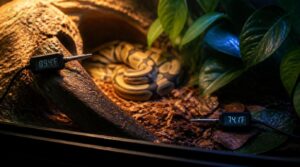
A thermometer only tells you the truth if it’s sitting in the right spot—get placement wrong, and even a perfectly calibrated sensor feeds you bad data.
Your ball python’s warm side, cool side, and everything in between depend on probes positioned with real precision, not guesswork.
Here’s exactly where each probe needs to go, and why every inch matters.
Monitor Both Enclosure Zones
A single probe tells half a truth. Your ball python needs dual-zone monitoring, warm side and cool side tracked simultaneously, so gradient verification isn’t guesswork.
Set alert thresholds at 85–95°F warm and 70–80°F cool. Weekly zone comparison against a handheld unit catches drift before it becomes dangerous, keeping your temperature gradient reliable and your maintenance routine consistent.
Position Probes at Substrate Level
Zone tracking only works if probe placement matches where your ball python actually rests. That means substrate level, not glass, not air. Mount probes 1–2 inches above bedding to mirror resting posture.
Substrate composition matters too: coconut fiber and cypress mulch conduct heat differently, skewing readings if you ignore moisture content and color absorption.
Shield Probes From Radiant Heat
Correct height means little if radiant heat from the basking bulb skews the reading itself. Add a ceramic or aluminum shield between probe and heat source, sized to block infrared without choking airflow. Low-emissivity, food-safe materials work best. This preserves thermal gradient accuracy and stops heat source interference from masking your actual substrate-level temperature.
Avoid Glass and Metal Contact
Glass and metal conduct heat differently than air, which means a probe resting against either surface reads the enclosure wall, not your python. Use silicone or plastic mounts instead.
Keep sensor housings clear of metal brackets to prevent conduction errors, and inspect probe tips regularly.
Worn tips shifting against glass invite corrosion and skewed data.
Cross-Check With Another Thermometer
One thermometer alone can’t confirm accuracy, it just reports a number. Run a dual thermometer comparison, ideally cross-manufacturer, to catch systematic bias.
A 1 to 2 degree gap signals trouble: recheck probe placement, then log readings over several days. Discrepancies past 2 degrees for three straight checks mean it’s time to replace the unit.
Install, Calibrate, and Maintain Thermometers
Placement only gets you accurate readings on day one—without proper installation and upkeep, sensors drift and thermostats lose their reference point within weeks.
A correctly mounted probe paired with a quality thermostat prevents the silent temperature creep that leads to burns or cold spots.
Here’s what keeps your setup calibrated and reliable for the long haul.
Secure Displays and Probes
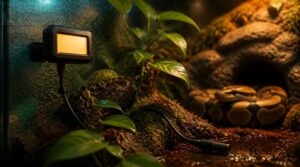
A cracked display or a chewed probe cable means one thing: guesswork. Choose units with shatterproof casing and tamper-resistant housing that lock out curious tails and stray screwdrivers.
Corrosion-resistant probe cables resist kinking during routine enclosure setup, while probes rated for 0–60°C tolerate ambient swings. Magnetic mounts stabilize displays on glass or acrylic, keeping your ball python enclosure readable at a glance.
Pair With Thermostat Controls

When your thermometer talks to a temperature controller, thermal gradient management stops being guesswork. Pairing links a sensor id to a zone, sometimes needing 5–15 seconds in pairing mode.
- Wireless connectivity for flexible enclosure setup
- Alert threshold configuration for drift warnings
- Firmware updates for reliable sync
Confirm sensor calibration sync before trusting automated setpoints.
Calibrate Every Three Months
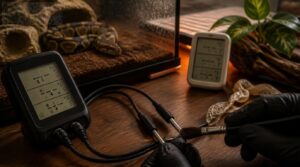
Quarterly calibration keeps drift from creeping in silently. Power on the unit, clean probes of dust and residue, and confirm your reference standard is itself within tolerance before testing.
Check readings against known points at both low and high ends. Log as-found and as-left values for every calibration check, then update the next due date so your reptile enclosure setup never runs on guesswork.
Replace Batteries Before Failure
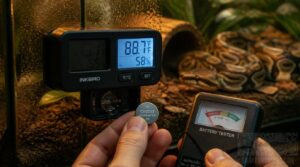
A dying button cell won’t announce itself, it just lets accuracy slip. Watch for dimming displays, delayed readings, or audible low-voltage warnings, and keep a spare battery on hand.
Test with a battery tester before installation, since capacity often drops below usable range 2-3 years in. Log replacement dates; scheduled swaps beat emergency ones every time.
Check Sensors for Drift
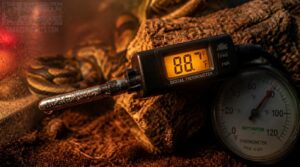
Silent bias is worse than outright failure, since you’ll trust a number that’s already wrong. Watch for:
- Readings drifting from your reference thermometer
- Slow response after icewater calibration checks
- Corroded probe contacts
- Inconsistent zone readings
- Persistent small deviations, not sudden jumps
Recalibrate quarterly against a known standard, and log every deviation you find.
Choose Your Best Thermometer Setup
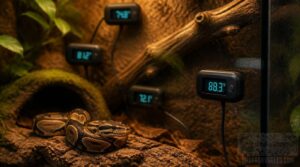
No single thermometer fits every setup—your enclosure size, material, and budget all shape the right choice. Getting this decision right means fewer blind spots and more consistent readings across both thermal zones. Here’s how to match your specific needs to the right configuration.
Match Your Enclosure Type
Glass terrariums demand external heat pad placement with an internal probe reading surface warmth, never direct contact.
Plastic tubs need humidity-tolerant sensors tucked beneath substrate without skewing results.
Small enclosures benefit from compact dual-sensor units monitoring both zones simultaneously.
Ventilated setups require probes positioned away from airflow, since drafts silently distort your ball python’s temperature gradient readings.
Compare Mounting Options
Once your enclosure type is settled, mounting hardware determines whether readings stay reliable. Magnetic vs wall mounts: magnets suit metal-adjacent setups; wall brackets resist vibration but need stud backing.
- Adhesive mounts: strong bond, degrades with humidity
- Clip mounts: tool-free flexibility, prone to slipping
- Floating probes: substrate-free stability
- Front-mount magnets: quick, tool-free placement
Suction cups work for glass but check bond strength regularly.
Prioritize Dual-Zone Monitoring
Mounting hardware only matters if you’re reading both zones. A single probe leaves the warm side or cool side unmonitored, masking drift.
| Feature | Single-Zone | Dual-Zone |
|---|---|---|
| Blind spots | High | Low |
| Alerts | One zone | Both zones |
| Calibration | Basic | Independent |
Prioritize dual sensor accuracy, cross-checked readings, and real-time alerts. Gradient balance depends on knowing both numbers, not guessing one.
Balance Price and Features
Dual-zone accuracy comes at a cost, and matching spend to actual need prevents overpaying for unused features.
- Budget units ($10-15): single readings, no humidity data, frequent recalibration
- Mid-range ($20-35): dual display, battery alerts, replaceable probes
- Premium models ($40+): data logging, app connection, faster updates
- Value pick: dual-zone accuracy within ±1°F beats flashy extras every time
For most ball python setups, mid-range delivers real value for money.
Select Reliable, Durable Sensors
Price only tells half the story. Sensor durability testing matters more: stainless probes resist 95% humidity corrosion, IP67 housings survive dust and brief immersion. Check accuracy over time, drift under 0.5°C monthly, plus calibration frequency (three-point checks, quarterly).
Pair with a temperature controller and data logging where possible. Correct probe placement extends sensor longevity regardless of price tag.
Frequently Asked Questions (FAQs)
What is the best thermometer to use in a ball python enclosure?
A ship’s captain trusts no single gauge blindly. Your ball python deserves the same discipline: a dual-zone digital thermometer with a water-resistant probe, ±5-0°F accuracy, and proper substrate placement, verified through regular calibration and cross-checking.
Can I use a human thermometer for ball pythons?
Technically, yes, but you shouldn’t. Human thermometers lack proper probe placement options for substrate or basking zones, giving inaccurate readings. A dedicated reptile thermometer with dual-zone monitoring captures your gradient correctly, protecting digestion and preventing dangerous guesswork.
How many thermometers does a python enclosure need?
One sensor won’t cut it, and guessing costs you a sick snake. You need at least two thermometers for true dual zone setup: one probe reading the warm side, one on the cool side, confirming your gradient stays intact.
Can thermostats interfere with thermometer accuracy over time?
Yes. Thermostat sensor drift and radiant heat interference near probes can skew a temperature controller’s readings over months, throwing off enclosure placement accuracy. Cross-check your thermostat against a separate thermometer regularly to catch drift before it compromises your python’s thermal gradient.
How long do reptile thermometer batteries typically last?
Expect 6 to 12 months from AAA or CR2032 button cell batteries, though constant backlight use halves that span. Choose replaceable cells over sealed units, and heed low battery alerts before drift compromises your readings.
Conclusion
Picture a warm-side stone holding steady at 92°F while your python digests in silence, no guesswork, no gamble. That image is the entire point.
Digital terrarium thermometers for ball pythons turn invisible risk into visible data, ±1°F accuracy standing between a thriving snake and one quietly suffering. Choose a model, mount it correctly, calibrate it every three months. Do that, and you’re not just measuring heat. You’re protecting a life that can’t tell you when something’s wrong.