This site is supported by our readers. We may earn a commission, at no cost to you, if you purchase through links.

Your landlord’s lease says no drilling, no permanent fixtures, and definitely no melted vinyl flooring from a heat mat gone rogue. That last one isn’t hypothetical, either. Every year, reptile keepers in rental units torch a patch of carpet or warp laminate because they grabbed the wrong heater for their setup.
The good news? Under tank heaters for apartments don’t have to mean choosing between your security deposit and your snake’s belly heat. Some designs peel off clean, some skip adhesive completely, and a few pair with thermostats that do the safety work for you. Knowing which type fits your enclosure, your flooring, and your landlord’s patience makes all the difference.
Table Of Contents
- Key Takeaways
- Top 5 Under-Tank Heaters for Apartments
- Are Under-Tank Heaters Apartment-Friendly?
- Choose The Right Size and Wattage
- Control Heat With a Thermostat
- Install Under-Tank Heaters Safely
- Compare Costs, Efficiency, and Convenience
- Frequently Asked Questions (FAQs)
- Are under tank heaters good?
- What is the most efficient way to heat a small apartment?
- What type of heater do apartments use?
- How warm do under tank heaters get?
- How long do under-tank heaters take to warm up?
- Can under-tank heaters be used with glass terrariums?
- Do under-tank heaters work during power outages or surges?
- Is it safe to layer substrate over the heater?
- Can under-tank heaters be moved between different enclosures?
- Conclusion
Key Takeaways
- A thermostat isn’t optional—without one, heat mats can’t self-regulate and your reptile risks serious burns, so always pair your mat with a probe-based temperature controller.
- Cover only about one-third of your enclosure’s floor with the heat mat, since full coverage removes the cool zones your reptile needs to regulate its own body temperature.
- Reusable, nonadhesive heat pads are the safer bet for renters, since they skip sticky residue, protect your security deposit, and typically outlast adhesive mats by a year or more.
- Before installing anything, check your lease for pet and alteration clauses, then route cords along baseboards and add airflow gaps and floor padding to keep both your apartment and your reptile safe.
Top 5 Under-Tank Heaters for Apartments
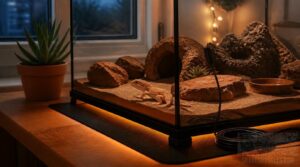
Not every under-tank heater fits apartment life, especially when lease rules, outlet access, and enclosure size all factor into the decision.
If you’re weighing wattage against your lease’s electrical limits, this guide to choosing thermostats for small apartments breaks down which models actually suit tight, rental-friendly setups.
Some options work best for small setups, others shine when you need finer temperature control or more coverage.
Here’s a rundown of five solid picks, each suited to a different kind of apartment reptile setup.
Compact Adhesive Heat Mats
When space is tight, sticking a mat under the tank just makes sense. Adhesive layer bonding creates a moisture-resistant seal on smooth, non-porous surfaces, unlike undersink or wallmounted setups.
- Verify substrate compatibility guide before applying
- Confirm heat output calibration matches enclosure size
- Test temperature uniformity testing across the surface
- Skip textured floors; bonds fail there
Point-of-use simplicity beats tankless complexity for one glass enclosure. Researchers have even explored bioinspired heat flux modulation in squid-skin-like materials, showing how changing surface patterns can help manage heat transfer more efficiently.
Reusable Nonadhesive Heat Pads
Renters wary of sticky residue on flooring have another option: nonadhesive pads that rest under the enclosure with no glue involved.
| Feature | Benefit |
|---|---|
| No adhesive | Protects floors |
| Reactivatable | Extends lifespan |
| Modular grid | Custom coverage |
The silicone heat layer spreads warmth evenly, resists tearing, and wipes clean with mild cleaners, no residue left behind.
Thermostat-and-mat Bundles
Wiping down a mat is easy. Guessing at temperature isn’t, which is where thermostat-and-mat bundles earn their keep.
You get a moisture-resistant housing, a probe for precise temperature control, and often high/low temperature alarms. Place the probe near the warmest floor spot, set your target in Fahrenheit or Celsius, and the digital display does the rest. Genuine plug-and-play, no guesswork.
Low-wattage Heating Mats
Precision is great, but sometimes you just need gentle, steady warmth without cranking your electric bill. Low-wattage heating mats (5-10 watts per square foot) deliver minimal heat output for apartment safe heating.
- Energy efficiency: pennies per month
- Low power draw, safe for continuous use
- Gentle floor heating, no hot spots
Perfect for smaller enclosures where temperature control precision matters more than raw output.
Large-enclosure Heating Mats
A full-floor mat (60-200 watts) beats point-of-use pads when your bearded dragon’s tank spans several feet. Even heat distribution kills hot spots.
| Feature | Small Pad | Large Mat |
|---|---|---|
| Coverage | Partial | Full floor |
| Watts | 4-8 | 60-200 |
| Gradient | Uneven | Stable |
Pair with a thermostat, level substrate, and secured cords. Cost rises, but so does safety and control.
Are Under-Tank Heaters Apartment-Friendly?

Renting comes with real limits, and any heating setup you choose needs to respect walls, outlets, and lease agreements without causing a headache. Under-tank heaters tend to fit that lifestyle better than most alternatives, but "better" doesn’t mean perfect for every snake or every setup.
For corn snakes especially, pairing an under-tank heater with the right burrowing substrate matters, and this beginner’s guide to safe reptile handling covers how to check warm-zone temps without stressing your snake.
Here’s what makes them work, where they fall short, and when you’ll want to reach for something else instead.
Benefits for Apartment Snake Keepers
Ever tried heating a whole studio apartment just to warm one snake? Under-tank mats skip that waste entirely, warming the substrate directly for faster digestion and steady thermal gradients.
- Consistent basking zones without room-wide heat
- Quicker morning warm-ups
- Stable temps despite drafts
- Safe for pets sharing your space
That’s real control, easy installation, and apartment-bathroom-friendly setups without the guesswork.
Space and Noise Advantages
Small apartments punish anything bulky, and heat mats simply don’t take the bait. Their space-saving design sticks flat against the tank, freeing floor space landlords (and roommates) appreciate.
No moving parts means no motor hum, no rattling. Quiet heating mats deliver direct heat transfer with minimal electrical draw, ideal for thin apartment walls, light sleepers, and easy installation without disruptive noise.
Species and Enclosure Compatibility
Not every snake takes to belly heat the same way.
Ground dwelling species with broad floor contact benefit most, while arboreal species climbing toward branch-level warmth may barely feel it.
Glass and plastic enclosures conduct heat unevenly too, so material matters as much as species when judging species and enclosure compatibility for your setup.
Limitations of Belly Heat
Belly heat has a ceiling, and it’s worth knowing before you buy. Heat rises unevenly, leaving hot spots and cold patches across the floor, with real temperature instability if a draft sneaks under your enclosure. Deeper bedding warms slowly too.
Heavier-bodied species often can’t draw enough surface warmth, which is where overhead heating starts making sense.
When Overhead Heating Works Better
Tall enclosures change the math entirely. If your setup runs vertically instead of wide, overhead heating creates a natural top-down gradient that belly heat simply can’t reach.
Arboreal species, bioactive setups, and multi-tier tanks all benefit from this overhead heating comparison. Look for models with built-in thermostat compatibility and safety certifications, since apartment wiring and space savings still matter here too.
Choose The Right Size and Wattage
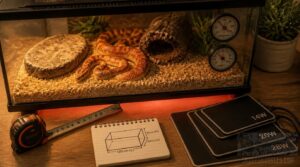
Sizing your heat mat isn’t a guessing game, and getting it wrong can mean a chilly snake or a scorched enclosure floor. The right choice depends on a few practical factors, from tank dimensions to what your enclosure is made of. Here’s what to weigh before you buy.
Match Mat to Enclosure
A few inches off in either direction can wreck your heat distribution, so measure your enclosure floor before buying anything.
- Length and width matching, edge to edge
- No overhang past the base
- Trimmable options for odd layouts
- Surface compatibility with glass, plastic, or wood
Precise mat sizing keeps placement accuracy tight and protects floors from hot spots or curling edges over time.
Heat One-third of Flooring
Sizing solved, now think placement. The Ideal Coverage Ratio is one third of the floor, not the whole tank. Full coverage wastes energy and removes cool retreats snakes need for a real Temperature Gradient Setup.
| Coverage | Result |
|---|---|
| 1/3 floor | Safe basking zone |
| Full floor | Overheating risk |
| Under 20% | Weak warmth |
| Back edge only | Uneven gradient |
| Centered pad | Wasted space |
Consider Enclosure Material
Coverage ratio only tells half the story. Your enclosure material changes how heat actually moves.
- Glass transfers heat slowly, needing longer warm-up
- Wood can warp, weakening seals
- Plastic turns brittle in cold rooms
- Acrylic resists impact but fogs over time
- Metal needs liners to prevent corrosion
Check Temperature Display readings after installation to confirm real output, not guesses.
Compare Wattage and Output
Material sets the stage, but wattage decides the show. Most under tank heaters for apartments run 5 to 40 watts, and that wattage to temperature ratio matters more than raw numbers.
A 15-watt mat on glass moves heat slower than the same wattage on thin plastic. Compare output against your enclosure, not just the box label, for real heat output efficiency.
Avoid Oversized Heating Mats
Bigger isn’t better here. Oversized mats create heat distribution risks, causing hot spots while straining your enclosure’s electrical load unnecessarily.
- Melted substrate ruining a beloved setup
- Breaker trips during winter’s coldest night
- Warped enclosure floors, costly repairs
- Uneven wear shortening your mat’s longevity
Choose mats matching your enclosure’s dry footprint. Safety cutoff features and proper fit prevent contact burns, preserving both temperature stability and your apartment’s electrical circuits.
Control Heat With a Thermostat
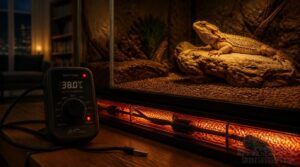
A heat mat without a thermostat is basically a stove with no dial, and that’s how enclosures overheat. Getting the temperature right isn’t a guessing game, it’s a system with a few key parts working together. Here’s what that system actually looks like, piece by piece.
Why Thermostats Are Essential
Plug a heat mat straight into the wall and you’re gambling. Mats don’t self-regulate, so temps climb unchecked, a real burn risk for snakes that can’t move off a hot spot fast enough.
A heat mat without a thermostat is a gamble, letting temperatures climb unchecked until a snake can’t escape the burn
A thermostat gives you precise control, comparing enclosure temps to your setpoint and cutting power before things overheat, protecting your pet and your rental.
Set Species-appropriate Temperatures
Dial your thermostat to match your reptile’s actual needs, not a generic guess.
Leopard geckos want a 90°F basking zone with cool side near 70-75°F. Small snakes prefer 80-90°F warm side, 70-75°F cool side.
This thermal gradient lets self-modulating behavior work naturally, your pet chooses its comfort, moving between zones as ambient regulation requires.
Position The Thermostat Probe
Your thermostat is only as smart as its probe placement. Slide the tip directly under the mat, flush against the enclosure floor, away from edges and drafts. Secure it with nonconductive tape, never resting loose on substrate. Keep it clear of water bowls. Accurate contact means your digital display and Fahrenheit/Celsius setting actually reflect reality, not guesswork.
Once your probe placement is dialed in, pair it with a properly sized enclosure using this boa terrarium size and setup guide to make sure temperature readings actually match your snake’s real-world environment.
Monitor With Digital Thermometers
Trust your gut? Not here. A dedicated digital thermometer confirms what your thermostat claims, since displays drift and probe placement matters twice over.
- Catching a silent hotspot before it burns
- Spotting a cold zone before your snake stops eating
- Confirming temperature accuracy within half a degree
- Sleeping better knowing your readings aren’t guesswork
Look for backlit displays, alert thresholds, and simple calibration methods for lasting reliability.
Prevent Burns and Overheating
A mat without limits is a burn waiting to happen. Your thermostat is the real overheat protection, cutting power before floor temps climb past safe ranges. Add a thermal fuse or high limit switch as backup, and place the mat exterior-side only. Test surface temps with an infrared thermometer regularly. That’s dry-burn protection you can actually verify.
Install Under-Tank Heaters Safely
Picking the right mat is only half the job, since a poor setup can turn a safe heater into a real hazard. Renters especially need to think beyond wattage, from lease terms to floor protection to where those cords actually run. Here’s what to check before you plug anything in.
Check Apartment Lease Rules
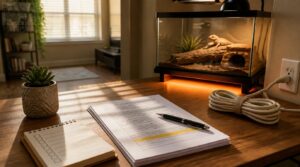
Before you plug anything in, pull out your lease and check the pet policy section, since some buildings ban reptiles outright regardless of enclosure size.
Look for language about unauthorized alterations, and if you’re subletting, confirm approval covers your setup too. Get landlord permission in writing when required, note maintenance request procedures for repairs, and review security deposit terms covering wall damage or outlet wear.
Create Airflow Beneath Enclosures
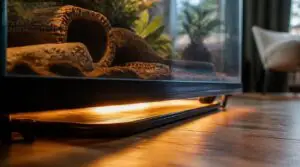
Once your lease checks out, give the mat room to breathe. Leave a 6 mm vent gap around the enclosure’s feet so air circulates underneath instead of pooling as trapped heat.
Skip rugs or thick padding. A slim, low-friction tray keeps airflow channels open, protects your floor, and stops hotspots before they start.
Protect Floors and Furniture
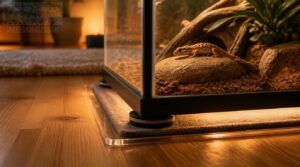
Airflow keeps hotspots away, but the mat still meets flooring directly. Slide a felt pad or clear vinyl tray underneath for cushioning.
- Adhesive felt pads for wood floors
- Rubber pads for tile, no residue
- Washable rugs to trap dirt
- Furniture coasters under enclosure legs
Wipe spills within 10 minutes and vacuum grit regularly. This point-of-use protection prevents warping and keeps rentals damage-free.
Route Cords Safely
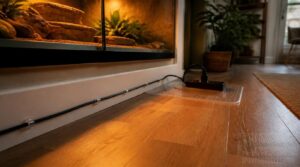
Once the tray’s down, tackle the cord itself. Run it along baseboards, not across walkways, and secure it with cable clips every 12-18 inches.
| Hazard | Fix | Why It Matters |
|---|---|---|
| Foot traffic | Baseboard routing | Prevents tripping |
| Tugging | Strain relief devices | Protects connectors |
| Spills | Cord protection mats | Blocks moisture damage |
Lift plugs off the floor. Safe routing means fewer accidents.
Test Temperatures Before Use
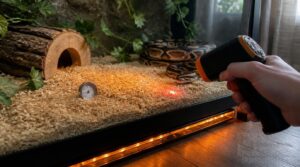
Don’t power anything on and walk away. Calibrate your thermometer first, then place it right on the floor where your snake beds down, checking sensor placement against your hottest zone.
Log readings every 15 minutes for two hours. This heat distribution check confirms stability and catches self-modulating quirks before they cause burns.
Compare Costs, Efficiency, and Convenience
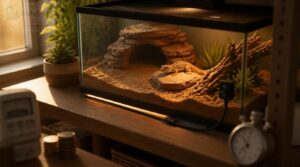
Buying the mat is just the starting cost, not the whole picture. Between electricity draw, replacement timelines, and whether a thermostat is bundled in, the real price tag looks different for every setup. Here’s how the numbers and the day-to-day convenience actually stack up.
Heater and Thermostat Costs
Budget matters here: a basic adhesive mat runs $15 to $60, while thermostat bundles add real value at $40 to $90. DIY skips the $100–$200 professional install fee entirely.
Compare that to tankless, point-of-use, or mini-tank water heaters (often 120V, sometimes self-modulating), where labor alone can hit hundreds.
Replacement thermostats cost $20 to $60 later.
Monthly Electricity Consumption
Since wattage doesn’t equal actual cost, a small adhesive mat pulls just 5 to 15 kWh monthly, while uncontrolled belt-style mats hit 60 kWh.
Ambient room temperature swings that number fast, apartments running cooler mean longer cycles.
Thermostat cycling efficiency cuts continuous operation cost by 20 to 50 percent, so you’re often looking at just a few dollars monthly, not twenty.
Adhesive Versus Reusable Designs
Stick or snap? That’s the real question here. Adhesive mats peel-and-stick fast, no hardware needed, but edges lift after heat cycles. Reusable clip-in designs cost more upfront yet clean easily and protect surfaces long-term.
- Quick install
- No residue
- Better heat distribution
- Lower waste
For renters wanting space-saving, point-of-use warmth without commitment, reusable wins.
Maintenance and Replacement Lifespan
How long will your heater actually last? Adhesive mats hold strong for 18 to 36 months before grip fades. Reusable pads run 24 to 60 months with regular cleaning.
Watch for uneven warmth or cool spots, both signal replacement time. Pair any mat with a thermostat, since steady cycling prevents element wear and stretches lifespan considerably.
Best Options for Renters
Renting shouldn’t mean skipping proper heat. Your best bet combines reusable heat pads with portable thermostat control, giving you a true renter’s solution: no damage, no drilling, just non-damaging adhesives or repositionable pads.
This lease-friendly installation works as a temporary heating solution you can pack up at move-out. It’s space-saving, point-of-use, and keeps safety features like overheat shutoff intact wherever you land.
Frequently Asked Questions (FAQs)
Are under tank heaters good?
Yes, when paired with a thermostat. They deliver energy efficiency, low cost, and safety features like self-limiting heat, plus easy installation, a space-saving footprint, and reliable warmth for point-of-use basking spots.
What is the most efficient way to heat a small apartment?
Think of your apartment as a leaky bucket: patch the holes first. Seal drafts, then pair a heat pump system with zone heating and a smart thermostat for the most energy efficient heating you’ll find.
What type of heater do apartments use?
Apartments often rely on central heating systems, electric baseboard heaters, or ductless mini splits, while hot water often comes from tankless or minitank units.
Hydronic radiant floors and heat pump units appear in higher-end, space-saving apartment bathrooms too.
How warm do under tank heaters get?
It’s all about finding the sweet spot: most mats hit 82 to 100°F at the surface, but wattage and a thermostat determine whether that heat stays safe or climbs too high.
How long do under-tank heaters take to warm up?
Most mats reach 10 to 30 minutes for full warm-up, depending on wattage, enclosure size, and substrate density. Higher-wattage mats and built-in thermostats speed things up, while cool rooms and thick substrate slow that frustrating wait down.
Can under-tank heaters be used with glass terrariums?
Yes, but glass conducts heat unevenly, so substrate insulation and a secure adhesive bond matter. Add a thermostat with proper probe placement, watch the temperature display, and keep moisture protection in mind near any electrical components.
Do under-tank heaters work during power outages or surges?
The safety gadget protecting your snake goes dark exactly when you need it most. Under tank heaters cut off during power outages; surge protectors guard against voltage spikes but won’t restore power, so backup power options like generators matter.
Is it safe to layer substrate over the heater?
Only if you respect substrate thickness limits and keep airflow underneath, use nonflammable materials, place your thermostat probe away from the mat, and check often for hot spots or warping before trusting the setup.
Can under-tank heaters be moved between different enclosures?
Technically portable, practically fussy: enclosure surface compatibility and heat transfer efficiency shift with each move, so relocating a portable heat source often means thermostat recalibration for safe reptile heating rather than simple plug-and-play convenience.
Conclusion
Think of belly heat like a good pair of socks: unglamorous, but it’s what keeps the whole system comfortable from the ground up.
The right under tank heaters for apartments won’t singe your floors or spike your electric bill, provided you pair them with a thermostat and respect the one-third rule.
Your snake gets its gradient, your landlord gets an undamaged unit, and you get to stop worrying every time the mat clicks on.