This site is supported by our readers. We may earn a commission, at no cost to you, if you purchase through links.
Your bearded dragon’s cage reads 40% humidity on the dial. Your phone’s weather app says the room sits at 25%. Something’s lying to you, and it’s probably that analog needle.
Cheap hygrometers drift 2-3% every month, quietly wrecking your humidity gradient while you trust a number that stopped being true weeks ago. That’s not a minor inconvenience. For species prone to respiratory infections or shedding trouble, bad data means real harm.
The digital vs analog humidity gauge for reptiles debate isn’t about gadgets and gimmicks. It’s about whether you’re actually managing your enclosure, or just guessing with extra steps. Here’s what separates a gauge you can trust from one that’s setting you up to fail.
Table Of Contents
Key Takeaways
- Analog gauges drift 2-3% every month and swing 5-10% off true readings, so that "trusted" dial may be lying to you weeks before you notice.
- Digital hygrometers hold accuracy within 1-2% RH and respond in seconds, letting you catch dangerous humidity spikes from misting or heat lamps before they harm your reptile.
- You should run a quarterly salt test calibration (using a damp salt slurry to hit a known 75% RH reference) on any gauge, digital or analog, to catch drift before it turns into a shedding or respiratory problem.
- Bigger enclosures need multiple sensors placed by zone, since one reading can’t capture the different humidity levels in your warm side, cool side, and humid hide.
Digital Vs Analog Reptile Humidity Gauges

Your reptile’s health hinges on this one gauge. Get it wrong, and you’re guessing blind. Here’s exactly how digital and analog stack up, point by point.
For a deeper breakdown of which type actually holds up in a humid terrarium long-term, check out this guide to choosing reptile thermometers for humidity control.
How Each Gauge Measures Humidity
Ever wonder why your dial gauge lags while your digital one updates instantly? It’s mechanical transduction versus capacitive sensing. Hair elements physically stretch with moisture; digital sensors detect substrate changes electronically.
| Type | Method |
|---|---|
| Analog | Hair/foil expansion |
| Digital | Capacitive shift + dew point calc |
Mechanical inertia slows analog. Digital adds temperature compensation for precision. Digital sensors rely on capacitive humidity sensing technology to detect tiny shifts in electrical capacitance as moisture levels change.
Accuracy and Response Time
Numbers don’t lie, and here they’re brutal. Digital hygrometers hold 1-2% RH accuracy; analog gauges swing 5-10%, drifting 2-3% monthly.
| Type | Response Time |
|---|---|
| Digital | Seconds |
| Analog | Minutes |
| Digital | 0.1% resolution |
| Analog | 5% increments |
| Analog | 15-20% hourly swings |
Misting your enclosure? Digital catches it instantly. Analog needles just sit there, lagging.
Readability and Monitoring Features
Speed matters, but can you actually read the thing at 2 AM? Digital LCDs show dual temperature and humidity readouts with backlit screens for night checks. Analog dials demand direct viewing angles or you’ll misjudge by 10%.
| Feature | Digital | Analog |
|---|---|---|
| Alerts | Programmable alarms | None |
| Memory | Min-max tracking | None |
Wireless monitoring seals the deal for serious keepers.
Power and Maintenance Needs
Wireless alerts won’t help if the batteries die mid-shed. Digital gauges run on LR44 cells lasting 3-12 months, some rechargeable USB units stretch 30-60 days per charge. Battery replacement runs $2-5 yearly.
| Type | Maintenance |
|---|---|
| Digital | Battery swap, screen wipe |
| Analog | Screw calibration, wear checks |
Analog needs zero power but demands quarterly recalibration with eyeglass screwdrivers. Skip that, and readings drift fast.
Price and Long-Term Value
A $7.99 analog gauge looks cheap. Check the five-year math before celebrating.
| Type | Initial Cost | 5-Year Total |
|---|---|---|
| Analog | $7.99 | ~$8.00 |
| Basic Digital | $9.99 | ~$109.89 |
| Rechargeable Digital | $11.99 | ~$11.99 |
Battery costs add up fast on disposables. Skip that trap: pick rechargeable digital, or accept analog’s accuracy within 3-5% tradeoff for real savings.
Which Humidity Gauge is More Accurate?
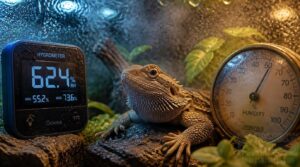
Accuracy isn’t a nice-to-have here—it’s what stands between a healthy reptile and a respiratory infection. Numbers matter, and so does knowing why they drift, what to do about it, and how fast your gauge actually catches trouble. Here’s what separates a gauge you can trust from one that’s quietly lying to you.
If you’re still dialing in your setup, this step-by-step boa constrictor thermostat calibration guide walks through catching those drift zones before they become a real problem.
Accuracy isn’t optional—it’s the line between a healthy reptile and a respiratory infection
Typical Digital Accuracy Range
Digital gauges usually hold accuracy within 3-5% RH, tight enough for real husbandry decisions. High-end units narrow that to 2-5% between 20-80% humidity, thanks to temperature compensation correcting sensor readings on the fly.
Push toward extremes, though, and error widens to 5-8% RH. Battery voltage below 3.3 volts degrades readings too. Manufacturer tolerances allow up to 2% RH offset between identical units.
Sensor Drift Over Time
Every sensor ages. Polymer coatings wear, adhesives break down, and thermal cycling shifts baseline readings, so sensor drift creeps in even on quality units.
Temperature swings compound the problem: imperfect compensation lets errors stack. High humidity accelerates polymer aging too.
Left unchecked, drift blows past accuracy within 3-5%. That’s why a strict calibration schedule matters more than the price tag ever will.
Salt Test Calibration Method
Want lab-grade proof your gauge isn’t lying? Mix a salt slurry (sandy, not runny) in a bottle cap, position the sensor 1-2 cm away, and wait 10-15 minutes for stabilization. Compare against the known reference humidity, roughly 75% for ammonium sulfate.
Run alternate salt verification with potassium nitrate near 11% RH. This salt test calibration exposes real sensor accuracy, digital or analog, no guesswork required.
Detecting Rapid Humidity Changes
A misting event can spike RH in seconds. Miss it, and you’re blind to real risk.
Response speed comparison matters here: fast digital probes catch swings under 2 seconds, while sensor lag on slow units masks danger. Boost data logging frequency to 1 Hz, use microclimate probe placement near substrate, and enable real-time alerts. Watch for sensor drift and apply temperature compensation, especially with wireless monitoring options.
Choosing Gauges for Reptile Enclosures
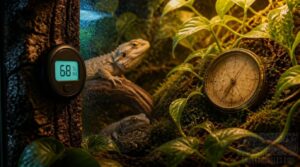
Not every gauge fits every setup. Your species, your enclosure, your microclimates—they all change the equation. Here’s what actually matters when you’re picking one.
Match Species Humidity Requirements
No single gauge fits every terrarium. Match the device to the species, not the other way around.
- Crested geckos: 60-80% RH
- Leopard geckos: 30-40% RH
- Green tree pythons: 70-90% RH
- Ball pythons: 50-60% RH
- Fat-tailed geckos: 30-50% RH
Tropical and arboreal species demand tighter accuracy. Desert dwellers tolerate wider swings. Guess wrong, and shedding problems follow.
Consider Enclosure Size
Species matched, now size the setup. A 20-gallon starter tank runs fine with one centrally located gauge. Push past 75 gallons, though, and one reading lies to you.
| Enclosure Size | Gauge Strategy |
|---|---|
| Under 20 gal | Single analog gauge |
| 20-50 gal | One digital, central |
| 50-75 gal | Add second sensor |
| 75+ gal | Multiple probes required |
| Any size | Analog for simple setups |
Monitor Multiple Microclimates
One gauge, one number, zero truth for big enclosures. Warm hide, cool corner, misted zone: each holds its own humidity. Build a zone mapping strategy with staggered probes. Multi-zone alerts catch drops before shedding fails.
- Track warm side, cool side, hide zones separately
- Set humidity alert alarms per zone
- Use data correlation analysis to spot patterns
- Sync calibration across all sensors monthly
Compare Mounting Options
Multiple probes need mounts that won’t budge. Suction cup mounting grips smooth glass tight but slips on mesh or textured walls. Magnetic mounts solve that, clinging to metal screens tool-free. Adhesive backing and Velcro backing suit permanent spots; fuzzyfastener backing offers quick swaps.
Clip and stand methods and remote probes round out multi-surface compatibility for staggered zone tracking.
Prioritize Alerts and Memory
A gauge mounted right means nothing if it can’t warn you. Alarm systems catch trouble while you sleep.
Prioritize these features:
- Zone-specific alerts for basking vs. humid hide
- Min-max memory tracking daily extremes
- Adjustable thresholds for day/night cycles
- Humidity spike detection within seconds
- CSV data export for trend review
Cheap gauges skip these. Don’t.
Placement, Calibration, and Replacement Tips
A great gauge means nothing if it’s mounted wrong or never checked. Placement, calibration, and timing all decide whether your readings actually mean anything. Here’s exactly where to put your sensor, how often to test it, and when to finally toss it.
Place Sensors on Cool Side

Wrong spot, wrong data. Sensor placement isn’t guesswork, it’s humidity gradient mapping.
Set your calibration spot on the cool side, matching temperature gradient alignment across the enclosure.
| Zone | Purpose |
|---|---|
| Cool side | Primary reading |
| Warm side | Comparison |
| Humid hide | Verification |
| Canopy (arboreal) | Activity zone |
This microclimate check keeps readings tied to where your reptile actually lives.
Avoid Heat and Misting
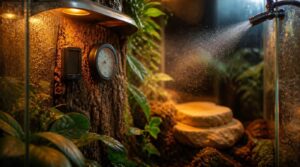
Heat lamps and misters wreck accuracy fast. Keep gauges 12-18 inches from misting nozzles, closer and readings spike 15-25% high. Direct spray avoidance matters most: probes in the spray path show 40-60% false spikes.
Skip substrate zones (evaporation skews data) and add heat shield placement near lamps. Sensor protection isn’t optional, it’s survival.
Check Readings Regularly
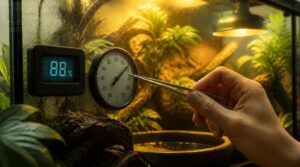
Consistency beats intensity here. Run daily checks the first two weeks after setup, then settle into weekly monitoring once baselines stabilize.
Compare morning versus evening readings for your 24-hour average. If an alarm sounds, verify with a second sensor within five minutes, log the event, and adjust misting fast.
Track weekly trends. Drift shows up before failure does.
Recalibrate Gauges Quarterly
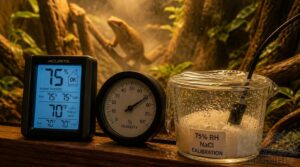
Every gauge drifts. Digital sensors slide 3-4% off true readings after three months, and low humidity dries electrodes until they overreport.
Run the salt solution method quarterly: damp (not dissolved) salt sealed with your probe for six to eight hours targets 75% RH. Adjust or log the offset. Time it with seasonal shifts, since winter heat and summer spikes both throw sensor accuracy off fast.
Know When to Replace
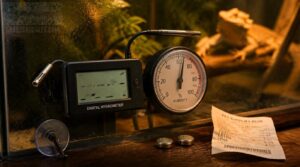
A dead gauge lies. Watch for erratic readings, blank screens above 90% RH, or numbers stuck outside 20-90%.
- Battery swap first (LR44 or LR1130)
- Physical damage: bent probes, detached suction cups
- Firmware glitches: won’t switch °F/°C
If problems persist, file a warranty claim with proof of purchase before replacing outright.
Top 6 Reptile Humidity Gauges
Theory only gets you so far. At some point you need real gauges, tested and ranked. Here are six options worth your money, from budget analog to precision digital.
1. Fluker’s Digital Thermometer Hygrometer
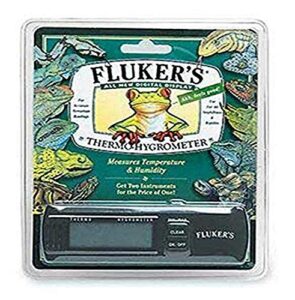
One gauge, two readings, zero guesswork. Fluker’s combo unit shows temperature and humidity on a single large digital display, updating in real time so you’re never chasing stale numbers.
It reads humidity from 10% to 99% RH and temp from 32°F to 122°F, with MAX/MIN memory tracking extremes since your last reset. Mounts with adhesive, no tools needed.
Watch for it though: some keepers report readings drifting 5-10% off and temps skewing by 3 degrees.
| Best For | Reptile and amphibian keepers who want a simple, all-in-one way to keep tabs on temperature and humidity in their terrarium or tank. |
|---|---|
| Measurement Type | Temperature & Humidity |
| Display Type | Digital |
| Power Source | Not specified |
| Mounting Method | Not specified |
| Unit Count | 1 Count |
| Primary Use | Reptile enclosures |
| Additional Features |
|
- Combines temperature and humidity monitoring into a single, easy-to-read digital display
- Compact design (just 4 inches) fits neatly into most enclosure setups
- Helps maintain consistent basking and ambient conditions for reptiles and amphibians
- Humidity readings can bounce around or be off by 5–10%
- Temperature readings may be inaccurate by about 3 degrees
- Some units have reported durability issues, including early failure
2. Zoo Med Analog Thermometer Humidity Gauge
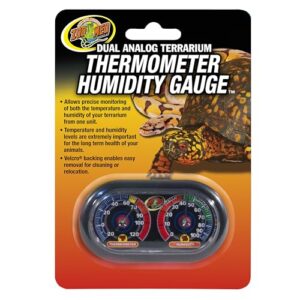
Skip the batteries entirely and Zoo Med’s analog gauge still gets the job done. Dual dials track temp and humidity with no electronics to fail, mounted via fastener backing on the glass.
Humidity reads 0-100% RH, temp spans 20°F to 120°F, plenty for bearded dragons or geckos. Fine print: expect ±5-10% error, coarser markings, and parallax skew if you’re not viewing it straight-on.
| Best For | Reptile and amphibian keepers who want a simple, no-battery way to keep an eye on temperature and humidity in terrariums, vivariums, or incubators. |
|---|---|
| Measurement Type | Temperature & Humidity |
| Display Type | Analog |
| Power Source | Not specified |
| Mounting Method | Velcro backing |
| Unit Count | 1 Count |
| Primary Use | Reptile enclosures |
| Additional Features |
|
- Dual dials let you monitor both temperature and humidity from one compact unit
- No batteries or electronics required, so there’s nothing to fail or replace
- Velcro backing makes it easy to mount, remove, and reposition as needed
- Humidity readings may need manual calibration to stay accurate
- Analog dials are less precise than digital gauges, with possible parallax skew
- Adhesive backing can weaken over time, requiring reapplication
3. REPTI ZOO Digital Thermometer Hygrometer
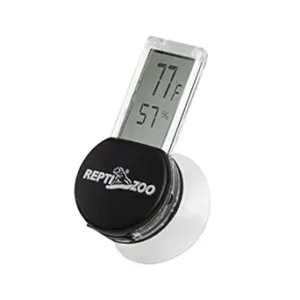
Want electronics without the guesswork? REPTI ZOO’s digital hygrometer covers 20-99% RH and 14°F to 122°F, with ±5% humidity accuracy beating any analog dial.
If you keep more than one enclosure, this guide to reptile humidity gauges for multiple tanks shows how to track each habitat separately.
Dual suction cups mount front or side glass. The LCD updates every 5 seconds and includes a spare battery, good for roughly a year combined.
Downside: suction cups loosen over time, and it’s splash-resistant, not waterproof. Submerge it and you’re buying a replacement.
| Best For | Reptile owners who want an easy way to keep tabs on both temperature and humidity across different zones of their terrarium. |
|---|---|
| Measurement Type | Temperature & Humidity |
| Display Type | Digital |
| Power Source | Battery |
| Mounting Method | Suction cup |
| Unit Count | 1 Count |
| Primary Use | Reptile enclosures |
| Additional Features |
|
- Dual suction cups let you mount it on the front or side glass, wherever works best
- Comes with a spare battery, giving you roughly a year of combined use
- Digital LCD display makes it simple to monitor both hot and cool sides for a proper gradient
- Suction cups can loosen or fail over time, so the unit may slip off the glass
- It’s only splash-resistant, not waterproof, so submersion can cause damage
- Some users report inconsistent battery life, with power draining faster than expected
4. Zoo Med Digital Thermometer Humidity Gauge
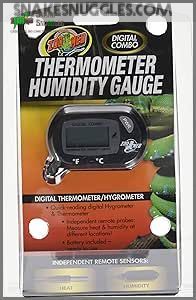
Suction cups loosen. Zoo Med skips that headache with dual 39-inch probes you tape, wrap, or wedge wherever needed.
The temp probe is fully waterproof, dunk it in a water feature without frying anything. Humidity sensor stays dry-only, 0-100% range, paired on one LCD showing both readings plus min/max.
Runs on one LR44 battery, users report 3+ years of life. Catch: wet humidity probes read falsely high, and the screen’s tough to see in low light.
| Best For | Reptile and amphibian keepers who need reliable temperature and humidity tracking for enclosures like leopard gecko, bearded dragon, ball python, or dart frog setups (and even chicken incubators). |
|---|---|
| Measurement Type | Temperature & Humidity |
| Display Type | Digital |
| Power Source | LR44 Battery |
| Mounting Method | Suction cups |
| Unit Count | 1 Count |
| Primary Use | Reptile enclosures |
| Additional Features |
|
- Waterproof temp probe and dual-probe design let you monitor temperature and humidity separately and accurately
- Long battery life, with users reporting 3 years from a single LR44 battery
- Easy to mount without relying on suction cups, since the long probe cords can be taped, wrapped, or wedged into place
- Humidity readings can skew inaccurately high if the probe gets wet
- Display is hard to read in low light or from certain angles
- Suction cups included for tank mounting may loosen or fail to stick over time
5. TempPro TP49 Digital Hygrometer Indoor Thermometer
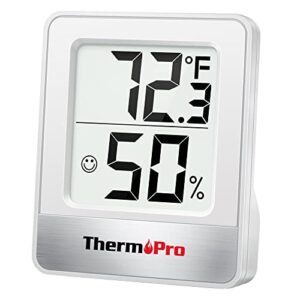
No probes here. TempPro reads humidity right at the display, 10-99% RH, ±2-3% accuracy. That NTC sensor also nails temperature within ±1°F.
The face icon comfort system shows dry, comfy, or wet air at a glance, no math required. Big bold digits read clean from across the room, even without backlight.
Mount it three ways: tabletop, magnetic, or wall hook. One catch, some units report display failure around two months in.
| Best For | Anyone wanting a quick, no-fuss way to check comfort levels at home—think nurseries, bedrooms, greenhouses, or even the guitar room. |
|---|---|
| Measurement Type | Temperature & Humidity |
| Display Type | Digital |
| Power Source | Battery |
| Mounting Method | Tabletop/Magnetic/Hanging |
| Unit Count | 1 Count |
| Primary Use | Home/Multi-use |
| Additional Features |
|
- Face icon comfort system gives an instant read on dry, comfy, or wet air, no calculations needed
- Big bold digits are easy to read from across the room, even without backlight
- Flexible mounting options (tabletop, magnetic, or wall hook) make it easy to place anywhere
- Some units report display failure after about two months of use
- Included battery may arrive defective or already depleted
- Below 30% RH, the "unhappy face" may pop up even in climates where that’s normal, which can be misleading
6. Inkbird ITH-10 Digital Thermometer Hygrometer
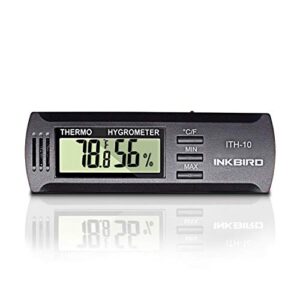
Thin enough to vanish inside any enclosure, the ITH-10 measures just 3.9 x 0.39 inches and updates every 2 seconds. Range runs -5°C to 60°C and 30-90% RH, with ±1°C and ±5%RH accuracy, tight enough for tropical or desert setups.
One screen shows temp and humidity together, no toggling required. Min/max memory holds even after power loss.
The catch? A single CR2 battery lasts 6-12 months, and replacing it means unscrewing the back panel. Small price for solid data.
| Best For | Musicians, hobbyists, and collectors who need a slim, easy-to-read thermometer-hygrometer for guitar cases, humidors, or small display enclosures. |
|---|---|
| Measurement Type | Temperature & Humidity |
| Display Type | Digital |
| Power Source | AAA Battery |
| Mounting Method | Not specified |
| Unit Count | 1 Count |
| Primary Use | Instrument/Multi-use |
| Additional Features |
|
- Ultra-thin profile fits easily into tight spaces like instrument cases or humidors
- Combined display shows temperature and humidity at once, with min/max memory that survives power loss
- Wide operating range (-5°C to 60°C, 30-90% RH) suits both dry and humid climates
- Battery replacement requires unscrewing the back panel, making it less convenient than swap-and-go models
- CR2 battery is less common than standard AAA batteries, so backups may be harder to find
- Accuracy, while solid, isn’t adjustable if a unit arrives slightly out of calibration
Frequently Asked Questions (FAQs)
Can low humidity harm a reptiles shedding?
Like a snake shedding its old skin for new, growth demands the right conditions. Yes, low humidity harms shedding badly. It dries membranes, causing retained eye caps, stuck skin around toes, even infection risk.
Does humidity affect a reptiles eye health?
Yes. Low humidity dries mucous membranes, causing retained shed around the eyes.
High humidity invites respiratory infections that stress overall comfort.
Either extreme raises irritation risk, so keeping humidity in the correct species range protects both shedding and eye health.
What humidity range supports reptile immune function?
Miss this range and you’re gambling with your reptile’s life. Immune function peaks between 40 to 80 percent, species dependent. Below 40 dries mucous membranes; above 80 breeds fungal risk. Track it, don’t guess it.
Can heat lamps damage a digital hygrometer sensor?
Absolutely. Surface temps above 180°F can fry sensor components in minutes, and capacitive elements lose accuracy fast, deviating 15-20% once heat climbs past that mark. Keep gauges 12 inches from lamps to stay safe.
Should multiple gauges be used in one enclosure?
One gauge tells a story. Two gauges tell the truth. Cool side, warm side, humid hide, they’ll all read differently. Cover every microclimate so your reptile always finds the moisture it needs.
Conclusion
Picture that needle frozen mid-swing while your dragon’s lungs work overtime in air that’s actually bone dry. That’s the real cost of guessing.
The digital vs analog humidity gauge for reptiles question isn’t close: digital sensors give you precision you can trust, catching drift before it becomes a vet bill. Analog dials feel simple, but simple isn’t safe.
Calibrate quarterly, place sensors wisely, and let real numbers, not nostalgia, run your enclosure.