This site is supported by our readers. We may earn a commission, at no cost to you, if you purchase through links.
You peel back a curled scrap of shed and find another torn piece underneath it, then another. That scattered, confetti-like mess in the enclosure tells you something went wrong long before the skin ever loosened. A healthy shed comes off as one continuous sleeve, eyes caps and all, but a snake shed in pieces points to a breakdown somewhere in the process, whether that’s humidity, hydration, or skin health.
Dysecdysis rarely happens without a cause, and identifying which piece of the puzzle is missing makes the difference between a one-time fluke and a recurring problem. Understanding what normal shedding looks like first gives you the baseline to spot exactly where things derailed.
Table Of Contents
- Key Takeaways
- Why Did My Snake Shed in Pieces?
- What Does a Bad Shed Look Like?
- Check for Retained Shed Afterward
- Humidity Problems That Break Up Sheds
- Other Causes of Fragmented Snake Sheds
- How to Fix a Shed in Pieces
- Safely Handle Stuck Shed Skin
- How to Manage Retained Eye Caps
- When Bad Sheds Need Veterinary Care
- Prevent Your Snake Shedding in Pieces
- Frequently Asked Questions (FAQs)
- How many times a year does a snake shed its skin?
- Why doesn’t my snake shed in One Piece?
- What are the early signs that a snake is about to shed?
- Do snakes shed their skin in One Piece?
- How often do healthy snakes normally shed skin?
- Can stress cause a snake to shed poorly?
- Does diet or nutrition affect shedding quality?
- Is it safe to bathe a snake regularly?
- Can fragmented shedding affect a snakes growth?
- Conclusion
Key Takeaways
- A shed that comes off in scattered pieces instead of one whole sleeve almost always traces back to low humidity, poor hydration, or an unsuitable substrate, not just bad luck.
- Fixing the environment first (proper humidity gradient, a humid hide, and fresh accessible water) resolves most fragmented sheds before any hands-on intervention is needed.
- Retained skin around the tail tip or eye caps can cut off circulation or trap debris, so checking those spots after every shed and softening stuck patches with warm soaks or damp towels—never tweezers or forced peeling—protects your snake from real injury.
- If sheds keep fragmenting despite solid husbandry, or you see swelling, discharge, a darkened tail tip, or signs of mites and infection, it’s time to bring in a vet rather than keep troubleshooting at home.
Why Did My Snake Shed in Pieces?
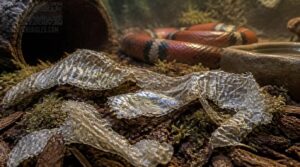
A shed coming off in pieces isn’t random bad luck; your snake’s body is telling you something specific went wrong. Healthy shedding follows a predictable process, and when that process breaks down, the reasons usually fall into a few clear categories. Here’s what’s actually happening beneath the surface.
If two sheds in a row come off incomplete despite good humidity, it’s worth reading up on why incomplete snake sheds happen and how to fix them before scheduling a vet visit.
Normal Versus Fragmented Shedding
A single ribbon versus a pile of scraps: that’s the real difference between healthy ecdysis and fragmented shedding. Normal sheds come off whole. Retained skin, torn edges, and stalled timelines signal trouble. Watch for:
A single ribbon versus a pile of scraps: that’s the real difference between healthy shedding and fragmented shedding
- Shed continuity assessment
- Shed texture comparison
- Shed duration tracking
- Eye cap retention
Poor husbandry practices and low humidity levels usually explain the tear. In a healthy shed, the mechanical shedding process allows the snake to peel off its old skin in a single continuous piece, so any breakage from that pattern is worth investigating.
How Healthy Snake Sheds Form
Before that ribbon slides free, biology does quiet work underneath. Fluid layer formation separates old keratin from fresh skin, lubricating the release. Pre-shed cues, dull color, cloudy eyes, appear right on schedule.
| Sign | What’s Happening |
|---|---|
| Dull skin | Fluid building |
| Cloudy eyes | Spectacle separating |
| Appetite drop | Energy redirected |
| Hiding | Vulnerability rising |
| Restlessness | Shed imminent |
What Dysecdysis Means
When that fluid layer never fully separates, you get dysecdysis: the clinical term for abnormal shedding, where skin can’t release in one continuous piece.
It’s shedding failure, a husbandry issue signaling that humidity levels, hydration, or skin health fell short.
The result is retained skin, patchy and incomplete ecdysis your snake can’t shake off alone.
What Does a Bad Shed Look Like?
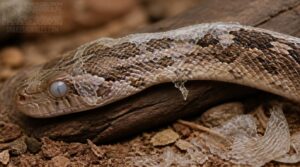
Once you know a shed went wrong, the next step is learning to spot it fast, before it turns into a bigger problem. A bad shed leaves clues on the skin itself, and those clues tell you exactly what your snake is dealing with. Here’s what to watch for.
Multiple Torn Shed Pieces
A healthy shed comes off in one continuous sleeve.
Multiple torn shed pieces signal a break in that process, usually from humidity dropping below 40%. Fragmentation often starts near the head, then scatters across the dorsal scales as the snake struggles to peel skin that’s already dried and stuck.
Rough, Papery Shed Texture
Run your fingers over a bad shed and you’ll feel the problem before you see it: a papery skin texture with jagged ridges instead of smooth continuity.
Keratin dries brittle when humidity levels drop, and rough surface interaction against cork bark tears it further. Keeled species show this worst.
- Jagged, crumpled edges
- Dull, cracked scale ridges
- Crinkled, tissue-like feel
- Uneven texture patches
Dry Skin Patches
Patchy scales tell their own story. Dry skin patches signal incomplete ecdysis, usually from low humidity levels disrupting fluid separation between old and new skin.
| Cause | Mechanism | Fix |
|---|---|---|
| Low humidity | Poor fluid separation | Humid hide |
| Dehydration | Reduced skin elasticity | Fresh water |
| Dry substrate | Pulls moisture out | Retain moisture |
Prolonged Shedding Duration
When shedding drags past two weeks, something’s gone wrong. Most snakes finish in 3 to 14 days, with ball pythons wrapping up in 3 to 7. Watch for:
- Cloudy eyes lingering past a week
- Skin cracking into papery fragments
- Restless rubbing without progress
Track cycles closely. Persistent delays warrant checking humidity levels and substrate moisture before assuming illness.
Check for Retained Shed Afterward
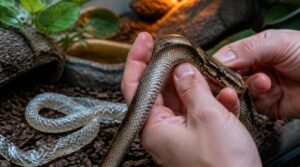
Once the shed comes off, your job isn’t quite done yet. A quick post-shed check tells you whether your snake actually got free and clear, or left something behind. Here’s exactly where to look.
For a full checklist of what to examine — eyes, belly scales, tail tip — these snake post-shed care tips walk you through every spot retained skin tends to hide.
Inspecting The Tail Tip
The tail tip hides trouble fastest. Run your fingers base to tip, feeling for a ridge: that’s retained shed. Check tail color, flexibility, and press-test for capillary refill; pale, stiff, or slow-refilling tissue signals constriction. Left unchecked, this cuts circulation entirely. Catch it early, before humidity levels and neglected substrate turn a minor snag into necrosis.
Checking Around The Eyes
The eyes tell their own story. Look for retained spectacles, dull or opaque caps sitting over vibrant new scales. Cloudy eyes should clear before shedding finishes; if not, that’s dysecdysis. Watch for head-rubbing or sudden shyness, classic behavioral eye changes signaling irritation. Check debris in the eye groove too, since trapped fragments invite infection.
Choosing a humidity-friendly substrate, like cypress mulch for balanced tank moisture, can make a huge difference in whether shedding goes smoothly around the eyes.
Examining Body Scales
Run your fingers along the flanks, tail base, and dorsal ridge. Retained patches feel papery against smooth scales or blunt keeled ridges. Scale texture analysis catches what eyes miss.
Watch for scale row counting irregularities near shed edges, dull ventral scales, or dulled pattern contrast. This scale integrity evaluation, paired with skin fold monitoring, flags fragmented shedding before it complicates.
Spotting Constricting Skin Rings
Distal points, tail tips, toes, and dorsal spikes, are where constricting rings form most, since circulation there’s already limited. Watch for dry, papery bands lighter than surrounding tissue, often with a "tourniquet" whitening.
Left unchecked, tail tip constriction cuts off blood flow within days, risking necrosis. Catching it early during shed removal checks prevents permanent loss.
Humidity Problems That Break Up Sheds
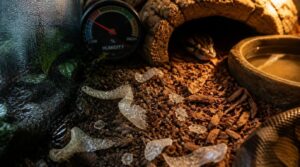
Humidity sits at the center of nearly every fragmented shed, so it’s worth getting right. Your enclosure setup, your hide placement, even your timing around shed cycles all play a part in whether that skin comes off in one clean piece. Here’s what actually moves the needle.
Species-Specific Humidity Targets
Because every species evolved under different skies, Species-Specific Humidity Targets matter more than any universal number. Humidity for Ball Pythons runs 65-70% pre-shed, while Tropical Snake Moisture Needs push toward 80%. Arid Species Dryness demands the opposite: hognoses shed cleanly near 40%.
- Ball pythons: 65-70%
- Tropical species: 80%+
- Desert species: 30-40%
- Corn snakes: 50%+
- Temperate species: 30-50%
Measuring Humidity Accurately
Knowing your target percentage means nothing without a reliable hygrometer. Digital models beat analog dials for accuracy, but require calibration against a salt solution monthly.
| Sensor Type | Best For | Accuracy Range |
|---|---|---|
| Digital capacitive | Daily monitoring | ±2-3% RH |
| Analog dial | Budget setups | ±5-10% RH |
| Dew point sensor | Precision breeding | ±1-2% RH |
Place sensors at breathing height, away from heat sources, for genuinely representative readings.
Excessive Enclosure Ventilation
That accurate hygrometer reading often exposes the real culprit: too much airflow. Excessive enclosure ventilation strips humidity fast, especially with screen tops or high-speed fans running unchecked.
Watch for:
- Vents positioned without baffles
- Front-to-back airflow across basking spots
- Screen tops with no partial covering
- Fans running continuously during shedding
- Low humidity despite regular misting
Adjusting vent placement and airflow direction protects your snake’s shedding cycle before it fragments.
Creating a Humid Hide
A plastic tub with a tight lid becomes your snake’s escape hatch from a dry, fragmenting shed. Layer damp sphagnum moss or vermiculite several inches deep, cut a snug, smooth entrance hole, and glue luffa strips inside for texture.
| Feature | Purpose |
|---|---|
| Damp substrate | Retains moisture |
| Luffa lining | Aids skin release |
| Sealed lid | Locks humidity in |
| Warm placement | Helps shedding |
Pre-Shed Humidity Adjustments
Once cloudy eyes or dulling scales signal the PreShed Phase, raise humidity 10-15% above baseline and hold it for 7-10 days. Your Humid Hide with damp sphagnum moss should sit near 80% RH.
Verify readings with a calibrated hygrometer for humidity measurement accuracy, then taper back to normal over three days once eyes clear.
Other Causes of Fragmented Snake Sheds
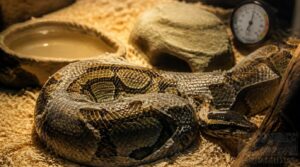
Humidity isn’t the only culprit behind a shed that comes off in pieces. Your snake’s hydration, substrate, skin condition, and overall health all play a part too. Here’s what else you’ll want to check.
Poor Hydration and Water Access
Water isn’t just for drinking. Snakes soak to hydrate skin from the outside in, so a bowl placed off the beaten path gets ignored, leaving levels untouched and skin wrinkled.
Give yours a stable, appropriately sized bowl near a hide, kept clean daily. Watch for tongue-flick marks, your proof they’re actually drinking.
Unsuitable, Dry Substrate
Substrate does double duty as flooring and humidity reservoir, and aspen fails the second job badly. It dries out fast, generates dust, and offers no moisture retention, so skin dehydrates and eye caps trap debris.
- Coconut husk holds moisture 3-4x longer
- Cypress mulch buffers humidity swings
- Aspen dries within hours
- Dust irritates airways and eyes
- Rough dry texture tears fragile skin
Swap it out.
Scars and Skin Injuries
Old scars don’t stretch or slough like healthy skin, they’re fibrous tissue laid down after resolution healing, and that mismatch physically blocks shed removal.
| Scar Type | Effect on Shedding | Action |
|---|---|---|
| Hypertrophic | Traps skin | Monitor |
| Keloid | Blocks release | Vet check |
| Contracture | Restricts movement | Assess |
| Adhesion | Sticks layers | Evaluate |
Skin lesion assessment matters here, persistent trouble warrants scar treatment options beyond home care.
Mites and Skin Infections
Ever notice tiny black flecks in the water bowl? That’s often Ophionyssus natricis, the snake mite, and heavy infestations cause dermatitis, itching, and dysecdysis. Fungal culprits like Ophidiomyces and bacterial scale rot create similar barriers.
Quarantine new snakes 60 days, disinfect enclosures with bleach, and treat promptly with vet-guided topical or parenteral options before fragmented shedding becomes routine.
Underlying Health Problems
Mites and scale rot aren’t the only culprits hiding under bad sheds. Respiratory infections, septicemia, nidovirus, and Inclusion Body Disease all disrupt the hormonal signals your snake needs for a clean molt.
Parasitic infections and nutritional deficiencies drain resources too, leaving skin brittle and prone to tearing.
If husbandry looks perfect but sheds still fragment, you’re likely facing a systemic health issue, not an environmental one.
How to Fix a Shed in Pieces
Once you’ve ruled out the usual suspects, it’s time to actually fix the problem instead of just diagnosing it. Your snake needs a clear path back to normal, healthy sheds, not just a list of what went wrong. Here’s exactly what to do, step by step, starting with the enclosure itself.
Correcting Humidity First
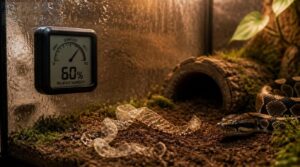
When a shed comes apart in pieces, humidity is the first thing you fix, not the last. Check your hygrometer at snake height, then adjust ventilation and substrate moisture to hit species-appropriate targets, generally 50-70% for most snakes. Correcting this baseline resolves most fragmented shedding before you attempt any physical intervention.
Offering a Humidity Chamber
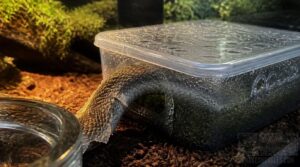
When ambient humidity alone isn’t cutting it, build a humidity chamber: a clear, ventilated container half-filled with damp sphagnum moss, entrance hole on top. Squeeze-test the moss for dampness without drip.
Size it so your snake curls comfortably but snugly, and place it near the water bowl on the enclosure’s warm side for a localized microclimate supporting proper skin sloughing.
Providing Fresh Drinking Water
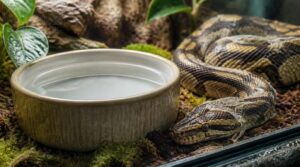
A humidity chamber solves half the equation, but internal hydration finishes the job. Make sure fresh drinking water stays available always, refreshed daily to prevent contamination.
Practical steps:
- Place the bowl where your snake reaches it without squeezing through gaps
- Check water temperature so it’s neither icy nor warm
- Choose a safe water source, treating tap water if needed
Rechecking The Snake’s Body
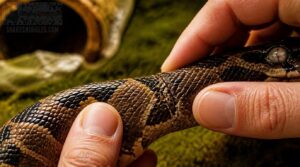
Run your fingers slowly down every inch of your snake’s body once humidity correction begins, feeling for raised skin rings or tight bands, especially near the vent and tail base.
Check scale texture for stiffness versus flexibility, note any dull patches signaling retained shed, and inspect eyes closely for eye cap retention before deciding your next move.
Avoiding Forced Shed Removal
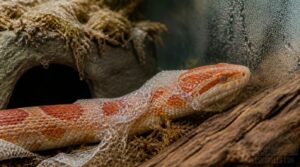
Peeling stuck skin off yourself feels productive, but it rarely is. Yanking dry patches tears live tissue underneath, undermining shed skin integrity and inviting infection.
Patience during shedding matters more than intervention. Correct humidity, offer a humid hide, and let the skin sloughing process finish on its own terms whenever possible. Supporting self-removal beats forcing it every time.
Safely Handle Stuck Shed Skin
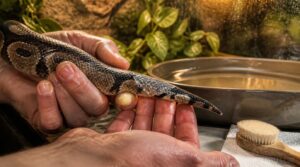
Retained skin won’t budge with force, and pulling at it risks tearing tissue your snake still needs. The safer route is patience, moisture, and a light touch that lets the skin release on its own terms. Here’s how to handle each step without causing harm.
Softening Retained Skin
Dry, cracked skin won’t budge on command. It needs moisture, patience, and the right technique.
- Soak in lukewarm water (85-90°F) for 10-15 minutes
- Add electrolyte drops for hydration support
- Mist body gently afterward
- Repeat daily if retained skin persists
Never rush retained shed removal. Soften first, always.
Using a Damp Towel
Sometimes a soak isn’t enough, and that’s where the damp towel technique earns its keep. Saturate a lint-free cloth with lukewarm water, wring out the excess, and knot your snake inside for 20-30 minutes on the enclosure’s warm side. The fabric’s texture aids gentle friction while trapped towel humidity control softens stubborn shed without oversaturating scales.
Supporting Gentle Self-Removal
Your job is to loosen the skin, not pull it. Once you’ve used the damp towel method or a supervised lukewarm soak, let your snake finish the job through natural movement against enclosure furniture.
Watch for:
- Rubbing against rough décor
- Slow, deliberate crawling
- Self-shedding without your hands touching skin
This patience prevents tearing that worsens fragmented shedding.
Protecting Delicate Scales
New scales underneath a fragmented shed are soft, thin, and easy to tear if you handle them wrong. Never scrape, tug, or use tweezers on stuck patches.
Stick to gentle shed assistance: damp cloths, soft-bristled brushes, or a supervised soak. Rough handling now risks scale injury, open wounds, or infection sites that undermine skin health for cycles to come.
Monitoring The Tail Tip
The tail tip deserves its own look every single shed cycle, since it’s the spot most prone to trapping retained skin. Grey, dull, or flaky tissue signals trouble.
Your post-shed checklist:
- Inspect within 24 hours
- Note color and texture
- Log humidity and duration
- Recheck at 48 hours if abnormal
Documentation reveals whether this is chronic or a one-off fluke.
How to Manage Retained Eye Caps
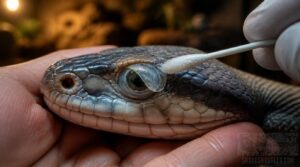
Retained eye caps call for a different kind of caution than skin stuck elsewhere on the body. Your snake’s eyes are far too delicate for the same handling tricks you’d use on a stubborn tail tip. Here’s what you need to know to spot the problem and handle it the right way.
Identifying Retained Eye Caps
How do you know a stuck eye cap when you see one? Look for eye cap cloudiness that lingers after the rest of the shed looks clean, then run a quick spectacle adhesion check.
| Sign | Normal Eye | Retained Cap |
|---|---|---|
| Clarity | Glossy | Dull, opaque |
| Edge | Smooth | Raised, stuck |
| Duration | Clears fast | Persists days |
Avoiding Tweezers and Peeling
Grabbing tweezers feels productive, but it’s the fastest route to a corneal scratch. Peeling at a stuck cap risks tearing the eye itself, not just the retained skin.
Avoiding tweezers and peeling matters here. Skip the instinct to pull. Instead, focus on gentle skin softening through moisture, which loosens the cap safely and lets it release on its own.
Improving Humidity Safely
So how do you loosen that cap without inviting mold? Bump humidity gradually using a hygrometer for real numbers, not guesswork.
- Mist the humid hide, don’t soak it
- Dampen moss instead of drenching it
- Balance ventilation to avoid stagnant air
- Check the humidifier’s placement away from bedding
- Watch surfaces daily for condensation buildup
Steady moisture, monitored closely, beats a sudden humidity spike every time.
Seeking Professional Removal
When soaking and gentle massage don’t budge that cap, it’s time to hand things over. Vets apply water-soluble ophthalmic gel to soften stubborn spectacles, sometimes using a surgical tool for full removal. Fluid therapy helps hydration throughout.
Afterward, watch for infection, keep nutrition solid, and maintain your humid hide. Professional removal beats forcing it every time.
When Bad Sheds Need Veterinary Care
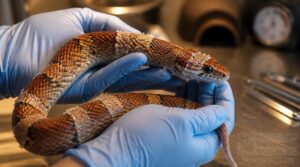
Most fragmented sheds resolve with better humidity and a little patience, but some don’t, and you need to know when home fixes stop being enough. Certain signs point to something your care routine can’t handle on its own. Here’s when it’s time to call in a vet instead of waiting it out.
Repeated Fragmented Sheds
One rough shed you fix with a humidity tweak. Three in a row means your husbandry practices need a real audit, not another quick patch.
- Recheck your humidity gradient and substrate moisture
- Confirm water bowl access stays consistent
- Review pre-shed monitoring notes for missed cues
- Log each shedding cycle for patterns
- Rule out illness if fixes don’t stick
Repeated fragmented sheds signal something systemic, not bad luck. Call your vet.
Persistent Retained Eye Caps
Two shed cycles pass and that cloudy spectacle is still there? That’s not a coincidence, that’s spectacle layer buildup, and humidity chambers alone won’t fix it anymore.
| Attempt | Result | Next Step |
|---|---|---|
| Humidity fix | Cap remains | Vet visit |
| Chamber soak | No release | Professional removal |
| Wait one more shed | Still stuck | Don’t wait again |
Swelling, Wounds, or Discharge
A shed piece stuck to raw skin isn’t cosmetic, it’s a doorway for infection. Watch for:
- Swelling around retained skin sites
- Purulent drainage, thick or milky
- Spreading redness or warmth to touch
Any discharge, worsening pain, or a friable, bleeding patch beneath old shed signals tissue damage requiring veterinary dermatology, not home soaking.
Darkened Tail Tip
A gray or darkened tail tip isn’t always an emergency, but stiff, brittle tissue is. That’s tail tip necrosis, caused by retained skin cutting off blood flow.
| Normal Pre-Shed | Dry Gangrene |
|---|---|
| Flexible, full | Hard, brittle |
| No sharp border | Clear demarcation |
| Reacts to hydration | Won’t rehydrate |
Once tissue dies, detachment and healing follow, but the window to save it closes fast.
Suspected Parasites or Infection
Fragmented shedding paired with lethargy, appetite loss, or visible specks near scales points to something living underneath the surface. Snake mites and Ophidiomyces (fungal skin disease) both sabotage normal ecdysis, while bacterial scale rot leaves discolored, foul-smelling patches.
Your vet will run skin scrapings or cultures to confirm, then prescribe targeted antiparasitics or antifungals. Quarantine any affected snake immediately, since these conditions spread fast through a collection.
Prevent Your Snake Shedding in Pieces
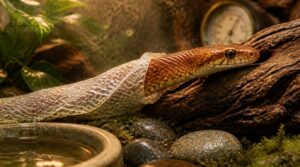
Fixing a bad shed matters, but stopping the next one from fragmenting matters more. Prevention comes down to a handful of habits you can build into your snake’s routine without much extra effort. Here’s what actually keeps sheds coming off clean, piece by piece.
Choose Moisture-Retaining Substrate
Ground layer matters more than most keepers assume. Coconut fiber holds roughly four pounds of water per dry pound, far outpacing Florida peat’s 0.81, giving you real substrate hydration balance.
- Coconut fiber or cypress mulch for water-absorbent bedding
- Sphagnum moss in humid hides for moss dampness control
- Aim for 50-65% water-holding capacity
Skip dry aspen. Substrate type directly dictates moisture retention at skin level.
Maintain a Humidity Gradient
Substrate moisture only works if it’s anchored by a real humidity gradient, not a flat number on one gauge. Keep the humid hide in a fixed spot, block stray airflow near it, and check readings at both zones.
Since warm air holds more moisture, watch temperature swings too. Stability here prevents shedding in pieces before it starts.
Provide an Accessible Water Bowl
Your snake needs a bowl large enough to curl up in completely, since soaking behavior only works when full-body submersion is possible.
- Choose ceramic or stainless steel for stability and bacteria resistance
- Size the bowl for full-body soaking, not just drinking
- Place it away from heat sources to avoid excess humidity
- Use low, wide rims for easy entry
- Change water daily
Track Every Shedding Cycle
Water access matters, but pattern recognition matters more. Keep a simple log: shed start date, completion date, humidity readings, and outcome (clean or fragmented).
| Data Point | Why It Matters |
|---|---|
| Cycle length | Flags deviations beyond 14 days |
| Humidity logs | Confirms proper humidity maintenance |
| Shed quality | Reveals fragmentation trends over time |
Digital tracking tools make this easy, turning guesswork into real shedding cycle optimization.
Watch for Pre-Shed Signs
Why wait for fragmented shedding when your snake already tells you what’s coming?
Watch for these pre-shed signs:
- Cloudy, bluish eyes
- Dull, hazy skin texture
- Reduced feeding response
- More hiding habits
- Defensive behavioral changes
That’s your cue: boost humidity control and hydration now, before the old skin locks in and tears apart during shedding.
Frequently Asked Questions (FAQs)
How many times a year does a snake shed its skin?
Juveniles shed every 4 to 6 weeks, chasing rapid growth, while adults slow to just 1-3 times yearly. Your snake’s age, species, and health all shape this rhythm, so track its cadence rather than expecting a fixed calendar.
Why doesn’t my snake shed in One Piece?
Getting a full, single shed comes down to humidity impact and hydration needs. Below 40% humidity, the fluid layer never forms properly, causing fragmentation, retained skin, and shedding problems tied to poor substrate or overall environmental husbandry.
What are the early signs that a snake is about to shed?
Like a curtain dimming before the final act, your snake signals its transformation early. Watch for cloudy eyes, skin dullness, appetite loss, increased hiding, and physical loosening, these opaque eyes and patchy skin mean shedding’s on its way.
Do snakes shed their skin in One Piece?
Not always. A healthy shed forms one continuous tube when skin elasticity and humidity align, but fragmented shedding, patchy shedding, and stuck shed happen when hydration or a humid hide falls short during the cycle.
How often do healthy snakes normally shed skin?
Fast growth rate drives frequent shedding: young snakes cycle every 4 to 6 weeks, while adults slow to every 1 to 3 months. Species shedding cadence, humidity, and hydration all shape a healthy shedding cycle.
If your snake seems to shed more often than expected, this guide to why snakes shed their skin so frequently explains what’s normal and when to check husbandry.
Can stress cause a snake to shed poorly?
Think of stress like sand in a machine’s gears. Yes, chronic stress disrupts hormonal shedding, adding to dehydration and poor husbandry. Reduce handling during ecdysis and keep a calm, stable environment to prevent shedding problems.
Does diet or nutrition affect shedding quality?
Absolutely, yes. Protein and vitamin C deficiencies weaken collagen and keratin, causing brittle, tearing skin. Calcium imbalance and irregular feeding disrupt shedding hormones. Correcting nutrition through supplementation and hydration resolves roughly 70% of chronic dysecdysis cases.
Is it safe to bathe a snake regularly?
Not like clockwork, more like a spa day reserved for real need: bathing isn’t required routinely. Use it for shedding help only, with shallow, warm soaks around 85°F for 10-15 minutes, then dry thoroughly.
Can fragmented shedding affect a snakes growth?
Yes, it can. Growth delay risks stem from dehydration, stress hormones suppressing appetite, and healing diverted energy.
Fragmented sheds also risk scar formation and constriction, so nailing your husbandry practices keeps ecdysis completion smooth, letting your snake’s growth stay on track, not stalled out.
Conclusion
You might think one rough shed isn’t worth this much fuss, but patterns matter more than single events. A snake shed in pieces is your snake’s way of flagging a fixable gap, whether that’s humidity, hydration, or health. Fix the environment, and the sleeve comes off whole again. Your snake isn’t broken. It’s just waiting on the right conditions to shed its old skin freely, completely, and on its own terms.