This site is supported by our readers. We may earn a commission, at no cost to you, if you purchase through links.

A mouse that’s too big can kill a hatchling snake, and one that’s too small leaves it hungry and stunted. I’ve seen regurgitation from a single oversized fuzzy, and recovery takes weeks.
The tricky part is that "what size mouse for hatchling" has two right answers: girth and weight, and they don’t always agree. A 12 g Ball Python, for example, should start on 0.6–0.9 g prey no matter how the mouse looks.
This guide breaks down both methods, plus measuring, thawing, and feeding schedules that keep hatchlings growing cleanly.
Table Of Contents
- Key Takeaways
- What Size Mouse Should Hatchlings Eat?
- How Do You Measure Hatchling Prey Size?
- Are Pinky or Fuzzy Mice Best?
- How Often Should Hatchlings Eat?
- Should Hatchlings Eat Frozen or Live Mice?
- What Happens When Prey is Oversized?
- Frequently Asked Questions (FAQs)
- What size are newborn mice?
- What is the 5 day mouse rule?
- What size mouse should I feed my baby ball in python?
- What does a 10 day old baby mouse look like?
- Can hatchlings eat hopper mice right away?
- What if my hatchling refuses its first meal?
- Do hatchlings need water available after feeding?
- Can two hatchlings be fed in the same enclosure?
- How long should I wait before handling after feeding?
- Conclusion
Key Takeaways
- Size hatchling prey by both girth (1/2 to 2/3 of jaw width, never over 1.5 times the snake’s widest point) and weight (5–15% of body weight, capped at 4–6% if digestion lags), since the two methods don’t always agree.
- Start hatchlings under two weeks on pinky mice only, then bridge to small fuzzies around 2–4 weeks by alternating sizes instead of jumping up, and wait for two clean meals before scaling prey up 0.1–0.2 g.
- Feed frozen-thawed mice exclusively—thawed overnight in the refrigerator, never refrozen, and warmed to 85–90°F—because live prey can bite and injure a hatchling.
- Oversized prey is the biggest danger: it causes regurgitation within 24–48 hours, possible esophageal blockage, and learned meal refusal, so if a meal comes back up, drop one prey size and wait seven days before feeding again.
What Size Mouse Should Hatchlings Eat?
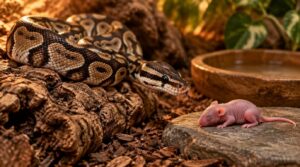
Getting prey size right is the single most important feeding decision you’ll make for a hatchling. There are two reliable ways to size a mouse: girth-based sizing and weight-based sizing. I’ll walk you through both so you can pick the right feeder with confidence.
If you’re unsure when your hatchling is ready for its first meal, this guide on when to start feeding baby corn snakes covers the timing alongside sizing.
Getting prey size right is the single most important feeding decision you’ll make for a hatchling snake
Girth-Based Sizing
Girth beats length every time when you’re sizing prey. Measure the mouse at its widest point behind the forelimbs, then compare it to your snake’s head.
A prey item girth of 1/2 to 2/3 of jaw width works for most hatchlings, including a hatchling Ball Python.
If girth hits 70–85% of head width, expect refusal or regurgitation.
Start small, log every feed, and scale up only after two clean meals.
Weight-Based Sizing
Weight-based sizing gives you numbers you can trust. Use the weight percentage method: prey should be 5–15% of body weight.
- Weigh your hatchling weekly on a 0.01 g scale.
- Feed prey at 5–15% of that weight.
- Cap meals at 4–6% if digestion lags.
- Scale up 0.1–0.2 g after two clean meals.
A 12 g hatchling Ball Python starts at 0.6–0.9 g prey, regardless of prey item girth. Log everything and adjust your feeding schedule from the data.
For a fuller picture of growth milestones and what to expect as your snake matures, this ball python growth guide breaks it down month by month.
How Do You Measure Hatchling Prey Size?
Once you’ve picked a sizing method, you need a repeatable way to measure. Guessing leads to inconsistent prey size selection, and hatchlings notice. Here’s my routine:
- Measure girth at the mouse’s widest point with calipers, plus nose-to-tail-base length.
- Weigh every feeder on a 0.1 g kitchen scale before offering it.
- Log each meal per individual so trends show up fast.
- Weigh your hatchling after feeding to check the gain.
That last step matters most. If a hatchling gains more than 6–8% of its body weight in one meal, the next mouse should be smaller. Keep records for a few weeks and you’ll know exactly what your animal tolerates before problems start.
Are Pinky or Fuzzy Mice Best?

Your measurements from the last section will tell you which size to grab, but here’s the short version: start with pinky mice. Hatchlings under two weeks should get pinkies only, since their jaws can’t handle anything thicker. From two to four weeks, you can offer a small fuzzy if the prey stays under about 1.5 times the hatchling’s head width.
As your snake grows, our guide to feeding requirements by age breaks down exactly when and how to size up from pinkies to adult prey.
Fuzzy mice run 25 to 40 percent larger than pinkies, and that extra girth matters more than length. If your hatchling’s midsection is growing fast, alternate a pinky with a small fuzzy to bridge the gap instead of jumping sizes. Watch for regurgitation or slow digestion after the first fuzzy; those are signs you moved up too soon. Validate with one or two clean meals before increasing again. Good prey size selection beats speed every time.
How Often Should Hatchlings Eat?
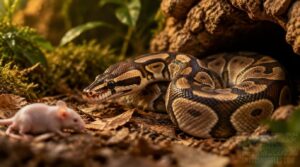
Hatchlings need a tighter feeding schedule than adults, and it changes fast as they grow. I’ve seen keepers overfeed or underfeed simply because they didn’t adjust with age. Here’s how to time meals across two key stages.
Under Three Months
Under three months, you’re feeding your hatchling every 5 to 7 days for a Ball Python, or every 3 to 4 days for faster-growing colubrids. Stick with appropriately sized pinky or fuzzy mice weighing about 10 to 15% of your snake’s body weight. I keep a simple log of dates and prey weights, because consistency now sets the feeding rhythm for life.
Three to Six Months
Every 7 to 10 days is your feeding frequency sweet spot for a 3–6 month hatchling. I space meals out as growth slows, watching monthly mass gain closely.
- Offer prey at 8–12% of body weight.
- Keep mouse size near mid-body girth.
- Track weight monthly, adjust prey progression.
- Reduce frequency if you see fat deposition.
Should Hatchlings Eat Frozen or Live Mice?
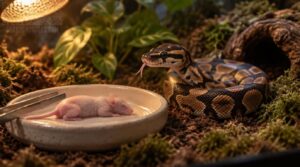
The answer here is simple: frozen-thawed, every time. Live mice can bite or scratch your hatchling, and those wounds get infected fast. I’ll walk you through safe thawing and proper warming so your snake’s first meals go smoothly.
Safe Thawing
Thawing frozen rodents properly matters more than most keepers realize. I always use the refrigerator method for frozenthawed mice, letting them thaw slowly and uniformly overnight. Room-temperature thawing invites bacteria, and warm water is worse.
Inspect your frozen prey after thawing: discard anything with freezer burn, discoloration, or a sour smell. Label thawed portions with dates, feed the oldest stock first, and never refreeze thawed mice.
Proper Warming
Picture a hatchling striking a prey item that’s ice-cold at the center. It hesitates, drops it, and walks away. That’s why warming matters.
Follow these steps:
- Warm prey to 85–90°F using safe prey thawing techniques, never direct heat.
- Keep your enclosure at 78–82°F so warmth holds during proper feeding.
- Rewarm anything ignored past five minutes.
Warm prey, interested hatchling, reliable feeding schedule.
What Happens When Prey is Oversized?
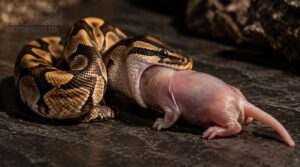
Oversized prey is the fastest way to ruin a hatchling’s feeding record. When a mouse is too wide, prey too large risks regurgitation within 24 to 48 hours, and repeated failures teach your snake to refuse meals later.
Watch the warning signs: head shaking, neck compression, and dragging feeding attempts past twenty minutes. Esophageal blockage is the scariest outcome, since a lodged mouse can choke a tiny snake quickly.
| Sign | Likely Cause | Your Fix |
|---|---|---|
| Regurgitation | Stomach pressure | Drop one prey size |
| Head shaking | Poor grip | Offer narrower prey |
| Long ingestion time | Prey exceeds gape | Return to pinkies |
Keep prey under 1.5 times the hatchling’s girth, and if a meal comes back up, wait seven days before feeding again so the gut recovers.
Frequently Asked Questions (FAQs)
What size are newborn mice?
What size are newborn mice? They’re tiny: about 5 to 0 grams and 0–5 cm long, hairless with closed eyes. That’s why a pinky mouse fits your hatchling perfectly.
What is the 5 day mouse rule?
Ever heard keepers swear by the 5 day mouse rule? It’s simple: feed your hatchling every five days once it’s past six months, letting each meal fully digest before you offer the next.
What size mouse should I feed my baby ball in python?
What size mouse should I feed my baby ball python? Match prey girth to 60–75% of the snake’s widest body width, or feed mice weighing 5–10% of its body weight.
What does a 10 day old baby mouse look like?
What does a 10 day old baby mouse look like? Think pink jellybean. It’s blind, hairless, translucent enough to show vessels, roughly 5–5 cm, with big-headed proportions and sparse dorsal fuzz emerging.
Can hatchlings eat hopper mice right away?
Can hatchlings eat hopper mice right away? Usually not. Hopper mice often exceed a hatchling’s stomach capacity. Match prey girth to 5 times your snake’s widest point, and start smaller unless you’re raising a juvenile Ball Python.
What if my hatchling refuses its first meal?
What if your hatchling refuses its first meal? Don’t panic. Check temperatures and humidity, then offer a smaller prey item. A juvenile Ball Python often skips meals after shedding. For hunger strike prevention, reduce handling and retry in 20–30 minutes.
Do hatchlings need water available after feeding?
Do hatchlings need water available after feeding? Yes. I offer a shallow dish (1–2 cm) right after meals, especially with Ball Pythons in dry rooms. If yours refuses, try again 1–2 hours later.
Can two hatchlings be fed in the same enclosure?
Yes, but only with caution. Two hatchlings can share an enclosure if it’s spacious, with separate hides and two feeding zones. Monitor aggression closely; separate immediately if biting, pouncing, or failed feeding appears.
How long should I wait before handling after feeding?
How long should you wait before handling after feeding? Give your hatchling at least 24 hours. Ball Pythons digesting larger meals need longer. Watch for stress behaviors, keep sessions under three minutes, and prioritize digestive safety.
Conclusion
Picture a hatchling coiled around a mouse that fits just right, swallowing without a hitch, then settling under its hide to digest. That’s the goal.
When you weigh your snake, match prey to 10–15% of body weight, and check girth before every meal, you remove the guesswork. Get what size mouse for hatchling right from day one, and you’ll avoid regurgitation, stunting, and stress.
Feed consistently, size carefully, and your hatchling will thrive.