This site is supported by our readers. We may earn a commission, at no cost to you, if you purchase through links.

A 10% swing in enclosure humidity is enough to delay your reptile’s shed or trigger respiratory stress. Most first-time owners don’t realize how fast those conditions shift, sometimes within hours, as substrate dries, temperatures fluctuate, and ventilation pulls moisture out.
The right reptile humidity gauges for first-time owners aren’t just accessories. They’re the difference between catching a problem early and discovering it after your animal is already suffering.
This breakdown covers three gauges at different price points and accuracy levels, so you can pick the one that fits your species, enclosure, and budget.
Table Of Contents
- Key Takeaways
- Why Reptile Humidity Gauges Matter
- Top 3 Reptile Humidity Gauges
- Choosing Your First Reptile Humidity Gauge
- Species-Specific Reptile Humidity Targets
- Gauge Placement, Calibration, and Maintenance
- Frequently Asked Questions (FAQs)
- What is the best humidity gauge for reptiles?
- What is the best humidity checker for reptiles?
- What is the ideal humidity level for reptiles?
- What is the best humidity thermostat for reptiles?
- Can one gauge monitor multiple enclosures simultaneously?
- How long do humidity gauge batteries typically last?
- Can foggers or misters physically damage my sensor?
- How should I respond to sudden unexplained humidity spikes?
- Conclusion
Key Takeaways
- A 10% humidity swing can delay shedding or cause respiratory stress, so tracking conditions in real time isn’t optional—it’s core to keeping your reptile healthy.
- Digital gauges (±2–5% RH accuracy) beat analog options by a wide margin, since analog dials can drift by 15–25% and can’t be recalibrated.
- Place at least two sensors per enclosure—one in the warm zone, one in the cool zone—and keep them 15–30 cm above the substrate and away from vents or heat sources.
- Calibrate your gauge every three to six months using a salt solution, and replace any unit that won’t hold calibration, since inaccurate readings make every humidity correction you make unreliable.
Why Reptile Humidity Gauges Matter
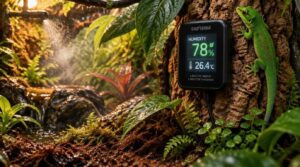
Because reptile health depends on precise environmental control, consistently tracking your humidity levels isn’t optional. Suboptimal humidity causes retained shed, respiratory infections, and dehydration, all of which are preventable. Reptile humidity gauges give you real-time data so you can act before small problems turn serious.
Pairing your gauge with a solid understanding of reptile humidity requirements by species ensures you’re targeting the right range, not just any range.
A reptile humidity gauge turns silent enclosure shifts into early warnings you can act on
For first-time owners, understanding why reptile humidity gauges matter starts with recognizing how quickly enclosure conditions shift. Temperature changes, substrate drying, and ventilation all alter readings within hours. Without a gauge, you’re guessing.
Stability matters as much as hitting the target range. Even a 10% swing can delay sheds or stress your animal. A reliable gauge lets you catch those fluctuations early, giving you the control needed to correct them before they affect reptile health.
Top 3 Reptile Humidity Gauges
Choosing the right humidity gauge depends on accuracy, budget, and enclosure type. The three options below cover digital and analog formats at different price points, giving you a clear range to choose from. Each one suits a slightly different keeper setup, so you can pick what fits your situation best.
1. Veanic 4-Pack Mini Digital Hygrometers
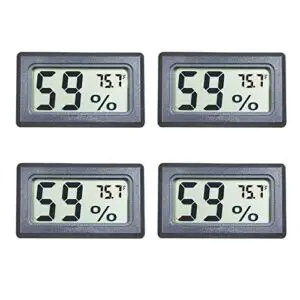
Four independent units make the Veanic pack immediately useful across multiple enclosures or zones. Each compact sensor measures 1.89" x 1.13" x 0.6", fitting inside tight spaces like 32oz mason jars or small reptile tanks without obstructing your setup.
You get ±2°F temperature accuracy and ±5% RH accuracy, with readings updating every 10 seconds. There’s no backlighting, so you’ll need adequate ambient light to read it. Pre-installed LR44 batteries and four extras are included, keeping you monitoring from day one.
| Best For | Anyone who needs to passively monitor temperature and humidity across multiple small spaces — like terrariums, wine fridges, instrument cases, or greenhouses — without fussing with apps or buttons. |
|---|---|
| Display Type | Digital LCD |
| Measurements | Temp & Humidity |
| Battery Required | Yes (LR44) |
| Mounting Method | N/A |
| Accuracy | ±5% RH |
| Enclosure Suitable | Reptile Tanks, Jars |
| Additional Features |
|
- Four independent units let you monitor several locations at once right out of the box
- Slim enough to fit inside tight enclosures like 32oz mason jars or small reptile tanks
- Pre-installed batteries plus four spares mean zero setup hassle and extended use
- No backlight makes the display hard to read in low-light conditions
- Humidity readings become unreliable below 15% RH, limiting use in very dry environments
- Display contrast drops sharply when viewed at an angle rather than straight on
2. REPTI ZOO Dual Reptile Thermometer Hygrometer
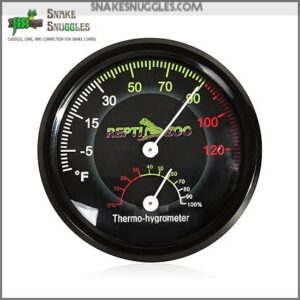
Where the Veanic controls multiple enclosures, the REPTI ZOO gives you dual-zone monitoring inside one tank. Its twin sensors track independent ambient and probe readings at the same time, all shown on a single backlit display you can read in dim enclosure lighting.
This gradient visibility makes the REPTI ZOO especially well-suited for the detailed temperature documentation that snake quarantine thermometer setups require across both warm and cool zones.
The water-resistant probe won’t fail under accidental misting. Readings update every 10 to 60 seconds, and you can recalibrate through a user-accessible port when drift appears. Accuracy sits at ±2-3% RH, which holds up for humidity-sensitive species.
| Best For | Reptile and amphibian keepers who want a simple, battery-free way to monitor temperature and humidity inside vivariums, hatchers, brooders, or propagators without disturbing the enclosure. |
|---|---|
| Display Type | Analog, Color-Coded |
| Measurements | Temp & Humidity |
| Battery Required | No |
| Mounting Method | Sticky Pad |
| Accuracy | ±5–7 Degrees |
| Enclosure Suitable | Vivariums, Hatchers |
| Additional Features |
|
- Tracks both temperature and humidity at once with dual gauges, giving you a full environmental read in a single glance
- Requires no batteries, eliminating the risk of power failure interrupting your monitoring
- Compact and sticky-pad mountable, so you can position it anywhere inside the habitat without opening the enclosure
- Accuracy can drift by 5–7 degrees in complex enclosure setups, making it unreliable for species with tight temperature tolerances
- The sticky pad loses adhesion on non-glass surfaces, which limits secure placement in enclosures made from other materials
- Falls short of digital meters in precision, so it’s not the best choice for humidity-sensitive reptile species that need exact readings
3. Exo Terra Analog Terrarium Hygrometer
The REPTI ZOO suits precision-focused keepers, but if you’re after something battery-free and easy to install, the Exo Terra Analog Hygrometer covers the basics without any complications.
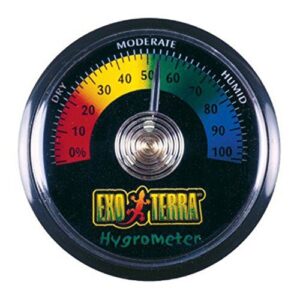
Its circular dial spans roughly 2.5 to 3 inches, and the included foam adhesive sticker mounts it in seconds. No batteries needed. Coverage runs 30-90% RH, fitting most common species.
For placement tips and habitat setup that help your readings stay accurate, ball python beginner care guides often recommend positioning the hygrometer on the cool side, away from heat sources and ventilation gaps.
Accuracy is the real tradeoff. Users report deviations of 15-25% RH, so treat it as a trend tracker, not a true precision instrument.
| Best For | Beginner reptile keepers who want a simple, battery-free way to keep a general eye on humidity without needing precise readings. |
|---|---|
| Display Type | Analog Dial |
| Measurements | Humidity Only |
| Battery Required | N/A |
| Mounting Method | Foam Adhesive |
| Accuracy | ±15–25% Deviation |
| Enclosure Suitable | Terrariums, Vivariums |
| Additional Features |
|
- No batteries required — completely passive and always ready
- Installs in seconds with the included foam adhesive sticker
- Affordable entry point for basic humidity monitoring in terrariums and vivariums
- Accuracy can be off by 15–25% RH, making it unreliable for species with strict humidity needs
- Cannot be calibrated to correct for drift or inaccurate readings
- Adhesive may fail in high-humidity environments or on certain enclosure surfaces
Choosing Your First Reptile Humidity Gauge
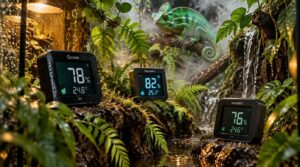
Picking the right humidity gauge comes down to a few practical, species-specific factors. Before buying, you’ll want to weigh accuracy, features, placement, and calibration against your reptile’s actual needs. The five criteria below will help you make a confident, informed choice.
Match Species Needs
Not every enclosure runs exactly the same. Your first step is matching species-specific humidity requirements to your gauge’s measurement range.
- Leopard geckos: 30–40% RH
- Ball pythons: 60–80% RH
- Chameleons: 70–90% RH
- Bearded dragons: 30–40% RH
- Red-eyed tree frogs: 80–90% RH
Understanding these targets lets you build a reliable enclosure humidity gradient that accommodates humidity-sensitive species without oversaturating cooler desert zones.
Prioritize Digital Accuracy
Three reasons digital wins: digital hygrometer units read within ±2% to ±5% RH, while analog dials drift 10% or more. When comparing digital vs analog sensors, accuracy decides. Check humidity sensor accuracy specs, confirm calibration support, and use simple hygrometer calibration methods like the salt test.
| Factor | Digital | Analog |
|---|---|---|
| Accuracy | ±2–5% RH | ±10%+ |
| Calibration | Salt test | Rarely adjustable |
| Readout | Exact numbers | Estimate |
Compare Useful Features
Fast-responding sensors reach 63% of their final reading within 5 to 15 seconds, which matters greatly in fluctuating enclosures.
A digital hygrometer with ±2–3% RH accuracy gives you reliable numbers at a glance, while analog gauges require interpretation and drift faster.
If you’re managing multiple enclosures, built-in data logging and configurable alerts make maintaining enclosure humidity stability less manual.
A hygrometer with logging and alerts lets you spot humidity trends across enclosures without hovering nearby all day.
Plan Sensor Placement
Sensors near vents can skew your readings by 15% or more.
For solid humidity gauge placement, position your sensor 15 to 30 cm above substrate, away from fans. In enclosures with distinct zones, you’ll want at least two: one near the warm basking area and one in the cool hide. That’s how you track real microclimates instead of misleading averages.
Verify Calibration Options
Calibration matters, but it’s only useful if your gauge has it. Before buying, confirm it offers user-initiated calibration or an offset adjustment. Many calibratable reptile hygrometers with offset adjustment let you fine-tune readings by a few percentage points, keeping accuracy reliable long after the initial setup.
Sensor drift correction becomes essential over time, especially after battery swaps. Test against a salt solution for reliable hygrometer accuracy, then schedule recalibration every few months. Treat humidity gauge accuracy testing as part of your daily care routine.
Species-Specific Reptile Humidity Targets
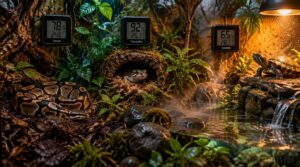
Getting humidity wrong doesn’t just slow a shed; it can trigger respiratory infections or leave retained skin on your animal. Species specific humidity requirements vary more than most owners expect.
Here are the target humidity levels by species:
- Ball python: 40–60% ambient; raise to 60–70% during the shedding window
- Leopard gecko: 30–40% ambient; moist hide reaches 60–80% at shed time
- Red-eared slider: 40–60% ambient; 60–70% near the basking zone
- Breeding season: raise targets by 5–15% for humidity-dependent species
- Post-illness recovery: restore species-specific humidity levels gradually over one to two weeks
Your gauge only earns its role in reptile husbandry when you know the number you’re chasing. Without a confirmed target humidity for your species, accurate readings are meaningless in practice.
Gauge Placement, Calibration, and Maintenance
Once you know your species target, placement determines whether your reading reflects reality. Mount your hygrometer 2 to 4 inches below the ceiling, away from direct heat sources, which skew digital sensors upward. Position it off the substrate on rock or vegetation to avoid false highs from surface moisture.
Run at least two gauges: one in the warm zone, one in the cool zone. This catches gradient differences your animal actually moves through during the day. A reptile hygrometer multipack makes it easy to outfit both zones at once without hunting down matching gauges separately.
Calibrate against a 75% RH salt solution every three to six months. If readings drift more than 3% across two consecutive checks, recalibrate before adjusting your enclosure setup. Replace any gauge that won’t hold calibration, since inaccurate readings undermine every humidity correction you make.
Frequently Asked Questions (FAQs)
What is the best humidity gauge for reptiles?
For most reptiles, the REPTI ZOO Dual Hygrometer is your best choice. It’s a digital hygrometer that delivers dual-probe accuracy, making reptile enclosure humidity monitoring consistent, straightforward, and reliable for first-time owners from day one.
What is the best humidity checker for reptiles?
The REPTI ZOO Dual leads as the best digital hygrometer for most reptile keepers. It pairs thermometry with multi-zone reptile enclosure humidity monitoring via external probes, giving you reliable, precise readings across your entire setup.
What is the ideal humidity level for reptiles?
Think of a rainforest floor versus cracked desert clay. There’s no single right answer. Your target humidity depends entirely on species: desert reptiles need 20-40%, while tropical species require 60-80% for healthy skin and sheds.
What is the best humidity thermostat for reptiles?
A true humidity thermostat for reptiles acts as your enclosure’s nervous system. The REPTI ZOO Dual combines ±2% RH accuracy with integrated temperature and humidity monitoring, making it the strongest pick for precise reptile care.
Can one gauge monitor multiple enclosures simultaneously?
Like relying on one thermometer for two entirely different climates, sharing a single gauge across enclosures invites error. Use separate sensors, or limit multienclosure monitoring to two tightly coupled enclosures sharing one digital humidity meter.
How long do humidity gauge batteries typically last?
Ironically, the device keeping your reptile alive is often the one you forget to maintain. Battery life on humidity gauges for reptiles runs 6 to 12 months, though nearby heat and backlight shorten that considerably.
Can foggers or misters physically damage my sensor?
Yes, direct mist contact can corrode metal contacts and permanently skew your digital humidity meter’s readings. Keep sensors at least 15–30 cm from the fog outlet, and choose an IP-rated enclosure to reduce condensation damage.
How should I respond to sudden unexplained humidity spikes?
Increase airflow briefly to drop the humidity level, then recheck after 15 minutes. If the spike persists, remove any excess moisture sources first. Test your sensor in a dry room to rule out calibration drift.
Conclusion
Congratulations, you’ve unlocked the thrilling world of humidity gauges. Buy the wrong one and you’ll second-guess every reading while your reptile quietly disagrees.
Choosing reptile humidity gauges for first-time owners doesn’t need to be complicated. Match the gauge to your species’ range, prioritize digital accuracy, and place sensors where your animal actually lives. Check calibration early, recheck it often. Consistent, reliable readings let you act before conditions become a problem, not after.