This site is supported by our readers. We may earn a commission, at no cost to you, if you purchase through links.
A rattlesnake crosses barren desert sand for days without drinking, yet somehow finds a hidden seep beneath a rocky outcrop—no visible water, no obvious signs, just an unerring sense that draws it to moisture. You might assume snakes simply stumble upon water sources by chance, but their detection systems reveal a sophistication that rivals any GPS.
Through mechanoreceptors embedded in specialized scale sensilla (microscopic sensory structures distributed across the integument), chemosensory sampling via the vomeronasal organ, and in certain species, infrared thermoreception capable of discriminating thermal gradients as subtle as 0.003°C, ophidian taxa have evolved multimodal sensory integration that transforms environmental cues—vibrations, chemical signatures, temperature differentials—into precise navigational data.
Table Of Contents
- Key Takeaways
- How Do Snakes Sense Water?
- Mechanosensory Detection of Water
- Chemical Sensing and Water Location
- Visual and Infrared Cues Near Water
- Adaptations for Drinking and Water Intake
- Frequently Asked Questions (FAQs)
- Can snakes sense water?
- What smell attracts snakes?
- Do snakes like it when it’s wet?
- How do snakes find water?
- What to do if you see a snake while swimming?
- How do snakes smell water?
- Do snakes get thirsty?
- Why do sea snakes need to sense water?
- How do they use this sense to hunt?
- What does this mean for conservation?
- Conclusion
Key Takeaways
- Snakes detect water through multimodal sensory integration combining mechanoreceptors in scale sensilla (detecting vibrations and hydrodynamic disturbances), chemosensory sampling via the vomeronasal organ (analyzing moisture gradients and chemical signatures), and in some species infrared thermoreception capable of discriminating thermal gradients as subtle as 0.003°C.
- Aquatic and sea snakes possess specialized dome-shaped sensilla with dramatically enhanced hydrodynamic reception capabilities covering over 70% of surface area in pelagic species, enabling precise prey localization and navigation in three-dimensional marine environments even in complete darkness or turbid conditions.
- The forked tongue delivers chemical particles to the Jacobson’s organ, which processes non-volatile compounds to distinguish water signatures from other environmental scents by selectively reacting to hydrophilic compounds and integrating olfactory cues with mechanosensory data from scale sensilla.
- Snake drinking mechanisms rely on specialized oral structures including tongue compression against the hard palate to form liquid boluses, capillary action within narrow oral grooves generating suction through surface tension, and coordinated muscular movements involving more than thirty muscles to transport water from mouth to esophagus.
How Do Snakes Sense Water?
You might think snakes just stumble upon water by chance, but these extraordinary reptiles actually employ a complex array of sensory adaptations—ranging from chemical detection through the Jacobson’s organ (vomeronasal organ) to mechanosensory scale sensilla capable of detecting hydrodynamic disturbances in aquatic environments—that enable them to locate water sources with considerable precision across diverse habitats.
The ability to detect water varies significantly depending on whether a species is adapted for life in types of snake habitats like marshes, rivers, or drier terrestrial environments.
Understanding how snakes sense water isn’t merely an academic curiosity; for species inhabiting arid regions where dehydration poses significant mortality risk, or for fully aquatic sea snakes (family Hydrophiinae) that must navigate three-dimensional marine environments while managing osmoregulatory challenges, the ability to detect and respond to water-related cues represents a critical survival mechanism that has been refined through millions of years of evolutionary pressure.
For snakes in arid deserts and marine environments alike, detecting water is not academic curiosity but a survival mechanism refined across millions of years
The sensory systems snakes use to find water involve complex interactions between chemosensory, mechanosensory, visual, and thermosensory modalities, each contributing specific information that your understanding of ophidian ecology requires careful examination of.
Overview of Snake Sensory Adaptations
You’ll find that snake sensory systems rely on specialized mechanoreceptors and sensory adaptations far beyond simple sight or smell. These reptile sensory systems include scale-mounted sensors detecting vibrations, infrared pit organs imaging heat signatures, and chemical analyzers in the vomeronasal apparatus.
Such sensory organ development facilitates precise environmental adaptation—tracking prey movements, traversing aquatic habitats, and triggering neurological responses essential for locating water sources critical to survival.
Snakes are able to detect subtle changes in their environment due to their unique vibration detection abilities.
Importance of Water Detection for Survival
While highly evolved sensory evolution allows snakes to locate water, your understanding of why this detection matters reveals how environmental balance determines survival across diverse habitats—from desert survival scenarios where water conservation dictates foraging schedules to aquatic adaptation in sea snakes whose mechanoreceptor arrays and hydrodynamic reception guide navigation toward osmotically favorable zones, ensuring snake hydration remains sufficient to sustain metabolic function within reptile sensory systems finely tuned for resource acquisition.
For a detailed overview of, consider exploring additional resources on survival water strategies.
Mechanosensory Detection of Water
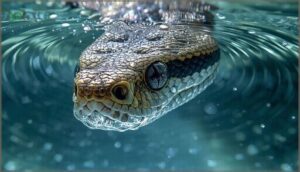
You’ll find that snakes possess advanced mechanosensory organs distributed across their head and body, allowing them to detect subtle mechanical stimuli and water-related vibrations in their environment with great precision. These specialized sensory structures, particularly scale sensilla and hydrodynamic receptors, enable both terrestrial and aquatic species to locate water sources through physical disturbances and pressure changes that propagate through air or aquatic substrates.
The following mechanisms illustrate how snakes employ mechanoreception to navigate toward water and survive in diverse habitats.
Role of Scale Sensilla in Sensing Water Movements
Scale sensilla—those minuscule tactile organs embedded within your snake’s head scales—serve as exquisitely sensitive mechanoreceptors, each housing a hairlike structure connected to underlying mechanosensory neurons that transmit hydrodynamic cues from minute water flow deflections, surface ripples, and droplet contact.
These same sensilla enable snakes to detect prey movements underwater, a capability especially refined in green and yellow aquatic species that hunt in streams and wetlands.
These scale organs enable water detection through three primary mechanisms:
- Directional current sensing via comparative stimulation across neighboring sensilla arrays
- Temporal encoding of flow velocity and turbulence patterns
- High-frequency disturbance detection characteristic of small water ripples
Hydrodynamic Sensing in Aquatic and Sea Snakes
In truly aquatic lineages—particularly sea snakes (Hydrophiinae)—you’ll observe pronounced dome-shaped sensilla protruding substantially from epidermal surfaces, dramatically amplifying hydrodynamic reception capabilities through enhanced Water Vibration Detection and Aquatic Navigation Systems.
This specialized mechanoreceptor architecture, densely distributed across cranial and trunk regions (mean coverage exceeding 70% surface area in pelagic species), enables Hydrodynamic Signal Processing of lateral water displacement patterns, enabling precise prey localization and Marine Sensory Ecology integration across multidirectional flow gradients even in absolute darkness or turbid conditions where visual input proves negligible.
Mechanoreceptors and Environmental Cues
Your snake’s mechanoreceptors across skin, jaws, and lips translate subtle environmental feedback—surface tension variations, water ripples, substrate vibrations—into neural signals that guide survival decisions.
These sensilla exhibit mechanosensory adaptation, modulating thresholds based on humidity and temperature, while integrating vibration detection with chemosensory input to fine-tune water localization accuracy.
This vertebrate mechanoreception synergy optimizes hydrodynamic reception, enabling precise behavioral responses to changing aquatic cues.
Chemical Sensing and Water Location
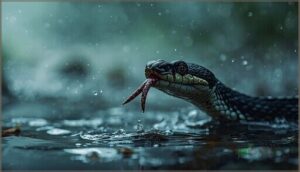
When you watch a snake flick its tongue in and out, you’re witnessing one of nature’s most advanced chemical detection systems at work. The forked tongue doesn’t just taste the air—it samples moisture gradients and chemical signatures that lead directly to water sources, even from considerable distances.
Through the Jacobson’s organ, snakes analyze these microscopic clues with exceptional precision, distinguishing between humidity, standing water, and the complex scent profiles of different aquatic environments.
Jacobson’s Organ and Tongue Function
Your forked tongue isn’t just flickering for show—it’s delivering chemical particles directly to the vomeronasal organ (Jacobson’s organ), which sits in the roof of your mouth rather than the nasal cavity.
This specialized chemosensory apparatus processes non-volatile compounds through receptor biology that complements your olfactory system, enabling sensory integration of environmental cues including moisture gradients through precise tongue mechanics and chemical sampling.
Sampling Moisture and Chemical Cues
When your tongue flicks out, you’re actively sampling the chemical landscape around you—a process that reveals moisture signatures invisible to other senses. This chemoreception involves:
- Airborne volatile compounds released from moist soil and shallow water that persist longer than transient cues
- Dissolved mineral signatures in water providing distinct chemical fingerprints
- Substrate sampling via tongue contact that detects humidity gradients guiding you toward drinking sites
Your olfaction integrates these hydrodynamic cues through sensory perception pathways, enabling precise water sampling and moisture detection essential for survival.
Differentiating Water From Other Scents
Your Jacobson’s organ selectively reacts to hydrophilic compounds associated with moist environments, distinguishing clean, neutral water vapor signatures from complex organic or prey odors through specialized chemoreception pathways.
This chemical discrimination integrates olfactory cues with hydrodynamic signals detected by scale sensilla, enabling precise moisture detection and water scent recognition.
Receptor sensitivity within snake sensory systems varies with age, health status, and environmental humidity gradients, modulating olfaction accuracy when locating essential hydration sources.
Visual and Infrared Cues Near Water

While you might assume snakes rely solely on scent to locate water, their visual systems—though often underestimated—play a surprisingly important role in detecting moisture-rich environments.
Some species have even developed infrared capabilities that allow them to sense thermal signatures near water bodies, particularly when hunting prey that congregates at these critical sites.
Understanding how snakes integrate visual and thermal information with their chemical senses reveals the complex multi-modal approach these reptiles use to navigate toward water.
Vision Capabilities in Aquatic Vs. Terrestrial Snakes
When you peer into the unblinking gaze of a serpent, you’re witnessing a visual system shaped by habitat demands—terrestrial species retain sharper color perception in daylight environments (utilizing multiple cone photoreceptors for improved chromatic discrimination), whereas aquatic forms prioritize motion detection and contrast sensitivity underwater, where retina anatomy often lacks traditional rods but compensates through specialized horizontal visual streaks that improve lateral-spanning awareness.
Key distinctions include:
- Maximal spatial resolution ranging 1.1–2.3 cycles per degree in sea snakes versus potentially higher acuity in diurnal terrestrial lineages
- Aquatic eye structure featuring elongated spherical lenses reducing refractive distortion in dense water environments
- Visual pigment shifts toward short, middle, and long wavelength sensitivities maximizing contrast detection across filtered underwater light spectra
- Ventral retina specializations in marine species supporting substrate-oriented foraging and obstacle detection near reef crevices
- Terrestrial snakes maintaining better color discrimination capabilities while aquatic counterparts sacrifice chromatic precision for improved movement tracking through optimized retinal ganglion cell distribution
Use of Infrared Sensing Near Water Bodies
While most serpents lack the thermal imaging capability you might associate with pit vipers, certain aquatic species maintain infrared detection organs that reveal heat signatures along water boundaries—specialized thermoreceptors embedded within labial scales register subtle temperature gradients (often ≤0.003°C differential sensitivity), enabling moisture tracking through thermal contrasts where evaporative cooling demarcates shorelines, seepage zones, and prey concentrations.
Thereby enhancing sensory perception systems critical for traversing thermally complex riparian microhabitats.
Integrating Visual and Chemical Information
Multimodal fusion of visual and chemical data represents the apex of sensory integration in ophidian navigation—your sensory perception relies on neural coding pathways that bind chromatic inputs from photoreceptors with volatile gradients captured via chemoreception, thereby establishing cross-modal reference frames wherein spatial co-localization of odor plumes and optical landmarks converges within shared thalamocortical circuits.
Enabling adaptive learning algorithms to hone water-seeking trajectories across heterogeneous riparian ecotones through redundancy-enhanced detection thresholds characteristic of sophisticated reptile senses and snake sensory systems optimized for animal navigation.
Adaptations for Drinking and Water Intake
Once you’ve located water, your next challenge is actually drinking it—and snakes have evolved surprisingly complex mechanisms to make that happen. Unlike mammals that lap water with their tongues, snakes rely on specialized oral structures, capillary action, and precise muscular coordination to draw water into their bodies efficiently.
Understanding these anatomical adaptations and behavioral strategies reveals how snakes have mastered one of survival’s most fundamental tasks across diverse habitats.
Drinking Mechanisms and Oral Structures
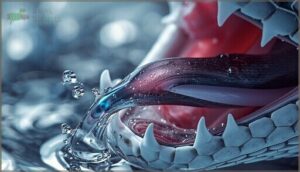
You’ll find that drinking mechanisms in snakes rely on intricate mouth structures working in concert to enable water intake during the swallowing process. Tongue movement compresses liquids against the hard palate, creating a bolus that travels along the oral groove toward the pharynx.
Five critical components enable this:
- The tongue presses tightly against the palate, forming cohesive liquid boluses for safe swallowing
- The hard palate provides rigid guidance directing water toward the throat
- Lips and oral vestibule seal completely, preventing spillage during intake
- Salivary glands continuously moisten oral surfaces, reducing friction and aiding bolus formation
- More than thirty coordinated muscles orchestrate movement from mouth into esophagus
These specialized mouth structures represent complex adaptations within snake sensory systems and reptile sensory systems broadly, complementing mechanosensory capabilities found in scale organs and sensilla that detect environmental water sources.
Capillary Action and Suction in Water Uptake
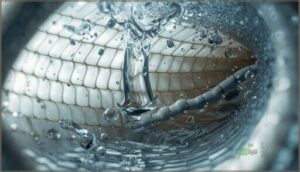
You’ll notice that, beyond mechanical compression, snakes leverage capillary rise within the oral sulcus to aid water uptake—narrow grooves along the roof of the mouth generate suction forces through surface tension and adhesive interactions between water molecules and epithelial tissues.
This hydrodynamic flow supplements tongue-driven bolus formation, enabling efficient liquid transport toward the pharynx even when the head remains partially submerged during drinking bouts.
Behavioral Strategies for Finding and Consuming Water

Beyond these physiological mechanisms supporting adaptive drinking and water uptake, you’ll observe that snakes employ complex environmental navigation strategies, integrating chemoreception via tongue-flicking with hydrodynamic reception to locate moisture-rich microhabitats—behavioral repertoires essential for snake hydration include route planning toward known reliable water sources, repeated sampling of substrate moisture gradients during aquatic foraging, and multisensory assessment of water quality before ingestion commences.
Frequently Asked Questions (FAQs)
Can snakes sense water?
Like a finely tuned radar scanning, your snake’s sensory systems detect water through hydrodynamic reception, mechanosensory inputs, and chemical sampling—specialized aquatic adaptations essential for marine biology, reptile sensory systems, and snake behavior survival.
What smell attracts snakes?
Rodent prey scents—especially urine and droppings, and pheromones—trigger the strongest chemosensory responses in most snake species.
Followed by amphibian secretions, fish odors, shelter-associated organic decay, and conspecific pheromones during mating aggregations.
Do snakes like it when it’s wet?
Whether snakes prefer wet conditions hinges on species-specific moisture needs and habitat origin—aquatic Hydrophiinae sea snakes thrive in marine humidity, whereas desert-adapted taxa require aridity for ideal thermoregulation, shedding dynamics, and water tolerance equilibrium.
How do snakes find water?
You’ll find snakes tracking water through integrated sensory perception—their forked tongues sample moisture gradients and chemical cues, while specialized scale sensilla detect hydrodynamic vibrations, guiding precise aquatic navigation toward essential water source location for survival.
What to do if you see a snake while swimming?
Should you encounter a snake while swimming, remain motionless initially to avoid stimulating mechanosensory receptors in Hydrophiinae or other aquatic serpents, then execute deliberate, controlled retreat movements toward the nearest shoreline exit point.
How do snakes smell water?
Your snake’s olfactory systems detect water vapor and chemical signals through its forked tongue, which delivers moisture-laden particles to the Jacobson’s organ—a specialized chemoreception structure that analyzes aquatic smell cues with extraordinary precision.
Do snakes get thirsty?
Like desert travelers craving an oasis, snakes experience thirst response when dehydration signs appear—sunken eyes, reduced skin turgor, and behavioral shifts toward water sources—demonstrating clear hydration needs beyond prey moisture content alone.
Why do sea snakes need to sense water?
You rely on hydrodynamic sensing—scale sensilla detecting waterborne vibrations—to locate prey fish, navigate murky marine habitats, and find surface breathing holes, representing critical sensory evolution supporting aquatic survival in ultrastructure-adapted Hydrophiinae mechanosensory systems.
How do they use this sense to hunt?
You might think snakes hunt blindly, but integrating hydrodynamic systems allows for precise prey detection.
Integrating chemical and infrared sensory systems allows for precise prey detection underwater through mechanosensory tracking of movement patterns, thermal signatures, and chemical trails for coordinated stealth approaches during water ambush scenarios.
What does this mean for conservation?
Understanding these sensory systems shapes Wildlife Conservation strategies: protecting wetlands preserves habitat connectivity, water management sustains ecosystem balance, and conservation biology integrates snake sensory systems research with reptile ecology to safeguard animal adaptations essential for Wildlife Protection.
Conclusion
Your understanding of how snakes sense water transforms these animals from instinct-driven predators into precision instruments of detection—mechanoreceptors mapping microscopic vibrations, chemosensory organs parsing molecular signatures, thermoreceptors distinguishing thermal gradients imperceptible to you.
Each modality, refined across millions of years, converges into integrated sensory cartography that renders invisible water sources accessible. When you observe a serpent moving toward hydration through seemingly featureless terrain, you’re witnessing multimodal neurological processing that rivals technological innovation—survival encoded in sensory architecture.