This site is supported by our readers. We may earn a commission, at no cost to you, if you purchase through links.

A corn snake that won’t breed often isn’t the problem. The enclosure is. One degree off on the warm side, a hygrometer that reads 50% instead of 70%, or a UVB tube mounted too far away can stall a pairing for an entire season.
Successful snake breeding lighting and setup works as a system. Your enclosure size, substrate, heat gradient, humidity, and day length all signal to your snakes that conditions are right to reproduce.
You’ll learn how to size the enclosure for your species, dial in temperature and moisture, time your photoperiods, and prepare lay boxes and incubators before the first egg drops.
Table Of Contents
- Key Takeaways
- Setting Up a Species-Appropriate Snake Breeding Enclosure
- Controlling Temperature and Humidity in Breeding Enclosures
- Optimizing Lighting for Snake Breeding
- Preparing The Breeding Enclosure for Safe Pairing
- Setting Up Snake Egg-Laying Boxes and Incubators
- Frequently Asked Questions (FAQs)
- What is the best lighting for snakes?
- How to properly breed snakes?
- How many lights does a snake need?
- How much money can you make breeding snakes?
- What lighting schedule triggers seasonal breeding cycles?
- How do power outages affect breeding success?
- Which snake species require specialized lighting equipment?
- Can LED strips replace traditional heating lamps?
- How often should lighting fixtures be cleaned?
- How often should breeding snakes be fed?
- Conclusion
Key Takeaways
- Build your enclosure around your species, with a floor sized to your snake’s length, the right substrate, and two snug hides (one warm, one cool) so every animal can thermoregulate.
- Hold a steady gradient with a warm side near 88°F and a cool side in the low 70s°F, then use hygrometers on both ends and a thermostat to keep humidity in your species’ range.
- Run your lights on a timer and shift day length with the seasons (corn snakes go from 14 hours in summer to 10 in winter), since photoperiod is what triggers breeding hormones.
- Prepare your lay box and incubator before the eggs arrive, keeping humidity high and temperatures steady, and move the eggs within 24 hours without ever rotating them.
Setting Up a Species-Appropriate Snake Breeding Enclosure
Enclosure size sets the foundation for any breeding project, so match it to your species before anything else. Good reptile enclosure design starts with the adult body length. For terrestrial snakes, make the floor at least as long as the snake and half as wide. A four-foot corn snake needs a 4×2-foot footprint. Arboreal species like green tree pythons want height instead, at least 1.5 times body length, with sturdy branches.
Once the footprint is settled, a detailed snake tank setup guide can walk you through heating, hides, and substrate so the enclosure works from day one.
Species specific requirements also shape your substrate. Corn snakes do well on a 3-4" mix of topsoil, ReptiSoil and play sand, which holds humidity and lets them burrow. Green tree pythons, by contrast, need high humidity levels of 60-80%, which is why moisture-retaining substrates such as cypress mulch and daily misting suit them well.
Give every snake two snug hides, one warm and one cool. Add cork bark, vines and leaf litter, then cover heat sources with mesh and choose front-opening doors with dual latches.
Controlling Temperature and Humidity in Breeding Enclosures
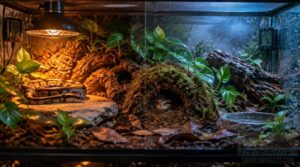
Once your hides and substrate are in place, you’ll start dialing in temperature and humidity. Snakes rely on thermoregulation, so build a gradient instead of one even reading.
Picture the enclosure like this:
- A warm side near 88°F, where a covered heat source keeps the basking spot steady
- A cool side in the low 70s°F, where humidity runs naturally higher
- A damp sphagnum moss hide that gives shedding snakes a pocket of moisture
Place hygrometers on both ends, then check them after every single adjustment. Good humidity management means misting or moistening substrate when readings drop, and cutting back when they climb. Ball pythons want 70-85%, while corn snakes settle around 65-75%. A thermostat keeps heat from drying the air.
Even with good habits, knowing the signs your snake enclosure is too dry, such as sunken eyes or retained eye caps, helps you act early.
Optimizing Lighting for Snake Breeding
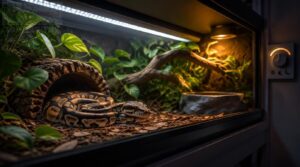
Lighting shapes how your snakes behave, breed, and stay healthy, so it’s worth getting right before pairing begins. You’ll want to set a day-night cycle that shifts with the seasons, then choose and place your UVB source with care. The two steps below walk you through each one.
Setting Day-Night Cycles and Seasonal Photoperiods
Think of photoperiod as your snakes’ calendar, written in light instead of ink. Skip it, and hormones stall.
Once cooling and lighting cycles have done their job, this corn snake breeding timeline from start to finish shows how each stage leads to a healthy clutch.
Photoperiod is your snakes’ calendar written in light, and without it, their hormones stall
Plug your lighting into a timer so day length never drifts. Corn snakes need 14 hours in summer, easing down to 10 in winter. Boas stay at 12 year-round. Pair them once days lengthen, before breeding season. UVB isn’t required for this.
Choosing and Safely Positioning UVB Lighting
Your lighting timer doesn’t need UVB, but your snakes still benefit from it. For snake breeding, choose a reptile UVB bulb: a T5 HO tube at 5% to 6%.
If you’re weighing a UVB tube against sunlight, this guide to natural vs. artificial lighting for snakes explains how each option affects your breeding setup.
Mount it inside the enclosure, over the warm end, about 30cm (12 inches) from the basking spot. Cover half to most of the length, leaving a shaded retreat. Replace it yearly.
Preparing The Breeding Enclosure for Safe Pairing
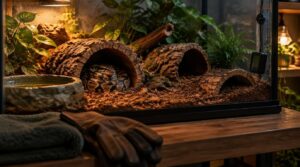
A pairing goes smoothly when your enclosure is ready before the snakes ever meet. Confirm the temperature sits at 80 to 85°F by day and 70 to 75°F at night, and keep humidity between 50 and 80%. Check your lighting schedule too, so neither snake gets startled by sudden changes.
Add several hides of different sizes so each snake can retreat. Introduce the male to the female’s enclosure, never the reverse, because she’ll stay calmer on her own ground.
Always supervise every introduction.
Keep a damp towel and gloves within reach as part of your breeding safety protocols. If either snake turns defensive, separate them with the towel instead of reaching in bare-handed, then try again in a few days.
Setting Up Snake Egg-Laying Boxes and Incubators
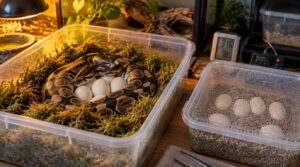
Sphagnum moss, damp vermiculite and perlite all work in a lay box, but moss holds humidity longest. Size it for your snake: about 30×40×20cm for a ball python, 20×30×15cm for a corn snake. Fill it two-thirds full and place it on the warm side two to three weeks before she’s due.
Check substrate moisture daily and keep humidity at 80 to 100 percent. If it’s dripping, add ventilation holes or replace it.
Move the eggs to your incubator within 24 hours of laying. Set it up with:
- Damp vermiculite in a tight-lidded container
- A thermostat you check daily for temperature swings
- A hygrometer holding humidity near 90 percent
Never rotate your eggs during egg incubation, because turning them interrupts development.
Frequently Asked Questions (FAQs)
What is the best lighting for snakes?
Your best reptile lighting starts with a 5%-6% T5 HO UVB tube over the warm end. Aim for a basking UVI of 5 to 0, and you’ll support vitamin D3 synthesis. Add full-spectrum daylight too.
How to properly breed snakes?
Snake breeding isn’t rocket science, but it’ll punish sloppy setups instantly.
Build a species-appropriate enclosure, dial in temperature and humidity, add low-level UVB, cool your snakes properly, then pair them under supervision, and incubate eggs.
How many lights does a snake need?
Think of lighting as a set of tools, not a quota. Most snakes need just one source for day and night cycles, plus a second heat bulb if your enclosure is large. Add UVB only for breeding setups.
How much money can you make breeding snakes?
Snake breeding rarely makes you rich. The average US reptile breeder earns about $69,416 a year, and normal morphs often won’t cover costs, while rare morphs can bring $1,000 to $2,000 per hatchling.
What lighting schedule triggers seasonal breeding cycles?
Shift your photoperiod gradually, adding 30-60 minutes weekly from 8 hours of light toward Pair reptile lighting schedules with a cooler temperature gradient, keep UVB consistent, and match Ferguson Zones to your species’ needs.
How do power outages affect breeding success?
What happens when the power cuts out mid-season? Your temperature control fails first, and incubation suffers fast. Even a few hours without heat or lighting can erase your breeding success factors, so install a battery backup.
Which snake species require specialized lighting equipment?
Corn snakes, ball pythons, boas, garter snakes and emerald tree boas all benefit from specialized lighting. These species-specific requirements call for low to moderate UVB output, so match your tube strength to your snake’s zone.
Can LED strips replace traditional heating lamps?
No, LED strips can’t replace heating lamps. They light your enclosure but produce almost no heat, so your temperature gradient collapses. Keep a thermostat-controlled heat source for basking, and use UVB separately.
How often should lighting fixtures be cleaned?
A dusty fixture can swallow your entire lighting setup! Wipe reptile lighting fixtures and UVB reflectors monthly with a microfiber cloth during enclosure cleaning, unplugging reptile lighting timers first. Dust cuts output up to 30%.
How often should breeding snakes be fed?
Feed breeding snakes every 10 to 14 days.
Before pairing, give your female 3 to 4 meals weekly to build nutrition reserves. Once she’s a gravid female, expect refusals. Keep males at 2 meals weekly.
Conclusion
Ball python eggs need steady 89°F incubation for roughly 60 days, and a few degrees of drift can cost you the clutch. That’s the lesson running through every stage here. Strong snake breeding lighting and setup isn’t about one perfect gadget. It’s about stable conditions that never surprise your animals.
Check your gauges daily, log every reading, and fix small errors early. Build it right, and your snakes will do the rest, season after season.