This site is supported by our readers. We may earn a commission, at no cost to you, if you purchase through links.

A snake can push open an unsecured lid with less force than you’d use to lift a paperback. That’s why a proper snake tank setup guide starts with escape-proofing, not decorations. Get the enclosure wrong, and you’ll deal with heat burns from heat rocks, respiratory infections from soggy substrate, or a corn snake exploring your bookshelf at 2 a.m.
The good news? Every mistake is preventable with the right measurements, temperatures, and cleaning habits from day one.
Below, you’ll find the exact tank sizes, substrate choices, and humidity targets that keep your snake healthy for decades.
Table Of Contents
- Key Takeaways
- Choose The Right Snake Tank Size and Enclosure Type
- Add Safe Substrate, Hides, and Enrichment
- Create The Proper Temperature Gradient and Lighting Cycle
- Set and Monitor Humidity and Hydration
- Clean and Maintain The Snake Tank Safely
- Frequently Asked Questions (FAQs)
- What is the best way to set up a snake tank?
- Should you mist your snakes tank?
- What do you put in the bottom of a snake tank?
- Do snakes like vertical or horizontal tanks?
- How do you set up a snake tank?
- How do you choose a snake tank?
- How do I set up a snake enclosure?
- What do you need for a snake tank?
- How do you keep a snake in a tank?
- How long should a snake tank be?
- Conclusion
Key Takeaways
- Size the enclosure for your snake’s adult length—roughly twice its body length with a horizontal footprint (a 4-foot corn snake needs about 4×2 feet)—not the hatchling size, and prioritize escape-proof lids and ventilation from day one.
- Build a proper temperature gradient with a heat mat under one third of the tank held at 28–32°C by a thermostat (never use heat rocks, which burn snakes), plus two hides on warm and cool sides and safe substrate like coconut coir or cypress mulch—skip toxic cedar and pine.
- Keep humidity around 50–60% for most species using ventilation and damp (not soggy) substrate, check a digital hygrometer twice daily, and watch for sunken eyes or tacky skin as dehydration warning signs.
- Maintain hygiene with daily spot-cleaning, deep cleans only when truly needed, and reptile-safe disinfectant applied after removing debris—following the label’s contact time, then rinsing and drying thoroughly.
Choose The Right Snake Tank Size and Enclosure Type
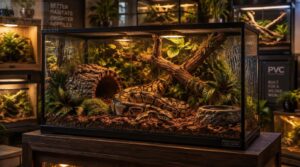
Getting your snake’s home right starts with picking the correct size and enclosure type. The options vary more than you’d think, and choosing wrong means fixing costly mistakes later. Here’s what to think about before you buy anything.
A good snake cage and habitat guide walks through these ratios species by species, so you can match the enclosure to your snake before spending a dime.
Species and Adult Size
Snake species dictate tank size. Here’s what adult sizes look like:
- Corn snakes reach 4–6 feet and need at least a 4×2 footprint
- Ball pythons grow to 3–5 feet and need comparable dimensions
- King snakes hit 3–6 feet, matching those enclosure needs
- Most colubrids reach full size in 2–3 years
Plan your enclosure dimensions around the adult, not the hatchling.
For example, corn snakes thrive in a 4x2x2 enclosure, and this corn snake terrarium size guide breaks down exactly what that looks like in practice.
Ventilation and Escape Prevention
A big tank means nothing if your snake slips out. You need smart ventilation and escape prevention working together.
The right balance of airflow and secure locking lids is one of the core essentials for snake habitat design, so it’s worth getting both right from day one.
| Feature | Purpose |
|---|---|
| Side vents | Crossflow, no draft |
| Screened panel | Fresh air intake |
| Gasket lid | Escapeproof seal |
| Sealed gaps | Enclosure security |
Check vents monthly and reseal gaps over 2 mm. Run a smoke test to confirm airflow direction, then log readings weekly.
Add Safe Substrate, Hides, and Enrichment

Now that you’ve picked the right tank, it’s time to make it feel like home. Start with safe substrate. Reptile carpet or tile works great for most species, and coconut coir or cypress mulch suits burrowers. Skip cedar and pine entirely; they’re toxic.
For burrowing species, aim for at least 4-6 inches of substrate so they can dig proper tunnels, and this guide to building naturalistic reptile environments walks you through layering it right.
Your snake needs hiding spots on both the warm and cool sides, plus one neutral hide if space allows. Choose hides with openings at least 1.5 times your snake’s girth so entry and exit stay easy.
Then add enrichment to keep your snake health on track:
- Rotate décor monthly to spark exploration
- Anchor branches and ramps securely
- Place prey scent on a clean rock occasionally
- Add cork bark for climbing
- Create a humid microclimate for rainforest species
Spot-clean daily and check for mold weekly.
Create The Proper Temperature Gradient and Lighting Cycle
Snakes can’t make their own heat, so your tank has to do it for them. You’ll need a proper temperature gradient, with a warm basking side and a cooler retreat, plus the right lighting cycle to keep your snake’s rhythm on track. Here’s how to get both set up right.
Heat Sources and Thermostats
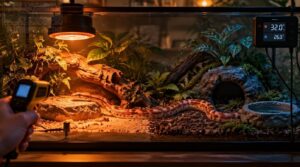
Think of your tank as a tiny apartment with a warm kitchen and a cool bedroom. That’s a temperature gradient, and your snake needs both ends for proper thermoregulation.
And since a stressed snake with a poor setup is more vulnerable to illness, it’s worth learning about recognizing snake parasites and prevention while you’re fine-tuning those temperatures.
A snake’s tank should work like a tiny apartment, with a warm kitchen and a cool bedroom for proper thermoregulation
Start with a heat mat under one third of the enclosure, held at 28–32°C by a reliable thermostat with its probe in the warm zone. Add a ceramic heat emitter for radiant warmth without light. Skip heat rocks entirely; they burn snakes.
Set your thermostat’s overheat cut-off a few degrees above your hot spot, and verify readings weekly with an infrared thermometer.
Lighting and UVB
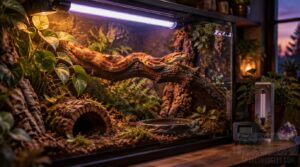
You don’t need UVB for every snake, but if your species benefits, use a 5.0 or 10.0 bulb placed 12–18 inches above the basking spot. Match your reptile lighting spectrum to your snake’s wild habits, and run UVB only during basking hours.
Set a 12:12 photoperiodic lighting schedule with a timer, and replace bulbs every 6–12 months.
Set and Monitor Humidity and Hydration
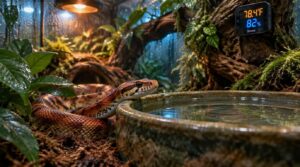
Two numbers rule this section: 50–60% humidity for most snakes, and one weekly weigh-in to track hydration. Get a digital hygrometer with a remote probe, place it at basking and humid spots, and check it twice daily. Humidity control is mostly ventilation and substrate moisture; damp substrate should squeeze into a few crumbs, never a soggy ball.
Hydration is simpler than it sounds. Offer a shallow, wide water bowl filled 1–2 cm, cleaned daily. Skip fancy misting systems if you like, a spray bottle works, but mist target zones 2–3 times daily during hydration-critical periods and wait 15–30 minutes for condensation to settle.
Watch for sunken eyes and tacky skin, both dehydration red flags. Before a shed, bump humidity slightly and keep water available nonstop.
Clean and Maintain The Snake Tank Safely
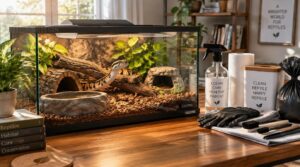
Picture your snake’s tank as a tiny apartment. Nobody wants to live in a messy one, and neither does your snake. Good enclosure hygiene keeps bacteria, odors, and stress away.
Here’s your practical cleaning schedule:
- Spot-clean daily by removing waste and uneaten food before they rot.
- Deep-clean only when needed, like after heavy soiling, since constant full resets stress your snake.
- Disinfect after cleaning, because disinfectants can’t cut through debris.
Use a reptile-safe disinfectant, follow the label’s contact time, then rinse and dry thoroughly. Keep separate tools for dirty and clean jobs, and wash your hands before and after handling. Bag waste before disposal so nothing tracks through your room.
Watch for dampness and slimy film, since substrate hygiene depends on staying dry. Good ventilation is your best defense.
Frequently Asked Questions (FAQs)
What is the best way to set up a snake tank?
Funny how a $20 plastic bin outperforms a fancy tank missing the basics. The best snake tank setup guide starts simple: right-sized enclosure, secure lid, safe substrate, two hiding spots, a proper temperature gradient, and clean water.
Should you mist your snakes tank?
Sometimes, but sparingly. Misting systems help when humidity levels dip below your species’ threshold, but frequent spraying invites mold. Instead, use a humid hide and damp substrate for reliable snake tank humidity control.
What do you put in the bottom of a snake tank?
Imagine your snake gliding across a soft forest floor. That’s your substrate. Use safe substrate like aspen shavings, coconut fiber, or paper towels. Your substrate selection should match your species’ humidity needs and make cleaning easy.
Do snakes like vertical or horizontal tanks?
Go horizontal. Most snakes live on the ground, so a wide, long enclosure beats a tall one. You’ll get better thermal gradients, easier cleaning, and more natural slithering room. Only arboreal species need serious vertical space.
How do you set up a snake tank?
Set up your snake tank by picking an enclosure twice your snake’s length with secure locks, adding safe substrate, diagonal hiding spots, a temperature gradient (warm 26–32°C, cool 22–26°C), a thermostat, water dish, and 12-hour lighting.
How do you choose a snake tank?
Pick a tank that lets your snake stretch out fully, ideally 5–5 times its adult length. A 4-foot snake needs roughly a 8′ x 2′ enclosure, with secure locks and escape-proof ventilation.
How do I set up a snake enclosure?
Setting up a snake enclosure means creating temperature zones with a thermostat, adding humidity control and coconut fiber substrate, two hiding spots, a water bowl, and secure locks. Clean regularly for comfort.
What do you need for a snake tank?
Think of it as a starter kit: a secure, escape-proof tank, heat source with thermostat, UVB if needed, substrate, two hiding spots, water bowl, hygrometer, and locks. That’s your snake enclosure essentials.
How do you keep a snake in a tank?
Like a tiny climate-controlled kingdom, your snake tank needs care. Keep a thermal gradient of 75–95°F, add secure hides, fresh water, and a locked lid. Clean weekly and monitor humidity levels daily.
How long should a snake tank be?
Aim for a snake tank at least twice your snake’s length, so a 4-footer needs an 8-foot enclosure. If space is tight, 5 times works, but prioritize enclosure length over height for natural movement.
Conclusion
Worried this sounds like a lot of work? It’s really just one afternoon of setup and ten minutes a week. Once your snake tank setup guide checklist is done, you’re mostly watching and feeding.
Lock the lid, nail the temperature gradient, and spot-clean regularly. Do that, and your snake gets a safe, comfortable home while you get peace of mind.
Set it up right the first time, and you’ll both relax for decades.