This site is supported by our readers. We may earn a commission, at no cost to you, if you purchase through links.

Most ball python care guides get the enclosure wrong, and the reason is simple: nobody bothers to look at where these snakes actually come from. I’ve kept pythons for fifteen years, and the biggest husbandry breakthroughs came from studying wild behavior, not pet store advice.
The ball python natural habitat stretches from Senegal’s savannas into the Congo Basin, a patchwork of grasslands, forest edges, and even abandoned farmland. These snakes spend their days hidden in rodent burrows and termite mounds, hunting after dark along riverine corridors.
Once you understand that world, the humidity, hides, and temperature gradients in your terrarium stop being guesswork.
Table Of Contents
- Key Takeaways
- Where Ball Pythons Live in The Wild
- Ball Python Habitats: Savannas, Forest Edges, and Farmland
- Climate and Seasonal Conditions in Their Natural Habitat
- Shelter, Activity, and Hunting in The Wild
- How Natural Habitat Shapes Ball Python Care
- Frequently Asked Questions (FAQs)
- Where do ball pythons live naturally?
- What snake is worth $100,000?
- What is the best habitat for a ball python?
- Is 70 degrees too cold for a ball python at night?
- Where are ball pythons found in the wild?
- Are ball pythons tropical or desert?
- Where do ball pythons naturally live?
- What is the ideal ball python natural habitat?
- Are ball pythons common in the wild?
- How do ball pythons camouflage themselves?
- Conclusion
Key Takeaways
- Ball pythons are savanna specialists from West and Central Africa—not rainforest dwellers—living in grasslands, forest edges, and even farmland where they shelter in rodent burrows and termite mounds.
- Their wild climate swings between a wet season (April–October) and a dry season, so captive care should mirror that rhythm with humidity around 50–60%, a humid hide during sheds, and seasonal variation rather than constant conditions.
- A proper enclosure recreates their patchwork habitat: a 75–92°F thermal gradient with a ~90°F basking spot and nighttime lows no colder than the mid-70s, deep burrowable substrate, multiple hides on both warm and cool ends, and scattered cover like cork bark.
- Ball pythons are nocturnal ambush predators that prioritize security before hunting, so providing secure, burrow-like retreats and evening feeding schedules matches their wild behavior and often fixes shy feeding in captivity.
Where Ball Pythons Live in The Wild
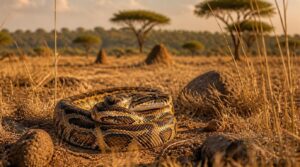
Before you can build a great enclosure, you need to know where these snakes actually come from. Ball pythons aren’t rainforest dwellers like many people assume, and their native range shapes almost every care decision you’ll make.
Getting their habitat dimensions right matters just as much, so it’s worth using a ball python enclosure size calculator to match the setup to your snake’s actual length and needs.
Let’s break down their wild distribution, starting with West Africa and moving into Central Africa.
West African Range
Across West Africa, ball pythons range from Senegal to Ghana, thriving in the West African savanna near riverine corridors. Consider what defines their home:
Their habit of curling into a tight ball when threatened is only one of many traits covered in this ball python species profile, which explains their habitat, behavior, and care needs.
- Savanna-forest edge mosaics
- Termite mounds for shelter
- Rodent-rich farmlands
- Riparian belts along the Gambia and Niger
- Hiding spots in leaf litter
You’ll see humidity levels of 60–80% and a natural thermal gradient here.
To recreate that warm basking side of the gradient indoors, a reptile thermostat heat mat keeps temperatures steady and safe.
Central African Range
Keep moving east from Ghana and you’ll reach the Central African Range, spanning the Congo Basin.
| Feature | Detail | Your Takeaway |
|---|---|---|
| Elevation | 200–800 m | Stable warmth |
| Shelter | Leaf litter, logs | Ground hides |
| Corridors | Riparian edges | Climbing options |
| Humidity | 50–60% dry season | Mist regularly |
| Activity | Dusk peaks | Feed evenings |
Here, unlike West Africa, forests dominate, so build a proper thermal gradient with strong nighttime cooling.
Aiming for nighttime lows in the low 70s works well here, and our guide to safe nighttime temperatures for snakes covers how to fine-tune that drop without overshooting.
Ball Python Habitats: Savannas, Forest Edges, and Farmland
Knowing the range is only half the picture. What matters just as much is the kind of ground a Ball Python actually lives on, and it’s more varied than most keepers expect.
The classic setting is a savanna grassland, where seasonal fires clear old growth and spark fresh herbaceous shoots. That new growth pulls in rodents, and the snakes follow. During the dry season, they retreat into burrows and termite mounds, which hold moisture when the surface bakes at 25–32°C.
Many of these sheltering species, from puff adders to cobras, are covered in this overview of snake habitats across Africa.
Forest Edges are another favorite. Canopy gaps create humidity gradients, and fallen logs, vine tangles, and hollow trees give a ball python shade and ambush cover. Edge zones concentrate prey, so activity clusters there. A sturdy cork bark hide cave recreates that hollow-log shelter, giving your ball python the same secure ambush cover it would seek in the wild.
Don’t overlook Farmland interfaces either. Hedgerows, ditch banks, and crop fields offer rodent-rich corridors, which is why so many wild-caught animals historically came from disturbed habitats. The Ball Python Natural Habitat is really a patchwork, and that flexibility is your biggest takeaway as a keeper.
Climate and Seasonal Conditions in Their Natural Habitat

Ball pythons come from a part of Africa where the weather swings between two very different seasons, and that rhythm shapes almost everything they do. If you want to understand why your snake behaves the way it does, you’ll need to grasp the wet and dry seasons it evolved with.
Let’s look at what the climate looks like in their home range, starting with those seasonal shifts.
Wet and Dry Seasons
Picture it: April storms roll across the savanna, and a ball python slips from its refuge into warm, damp night air. In the wild, its year splits into two acts.
The wet season (April–October) brings temporary pools, hunting opportunities, and cooler storm nights. The dry season pushes it toward streamside refuges. You’ll mirror this rhythm at home with a moist hide box during sheds.
Temperature and Humidity Patterns
At the center of ball python care lies a simple truth: their wild climate is steady. A proper Thermal Gradient of temperatures between 75-92F lets them thermoregulate naturally.
- Humidity Control should mirror seasonal swings, targeting humidity levels of 50-60%
- Burrow-like hides hold stable 26-30°C microclimates
- Post-rain humidity spikes trigger shedding and activity
Shelter, Activity, and Hunting in The Wild

At dusk, ball pythons leave their burrow shelters and slip into the open, and you can learn a lot from that rhythm. Their nocturnal lifestyle keeps them safe from heat and hungry eyes, while their patience does the hunting for them.
They’re classic ambush predators. Instead of chasing prey, a ball python coils near a rodent trail or termite mound and waits, sometimes for hours, until a lizard or small mammal wanders close enough to strike. Scent and camouflage do most of the work.
Here’s how their wild habits break down:
| Behavior | What It Looks Like |
|---|---|
| Shelter use | Rodent burrows, rock crevices, termite mounds |
| Activity | Peak movement after dark, brief daytime forays |
| Hunting | Patient ambush on rodents, lizards, birds |
| Seasonal shifts | Relocates shelters to track humidity and prey |
Notice the pattern: security first, then opportunity. That’s the blueprint you’ll want to recreate at home.
How Natural Habitat Shapes Ball Python Care

Close your eyes and stand at a Ghanaian forest edge at dawn: damp leaf litter underfoot, a burrow mouth breathing cool air, warmth already building on an exposed mound. That’s the environment your ball python’s body expects, and you can rebuild it in a vivarium.
Here’s what matters most:
- Layered substrate deep enough for burrowing, at least 4 inches
- A thermal gradient from a 90°F basking spot down to a 78°F cool zone
- Multiple hides on both warm and cool ends
- Humidity held around 60%, rising during simulated wet seasons
- Scattered cover, cork bark, and brush to encourage natural foraging
I’ve watched shy feeders transform once their enclosure mimicked these wild rhythms. Match the habitat, and the behavior follows.
Match the wild habitat, and even shy feeders transform—their natural behavior follows
Frequently Asked Questions (FAQs)
Where do ball pythons live naturally?
Where do ball pythons live naturally? They’re native to West and Central Africa, from Sierra Leone through Ghana, Nigeria, and Cameroon. You’ll find these burrowing snakes in open grasslands, savannas, and forest edges, where temperatures hover between 75 and 95°F.
What snake is worth $100,000?
The lavender albino ball python has sold for around $100,000. Rare morphs reach these prices when breeders first prove out a genetic trait, and prices drop as supply catches up.
What is the best habitat for a ball python?
What is the best habitat for a ball python? A spacious enclosure with a proper heating gradient, secure hides, and 50–70% humidity. Your tank setup needs 3–6 square feet, 75–95°F temperatures, and naturalistic substrate.
Is 70 degrees too cold for a ball python at night?
Yes, 70°F is too cold. Ball pythons need nighttime temperatures between 75-92F, with sustained drops below 75 causing lethargy and reduced feeding. Maintain a proper thermal gradient and humidity levels of 50-
Where are ball pythons found in the wild?
Picture a farmer in southeastern Nigeria lifting a sheet of tin and finding a python coiled beneath. Ball pythons live across the SubSaharan Region, from Senegal and Ghana through Cameroon into the Congo Basin, favoring savanna habitat edges, grasslands, and farmland.
Are ball pythons tropical or desert?
Ball pythons are neither strictly tropical nor desert animals. They’re savanna specialists, living in African grasslands and forest edges with moderate humidity and temperatures. When you set up your Enclosure, replicate that middle ground, not a rainforest or arid basin.
Where do ball pythons naturally live?
Ball pythons call the Sub-Saharan region home, stretching from West Africa’s Guinea and Ghana eastward into Chad and the Congo. Their natural habitat spans savannas, open forests, and farmland edges, where loose soil and termite mounds offer shelter.
What is the ideal ball python natural habitat?
What is the ideal ball python habitat? Think warm savanna edge: grasslands and open woodland with daytime temps of 75–95°F, humidity around 50–60%, a humid hide, secure burrow-like retreats, and nearby water for your nocturnal hunts.
Are ball pythons common in the wild?
In much of their geographic distribution, ball pythons are common, though patchy. Across the subSaharan region, Python regius thrives in savannas and forest edges, with local densities rising where shelter and prey concentrate.
How do ball pythons camouflage themselves?
Camouflage is your superpower. Your irregular blotches and saddles break up your outline against bark, leaf litter, and shadows. You stay motionless for hours, align with substrate textures, and favor shadow-rich hiding spots like burrow entrances.
Conclusion
Picture a snake slipping out of a termite mound at dusk, the air thick after the first rains, grass still dripping. That’s the world your ball python carries in its genes.
The ball python natural habitat isn’t a jungle, and it isn’t a glass tank; it’s a patchwork of burrows, cover, and warmth. Recreate that patchwork, and you’ll watch your snake thrive.
Match the wild, and captivity stops feeling like confinement.