This site is supported by our readers. We may earn a commission, at no cost to you, if you purchase through links.

Pick up a ball python and flip it over, and you won’t find anything as obvious as what you’d see on a dog or cat. Snakes hide their reproductive anatomy inside the tail, tucked behind a single vent. That’s why so many new owners guess wrong, sometimes for years.
Here’s the good news: your snake is still giving you clues, you just need to know where to look. Tail length, thickness, taper, even the number of scales past the vent can point you toward an answer. Some methods take seconds. Others require a steady hand, patience, or a trip to the vet.
If you’re wondering how can you tell the gender of a snake without guesswork or unnecessary stress on your pet, the steps ahead walk you through exactly what to check, in the right order, starting with what your snake’s species and age can already tell you.
Table Of Contents
- Key Takeaways
- What to Know Before Sexing Your Snake
- You Can Tell by Tail Shape or Professional Sexing
- How to Check Snake Gender Step-by-Step
- Species-Specific Male and Female Differences
- Professional Snake Sexing Methods and Safety
- Frequently Asked Questions (FAQs)
- How can I identify a male and female snake?
- How is snake gender determined?
- How to get a snake sexed?
- How to tell a snakes gender by its tail?
- How can you tell if a snake is a boy or girl?
- How to tell a ball python’s gender?
- What are gender differences in snakes?
- Is snake masculine or feminine?
- Do snakes change gender based on temperature?
- How often should snakes be checked for gender?
- Conclusion
Key Takeaways
- Snakes hide their reproductive anatomy inside the tail, so you’ll need to check tail length, thickness, and taper past the vent rather than looking for obvious external differences like you’d see on a dog or cat.
- Males typically have longer, thicker tails that taper gradually (30-40% of tail length) because they house internal hemipenes, while females taper more abruptly (within 10-15%) and have shorter tails.
- Visual clues like tail shape only offer educated guesses, since sexing accuracy depends on species, age, and sexual maturity; only professional methods like cloacal probing, hemipene popping, or ultrasound can confirm a snake’s sex with certainty.
- Always handle your snake calmly and never force the tail during examination, as stress or injury can both harm your pet and throw off your results.
What to Know Before Sexing Your Snake

Before you flip your snake over and start looking for clues, it helps to know a few ground rules first. Sexing a snake isn’t a one-size-fits-all process, and rushing in without context can lead you astray. Here’s what you need to keep in mind before you begin.
Once you’ve confirmed your snake’s sex, you’ll want to dig into corn snake breeding essentials to see how that knowledge actually shapes your next steps.
Species Affects Sexing Accuracy
No single trick works across every species, so don’t expect a universal sexing method. Ball pythons, rat snakes, anacondas, and European adders each show different clues, from spur size to scale counts. Molecular sexing helps in roughly 4,000 species, but fails where temperature determines sex. Scale patterns and coloration vary too, so always research your snake’s specific species first.
In many species, males possess longer tails than females of the same body length, since the extra length accommodates their internal hemipenes.
Age Changes Visible Differences
A hatchling and a five-year-old adult won’t show the same clues, even within one species. Juvenile tail length differences stay subtle, and subcaudal scale width, hemipenal bulge appearance, and cloacal vent enlargement only become obvious after sexual maturity. Growth rate divergence between sexes adds further confusion early on.
Wait until your snake matures before trusting sexual dimorphism in tail shape or thickness.
Handle Your Snake Calmly
Once your snake’s mature enough to check, your next move is getting it calm in your hands, since a stressed snake tenses its tail and hides the very clues you’re after.
- Approach from the side, shoulders level
- Support the midsection with both hands
- Speak softly, move slowly
- Let it explore your wrists
- Return it gently afterward
Calm handling makes accurate sexing possible.
Never Force The Tail
Once your snake’s calm, resist the urge to straighten that tail yourself. Forcing the tail can injure the cloaca, bending or twisting tissue you’re trying to inspect. It also spikes stress, sometimes causing lasting behavioral changes.
If you feel resistance, stop. That’s your cue to reassess, not push. Gentle tail support protects your snake and keeps your sexing results accurate.
Visual Clues Are Estimates
Think of visual sexing as an educated guess, not a verdict. Tail length variation, tail shape differences, and cloacal vent ambiguity all shift with growth, so:
- Age skews proportions
- Species alters norms
- Size growth influences taper
- Coloration hints mislead
- Cloacal spur presence varies
Sexual dimorphism helps, but only probing or hemipene checks confirm gender reliably.
For a closer look at how tail thickness and probe depth translate into a reliable read, this ball python sex determination guide walks through the process step by step.
You Can Tell by Tail Shape or Professional Sexing
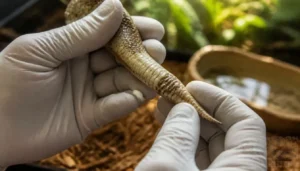
Once you know what to look for, tail shape becomes your first real clue. It won’t give you a guaranteed answer on its own, but it’s a solid starting point before turning to more precise methods. Here’s what to check, from simple visual cues to professional confirmation tests.
Males Often Have Longer Tails
Why do male tails stretch on longer than expected? Male tail morphology hides hemipenes, the internal reproductive organs needing extra room. This drives real sexual dimorphism in tail shape between male snakes and female snakes.
Boas and pythons often show this clearly, tails accounting for a noticeable chunk of posterior length, useful early in snake sex determination before checking ventral tail ratio.
Females Usually Taper Sooner
Look closely past the vent and you’ll notice a quicker taper in female snakes, a clear sign of snake tail morphology at work. Earlier tail tapering reflects the female tail base, which stays fairly uniform before narrowing.
Check cloacal vent position and subcaudal scale count. Without hemipenes, there’s less need for length, so the tail base width shrinks sooner, a subtle but reliable form of sexual dimorphism.
Tail Thickness Offers Clues
A gentle pinch near the vent tells a story, if you know how to read it. Tail base musculature builds up in males housing hemipenes, creating firmer, thicker tissue than the smoother female taper.
Watch for: 1) cloacal vent thickness, 2) subcaudal scale depth, 3) tail diameter consistency.
Age-related tail growth makes this sexual dimorphism clearer in adults than hatchlings.
Anatomy Tests Confirm Sex
Ready for certainty? Skip guesswork and let trained hands confirm it. Cloacal probing checks probe insertion depth, males allow 9-15 subcaudal scales, females only 1-3.
| Method | What It Shows | Who Performs It |
|---|---|---|
| Probing | Depth via probe kit | Professionals |
| Hemipene palpation | Confirms male anatomy | Experts |
| Ultrasound | Imaging reproductive organs | Veterinarians |
These techniques deliver real sex determination accuracy, unlike guesswork alone.
Species Differences Matter
No two snake species read the same way. Tail bulge varies widely, some show it clearly, others barely at all. Scale morphology, geographic variation, and mating season all shift what you see. Boas differ from colubrids, which differ again by population.
That’s why tail shape alone can’t replace cloacal probing for real sexual identification in herpetology.
How to Check Snake Gender Step-by-Step
Now it’s time to put what you’ve learned into practice with your own snake. This process works best when you move through it in order, one step at a time. Here’s exactly how to check, from start to finish.
Identify Species and Age

Before touching your snake, nail down two things: species and age. Species identification determines which sexing methods even apply, since spurs work for boas but not colubrids.
Young snakes often lack visible dimorphism until sexual maturity hits, so a juvenile ball python may show no reliable clues yet. Check breeder records or growth patterns to estimate age first.
Locate The Cloacal Vent
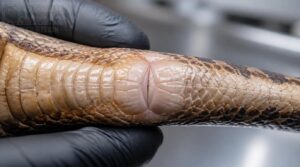
Once you know the species and age, find the vent, a single slit on the ventral midline marking the cloaca.
- Sits within the last 25% of body length
- Slightly glossy versus matte dorsal scales
- Flanked by wider final ventral scales
- Faint groove often trails toward the tail
- Located just anterior to any cloacal spurs
Use bright lighting and support the body for safe vent examination.
Examine Post-Vent Tail Length
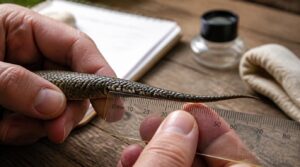
With the vent located, measure straight back to the tail tip in centimeters, that’s your post-vent tail length. Pair it with snout-vent length for a proper tail-body ratio.
Growth rate differs by sex: males add roughly 0.142 cm per SVL unit, females only 0.086 cm. Stretch gently and stay consistent for reliable sexing results.
Compare Thickness and Taper
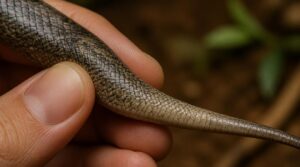
Once you’ve got your ratio, run your fingers gently along the tail base. Hemipenis width (2-4mm) creates real thickness in males, tapering only after 30-40% of tail length. Female snakes show abrupt tapering within 10-15%.
Check subcaudal plate shape too, males run longer, more elongated scales, tied to body mass correlation and growth rate divergence.
Record Clues Without Probing

Why write things down instead of trusting memory? Because sex clues are subtle, and comparing notes over weeks reveals patterns single glances miss.
Track four things:
- Tail base thickness and taper distance
- Vent scale patterns and any irregularities
- Body girth ratios near the cloaca
- Age and shed history
Never force a cloacal examination. Non-invasive observation, recorded consistently, beats guessing every time.
Species-Specific Male and Female Differences

No two snake species read quite the same way. Spurs, size, and coloring all shift depending on what’s coiled in front of you. Here’s what to look for once you know the species you’re working with.
Compare Boa and Python Spurs
Those tiny claw-like bumps near the vent, called anal spurs, tell a story if you know how to read them.
Spur size differences show up clearly between boa and python species. Boas often flash larger, more visible spurs, while pythons often keep theirs small and subtle.
Male spur prominence usually beats females’, but always confirm with other clues.
Consider Adult Size Differences
Size tells its own story once your snake reaches sexual maturity. In anacondas, females grow roughly 4.7 times larger than males, while female rat snakes run about 14% smaller than males, proof that size patterns flip by species.
Track growth rate and adult length for enclosure size planning, prey size requirements, and body girth assessment, since seasonal fasting patterns are normal in larger adults.
Check Species-Specific Coloration
Color can whisper a snake’s gender, if you know which species to trust. Male dorsal patterns often run bolder, while female ventral hues stay muted. Watch for:
- Vivid male stripes in garter snakes
- Dichromatic adders with sex-linked colors
- Seasonal color shifts during breeding
Check tail base contrast and iris color too, but remember coloration clues are species-dependent, never universal for sexing.
Treat Behavior as Unreliable
Ever watched a "male" snake act aggressive, only to find out it’s a defensive female? Behavioral differences fool even experienced keepers.
A defensive female snake can look just as aggressive as a male, fooling even experienced keepers
Stress alters behavior, and individual variation matters more than sex.
Tail flick ambiguity and probe response inconsistent results mean posturing lies. Even hemipenes checks via probing or ultrasound beat guessing games.
Environmental influences skew everything, so never trust sexing on temperament alone.
Account for Sexual Maturity
A juvenile’s tail won’t reveal much, since sexual maturity changes everything. Maturity timing factors vary by species, diet, and temperature, so patience matters.
Watch for growth spurt indicators and puberty onset signs, like hormonal shift patterns triggering visible tail and vent changes. Age verification methods help confirm readiness.
Skip probing or checking hemipenes and reproductive organs near the cloaca until your snake’s mature. Sexing too early risks harm and unreliable results.
Professional Snake Sexing Methods and Safety

Sometimes the safest bet is to leave sexing to someone with hands-on training. Professionals use specific tools and techniques that go beyond what you can safely try at home. Here’s a look at the methods vets and experienced breeders rely on.
Cloacal Probing by Professionals
When visual clues fall short, trained professionals turn to cloacal probing, the most reliable method for sexing snakes.
Using lubricated stainless steel probes, they gently insert into the vent and apply depth scale counting: males show 8-16 subcaudal scales, females less than 6.
- Probe sanitation
- Sulcus identification
- Scale counting
- Written documentation
This requires professional certification and steady hands, never force.
Hemipene Popping by Experts
Probing gives a good estimate, but hemipene popping offers a more direct look. An expert applies gentle pressure near the tail base, causing brief hemipenal protrusion in males, nothing appears in females.
This differs by species, since boas and pythons show distinct swelling patterns. Experts document findings and monitor for swelling afterward, swelling patterns. Experts document findings and monitor for swelling afterward, keeping welfare and gentle handling the top priority throughout.
Ultrasound for Visual Confirmation
When popping feels inconclusive, ultrasound settles the question. This diagnostic ultrasound uses transabdominal scanning to view gonadal tissue directly, spotting hemipenes or ovarian follicles without entering the body.
Real-time hemipene detection during the scan confirms males, while Doppler flow assessment checks reproductive maturity. It’s non-invasive, doesn’t require anesthesia, and gives you visual confirmation most methods can’t match.
Review Reliable Breeder Records
Buying from a breeder? Skip the guesswork entirely. Ask for health clearance verification, litter documentation review, and genetic diversity metrics showing planned pairings. Reliable records already state snake sex identification, confirmed through professional methods, not assumptions.
Reputable breeders offer post-sale support and welcome reference checks. That paper trail beats any tail-taper guess, especially once sexual maturity and breeding history come into play.
Consult a Reptile Veterinarian
When in doubt, let a professional settle it. A qualified reptile veterinarian offers accurate gender determination using cloacal probing technique, ultrasound, or other veterinary imaging.
Check a reptile vet directory for proper vet selection criteria and low-stress handling. Cost of exams usually runs $75–150, though diagnostic tools used for imaging can run higher.
Frequently Asked Questions (FAQs)
How can I identify a male and female snake?
Snakes don’t wear labels, but their bodies do the talking. Check tail base bulge, ventral pore size, and size dimorphism ratio. Look for color pattern differences and courtship behavior signals too, since hemipenes near the cloaca confirm true gender.
How is snake gender determined?
Vets and keepers rely on cloacal probing, hemipene eversion, tail shape, size dimorphism, and behavior. For certainty, ultrasound imaging or checking subcaudal scales and cloacal spurs settles the question when visual clues alone leave you guessing.
How to get a snake sexed?
A reptile veterinarian offers the safest route for reptile sexing, using cloacal probing or ultrasound imaging. Experienced breeders may try hemipene eversion, but skip behavioral cues or size dimorphism guesses since they’re unreliable without proper training.
How to tell a snakes gender by its tail?
Check the hemipenal bulge just past the cloaca. Males show a thicker base, gradual tail taper angle, and longer tail length ratio, often 9-15 subcaudal scales. Females taper quickly within 1-3 scales, revealing clear morphological differences.
How can you tell if a snake is a boy or girl?
Look for tail thickness, vent anatomy, cloacal spur observation, and subcaudal scales after the vent. For professionals compare vent scale count, use probing or popping, and confirm males with probe depth measurement and hemipene eversion.
How to tell a ball python’s gender?
Before you guess, compare tail thickness, Tail base width, Vent scale morphology, and Subcaudal scale count past the cloaca; males show tails from hidden hemipenes, while Hemipene palpation or probing with probe kit confirms sex.
What are gender differences in snakes?
Males often show cloacal spurs, larger anal pores, longer thicker tails, and visible hemipenes during cloaca probing.
Females show sexual size dimorphism, color pattern differences, and no reproductive organ visibility, though species may reverse sizes.
Is snake masculine or feminine?
Like calling rain brave, calling a snake masculine or feminine misses the point: in English, snake has no linguistic gender. A snake’s biological sex is male or female, identified by anatomy as hemipenes and cloaca.
Do snakes change gender based on temperature?
Snakes don’t swap gender by temperature. Genetic gender basis sets male and female development. Temperature sex determination, incubation temperature effects, environmental sex influence, and sex reversal reptiles exclude snakes, which lack sequential hermaphroditism and hemipenes.
How often should snakes be checked for gender?
Timing truly matters here. Wait for sexual maturity, usually 12 to 24 months, before a full check. After that, one accurate assessment during annual health exams usually suffices unless you’re breeding or growth monitoring reveals unclear vent anatomy.
Conclusion
Good things come to those who look closely, and your snake is no exception. Now you know how can you tell the gender of a snake: check tail taper, thickness, and length before trusting guesswork. Visual clues offer solid estimates, but only a vet’s probe or pop confirms sex with certainty. Handle gently, record what you observe, and let patience guide your hands. Your snake’s tail was quietly answering all along.