This site is supported by our readers. We may earn a commission, at no cost to you, if you purchase through links.

Your ball python lives almost entirely inside that enclosure. That’s not a guilt trip, it’s a design brief. A poorly built vivarium stresses your snake, complicates your routine, and looks terrible on your shelf.
Ball python vivarium setup ideas flood the internet, but most skip what matters: substrate depth for burrowing, humidity targets for clean sheds, materials that won’t warp or off-gas. Ammonia from urates hits harmful levels in under 48 hours, so design choices shape how easy it is to keep things clean.
From bioactive builds to desert enclosures layered with cork bark and terracotta, the right setup is worth building once and building right.
Table Of Contents
- Key Takeaways
- Ball Python Vivarium Themes to Inspire Your Setup
- Choosing The Right Enclosure Size and Material
- Creating a Naturalistic or Bioactive Ball Python Habitat
- Top 10 Products for a Ball Python Vivarium
- 1. JW Pet Hol EE Roller Dog Toy
- 2. Zoo Med Reptile Bulb Combo
- 3. Zoo Med Excavator Clay Burrow Substrate
- 4. Zilla Reptile Rock Lair Hideout
- 5. Anoak Artificial Succulent Plants
- 6. Lucky Herp Reptile Heat Lamp Bulbs
- 7. Fluker’s Reptile Corner Bowl
- 8. Exo Terra Reptile Water Dish
- 9. ReptiEarth Coconut Fiber Reptile Bedding
- 10. Orchid Valley Reptile Hide Log
- Keeping Your Ball Python Vivarium Clean, Secure, and Enriching
- Frequently Asked Questions (FAQs)
- What is a holy grail ball python?
- What are some creative decor ideas for a snake terrarium?
- What is the perfect enclosure setup for a ball python?
- What are some enrichment ideas for ball pythons?
- What do ball pythons like in their enclosures?
- What is the best tank set up for a ball python?
- What can I put in my ball python enclosure?
- How to mentally stimulate a ball python?
- Do ball pythons like fake plants?
- What are the enrichment ideas for snakes?
- Conclusion
Key Takeaways
- Ammonia from urates reaches harmful levels in under 48 hours in a sealed enclosure, making daily spot-cleaning the minimum standard, not an optional habit.
- Ball pythons can live over 30 years in captivity, so every material and design decision you make at setup compounds across decades of daily husbandry.
- A functional adult enclosure requires at least 36 inches in length, 2-4 inches of substrate for burrowing, and humidity held consistently between 50-70% to support clean, complete sheds.
- Bioactive setups using isopods and springtails create a self-regulating waste cycle that reduces cleaning frequency while naturally stabilizing humidity gradients across the enclosure.
Ball Python Vivarium Themes to Inspire Your Setup
Because your ball python spends most of its life in a vivarium, the theme sets the tone for every husbandry decision you’ll make. Start with a desert-inspired palette: warm terracotta tones, cork bark climbing features, and a coconut fiber and orchid bark substrate that looks authentic and cleans easily.
For more ways to bring your setup to life, ball python habitat decoration ideas can spark creative combinations that keep the enclosure visually dynamic and stimulating for your snake.
If you want something more lively, a bioactive vivarium setup uses live plants and microfauna to cycle waste and regulate humidity naturally. It’s truly rewarding to maintain and it genuinely looks stunning.
For a leaner build, lean into a naturalistic reptile enclosure with driftwood verticals, rock hides, and deciduous décor you rotate every four to six weeks. Your ball python habitat doesn’t need to be complicated. It needs to be intentional.
Your ball python habitat doesn’t need to be complicated — it needs to be intentional
Choosing The Right Enclosure Size and Material
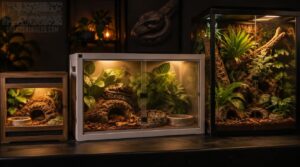
Your enclosure choice sets the foundation for everything else. Size, material, and build quality all directly affect your python’s health, your humidity control, and your long-term maintenance load. Here’s what you need to know before you buy.
Adult Enclosure Dimensions
For an adult ball python, your enclosure size starts at 36 inches in length and a width of 18 to 24 inches for proper thermoregulation.
Height matters too. Aim for 12 to 18 inches so your python’s got room to climb. Round it out with 2 to 4 inches of substrate for burrowing, and your vivarium design is already solid.
PVC Enclosure Benefits
Once you’ve nailed your dimensions, consider PVC enclosures for your vivarium setup. They’re up to 40% lighter than dense wood composites, with moisture-resistant, non-porous surfaces that clean fast and won’t warp in humid conditions.
Gasketed joints seal tight. Thermal insulation stays uniform across the panel, cutting hot spots. You can dial in custom enclosure sizes to match your exact interior layout.
Custom Wood Options
Wood gives your vivarium setup something PVC never will: character. For a naturalistic vivarium, custom wood options match dimensions and finishes to your exact build.
- Sealed maple or beech veneers resist warping under enclosure humidity
- Epoxy or polyurethane coatings block moisture at substrate level
- Low-VOC water-based finishes minimize off-gassing for your ball python
- FSC-certified hardwoods hold steady through long humidity cycles
Glass Tank Considerations
Glass tanks look great in any ball python vivarium, but they demand more work than PVC. Heat escapes faster through glass walls, so nail your thermal gradient setup and watch for condensation, which signals humidity or ventilation problems. Reflections stress shy snakes; a matte back panel cuts the glare. Check your silicone seams regularly to prevent leaks and escapes.
Creating a Naturalistic or Bioactive Ball Python Habitat
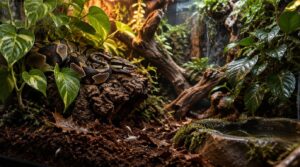
Step into naturalistic design and your ball python vivarium becomes a living system, not just a box. A bioactive setup layers coconut fiber, leaf litter, and reptile-safe soil to create humidity gradients your snake will actually use. Add isopods and springtails to break down waste naturally and keep the floor tidy between deep cleans.
For a naturalistic vivarium, think in microclimates. Pothos and ficus handle low light and high humidity without giving up on you. Aim for five to seven vivarium plants in a 60-80 cm enclosure to build real canopy cover. Cork bark, driftwood, and resin hides give your snake climbing options and a place to disappear.
Keep humidity control tight at 50-70% with adjustable venting and a hygrometer near the warm end.
A dedicated reptile vivarium humidity controller takes the guesswork out of maintaining that sweet spot automatically.
Top 10 Products for a Ball Python Vivarium
Getting the right gear makes every part of this easier. These 10 products cover the essentials—substrate, hides, lighting, and water dishes—so you’re not guessing what your snake actually needs. Pick what fits your setup and build from there.
1. JW Pet Hol EE Roller Dog Toy
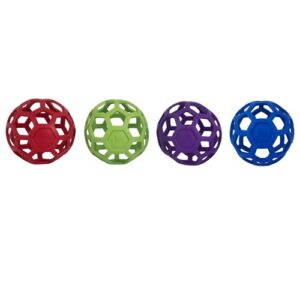
Sounds weird, but stick with it. The JW Pet Hol EE Roller is technically a dog toy, and it works surprisingly well inside a ball python enclosure. The open rubber lattice gives your snake something to investigate, nose into, and push around. That’s low-key enrichment that won’t overstimulate a species that genuinely prefers slow, deliberate exploration.
It’s made from natural rubber, it’s non-toxic, and it measures 7.5 inches across, so it fits comfortably in most mid-size setups without crowding the layout. Cleaning is simple: warm soapy water, rinse, dry completely before placing it back in.
One thing to stay on top of: check it regularly for cracks or splitting. Damaged rubber can snag or splinter, and either scenario creates a real hazard inside the vivarium. Swap it out the moment it shows wear.
| Best For | Ball python owners looking for an affordable, non-toxic enrichment object that encourages natural exploratory behavior without overwhelming a slow-paced reptile. |
|---|---|
| Material | Natural Rubber |
| Primary Use | Enrichment Toy |
| Indoor Use | Yes |
| Pet Safety | Yes |
| Maintenance Level | Low |
| Vivarium Role | Enrichment Zone |
| Additional Features |
|
- Made from natural rubber, so it’s non-toxic and safe to place inside a vivarium with no chemical concerns
- At 7.5 inches across, it fits comfortably in most mid-size enclosures without eating up valuable floor space
- The open lattice design invites investigation and gentle pushing, giving your snake low-stimulation mental engagement
- Requires regular inspection for cracks or splitting, since damaged rubber can create snagging or splintering hazards inside the enclosure
- Designed as a dog toy, so longevity in a reptile-specific context isn’t guaranteed or tested by the manufacturer
- Cleaning and drying must be thorough before returning it to the vivarium, adding a small but consistent maintenance step
2. Zoo Med Reptile Bulb Combo
Ball pythons spend roughly 18 hours a day inactive, so temperature consistency matters more than most keepers realize. Get your thermal setup wrong and you’ll see feeding refusals, sluggish behavior, and stress fast.
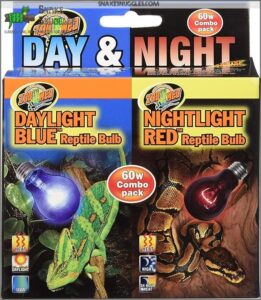
The Zoo Med Reptile Bulb Combo takes the guesswork out of that. One box delivers two 60-watt glass bulbs: a Daylight Blue for daytime warmth with UVA support, and a Nightlight Red for overnight heat that stays dim enough to leave your snake’s sleep cycle alone. Both use a standard E26/E27 socket, but confirm your fixture’s wattage rating first.
UVA isn’t just for lizards; it helps psychological health in snakes too, making daytime behavior more natural.
Don’t run either bulb without a thermostat. Unregulated temperatures creep higher than your ball python needs, fast.
| Best For | Reptile keepers who want a single, affordable solution for round-the-clock temperature management for both day-active and night-active species. |
|---|---|
| Material | Glass |
| Primary Use | Reptile Heating |
| Indoor Use | Yes |
| Pet Safety | Yes |
| Maintenance Level | Low |
| Vivarium Role | Temperature Control |
| Additional Features |
|
- Covers a full 24-hour heating cycle with one purchase — the blue bulb handles daytime warmth while the red keeps overnight temps stable without disturbing sleep.
- Both bulbs emit UVA light, supporting natural behavior and psychological wellbeing beyond just physical heat needs.
- Standard E26/E27 base means they’ll fit most common reptile lamp fixtures without an adapter.
- Durability is hit or miss — some users report a shorter lifespan than expected for the price.
- Heat output may fall short for larger enclosures or species with higher temperature demands.
- Not universally compatible with all fixtures, so wattage and socket ratings need checking before purchase.
3. Zoo Med Excavator Clay Burrow Substrate
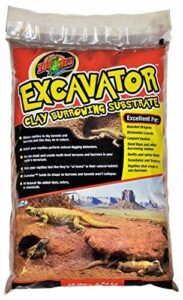
Think of it as moldable terrain in a bag. Mix the Excavator Clay with water, shape your burrows, ledges, or cave entrances, then let it cure. Once dry, it holds firm enough that tunnels won’t collapse under your snake’s weight. That security matters for a species that treats tight spaces as stress relief.
Pack entrances firmly when sculpting. Soft, collapsible mouths can trap your snake and defeat the whole purpose. Layer coconut fiber or cypress mulch on top too, since this substrate doesn’t retain humidity well on its own. Target 60-70% relative humidity to keep the structure stable.
One 10 lb bag works for smaller builds. Larger enclosures will need two. Check for cracks weekly and repair them by dampening and compacting the clay before a small breach turns into total collapse.
| Best For | Reptile keepers who want to create naturalistic, structured environments with custom burrows, caves, and ledges for species like bearded dragons, leopard geckos, and burrowing snakes. |
|---|---|
| Material | Clay |
| Primary Use | Substrate Sculpting |
| Indoor Use | Yes |
| Pet Safety | Yes |
| Maintenance Level | Moderate |
| Vivarium Role | Substrate Layer |
| Additional Features |
|
- Fully moldable and sculptable, letting you design custom tunnels, ledges, and cave entrances that cure into a firm, stable structure
- Once dry, holds its shape well enough to support the weight of reptiles without collapsing
- Compatible with other substrates like coconut fiber or cypress mulch for more complete bioactive setups
- Messy to work with during mixing and shaping, requiring a tarp or prep surface for cleanup
- Doesn’t retain humidity on its own, so additional layers or misting routines are needed to hit target levels
- One 10 lb bag only covers smaller builds — larger enclosures will require multiple bags, adding to cost and prep time
4. Zilla Reptile Rock Lair Hideout
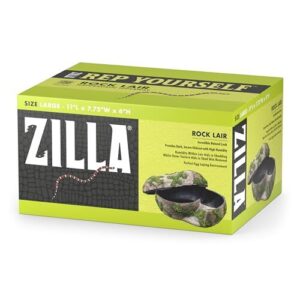
The Zilla Rock Lair is a proper burrow substitute. Its side entrance blocks ambient light so the interior stays genuinely cave-dark, and the rough textured exterior does real work during shedding by giving your snake something to rub against.
Tuck damp sphagnum moss inside and you’ve got a built-in humidity pocket that helps with clean, complete sheds without a separate humid hide cluttering your setup. At 11 x 7.75 x 6 inches, it fits adults comfortably, and the plastic shell wipes down fast, no scrubbing required.
Fair warning: some owners report an odd smell straight out of the box, so rinse it well before introducing your snake. It’s heavier than it looks at 5.51 lbs, but that weight keeps it planted even when your python decides to redecorate.
| Best For | Naturalistic hide with built-in humidity for shedding or egg laying |
|---|---|
| Material | Plastic |
| Primary Use | Reptile Hide |
| Indoor Use | Yes |
| Easy Maintenance | Easy |
| Pet Safety | Yes |
| Weight | 5.51 lbs |
| Additional Features | High humidity retention, rough shedding texture, egg-laying support |
| Best For | Reptile owners who want a naturalistic hide that doubles as a humidity chamber for cleaner sheds, particularly for snakes, geckos, and egg-laying species. |
|---|---|
| Material | Plastic |
| Primary Use | Reptile Hide |
| Indoor Use | Yes |
| Pet Safety | Yes |
| Maintenance Level | Easy |
| Vivarium Role | Hide Zone |
| Additional Features |
|
- The rough exterior texture gives reptiles something to rub against during shedding, making the process easier and more complete.
- A side entrance keeps the interior cave-dark, encouraging natural hiding behavior and reducing stress.
- Plastic construction makes cleaning simple — a quick wipe-down is all it takes.
- Several owners report an unpleasant smell straight out of the box, requiring a thorough rinse before use.
- At 5.51 lbs, it’s heavier than expected and needs careful handling.
- The price point is higher than comparable hides on the market.
5. Anoak Artificial Succulent Plants
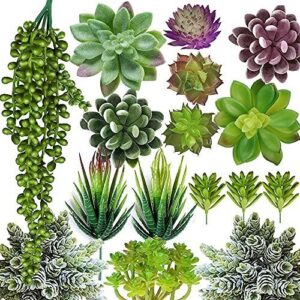
Once the hide’s in place, greenery sells the illusion. The Anoak set gives you 16 faux succulents in assorted sizes, ranging from 1.57 to 5.9 inches wide and up to 13.38 inches long, so you’ve got good options for layering at different depths throughout the enclosure.
They’re made from PVC with a flocking coating that adds real texture and keeps them looking less obviously fake. No watering, no wilting, no light requirements. Tuck them behind rocks, into corners, or alongside the hide.
Before placing them, check each stem for exposed wire ends. And despite the "odorless" label, a handful of buyers report an off-putting smell out of the box, so give them a rinse first. A monthly wipe-down with a damp microfiber cloth keeps them clean without leaving any residue behind.
| Best For | Anyone who wants the look of real succulents without the upkeep, great for vivariums, home decor, or gifting. |
|---|---|
| Material | Plastic |
| Primary Use | Terrarium Decor |
| Indoor Use | Yes |
| Easy Maintenance | Very Easy |
| Pet Safety | Yes |
| Weight | 6.4 oz |
| Additional Features | 16-piece plant set, no watering required, odorless and pet-safe |
| Best For | Anyone who wants realistic-looking succulents without any upkeep, whether for terrariums, vivariums, home decor, or as a low-maintenance gift. |
|---|---|
| Material | PVC Plastic |
| Primary Use | Terrarium Decor |
| Indoor Use | Yes |
| Pet Safety | Yes |
| Maintenance Level | Very Easy |
| Vivarium Role | Decor Layer |
| Additional Features |
|
- 16 pieces in a range of sizes, giving you plenty of options for layering and filling out an enclosure or display
- Flocking coating adds genuine texture, making them look less obviously plastic than typical faux plants
- Zero maintenance — no watering, light, or pruning needed, and they’re safe around pets
- Some buyers report a noticeable odor straight out of the box, despite the "odorless" claim
- A few pieces can run on the smaller side, which may limit where they work effectively
- Realism is hit or miss — some succulents in the set look more convincingly natural than others
6. Lucky Herp Reptile Heat Lamp Bulbs
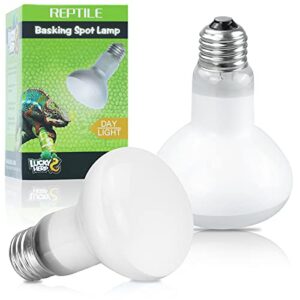
Once the plants are placed, you need to nail the temperature. Lucky Herp’s heat lamp bulbs come in 50W and 100W options, giving you real flexibility depending on your enclosure size.
The 100W version throws a solid basking spot while warming the surrounding air, which is exactly how ball pythons thermoregulate. Mount it 8 to 12 inches from the basking surface, pair it with a thermostat, and keep the warm side between 88 and 92°F. These are daytime-only bulbs; swap to a ceramic heat emitter after lights out so your snake isn’t getting blasted with light through the night.
Worth noting: there’s no UVB output, so keep a dedicated lamp running alongside it. Lifespan is rated at up to 2,000 hours, but early failures are common enough that stocking a spare makes sense.
| Best For | Reptile owners who want a reliable, affordable heat lamp compatible with bearded dragons, turtles, lizards, and other cold-blooded pets. |
|---|---|
| Material | Glass |
| Primary Use | Reptile Heating |
| Indoor Use | Yes |
| Easy Maintenance | Low |
| Pet Safety | Yes |
| Weight | 5 oz |
| Additional Features | 2,000-hour service life, standard E26 compatible, 2-pack value |
| Best For | Reptile owners looking for an affordable, flexible basking lamp compatible with bearded dragons, tortoises, leopard geckos, iguanas, and similar species. |
|---|---|
| Material | Glass |
| Primary Use | Reptile Heating |
| Indoor Use | Yes |
| Pet Safety | Yes |
| Maintenance Level | Low |
| Vivarium Role | Temperature Control |
| Additional Features |
|
- Available in 50W and 100W options, making it easy to match your enclosure size and heating needs
- Emits UVA light that supports natural reptile behaviors like appetite, digestion, and activity
- Fits standard E26 sockets and works with most reptile dome lamps, so setup is straightforward
- Produces no UVB radiation, meaning you’ll need a separate UVB lamp for complete lighting
- Only suitable for daytime use — you’ll need a ceramic heat emitter for overnight warmth
- Early bulb failures are frequently reported, so keeping a spare on hand is a smart move
7. Fluker’s Reptile Corner Bowl
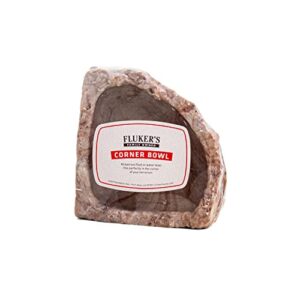
With heat locked down, water’s the next priority. Fluker’s Corner Bowl is built from acacia wood and measures 6 x 5 x 1.5 inches. The squared back sits flush against the corner, keeping the center of the enclosure open for your snake to actually move through.
The organic, earthy design fits right into bioactive or naturalistic setups. At 1.5 inches deep, it’s shallow enough for safe soaking without drowning risk for most adults. Replace water every 2-3 days and wash with reptile-safe detergent. Wood grain holds residue, so rinse thoroughly.
Worth knowing: leakage has been reported by some users, and colors vary between units. Durability feedback is mixed. Inspect it regularly and keep it away from direct heat sources, which can warp the wood over time.
| Best For | Ball python owners wanting a naturalistic corner water dish that doesn’t eat into usable floor space. |
|---|---|
| Material | Acacia wood |
| Primary Use | Water and feeding dish |
| Indoor Use | Yes |
| Easy Maintenance | Moderate |
| Pet Safety | Yes |
| Weight | 14.4 oz |
| Additional Features | Corner-fit design, soaking-friendly depth, organic earthy appearance |
| Best For | Ball python owners who want a naturalistic corner water dish that keeps the center of the enclosure open for movement. |
|---|---|
| Material | Acacia Wood |
| Primary Use | Water Dish |
| Indoor Use | Yes |
| Pet Safety | Yes |
| Maintenance Level | Moderate |
| Vivarium Role | Water Station |
| Additional Features |
|
- Corner-fit design sits flush against the wall, freeing up floor space for your snake to roam
- Acacia wood gives it a natural, earthy look that blends well into bioactive or naturalistic setups
- At 1.5 inches deep, it’s shallow enough for safe soaking without drowning risk for most adult snakes
- Some users have reported leakage issues
- Wood grain can trap residue, requiring thorough rinsing to keep clean
- Durability is inconsistent, and direct heat exposure can warp the wood over time
8. Exo Terra Reptile Water Dish
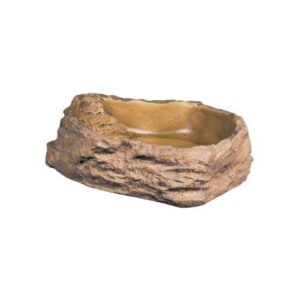
If wood durability concerns you, the Exo Terra Water Dish (PT2803) is a solid alternative. Made from food-grade resin, it’s molded with a textured rock-pool finish that fits naturally into desert, tropical, or jungle setups. The smooth interior makes cleaning fast.
The non-porous surface means bacteria won’t take hold between cleanings. Built-in safety steps keep smaller animals from getting stuck, which is useful for juveniles or mixed-species enclosures. It’s also stable and won’t tip easily. At 8.7 x 6.7 x 2 inches, it fits most adult ball pythons without eating into usable floor space. Keep water depth at 1 to 1.5 inches.
Fair warning: it’s heavy. Lifting it out for routine maintenance takes real effort. Swap water daily in warmer setups, rinse with reptile-safe disinfectant, and dry it completely before replacing the dish.
| Best For | Reptile and amphibian owners who want a water dish that looks natural in the tank and is easy to keep clean. |
|---|---|
| Material | Plastic/Resin |
| Primary Use | Reptile Watering |
| Indoor Use | Yes |
| Easy Maintenance | Easy |
| Pet Safety | Yes |
| Weight | 1 kg |
| Additional Features | Anti-drowning safety steps, food-grade resin build, non-porous bacteria prevention |
| Best For | Reptile and amphibian owners who want a water dish that blends into their tank’s natural aesthetic while staying easy to clean and safe for smaller or juvenile animals. |
|---|---|
| Material | Resin |
| Primary Use | Water Dish |
| Indoor Use | Yes |
| Pet Safety | Yes |
| Maintenance Level | Easy |
| Vivarium Role | Water Station |
| Additional Features |
|
- Non-porous resin surface resists bacteria buildup between cleanings, keeping water safer for longer.
- Built-in safety steps help smaller animals and juveniles escape the water, reducing drowning risk.
- Stable, tip-resistant base and a natural rock-pool look that suits desert, tropical, and jungle setups alike.
- Heavier than most water dishes, making routine removal and cleaning more physically demanding.
- Actual dimensions may differ slightly from what’s listed, so sizing can be hit or miss.
- Too shallow for large reptiles that need deep soaks, limiting its use as animals grow.
9. ReptiEarth Coconut Fiber Reptile Bedding
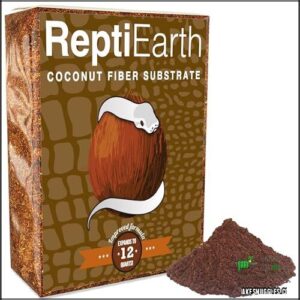
Substrate is one of those decisions that quietly shapes everything else in your vivarium. ReptiEarth’s coconut fiber uses a 70-30 micro-to-small strand mix that stays loose and fluffy instead of compacting under hides and decor over time.
It comes triple-washed, dust-free, and ready straight from the bag. No rinsing, no prep. Run it dry to hold moderate humidity, or mist it lightly to dial in that 60-80% humidity range ball pythons need through shed cycles. It controls both without complaint.
Spot cleaning takes minutes, and the natural fibers actively suppress odor between full substrate changes every two to four weeks. This substrate also integrates well into bioactive setups, which adds real long-term value. Just don’t over-moisten it, or you’ll spike humidity well past what your snake actually needs.
| Best For | Reptile and amphibian keepers who want a ready-to-use, natural substrate that supports burrowing behavior and reliable humidity control in tropical or bioactive setups. |
|---|---|
| Material | Coconut Fiber |
| Primary Use | Reptile Substrate |
| Indoor Use | Yes |
| Pet Safety | Yes |
| Maintenance Level | Easy |
| Vivarium Role | Substrate Layer |
| Additional Features |
|
- The 70-30 micro-to-small strand blend stays loose and fluffy over time, resisting the compaction that makes other substrates flatten under hides and decor.
- Comes triple-washed and dust-free straight from the bag — no prep or rinsing required before use.
- Works dry for moderate humidity or lightly misted to hit the 60-80% range tropical species need, and integrates well into bioactive setups.
- Fine fibers can work their way into a reptile’s mouth or nose pits during feeding, which may be a concern for some keepers.
- Over-moistening is easy to do and can spike humidity well beyond what most species need.
- Some users feel the brick doesn’t expand as much as expected, making the volume feel small relative to the price.
10. Orchid Valley Reptile Hide Log
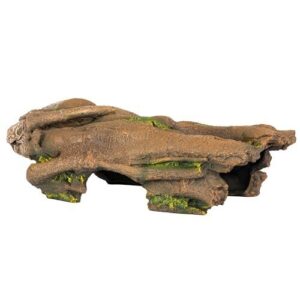
Hides tie your whole setup together, and the Orchid Valley Reptile Hide Log is a solid choice. It’s resin, so you get bark-like texture without rot risk, a real advantage when your enclosure holds humidity at 60%.
At 15.47 by 10.2 by 5.87 inches, it fits small to medium ball pythons comfortably. The open-ended log design plus a side peek hole gives your snake two exits, cutting stress and reinforcing natural security behaviors. The smooth interior keeps scales safe during sheds, and the textured exterior doubles as a climbing surface.
Rinse it before first use to clear packaging residue, and check the seams for any rough spots. It won’t suit a full-grown adult, so size up if your snake has outgrown medium hides. Position it near the warm end of your gradient.
| Best For | Small to medium reptiles and rodents like geckos, snakes, and younger ball pythons who need a safe, cozy hide in their tank. |
|---|---|
| Material | Resin |
| Primary Use | Reptile Hide |
| Indoor Use | Yes |
| Easy Maintenance | Easy |
| Pet Safety | Requires Prep |
| Weight | 26.5 oz |
| Additional Features | Peek hole feature, climbable twisted bark, open-ended log design |
| Best For | Small to medium reptiles like leopard geckos, ball pythons, and bearded dragons who need a secure, naturalistic hide in their enclosure. |
|---|---|
| Material | Resin |
| Primary Use | Reptile Hide |
| Indoor Use | Yes |
| Pet Safety | Yes |
| Maintenance Level | Easy |
| Vivarium Role | Hide Zone |
| Additional Features |
|
- Resin construction mimics real bark texture without the risk of rot, making it ideal for humid terrariums
- Open-ended design with a side peek hole gives reptiles multiple exit points, reducing stress and supporting natural behavior
- Smooth interior protects scales and skin during sheds while the textured exterior doubles as a climbable surface
- Runs smaller than expected, so it won’t comfortably fit larger or fully grown reptiles
- Paint finish can be inconsistent, leading to mixed impressions of the overall look
- Requires a thorough rinse before first use to remove packaging residue
Keeping Your Ball Python Vivarium Clean, Secure, and Enriching
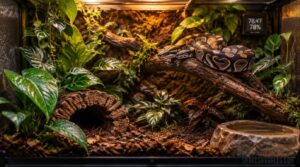
Ammonia from urates can spike to harmful levels in under 48 hours in a sealed enclosure, so vivarium maintenance isn’t optional. Remove waste daily, spot-clean weekly, and you’ll stay ahead of buildup before it quietly stresses your snake.
For enclosure security, tamper-resistant latches are non-negotiable. Ball pythons are methodical problem solvers, and a loose lid is all the invitation they need. Keep the cage away from kitchens and high-traffic areas too.
Maintain humidity control between 50-60% with localized basking spots. Good airflow prevents mold without drying things out. In a bioactive setup, 2-3 inches of substrate helps odors stay buried.
For reptile enrichment, keep it simple: cork bark, varied hides, and occasional prey scent on safe items go a long way.
Frequently Asked Questions (FAQs)
What is a holy grail ball python?
A holy grail ball python is a standout specimen, not a codified morph. Think deep black banding, razor-sharp pattern edges, and a vivid dorsal stripe. Rarity and visual quality drive everything, including that price tag.
What are some creative decor ideas for a snake terrarium?
Wild ball pythons can travel up to 3 kilometers in a single night. Match that restless instinct with layered cork bark hides, reptile-safe artificial succulents, smooth driftwood, and textured slate for a genuinely naturalistic vivarium.
What is the perfect enclosure setup for a ball python?
You need a thermal gradient, two hides, and solid humidity control. A 36x18x12 PVC enclosure with coconut fiber substrate nails the basics. Keep your basking spot at 90°F and the cool side right around 80°F.
Maintaining 60–70% humidity is equally critical, and understanding why boa constrictors need high enclosure humidity helps you dial in those numbers with confidence.
What are some enrichment ideas for ball pythons?
Rotate hiding spots weekly to fight habituation. Add climbing structures at varied heights for real enrichment. Scatter scent cues near burrows to encourage foraging. A naturalistic vivarium with bioactive substrate keeps your python’s instincts sharp.
What do ball pythons like in their enclosures?
Ball pythons can live over 30 years in captivity, so every setup choice counts. They need tight, secure hides, a proper thermal gradient, around 60% humidity, and natural substrate to feel safe and truly thrive.
Because escaped or released pets can sometimes survive outdoors, it’s worth understanding whether a pet snake can survive in the wild and why releasing one is never an option.
What is the best tank set up for a ball python?
The best ball python vivarium nails five things: solid enclosure security, the right dimensions, a steady temperature gradient, humidity control around 55%, and hides on both the warm and cool sides your snake will use.
What can I put in my ball python enclosure?
Picture a corner reptile enclosure design: coconut husk substrate, two hides placed on opposite temperature zones, a climbing branch, and a moist hide on the warm side for solid humidity control. That covers the essentials.
How to mentally stimulate a ball python?
Switch one hide, branch, or substrate patch every single day. Scent enrichment and climbing structures trigger natural curiosity and keep your snake actively investigating. Short supervised exploration sessions outside the enclosure add real, meaningful variety.
Do ball pythons like fake plants?
Fake plants are genuinely great for your snake. They provide dense, stress-reducing cover that noticeably calms behavior, and they’ll make your ball python vivarium feel secure without rot, humidity swings, or complicated live plant care.
What are the enrichment ideas for snakes?
Rotate hides, mix substrate textures, and move feeding spots around regularly. Snake behavior sharpens when the environment stays unpredictable, so add climbing elements and scent variety to push your naturalistic habitat enrichment beyond basic decor.
Conclusion
Ball pythons can live up to 30 years in captivity. That’s not a fun fact; it’s a reason to build this right. When you explore ball python vivarium setup ideas for inspiration, you’re not just decorating a box; you’re engineering a real habitat your snake will actually live in.
Get the substrate depth right. Nail the humidity. Pick materials that hold up. Build it once, build it well, and your snake will thrive for decades.
If you’re working with a tight budget, this affordable snake habitat setup guide shows how to spend wisely without cutting corners.
For layout ideas that bring all these elements together, snake cage design plans can help you map out a setup your snake will actually want to live in.