This site is supported by our readers. We may earn a commission, at no cost to you, if you purchase through links.
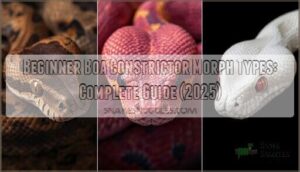
Walking into a reptile expo for the first time, you’ll notice something surprising: not all boa constrictors look like the brown-and-tan snakes you’ve seen in photos. Some are bright pink with gold accents, others are pure white with ruby eyes, and a few shimmer with colors that look almost iridescent. These aren’t different species—they’re morphs, which are color and pattern variations created through selective breeding.
For beginners exploring boa keeping, understanding these beginner boa constrictor morph types makes the difference between bringing home a snake that matches your lifestyle and choosing one that leaves you overwhelmed. The genetics might sound complicated at first, but once you know which traits make certain morphs beginner-friendly, you’ll recognize that some of these stunning variations are actually easier to care for than their wild-type cousins.
Table Of Contents
- Key Takeaways
- What Are Boa Constrictor Morphs?
- Genetics Behind Boa Morph Types
- Key Traits of Beginner Boa Morphs
- Popular Beginner Boa Morph Types
- Color and Pattern Variations in Morphs
- Choosing The Right Boa Morph
- Understanding Boa Morph Pricing
- Finding Reputable Boa Breeders
- Health and Ethical Considerations for Morphs
- Frequently Asked Questions (FAQs)
- Conclusion
Key Takeaways
- Boa morphs aren’t separate species—they’re the same snake with different colors and patterns created through selective breeding, following dominant, recessive, or codominant genetic inheritance patterns.
- Beginner-friendly morphs like Colombian Red-Tails, Hypos, and Kahl Albinos combine manageable care requirements with docile temperaments and reasonable prices ($150-$800), making them ideal starting points for new keepers.
- Captive-bred boas dramatically outperform wild-caught specimens, showing 67% fewer parasite infections, better feeding responses, and calmer behavior while supporting ethical conservation practices.
- Some morphs carry hidden health risks from intensive line-breeding—including spine defects, neurological issues, and reduced fertility—so prioritizing genetic diversity and reputable breeders protects your snake’s long-term wellbeing.
What Are Boa Constrictor Morphs?
If you’ve spent any time browsing boa listings online, you’ve probably noticed terms like “hypo,” “albino,” or “sunglow” attached to different snakes. These aren’t separate species—they’re morphs, which are specific color and pattern variations created through selective breeding.
Understanding what morphs actually are will help you make smarter choices as you explore boa keeping.
Definition of Morphs
When you’re exploring boa morphs, you’re looking at genetic variations that create stunning color variations and pattern differences. A boa constrictor morph isn’t a different species—it’s the same snake with unique traits caused by genetic mutations. Here’s what defines these fascinating reptiles:
- Morph identification relies on specific physical characteristics like color and pattern
- Genetic variations affect pigmentation and scale traits through inheritable mutations
- Trait inheritance follows dominant, recessive, or co-dominant patterns across generations
- Breeding purpose focuses on producing visually unique boas for enthusiasts
- Appearance impact ranges from subtle hue shifts to dramatic pattern transformations
Understanding these genetics helps you appreciate what makes each morph special.
Boa constrictor morphs refer to variations in color and pattern.
How Morphs Differ From Species
You might wonder if your albino boa is a different species from a wild-type—it’s not. Boa constrictor morphs share the same genome differences from other snakes, while genetic mutations only change a few genes. True species show reproductive isolation and evolutionary lineages through genome-wide genetic divergence. Selective breeding creates boa constrictor genetics variations, not new species.
Breeders sometimes use breeding related boas to simplify the breeding process. Genetic morphs interbreed freely with wild types, making boa identification about appearance, not species classification.
Reasons Morphs Are Bred
Breeders pursue morphs for several reasons that extend beyond simple novelty. The motivations blend practical goals with scientific curiosity:
- Market demand drives production of unique colorations that command higher prices and appeal to collectors.
- Genetic exploration allows breeders to document inheritance patterns and understand recessive, dominant traits.
- Aesthetic goals satisfy hobbyist preferences for striking albino, hypo, and designer patterns.
- Conservation role reduces wild-caught demand through captive breeding programs.
Genetics Behind Boa Morph Types
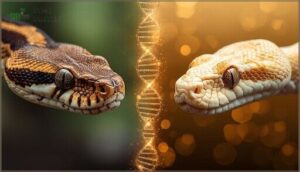
Understanding how boa morphs are created starts with the basics of genetics. You don’t need a biology degree to grasp how traits pass from parent snakes to their babies, but knowing a few key concepts will help you make smarter breeding decisions down the road.
Let’s break down the three main ways genes work in boa constrictors and how breeders use that knowledge to produce the morphs you see today.
Dominant, Recessive, and Codominant Traits
Understanding Boa genetics starts with three inheritance patterns. Dominant genes like Jungle show up with just one copy, making Dominant Expression straightforward. Recessive genes, such as Albino, need two copies, so Recessive Carriers look normal but pass traits along. Codominant Combinations like Hypo display partial effects with one copy, creating unique Breeding Outcomes.
Knowing these patterns helps you predict offspring and avoid Homozygous Concerns.
Genetic Inheritance Patterns
Punnett Squares map out Breeding Outcomes by showing how Dominant Genes and Recessive Traits combine. When you breed two carriers of a recessive gene, you’ll usually see:
- 25% of babies show the morph
- 50% carry the hidden gene
- 25% are completely normal
- Genetic Mutations can appear unexpectedly
- Boa genetics follow predictable ratios
This pattern helps you plan pairings and understand what your clutch might look like.
Selective Breeding Techniques
When you’re ready to create your own morphs, selective breeding starts with choosing healthy pairs that carry the desired traits. Breeders target specific genetics—dominant, recessive, or codominant—to produce morph combinations while managing inbreeding risks and ethical concerns around genetic diversity.
| Technique | Purpose | Key Risk |
|---|---|---|
| Line breeding | Preserve desirable traits | Inbreeding depression |
| Outcrossing | Restore genetic diversity | Diluted morph traits |
| Progeny testing | Confirm hidden genetics | Time investment |
Proper breeding infrastructure—climate control, space, and feeding schedules—ensures your operation remains sustainable and your boas thrive.
Key Traits of Beginner Boa Morphs
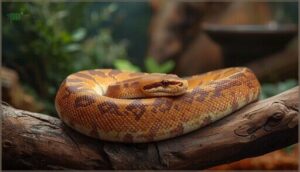
When you’re starting out with boas, it helps to know what sets beginner-friendly morphs apart from the rest. These traits—temperament, size, and care needs—give you a solid picture of what to expect day-to-day.
Let’s walk through the key characteristics that make certain morphs a great match for newcomers.
Temperament and Handleability
Most beginner-friendly boa morphs—especially Colombian and Dumeril’s types—display a docile temperament that tolerates handling well. Studies show boa constrictor personality traits remain consistent over time, so a calm juvenile usually becomes a calm adult.
Watch for stress indicators like rapid breathing or sudden strikes. Handling frequency of 10–15 minutes once or twice weekly builds trust without triggering defensive behaviors, keeping your snake comfortable and handleable.
Typical Size and Growth Rates
Your new boa will hatch at about 15–24 inches (neonate size) and weigh around 40–80 grams. Juveniles generally hit 3–4 feet within their first year, depending on feeding frequency and growth factors.
Adult dimorphism is clear: female Boa imperator often reach 7–8 feet and 25–30 pounds, while males stay closer to 5–7 feet—manageable sizes for long-term Boa Constrictor care.
Care Complexity
Boa Constrictor care demands consistency, but you won’t be drowning in daily tasks. You’ll handle your boa once or twice weekly after a 2-week acclimation period—handling frequency matters for stress reduction.
Enclosure size for adults runs about 8×4×4 feet, with weekly humidity checks and substrate changes every 2–3 months.
Your feeding schedule shifts from weekly (neonates) to monthly (adults), and health monitoring catches respiratory issues early.
Beginner-Friendly Boa Morphs thrive with proper Boa Enclosure Setup and behavioral enrichment through gentle exercise.
Popular Beginner Boa Morph Types
Now that you understand what makes a morph beginner-friendly, let’s look at some proven options that won’t overwhelm you as a new keeper.
These morphs combine manageable care needs with reliable temperaments and wide availability.
Each one brings something different to the table, so you can find the right fit for your setup and experience level.
Colombian Red-Tailed (Common) Boa
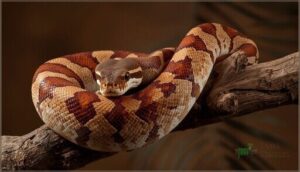
If you’re looking for classic appeal and beginner suitability in a snake, the Colombian Red-Tailed Boa is hard to beat. These common boa constrictors grow to about 6–10 feet and live up to 30 years with proper boa constrictor care.
Their calm boa temperament makes handling a breeze, and at around $150–$200, the cost analysis is beginner-friendly.
Size considerations matter, though—larger females can hit 60 pounds.
Hypomelanistic (Hypo) Boa
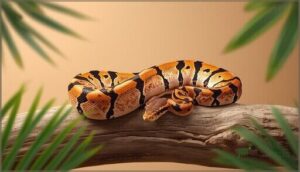
Want a cleaner, more vibrant look without extra care demands? Hypomelanistic Boas deliver exactly that. Hypo genetics reduce dark pigment, boosting color intensity—perfect for beginner-friendly boa morphs that stand out. While designer morphs can hit $1,000–$1,200, simpler hypo boa constrictors often stay under $400, balancing market demand with beginner affordability.
- Widely available on major classified platforms
- Improve pattern intensity in multi-gene projects
- Prices stabilize between normal and premium tiers
- Popular foundation for developed breeding projects
Albino Boa (Kahl-Line)
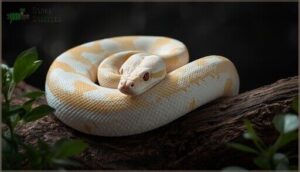
If you love a striking look, the Albino Boa—especially the Kahl strain—delivers. Kahl genetics trace back to a famous 1992 breeding success, producing white-and-yellow beauties that now run $350–$800.
This beginner-friendly morph does bring photophobia issues, so you’ll need gentle lighting. Despite that, these boa morphs remain popular, their lineage history and manageable morph prices securing strong pricing trends among hobbyists.
Dumeril’s Boa
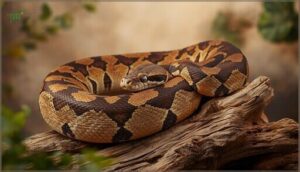
For a docile temperament and manageable size, consider Dumeril’s Boas. These beginner-friendly boa morphs reach 4–7 feet over five years—slow growth that eases first-time care.
Their natural appearance features a tan ground with dark blotches and iridescence, giving you a morph-like look without complex breeding.
Thick bodies and sedentary habits mean excellent space efficiency, making boa constrictor identification straightforward and husbandry simpler than many common boa constrictor types.
Color and Pattern Variations in Morphs
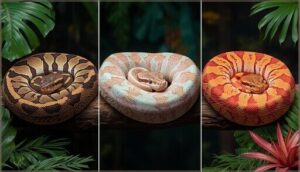
Once you’ve picked your beginner morph, you’ll quickly notice that boa colors and patterns can look pretty different even within the same genetic line. Some morphs keep their bold, classic saddle markings, while designer morphs combine multiple genes to create entirely new looks.
Your boa’s appearance will also shift as it grows and as you fine-tune its habitat, so let’s break down what to expect.
Classic Vs. Designer Morphs
Classic boas offer wild-type coloration and full genetic diversity, making them healthier, easier to breed, and wallet-friendly—often under $300.
Designer morph combinations, like albino-hypo blends, can exceed $2,000, showcasing eye-catching colors but sometimes carrying health concerns from intensive line-breeding.
Beginner-friendly boa morphs, such as single-gene hypos or Kahl albinos, strike a balance by offering visual appeal without the ethical breeding risks or pricing trends of multi-gene designer boa constrictor morphs.
Pattern Differences Among Morphs
When you’re shopping for a boa, pattern morphs really do stand out from one another. Saddle variations depend on the genetic basis driving each morph’s boa pattern variations:
- Jungle boas elongate saddles into connected stripes, creating dramatic pattern disruption along the back.
- Motley morphs produce circular or irregular blotches, resembling corn snake patterns.
- Leopard boas feature spaced, large blotches with reduced pattern density.
- Aztec morphs display gradient color influence with pronounced, bold saddles.
Color influence from genes like albino or IMG shifts how clearly you’ll see these boa morph characteristics—hypo lines reveal clearer saddle edges, while IMG boas darken over time, masking boa patterns through development changes.
How Age and Environment Affect Appearance
As your boa matures, you’ll notice ontogenetic changes—juveniles display brighter reds and sharper contrast that gradually dull over three to five years.
Temperature impact, humidity effects, and light exposure all shape how vivid your boa color morphs appear daily.
Poor health indicators like incomplete sheds or stress darken patterns, while proper care keeps boa genetics shining through those stunning boa pattern variations.
Choosing The Right Boa Morph

Picking the right boa morph isn’t just about what looks cool—it’s about matching a snake to your space, your schedule, and your experience level. Different morphs can have slightly different needs and temperaments, even though they’re all the same species at heart.
Let’s walk through the key factors you’ll want to think about before you bring your new boa home.
Space and Enclosure Considerations
Your boa’s future home isn’t just four walls—it’s where your snake will spend its entire life, so getting the enclosure setup right from day one matters. Most adult boas between 6–8 feet need at least a 6-by-3-by-3-foot space, though bigger is always better.
Here’s what to plan for:
- Enclosure Size – Use the length-by-half-length-by-half-length rule for proper boa habitat dimensions
- Vertical Space – Include climbing branches, especially for semi-arboreal morphs
- Temperature Gradient – Create a warm end around 88–92°F and a cool zone in the mid-70s
- Humidity Levels – Maintain 60–70% through substrate choice and ventilation systems
Morph-Specific Temperament Differences
Here’s the truth many new keepers miss: temperament isn’t written into color genes. Morph temperament myths suggest albino or hypo boas are more aggressive, but individual boa behavior varies far more within each morph than between them.
Handling influences temperament more than genetics vs. behavior, though Dumeril’s calm nature stands out.
Understanding boa temperament means judging each snake on its own personality, not its pattern.
Long-Term Care Requirements
You’re signing up for 20–30 years—a serious lifespan commitment that demands enclosure upgrades, veterinary oversight, and careful nutritional planning.
Long-term boa constrictor care means budgeting for recurring reptile care costs, snake care equipment, and veterinary care visits that add up over decades.
Health issues happen, and the financial burden grows with your boa’s age. Be ready for the long haul.
Understanding Boa Morph Pricing

If you’re budgeting for your first boa, you’ll quickly notice that prices can swing from around a hundred bucks to several thousand dollars depending on the morph. Understanding what drives these differences helps you make a smart choice that fits your wallet and your goals as a keeper.
Let’s break down the typical price ranges, the factors that push certain morphs higher or lower, and what the current market looks like for beginners.
Typical Price Ranges for Beginners
If you’re curious about morph affordability, most beginner-friendly boa morphs fit a modest budget without breaking the bank. Normal Colombian boas start around $50 to $200, while hypomelanistic types run about $200 to $400. Simple albino combinations often land between $500 and $900.
Your initial investment stays reasonable, but remember that long-term costs for housing and care often exceed what you pay for the snake itself.
Factors Affecting Morph Value
Several forces shape what you’ll pay for your boa morphs beyond simple color differences. Genetic rarity drives prices upward when a morph first hits the market—newly released combinations easily reach $5,000 to $10,000.
Visual quality matters too; high-contrast, clean-pattern animals sell for 20% to 50% more than clutchmates with duller coloring.
Breeder reputation adds value, since documented lineage and health viability often justify premiums of 25% to 100% over unproven stock.
Market Trends and Availability
Online access has exploded—over 4,000 boa constrictors appear on MorphMarket alone in 2025, up more than 20% since 2023. That growth means you’ll find beginner-friendly boa morphs like hypo and Kahl albino at dozens of breeders simultaneously. The morph market continues expanding as demand rises for unique patterns:
- Single-gene hypo boas generally run under $400
- Kahl albino morphs range from $350 to $800
- Multi-gene combos climb into the $2,000–$3,000 bracket
- Locality lines like Nicaraguan dwarfs sell quickly due to limited supply
Future outlook remains strong through 2028, with steady availability supporting new hobbyists.
Finding Reputable Boa Breeders

Finding the right breeder can make all the difference in your boa ownership journey, especially when you’re just starting out. A good breeder won’t just sell you a healthy snake—they’ll answer your questions, share care tips, and stay available long after you take your new boa home.
Let’s walk through what separates the pros from the rest so you can shop with confidence.
Signs of a Responsible Breeder
How do you spot a breeder who’s truly invested in their animals? Reputable boa breeders provide detailed provenance records, written health guarantees (usually 7 to 30 days), and documented feeding histories. They follow ethical standards, comply with legal regulations, and offer ongoing buyer support.
Look for breeders who prioritize routine veterinary checkups, maintain clean facilities, and openly share lineage information—these practices signal responsible reptile husbandry and genuine care for boa health and issues.
Captive-Bred Vs. Wild-Caught Boas
Choosing captive-bred boas over wild-caught specimens dramatically improves your odds of success. Captive breeding reduces parasite prevalence—studies show 100% of wild-caught boas carry gastrointestinal parasites versus just 33% of captive-bred animals. You’ll also see better acclimation success, lower disease transmission risk, and support ethical sourcing that benefits conservation impact. For exotic pets like Boa imperator, this choice reflects responsible reptile husbandry.
Key advantages of captive-bred boas:
- Predictable feeding—captive-bred juveniles accept pre-killed rodents from day one, eliminating stress for you and your snake.
- Lower veterinary costs—fewer parasites and health issues mean less time at the vet and more time enjoying your new companion.
- Established temperament—captive-bred boas show calmer behavior and adapt to handling quickly, making them ideal beginner Boa constrictors.
Health Guarantees and Support
When purchasing your boa, reputable breeders offer live arrival guarantees and health warranties covering the first 7 days. Responsible sellers provide long-term support, answering questions about health issues, veterinary care, and signs of illness in boas.
Your buyer duties include proper husbandry and prompt notification of concerns.
After-sale care extends beyond guarantees—experienced breeders connect you with reptile veterinarians and offer guidance for long-term care throughout your snake’s life.
Health and Ethical Considerations for Morphs
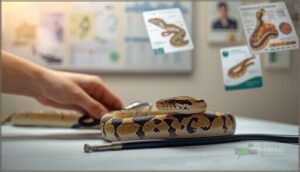
Choosing a morph isn’t just about picking the prettiest colors—you also need to think about the health and ethics behind the breeding. Some morphs come with genetic quirks or health challenges that can affect your boa’s quality of life, and responsible breeders make choices that prioritize the animal’s well-being.
Let’s look at the key health and ethical factors you should understand before bringing a morph home.
Common Health Issues in Morphs
Some boa color morphs carry hidden costs beyond their stunning looks. Genetic defects like spine kinks and eye malformations appear in 5–20% of tightly line-bred projects, while neurological issues cause wobble symptoms in certain morphs.
IBD prevalence hits 27% in captive boas, and fertility problems plague inbred lines.
Husbandry morbidity rises when genetic mutations weaken your snake’s resilience against respiratory and bacterial infections.
Genetic Diversity and Outcrossing
When you limit your boa genetics pool, inbreeding effects stack up fast—every close pairing boosts homozygosity and exposes hidden defects. Smart breeding means tracking genetic diversity and planning outcrosses to keep your lines healthy:
- Population Size – Maintain at least 100–500 effective breeders to preserve 90% of allelic richness.
- Outcrossing Benefits – Introduce unrelated stock every 3–5 generations to restore heterozygosity.
- Locality Diversity – Source breeders from different clades to widen your genetic pool.
- Genetic Monitoring – Track pedigrees and inbreeding coefficients to catch trouble early.
Ethical Breeding Practices
You can’t build a sustainable boa constrictor breeding program on shortcuts—ethical breeding practices demand attention to welfare standards, inbreeding limits, and sourcing responsibility from day one.
Reputable breeders track boa genetics across generations, maintain genetic diversity through strategic outcrossing, and offer health guarantees that protect both animals and buyers.
Responsible breeding means prioritizing long-term boa health over market trends.
Frequently Asked Questions (FAQs)
Can different boa morphs be housed together safely?
Housing different boa morphs together isn’t recommended. Despite looking different, they carry the same Disease Transmission and stress factors. Injury Potential rises during feeding, and ethical Cohabitation Risks outweigh any convenience—boas thrive when housed solo.
How often do beginner morphs typically reproduce?
Most females reach breeding maturity around three to four years, then produce litters every two to three years.
This breeding frequency maintains their reproductive health while managing the demands of gestation and recovery.
What permits or licenses are required for ownership?
Most beginner boa morphs need no federal permit in the U.S., but state permits, local ordinances, and EU documentation vary widely.
Check your area’s exotic pet laws and welfare licensing rules before buying.
Do morphs require different dietary needs than normals?
No, morphs don’t need different diets than normal boas. All boa constrictors eat the same prey—appropriately sized rodents—with feeding frequency based on age, size, and body condition, not color genetics.
Conclusion
Choosing your first boa is like picking a hiking trail—some paths welcome newcomers with clear markers and gentle slopes, while others demand experience you haven’t built yet. The beginner boa constrictor morph types we’ve covered here offer that friendlier route into reptile keeping.
Start with proven morphs like Colombians or Hypos, prioritize health over flashy genetics, and connect with breeders who’ll support your journey. Your perfect snake is waiting, and now you know exactly how to find it.
- https://www.morphmarket.com/morphpedia/boa-constrictors/normal/
- https://www.imperatormorphs.com/boa-morphs/
- https://community.morphmarket.com/t/what-are-some-of-the-best-boa-constrictor-morphs-to-invest-in/49560
- https://pmc.ncbi.nlm.nih.gov/articles/PMC6836717/
- https://www.youtube.com/watch?v=heMLkwsml3s