This site is supported by our readers. We may earn a commission, at no cost to you, if you purchase through links.

Named after zoologist John George Children in 1844, Antaresia childreni still surprises new keepers with how compact it stays: most adults top out between 30 and 48 inches, rarely pushing past 5 feet. That modest size, paired with a docile temperament, makes this Australian native one of the most forgiving pythons you can bring home.
But forgiving doesn’t mean foolproof. Get the basking temperature wrong by a few degrees, skip quarantine on a new arrival, or misjudge feeding intervals, and you’ll see the consequences in weeks, not months.
This childrens python care sheet walks through exactly what your snake needs, from enclosure setup to spotting early signs of illness, so you can build the routine right the first time.
Table Of Contents
- Key Takeaways
- Children’s Python Basics for New Keepers
- Step-by-Step Enclosure Setup
- Heating, Lighting, and Humidity Guide
- Feeding, Water, and Handling Routine
- Cleaning, Health, and Quarantine Care
- Frequently Asked Questions (FAQs)
- What do I need for a children’s Python?
- How to care for baby pythons?
- Can childrens pythons swim safely?
- How often do childrens pythons shed?
- Do childrens pythons bite their owners?
- What sounds do childrens pythons make?
- Can multiple childrens pythons breed together?
- What safe handling grip prevents tail injury?
- How often should adult pythons be handled weekly?
- What tools help maintain safe feeding distance?
- Conclusion
Key Takeaways
- Maintain a basking temperature of 88°F to 100°F with a cool side of 75°F to 80°F, and keep humidity between 40-60% (adjusted seasonally) to prevent shedding problems and respiratory illness.
- Feed hatchlings appropriately-sized frozen-thawed rodents every 5-7 days and adults every 10-14 days, always waiting 24-48 hours after feeding before handling to avoid regurgitation.
- Quarantine any new snake for 60 to 90 days with dedicated tools and two separate vet fecal screenings before introducing it to an existing collection.
- Children’s pythons are beginner-friendly due to their compact adult size (30-48 inches), docile temperament, and 20-30 year lifespan, but still require daily temperature monitoring and consistent husbandry to thrive.
Children’s Python Basics for New Keepers
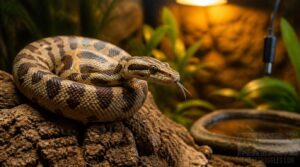
Before you set up a single hide or heat lamp, it helps to know exactly what kind of snake you’re working with. Children’s pythons have a specific background, growth pattern, and temperament that shape every care decision you’ll make down the road. Here’s what you need to know before bringing one home.
If you’re still deciding whether one fits your lifestyle, this guide on whether Children’s pythons make good pets weighs their steady heat and humidity needs against their easygoing temperament.
Before you even pick a species, it’s worth understanding boa constrictor ownership laws and permit requirements in your area—because getting that wrong can mean confiscation, charges, and losing your snake for good.
Since ownership rules vary by state and species, it’s worth checking exotic pet ownership requirements by state before you commit to keeping one.
If you’re weighing other beginner-friendly species, our complete guide to boa constrictor pet care covers similar husbandry basics worth comparing.
Their manageable size and easygoing nature make them a favorite among first-time keepers, and this guide to Children’s python temperament and care breaks down exactly what to expect.
Scientific Name and Origin
Meet Antaresia childreni, the formal tag under Linnaean binomial nomenclature—genus capitalized, species lowercase. The epithet honors zoologist John George Children, not any geographic clue this time.
Despite the name, this species hails from northern and northwestern Australia’s rocky outcrops and forests. That taxonomic precision matters: it prevents confusion with lookalike pythons during species identification and classification.
Adult Size and Growth
Most keepers ask "how big does this thing get?" before anything else, and the honest answer is: not huge. Expect 30 to 48 inches, with maximum length potential capping near 5 feet. Growth spurt timing varies individually, slowing near maturity milestones.
Sexual dimorphism is modest—females carry slightly more body mass variation than males, a subadult trait worth noting for species specific husbandry planning.
Lifespan in Captivity
Size is modest, but longevity isn’t: expect 20 to 30 years with proper care, sometimes longer.
| Factor | Wild | Captive |
|---|---|---|
| Predation | High risk | Removed |
| Vet care | None | Preventive |
| Food access | Inconsistent | Steady |
Reptiles often gain the most from captivity, provided husbandry matches their biological needs—unlike large mammals, whose lifespans don’t stretch as easily behind glass. Consistent food availability benefits many species by ensuring they receive regular nutrition.
Temperament and Activity
Longevity means little without knowing what you’re living with, and this species delivers a docile nature most days.
Expect crepuscular activity, peak movement at dawn and dusk, with natural burrowing and opportunistic hunting styles in between.
Individual personality traits vary, but exploration through climbing shows up often.
Calm animal temperament makes daily care far less stressful for new keepers.
Beginner Suitability
Why do so many first-time keepers land here? Manageable size, calm temperament, and forgiving husbandry make this a genuinely beginner-friendly snake.
- Low initial commitment: minimal equipment beyond a secure enclosure
- Gentle learning curve for reptile husbandry basics
- Docile handling reduces first-timer anxiety
- Predictable feeding schedule builds confidence
Skill requirements stay modest. That said, exotic pet care still demands consistency, this nonvenomous constrictor isn’t a "set it and forget it" pet.
You’ll still need to monitor temperatures daily and maintain that thermal gradient, so check out this guide to Honduran milk snake morphs to see how coloring can vary by lineage.
Step-by-Step Enclosure Setup
Getting the enclosure right matters more than almost anything else in this hobby, since a poorly set up tank leads to stress, illness, or a snake that simply won’t thrive. Your Children’s Python needs specific dimensions, secure locking mechanisms, and the right mix of hides and textures to feel safe.
Here’s exactly what to set up, piece by piece.
Minimum Tank Size

Bigger isn’t always better, but too small is always a problem. Start hatchlings in a 20-gallon tank; juveniles do well in 29 gallons as they grow.
Two hatchlings housed together need 40 gallons to avoid crowding stress.
Adults reaching 4 feet need at least 55 gallons—larger volumes mean steadier temperatures, since small tanks swing hot or cold fast.
Escape-Proof Lid Setup
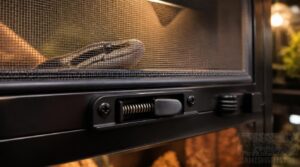
Never underestimate a python’s nose for gaps—if it fits their snout, they’ll test it nightly. A spring-loaded latch that engages automatically beats any lid you must remember to lock, with a secondary manual lock as backup redundancy.
Choose rigid, warp-resistant frames with full-contact gaskets sealing the edges. Screened vents keep airflow moving without creating fresh escape routes, keeping your escapeproof setup genuinely secure.
Warm and Cool Hides

A snake with no hide feels like you sleeping in a house with no walls—exposed and stressed.
A hideless snake is like a person sleeping in a house with no walls—exposed and stressed
Place one hide at the warm end (within the basking range) and one at the cool end, both snug enough for full wall contact. Size up as your python grows. Cork bark, half-logs, or commercial caves all work, provided they support real thermoregulation across the gradient.
Safe Substrate Depth
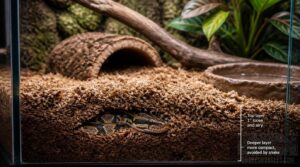
Depth matters more than most keepers assume. Aim for 2 to 3 inches of shredded aspen or coconut coir, loose enough for burrowing without compacting. Beyond 4 inches, buried waste can create anoxic pockets and hydrogen sulfide odors—a clear sign of gas buildup.
Mix particle sizes, stir the top layer during cleaning, and keep that surface inch loose for easy digging and better microclimate control.
Branches, Cork, and Rocks
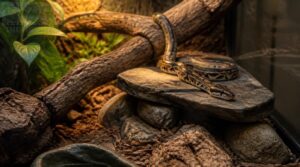
Empty enclosures breed boredom. Add cork bark and a low branch or two for natural climbing structures—cork’s grip texture helps clawed feet grasp, while staying lightweight and antimicrobial. Choose smooth, nonporous rocks for basking spots, wedged with wide, stable contact so nothing rolls during a molt.
Inspect everything for cracks first. This kind of enrichment through texture meets material safety standards while keeping your naturalistic enclosure functional, not just decorative.
Heating, Lighting, and Humidity Guide

Getting the temperature and humidity right is where most keepers either succeed or run into trouble, since a Children’s Python can’t regulate its own body heat like you can.
Your enclosure needs to offer a real range of conditions, not just one comfortable setting.
Here’s what you need to know to get the thermal gradient and moisture levels dialed in correctly.
Basking Temperature Range
88°F to 100°F is your target basking surface temperature—overhead halogen bulbs or radiant panels work best.
Ideal basking targets support digestion temperature support, since ball python relatives like this species process meals sluggishly in cooler zones. Preventing overheating matters too.
- Position heat source at one end for a true gradient
- Use a probe thermometer directly on the basking surface
- Recheck weekly with a thermometer hygrometer combo
Cool Side Temperatures
The cool end should sit between 75°F and 80°F, giving your python somewhere to retreat once it’s done basking. That 8–12°F drop below the basking spot creates a real thermal gradient, letting the snake regulate its own body temperature naturally.
Ambient room temperature affects this zone directly, so drafty rooms or poor ventilation airflow can cause swings. Check it daily with a digital probe near substrate level.
Thermostat and Probe Placement
Where you put your probes matters as much as your setpoints. Place the primary probe directly on the basking surface, not dangling near the bulb, to avoid false-high readings. Secure probe cables with clips so shifting substrate or curious coils can’t displace them.
- Basking surface probe
- Cool-side substrate probe
- Zip-tied cable
- Weekly cross-check thermometer
Check weekly for temperature drifts beyond 2°F.
Ideal Humidity Range
Once probes confirm your temperatures, shift attention to moisture. Aim for 40-60% relative humidity, adjusting seasonally—40-50% in cooler months, 50-60% when it’s warmer, to support clean sheds.
- Track readings with calibrated digital hygrometers, checked monthly for drift
- Correct swings beyond range within 24 hours
- Improve airflow if fogging or musty odors signal mold risk
Good microclimate management means monitoring trends daily rather than guessing, keeping your python comfortable without inviting the mold and bacteria damp corners breed.
Humid Hide Setup
Grab a small tub with a single entry hole—about 1.5 to 2 times your snake’s head width—and pack it with damp sphagnum moss or coconut fiber. This microclimate boosts local relative humidity far above ambient levels, supporting ecdysis.
Keep substrate moist, not soggy, using the squeeze test. Vent lids prevent mold. Place it warm-side, off direct heaters, checking temps with a probe.
Feeding, Water, and Handling Routine
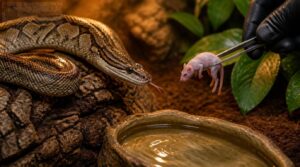
Feeding time is where most keeper mistakes happen, from wrong prey size to handling too soon after a meal. Get this routine right, and you’ll avoid regurgitation, stress, and slow growth down the line. Here’s exactly how to feed your Children’s python, from hatchling to adult.
Frozen-Thawed Rodent Diet
Frozen-thawed rodents deliver roughly 20-25% crude protein and 10-12% fat, with 60-70% moisture keeping digestion easy. Never feed live prey—it risks injury to your snake and you.
Thaw fully in warm water, never a microwave, until no ice remains at the center. Match prey width to roughly half your snake’s girth, and always present it with feeding tongs, not fingers.
Hatchling Feeding Schedule
Young Children’s pythons eat every 5-7 days, taking single pinky mice sized to 10% of body weight or less. Watch weight gain, not the calendar—adjust frequency if growth stalls.
- Offer prey via tongs, just inside the enclosure
- Wait 24 hours, checking for regurgitation
- Skip handling 1-2 days post-feeding
Refused meals? Wait a couple days before retrying.
Adult Feeding Schedule
Once your python matures, growth slows and so does its appetite—feed adults every 10-14 days, adjusting frequency based on body condition rather than the calendar. Underweight snakes get more frequent meals; overweight ones get fewer.
Warm frozen-thawed rodents to 75-100°F before offering. Refusals happen, especially seasonally—remove uneaten prey and retry later. Always observe post-meal handling restrictions: 24-48 hours undisturbed, no exceptions.
Correct Prey Size
Measuring body width matters more than counting mice by eye. Match prey to the snake’s widest point—not longer, not thicker.
- Check girth monthly, tracking growth trends
- Skip regurgitation risks by never exceeding 10% body weight
- Choose rats only once mice feel undersized
- Log ideal prey weight to catch stalled growth early
Consistency in prey item selection keeps dietary requirements steady and digestion predictable.
Safe Handling After Meals
Your snake just ate—now leave it alone. Handling too soon disrupts post-feeding digestion and triggers regurgitation, a stressful setback for both of you.
Wait 24 to 48 hours before picking it up again. During feeding tongs safety matters too: use tools at least 30 cm long, keeping fingers clear of strike range.
Afterward, wash your hands—basic post-meal hygiene prevents bacterial spread from handling frozen-thawed rodents.
Cleaning, Health, and Quarantine Care
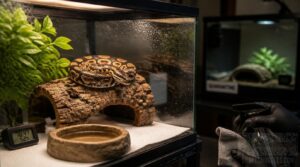
A clean enclosure is your first line of defense against illness, and health checks give you an early warning system when something’s off.
Quarantine protects the snake you already have from whatever a new arrival might be carrying.
Here’s what a solid cleaning and health routine actually looks like, day to day and season to season.
Daily Spot Cleaning
Every day counts for keeping your enclosure sanitary. Remove waste and damp substrate immediately using gloves, then spot-treat stains with a reptile-safe cleaner, blotting outward to center. Wipe the water dish, refill it fresh, and rake substrate lightly.
- Clear fecal matter and shed skin
- Sanitize tools between uses
- Wash hands before and after
Log each cleaning event for health tracking.
Monthly Deep Cleaning
Spot cleaning takes care of daily waste, but every 4 to 6 weeks your enclosure needs a full teardown clean. Remove all substrate, decor, and hides; discard old bedding entirely rather than reusing it.
Disinfect the enclosure, water dish, and furnishings with a reptile-safe solution, rinsing thoroughly. Replace substrate fresh, then reassemble hides and climbing structures to restore your snake’s familiar habitat layout.
For a full walkthrough of how often to deep clean and which products are safe, see this step-by-step guide to cleaning a snake enclosure.
New Snake Quarantine
Bringing home a new python doesn’t mean introducing it to your collection right away.
Quarantine for 60 to 90 days in a separate enclosure, using dedicated tools and gloves.
Schedule two vet fecal screenings weeks apart to catch mites or parasites.
Wash hands and change clothes before entry.
Clearance requires a clean bill of health.
Shedding Problem Signs
Cloudy eyes signal the shedding process has begun; expect dysecdysis (incomplete shedding) if humidity drops below 40%.
Watch for stuck shed around the tail tip or mouth, patchy skin, and irritated pink areas. Retained tail fragments restrict movement and need gentle removal. Bump humidity and add a damp hide to support ecdysis until the cycle completes.
Respiratory Illness Warning Signs
Wheezing or clicking sounds mean trouble — never ignore open-mouth breathing. Respiratory infections often start subtly: mild lethargy, then labored effort. Watch for:
- Rib pulling with each breath
- Bubbling or crackling sounds
- Excess mucus near the mouth
- Persistent gaping
- Lethargy paired with poor appetite
Unlike stomatitis (mouth rot), lung infections need immediate veterinary care. Good hygiene and disease management practices help prevent both.
Frequently Asked Questions (FAQs)
What do I need for a children’s Python?
Think of it as a burrow you build, not a tank you buy: secure lid, 36"×18"×18" enclosure, warm hide, humid hide, thermostat-controlled 88–100°F basking zone, aspen substrate, climbing branches, and a hygrometer for tracking 40–60% humidity.
How to care for baby pythons?
Hatchling Antaresia childreni need snug 10–20 gallon enclosures, 88–92°F basking spots, and 50–70% humidity. Feed appropriately-sized pinky mice every 5–7 days, offer fresh water, and wait 48 hours post-meal before gentle handling to avoid regurgitation.
Can childrens pythons swim safely?
Yes, but only briefly. Keep water at 82-86°F, limit soaks to 5-15 minutes, and watch closely—thrashing or escape attempts signal distress. Dry and warm them fully afterward; never soak within 24 hours of feeding.
How often do childrens pythons shed?
Juveniles shed every 3-4 weeks during growth spurts, slowing to 6-8 weeks as adults mature. Cloudy eyes signal an approaching shed—nudge humidity toward 50-60% then, since proper hydration and moisture prevent retained skin around eye caps.
Do childrens pythons bite their owners?
Picture a startled toddler swatting at a stranger’s hand—that’s a hatchling’s bite reflex. Children’s pythons are naturally docile, and defensive strikes fade within 2-4 weeks of calm, consistent handling as trust builds.
What sounds do childrens pythons make?
Expect light hissing when stressed, faint pops from jaw adjustment, or soft squeaks during feeding strikes. Wheezing signals low humidity or respiratory trouble. Otherwise, this docile, nocturnal species stays quiet—normal breathing is calm, regular, occasionally sighing.
Can multiple childrens pythons breed together?
Two snakes in a tank doesn’t guarantee a clutch of eggs. Successful copulation demands a mature male and female, correct body condition, and seasonal cues, not just proximity, cage space, and hopeful timing.
What safe handling grip prevents tail injury?
Support the tail base with one hand while your other hand stabilizes midbody, keeping grip firm but gentle. Avoid pinching, and never grab the tail tip. This prevents tail strain during lifting, matching the docile nature Children’s pythons are known for.
How often should adult pythons be handled weekly?
Like a metronome ticking gently, not frantically, handling should stay steady but sparing. Once or twice weekly suits adult pythons best, sessions kept brief, always avoiding the 48-72 hour window after feeding to protect digestion and prevent regurgitation.
What tools help maintain safe feeding distance?
Stainless steel tweezers or long feeding tongs keep your hands well clear of strike range during feeding. Add visual feeding barriers and a designated safe feeding zone, then sanitize tools after each use with frozen-thawed rodents to limit bacterial spread.
Conclusion
What separates a thriving Children’s python from a struggling one? Usually just a few degrees on the thermostat and a little patience during quarantine.
Follow this childrens python care sheet closely, and you’ll sidestep the missteps that send new keepers to the vet within weeks.
Your snake won’t ask for much: a warm hide, a clean tank, and food on a steady schedule.
Get those basics right, and you’ll have a calm, healthy companion for decades.