This site is supported by our readers. We may earn a commission, at no cost to you, if you purchase through links.

You can engineer a snake’s appearance like a painter mixing pigments on a palette—except your medium is genetic code, and your canvas breathes. Corn snake morphs demonstrate what happens when recessive traits, selective breeding, and chromatophore manipulation converge: Blood Reds glow like molten copper, Palmetto patterns defy conventional snake biology, and Scaleless variants challenge everything you thought you knew about reptilian skin.
The genetics driving these transformations aren’t random mutations—they’re calculable, stackable, and increasingly accessible to breeders who understand how melanophores, xanthophores, and iridophores interact at the cellular level.
Whether you’re drawn to the rebellious aesthetics of high-contrast Tesseras or the subtle elegance of Opal’s lavender undertones, each morph represents a distinct genetic blueprint you can decode, combine, and push toward entirely new visual territory.
Table Of Contents
- Key Takeaways
- What Makes Corn Snake Morphs Visually Appealing?
- Most Striking Red and Orange Morphs
- Beautiful Yellow, Brown, and Earth-Toned Morphs
- Eye-Catching Gray, Black, and White Morphs
- Distinctive Pattern Morphs and Combinations
- Rare and High-End Designer Morphs
- Frequently Asked Questions (FAQs)
- What is a color morph corn snake?
- Can you identify corn snake morphs without a PhD?
- How do corn snake morphs form?
- How many morphs are there in a corn snake?
- What does Anery corn snake morph look like?
- Is the motley corn snake a morphological pattern?
- How do corn snake morphs affect temperament?
- Which morphs require special lighting or care?
- Can different morphs be housed together safely?
- Do certain morphs have shorter lifespans?
- Conclusion
Key Takeaways
- Corn snake morphs result from calculable genetic mutations affecting three chromatophore types (melanophores, xanthophores, iridophores), allowing breeders to engineer specific color and pattern outcomes through selective trait combination rather than random chance.
- Pattern morphs like Motley, Stripe, and Tessera completely redesign scale distribution independently of color genetics, with Tessera being particularly notable as a dominant trait that produces visible results in first-generation offspring.
- Rare designer morphs such as Scaleless and Palmetto command premium prices ($500-$2000) due to complex genetics and breeding challenges, while compound morphs like Opal demonstrate how stacking recessive traits creates accessible entry points into advanced color manipulation.
- Most morphs maintain identical temperament and 15-20 year lifespans regardless of appearance, though specialized variants like Light Sensitive Albinos and Scaleless morphs require modified husbandry practices including shade provision and humidity management.
What Makes Corn Snake Morphs Visually Appealing?
When you first encounter a corn snake morph, three distinct biological factors shape what you’re seeing. Color variations emerge from specific pigmentation mutations that alter melanin and carotenoid expression in the scales.
Beyond hue, pattern modifications and scalation differences combine to create the visual diversity that makes each morph uniquely identifiable.
Color Variations and Pigmentation
You’ll find corn snake color morphs driven by three chromatophore classes—melanophores, xanthophores, and iridophores—whose spatial arrangement determines every hue you see. Pigment genetics controls melanin production: amelanistic (albino) morphs lack black pigment entirely due to OCA2 mutations, while anerythristic types eliminate red-yellow tones.
Chromatophore structure and iridophore function create structural colors, enabling breeders to push color expression into innovative territory through targeted genetic combinations. Understanding snake color morphs is essential for breeders to create unique patterns and hues.
Unique Pattern Morphs
Beyond pigment control, pattern genetics lets you engineer entirely new body plans. Motley morphs invert saddle patterns into elongated marks with clean ventral surfaces—a recessive trait requiring two alleles. Stripe creates longitudinal bands through a recessive gene allelic to Motley.
Tessera breaks the rules: it’s dominant, producing bold dorsal stripes bordered by dark pigment in 50% of first-generation offspring when bred to normal types. The unique pattern of Tessera corn snakes is characterized by a dorsal stripe pattern.
Scalation Differences
Pattern isn’t the only dimension you control—scalation itself becomes design territory. Scaleless morphs eliminate most dorsal scales, leaving smooth epidermis over 25–29 rows of absent keratinized structures while retaining functional ventral scales for grip. This recessive mutation preserves ventral pattern but removes the textured surface entirely.
- Keel variation shows minimal expression in corn snakes compared to rat snakes, with smooth dorsal scales producing glossy color morphs
- Subcaudal scales maintain standard single or divided arrangements across all snake morphology variants regardless of pattern or color
- Scaleless morph individuals retain ocular spectacles and appear to have enlarged eyes due to missing surrounding head scales
Most Striking Red and Orange Morphs
Red and orange morphs represent some of the most visually commanding variations in the corn snake breeding world. These specimens showcase intensified warm pigmentation that breaks from traditional wild-type coloration through selective genetic expression.
The following morphs demonstrate how breeders have pushed the boundaries of red and orange hues to create snakes that genuinely stand out in any collection.
Blood Red
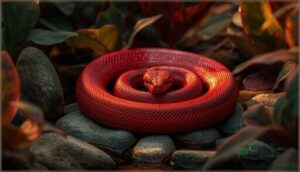
You’ll find Blood Red morphs among the most dramatic color expressions in captive-bred corn snakes. This genetic trait combines the recessive diffused mutation with selective breeding for intense red pigmentation, eliminating dark borders and ventral checkerboard patterns.
The result? A nearly uniform red appearance that showcases how targeted breeding strategies can heighten natural color intensity while reducing pattern complexity through consistent genetic inheritance.
Crimson
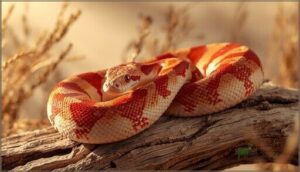
You’re looking at selective mastery when you encounter the Crimson morph—a hypomelanistic genetic trait fused with Miami phase lineage that slashes melanin while amplifying red pigmentation. These color morphs deliver high-contrast saddle patterns against pale backgrounds, commanding $115-$200 depending on color intensity.
Through decades of strategic snake breeding targeting specific genetic traits, breeders transformed regional Florida variants into one of today’s most coveted color patterns.
Fire
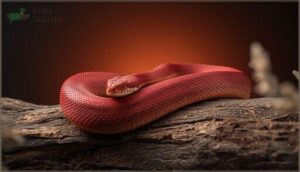
Fire genetics combine amelanistic and diffused genetic traits, eliminating black pigment while reducing dorsal pattern—a major advancement in snake breeding. You’re witnessing red pigmentation at its most saturated intensity, where carotenoid compounds dominate without melanin interference.
This color morph showcases:
- Deep, uniform crimson coloration with minimal blotch visibility
- Patternless ventral scales replacing standard checkering
- Hatchling fire patterns that fade into cleaner adult morphology
- Strategic breeding potential for compound color morphs and patterns
Adult specimens command $70-$250 based on color saturation and lineage quality.
Beautiful Yellow, Brown, and Earth-Toned Morphs
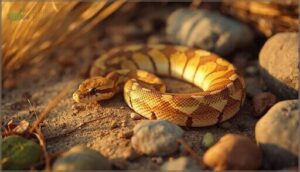
If you’re drawn to warm, earthy tones that mirror the natural landscapes corn snakes inhabit, this color category offers some of the most understated yet enchanting morphs in the hobby.
Yellow and brown mutations produce snakes with golden, amber, and caramel hues that break away from the traditional red-orange palette without sacrificing visual impact.
These morphs demonstrate how selective breeding can emphasize subtler pigments to create specimens that are both distinctive and surprisingly adaptable in combination breeding projects.
Caramel
Caramel corn snakes transform the standard palette into something closer to liquid gold—rich butterscotch tones instead of fiery orange-reds. This simple recessive morph pricing sits around $100, making caramel genetics accessible for breeding strategies targeting butter and amber combinations.
You’ll notice these golden patterns intensify as your snake matures, with hatchlings showing subtle yellows that deepen over years. The color shift is pure chemistry in motion.
Golden patterns intensify as your snake matures, with hatchling yellows deepening into rich amber through years of pure biochemical transformation
Honey
Honey corn snakes fuse two recessive genes—Caramel and Sunkissed—into a visual powerhouse of golden-yellow pigmentation with bold, high-contrast saddles. The genetic basis here is straightforward: breed two Honey morphs, and you’ll harvest 100% Honey offspring every time.
Visual characteristics include:
- Golden-yellow base color with amber undertones
- Sharp saddle borders in pale gray or cream
- Modified head pattern from the Sunkissed component
- Reduced lateral speckling compared to standard Caramel morphs
Pricing hovers around $99, positioning Honey as a mid-tier designer morph—accessible yet distinctive enough to anchor breeding strategies targeting complex color morphs.
Butter
Butter morphs unite amelanistic and caramel genetics into a cream-to-yellow phenotype that redefines visual appeal in earth-toned color morphs. Homozygosity at both loci eliminates black melanin while suppressing brown pigment, yielding golden saddles on a pale background.
Breeding techniques exploit this double-recessive pattern—cross two Butters, expect uniform Butter clutches.
Market trends place individuals near $100–$200, reflecting stable demand for this mid-tier color morph in designer projects.
Eye-Catching Gray, Black, and White Morphs
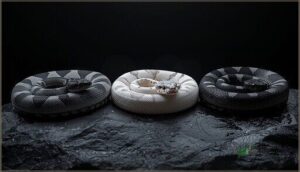
If you’re drawn to sleek, monochromatic aesthetics, gray, black, and white morphs deliver a minimalist sophistication that stands apart from the vibrant reds and oranges.
These morphs strip away warmer pigments through genetic mutations, revealing cool-toned palettes that range from sharp charcoal contrasts to nearly ghost-white appearances.
You’ll find that each morph in this category offers a distinct take on subdued elegance, proving that visual impact doesn’t always require bold color.
Anerythristic (Anery)
You’re looking at a living grayscale masterpiece when you encounter an anerythristic corn snake—one of the most dramatic color morphs in the hobby. This recessive mutation strips away all red and orange pigmentation, leaving striking black-and-gray patterns that intensify the snake’s natural geometry.
Anery genetics follow clean Mendelian inheritance: breed two heterozygous carriers, and 25% of offspring display that high-contrast anery phenotype you’re chasing.
Charcoal
Charcoal genetics represent anerythristic Type B, a distinct recessive mutation that selectively strips red pigment while preserving black and gray tones. You’ll recognize this morph by its crisp dorsal blotches against a soft gray base that lightens as your snake matures.
Charcoal acts as the foundation for complex breeding strategies, fueling designer morphs like Blue and Blizzard. Expect to invest $90–300 depending on lineage and pattern quality.
Blizzard
When you reveal amelanistic and charcoal recessive traits, you produce the Blizzard—a nearly patternless morph that emerges as glossy pink before maturing into striking solid white with red eyes. This compound morph demonstrates intricate color genetics in action, requiring homozygosity at both loci.
- Hatchlings display glossy pink coloration that gradually lightens
- Adults present totally white bodies with minimal ghost patterning
- Ventral surfaces show only faint yellow markings
- Market pricing usually ranges $100–250 for juveniles
Snow
You’re witnessing another double-recessive advancement when Snow morphs enter the picture—this time combining amelanistic and anerythristic type A genes to strip away both black and red pigment simultaneously. What emerges are ghostly white snakes with soft pink or lavender saddles and ruby eyes, creating an almost ethereal appearance.
Hatchlings show more pronounced pastel tones that gradually fade as they mature, softening into cream-and-white combinations around three years of age.
Distinctive Pattern Morphs and Combinations
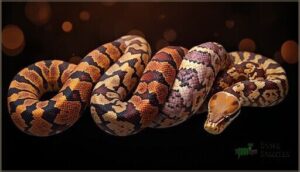
Pattern morphs break the traditional rules of corn snake appearance, transforming how color distributes across their scales. These genetic variations don’t just tweak the colors—they completely redesign the visual blueprint.
You’ll find four distinctive pattern types that command attention and rewrite what’s possible in selective breeding.
Motley
The Motley corn snake morph transforms blotch distribution through recessive CLCN2 gene variants, creating elongated dorsal markings that fuse anteriorly while eliminating lateral spots. You’ll observe a cleaner flank appearance and mostly white ventral scales without the wild-type checkerboard.
Motley genetics allow smooth color interaction—pattern expression remains consistent across amelanistic, anerythristic, and normal backgrounds.
Breeding strategies leverage this compatibility, producing designer combinations that command $80–$200+, positioning Motley as your foundation for visual appeal in multi-trait projects.
Stripe
Stripe corn snake morphs replace traditional blotches with longitudinal dorsal stripes running neck-to-tail, governed by recessive alleles allelic to Motley. You’ll see two parallel dark bands—often fragmenting into dashes posteriorly—flanked by thinner lateral markings and a clean white ventral color lacking checkerboard patterns. This pattern variance commands $100–$200, with stripe genetics stacking seamlessly onto amelanistic or anerythristic backgrounds for bold designer combinations.
- Dorsal stripes break into segmented dashes near the tail
- Reduced head markings create “evil eyebrow” aesthetics
- Lateral markings frame stripe-free flanks for visual contrast
Tessera
Tessera morphs break convention with a narrow, continuous dorsal stripe—often tan or pale orange—bordered by dark pigment that creates high-contrast linear patterning unlike wild-type blotches. You’ll spot intricate lateral maze-like markings and variable belly patterns.
Inherited as a dominant trait, Tessera genetics deliver visual phenotypes in the F1 generation, making morph breeding efficient.
Hatchlings run $100–$200, with premium designer combinations reaching $500–$600.
Diffused
Diffused corn snake morphs showcase dramatic pattern reduction—saddles fade into ground color as they mature, while the ventral surface loses its characteristic checker pattern entirely. This recessive trait produces nearly solid white bellies and subdued lateral markings.
When combined with masque genes in composite breeding projects, Diffused creates the foundation for Blood Red morphs. Genetic expression delivers intensely saturated, nearly patternless specimens.
Head morphology also shifts, with reduced ornamentation enhancing the clean aesthetic.
Rare and High-End Designer Morphs
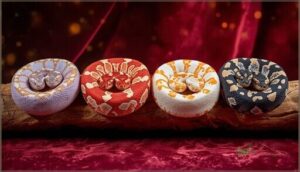
If you’re ready to step beyond the ordinary and claim something truly remarkable, rare designer morphs represent the cutting edge of corn snake genetics. These high-end specimens push boundaries through unmatched combinations of traits—some so striking they command premium prices exceeding several hundred dollars.
Below, you’ll find four of the most sought-after morphs that reshape what’s possible in captive breeding.
Scaleless
You’re looking at perhaps the most audacious advancement in snake breeding: the Scaleless morph emerged in 2002 through cutting-edge hybridization between Pantherophis guttatus and Pantherophis emoryi. This recessive mutation demands both parents carry the gene, creating specimens that command $500 to $2000.
- Completely smooth, leather-like texture replacing traditional scales
- Reduced fertility presenting real breeding challenges
- Het Scaleless genetics priced accessibly at $70 to $200
The morph pricing reflects its groundbreaking status in reptile care and pet ownership circles.
Palmetto
The Palmetto morph represents an incomplete dominant mutation combining anerythristic, amelanistic, and lavender genetics—producing white bodies with pixel-like orange-red speckles and striking black eyes. Only two wild specimens have been documented, cementing this pattern formation’s extreme rarity.
You’ll find Palmetto corn snake morphs commanding $350 to $2000, with females averaging $550 or higher due to breeding potential in rare morphs markets.
Coral Snow
Your exploration of rare breeding reveals the Coral Snow’s compound recessive genetics—amelanistic crossed with anerythristic lineages producing faded pink morphs with orange patches and white ventral scales. This color morphing demonstrates visual appeal through pattern formation that blends albino characteristics with snow patterns, creating a distinctive corn snake phenotype.
Market data from 2021-2025 shows consistent pricing between $120 and $225 for juvenile specimens, reflecting stable demand in color morphology breeding circles.
Opal
While Coral Snow commands premium pricing, the Opal morph offers you an accessible entry into compound genetics. This amelanistic-lavender combination produces distinctive pink-purple hues with faint saddles—visual appeal stemming from double recessive inheritance.
Breeding strategies targeting lavender influence yield predictable pink hues at $65-$100, positioning Opal as an affordable designer option. Your pattern preferences and color goals determine whether this morph’s subtle phenotype matches your collection vision.
Frequently Asked Questions (FAQs)
What is a color morph corn snake?
A color morph corn snake is a selectively bred variant of Pantherophis guttatus displaying altered pigmentation or pattern due to specific genetic mutations affecting chromatophore function.
These mutations result in deviations from the wild-type orange-red phenotype, achieved through recessive or dominant alleles.
Can you identify corn snake morphs without a PhD?
You don’t need specialized credentials—visual recognition works for most morphs. Hobbyist resources, step-by-step guides, and reference photos help you identify common corn snake color and pattern variations.
Genetic testing resolves trickier breeding strategies.
How do corn snake morphs form?
Genetic mutations in wild populations spark morphs—breeders then isolate and enhance these traits through selective breeding techniques.
Single-gene changes alter pigmentation or pattern formation, while controlled crosses establish new color inheritance lines in captivity.
How many morphs are there in a corn snake?
You’re looking at over 800 distinct morphs in today’s captive trade—an explosion of genetic variation born from roughly 33 foundational traits combined through selective breeding techniques that manipulate color genetics, pattern inheritance, and species diversity.
What does Anery corn snake morph look like?
The Anerythristic (Anery) corn snake morphs display striking gray patterns with dark eyes and black-outlined body markings, completely lacking red and orange pigmentation.
You’ll notice charcoal saddles against silver backgrounds, creating bold, monochromatic snake coloration.
Is the motley corn snake a morphological pattern?
Motley morphs manifest as morphological traits, not color changes. This pattern mutation modifies visual morphology through genetic patterns—replacing wild-type saddles with circles, dots, or stripes while maintaining corn snake colors underneath, creating distinctive pattern expression.
How do corn snake morphs affect temperament?
Morphs don’t alter temperament—visual traits aren’t linked to behavioral genetics in corn snakes. Genetic inheritance controls color and pattern, not aggression.
Environmental factors, handling effects, and clutch origin shape snake behavior far more than reptile genetics or morph designation.
Which morphs require special lighting or care?
Think of your corn snake morph like a rare sports car—some need extra tuning. Light Sensitive Albino morphs demand shaded retreats, Scaleless Care hinges on Humidity Management, and morphs with Neurological Issues benefit from Specialized Enclosures and routine observation.
Can different morphs be housed together safely?
You can house different corn snake morphs together, but it’s risky. Cannibalism risk, stress factors, and biosecurity measures make individual housing the safest choice.
Housing density increases disease transmission and resource competition markedly.
Do certain morphs have shorter lifespans?
Like rolling dice with different genes, most corn snake morphs live the standard 15–20 years when you provide proper husbandry.
Genetic health trumps appearance—responsible breeding practices and environmental factors matter far more than morph longevity variations.
Conclusion
The morphs you breed today will reshape what “normal” means tomorrow—each pairing pushes corn snake morphs visually appealing beyond convention into uncharted chromatic territory. You’re not just selecting traits; you’re authoring evolutionary shortcuts that nature would take millennia to produce.
Whether you’re stacking recessive alleles for that elusive Palmetto or refining a Tessera’s geometric precision, remember: every hatchling represents a genetic decision you made with deliberate, calculated intent. Your palette. Your rules.
- https://snakeinsider.com/how-much-is-a-corn-snake/
- https://community.morphmarket.com/t/corn-snake-genetics-question/21649
- https://www.youtube.com/watch?v=cUmzaV63hTU
- https://www.nhm.ac.uk/discover/news/2016/september/study-sheds-light-on-snake-vision.html
- https://www.animalbehaviorandcognition.org/uploads/journals/26/AB_C_2020_Vol7(1)_Kravchuk_Watson.pdf