This site is supported by our readers. We may earn a commission, at no cost to you, if you purchase through links.
A boa that sits at 79°F on the warm side won’t digest its dinner. It’ll regurgitate the meal, lose weight, and stress out in a tank that looked perfect on day one.
That’s the quiet problem with caring for boa constrictor morphs. A hypo, anery, or albino boa looks stunning, but its genetics don’t change its needs. Every morph still demands a 88–92°F basking surface, 60–70% humidity, and prey sized to its widest girth.
Get those numbers right and your boa feeds on schedule, sheds in one clean piece, and lives for decades. Start with the enclosure, because everything else depends on it.
Table Of Contents
- Key Takeaways
- Identify Boa Morphs and Their Care Needs
- Set Up Your Boa Morph’s Enclosure
- Feed Your Boa Morph Safely
- Protect Your Boa Morph’s Health
- Handle and Enrich Your Boa Morph
- Frequently Asked Questions (FAQs)
- Are boa constrictors easy to take care of?
- What are the most expensive boa constrictor morphs?
- How many babies do boa constrictors have at a time?
- Can you explain the different morphs of boa constrictors?
- How long do boa constrictor morphs live?
- Can boa morphs be housed together safely?
- What causes color changes in boa morphs?
- Are boa constrictor morphs legal everywhere?
- Do boa morphs require special permits or paperwork?
- How long do boa constrictor morphs typically live?
- Conclusion
Key Takeaways
- Morph color doesn’t change your boa’s care needs, so build the enclosure around the species’ basics: an 88–92°F basking surface, a cooler 75–80°F retreat, 60–70% humidity, and a thermostat on every heater.
- Feed frozen-thawed prey sized to your boa’s widest body section, on a schedule matched to its age, and skip handling for 24–48 hours afterward so it doesn’t regurgitate.
- Buy a captive-bred boa from a reputable breeder with documented parentage, health records, and a written guarantee, because looks alone can’t prove a morph’s genetics.
- Treat a boa as a 20–30 year commitment: house it alone, keep its space clean and mite-free, and call a vet right away for open-mouth breathing, repeated regurgitation, or other illness signs.
Identify Boa Morphs and Their Care Needs
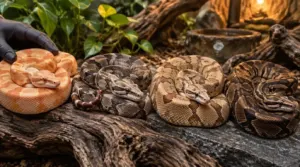
How do you know what you’re actually looking at? Start with morph identification, because a "morph" is just an inherited color or pattern variant within one species, not a separate animal. Albino, anerythristic, hypo, and motley are all common Boa imperator examples, and each describes a different pigment or pattern trait.
Keep in mind that a morph’s look doesn’t always predict its personality, so it’s worth reading about how boa constrictor morphs differ in temperament before choosing one.
Here’s the part that surprises keepers: appearance alone can’t prove genetics. Similar-looking snakes can have different causes, so demand documented parentage. Recessive traits need two copies to show, and a "het" carries just one.
Now the good news. Boa constrictor morphs don’t need special husbandry. Species, size, and individual health drive care complexity, not color. Still, check each line’s genetic health record, and expect albinos to be light-sensitive.
Don’t assume temperament and handleability follow pattern, either. Judge the individual snake.
Set Up Your Boa Morph’s Enclosure
Your boa’s enclosure isn’t just a box. It’s the control system for its health, and every setting you choose either helps its growth or stresses it. Below, you’ll find the five areas to dial in, from size and substrate to heat, humidity, and lighting. Get each one right, and you’re building a setup your morph can thrive in for years.
Enclosure Size by Growth Stage
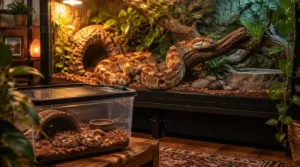
The right enclosure size keeps your boa secure, not stressed. Match it to length, and expect growth spurts to push upgrades. Hatchlings feel insecure in oversized tanks, so don’t upgrade early.
- Neonate enclosure: 24"x18"x12"
- Juvenile: 48"x24"x24"
- Adult: 72"x36"x36"
- Over 8 feet: 96"x48"x48"
Check space and enclosure considerations, including your temperature gradient, before every upgrade. Always prioritize length over total volume. Because buying separate juvenile, sub-adult, and adult enclosures costs a lot more than upgrading once, planning for adult size from the start is the most cost-effective strategy.
Safe Substrates and Supportive Climbing Structures
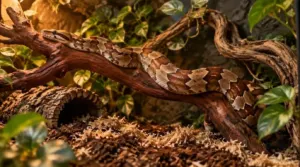
Your substrate options matter more than most keepers think. Use cypress mulch, aspen shavings, or coconut fiber, and never pine or cedar, because their oils irritate your boa’s lungs. Skip sand alone and reptile carpet too.
Whichever bedding you choose, pair it with proper humidity and a step-by-step guide to setting up a comfortable pet snake enclosure so your boa stays healthy.
Add sturdy manzanita or grapevine branches, anchored firmly, plus cork bark hides. Climbing structures turn enclosure setup into real environmental enrichment.
Heating, Thermal Gradients, and Thermostat Safety
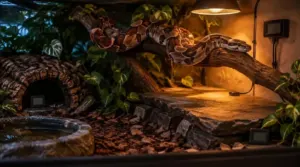
Your climbing branches and hides only work if the heat is right. Build a thermal gradient with the warm-side surface at 31–33°C (88–92°F) and a cool retreat at 24–27°C (75–80°F). Never let temperatures sit above 35°C (95°F).
Run every heater through a thermostat, and check thermostat safety often. Secure the probe at the heated surface, then verify both ends with independent thermometers.
Humidity Control and Shedding Support
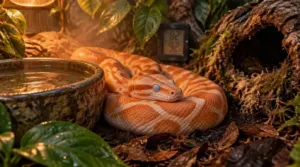
A digital hygrometer at snake level is your best tool for humidity control. Aim for 60–70%, then nudge it toward 70–80% when your boa’s eyes turn bluish, since the shedding cycle runs one to two weeks.
Starting with a healthy animal makes humidity and shedding much easier to manage, so it pays to buy a captive-bred boa constrictor from a reputable breeder.
Use a large soaking bowl, keep substrate moisture damp but never soggy, and offer a humid hide with moist sphagnum. Prioritize regular enclosure cleaning.
Lighting, UVB, and Day–Night Cycles
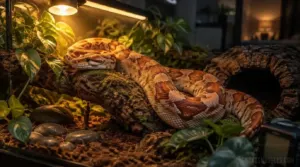
A boa’s lighting requirements are simpler than you’d think. Run a timer for 10 to 12 hours of light daily, then kill the white lights at night. Steady darkness protects circadian rhythms. Skip red or blue night bulbs.
UVB lighting is optional, but low-output UVB helps natural behavior. Always provide a shaded retreat, and replace lamps on the manufacturer’s schedule.
Feed Your Boa Morph Safely
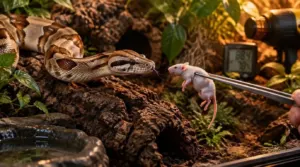
Picture a 14-month-old boa that suddenly starts regurgitating every meal. The owner discovers the rats were far too big and the boa was handled right after eating. Sound avoidable? It is.
Start with prey size selection. Match prey diameter to your boa’s widest body section, or go slightly smaller. You want only a faint bulge afterward. Hatchlings take hopper mice (8-12g), juveniles take medium mice (17-20g), and adults move to weaned rats or larger.
Offer only frozen-thawed prey. Warm it to 100-105°F with a heat gun, never a microwave, to spark a strong feeding response.
Set your feeding frequency by age: hatchlings every 5-7 days, juveniles every 7-10, adults every 10-21. Log your feeding schedule and skip handling 24-48 hours.
Protect Your Boa Morph’s Health
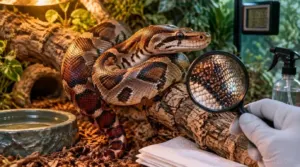
Your boa’s health depends on what you do before problems show up, not after. Three areas matter most: choosing a healthy snake, keeping its space clean and mite-free, and knowing when a symptom needs a vet. Master these, and you’ll control the risks that cost keepers the most.
Your boa’s health depends on what you do before problems appear, so choose a healthy snake, keep its space clean, and know when to call a vet
Selecting Healthy Boas and Verifying Genetics
Would you trust a stranger with a $1,500 purchase? Start with Finding Reputable Boa Breeders, then focus on Selecting Healthy Boas you can inspect. Prefer CaptiveBred Vs WildCaught Boas every time, since captive-bred animals carry paperwork. Check these:
- Clear eyes, clean vent
- Lineage records for both parents
- Lab-dated tests for Verifying Genetics
- Parasite test records
- Written Health Guarantees and Support
Cleaning, Disinfection, and Mite Prevention
Mites love neglect. Protect health and hygiene with strict quarantine procedures, and check substrate safety daily.
| Task | Action |
|---|---|
| Enclosure cleaning | Wash with detergent |
| Enclosure disinfection | Rinse, dry fully |
Move your boa to a secure container. Never mix products, ventilate well, and keep your snake away until surfaces dry. Discard porous furnishings after infestation, and inspect eyes, chin, and heat pits.
Illness Signs Requiring Veterinary Care
Don’t wait on respiratory distress. Open-mouth breathing, wheezing, clicking, or mucus at the nostrils means call your vet now, and a neck stretched upward to breathe is an emergency.
Watch for digestive stalls too: repeated regurgitation, or a swollen belly with no feces. Add shed trouble, mouth swelling, or tremors, and book an exam. Strong health and hygiene habits support IBD prevention.
Handle and Enrich Your Boa Morph
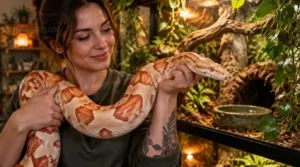
A healthy boa is a boa you can handle with confidence, so put that health work to use. Safe handling starts with patience. Give your boa time to acclimate, then run 5-minute sessions every few days. Build to 10-15 minutes daily, but never more than once per day.
Let your boa crawl onto your wrist or upper arm, then support its head and back. Never lift it by the tail. Face training matters too: teach your boa that your face isn’t food, especially with a medium or large snake.
Handling also counts as environmental enrichment. Add climbing branches and rearrange your reptile enclosure setup now and then. Watch for stress signs, and cut sessions short when you see them. Your boa will reward the routine.
Frequently Asked Questions (FAQs)
Are boa constrictors easy to take care of?
A boa is a 25-year promise coiled in muscle.
No, they’re not easy. You’ll need serious enclosure size, steady temperature regulation, 50–70% humidity control, careful feeding frequency, and daily health monitoring. Try corn snakes first.
What are the most expensive boa constrictor morphs?
Designer boa combos can hit $5,000 to $6,000 at release. Boa constrictor morphs like IMG Motley Albino sit near $2,200 to $2, Check market trends and availability, and verify genetic inheritance patterns before you buy.
How many babies do boa constrictors have at a time?
Boas usually have 20 to 30 babies. Clutch size ranges from 10 to 65, shaped by the mother’s age, size, and health. Hatchlings need Neonate care and growth rate monitoring against Typical Size and Growth Rates.
Can you explain the different morphs of boa constrictors?
Wondering what Boa constrictor morphs really are? Think Classic Vs Designer Morphs, Pattern Differences Among Morphs, How Age and Environment Affect Appearance, and Beginner Boa Constrictor Morph Types: it’s all about color, pattern, and genetics.
How long do boa constrictor morphs live?
Ready for a 20 to 30 year commitment? That’s your realistic boa lifespan, and 40 isn’t unheard of. Morph color doesn’t change it. Genetics, boa enclosure setup, health monitoring, and boa veterinary care do.
Can boa morphs be housed together safely?
No, don’t house boa morphs together. Boas are solitary, and shared space breeds stress, feeding conflicts, and injuries. Use secure housing with proper enclosure size for each snake, and quarantine newcomers before any contact.
What causes color changes in boa morphs?
Picture a ruby-red boa fading to rust by its third birthday. Ontogenetic color change in boas is normal: growing scales spread pigment thinner, while shed cycles, melanosome shifts, and color morph inheritance like IMG darken adults.
Are boa constrictor morphs legal everywhere?
Think of the law as a map, not a morph guide. Legality varies by country, state, and city, and CITES restrictions can apply to transport. Check your species, location, and permits first.
Do boa morphs require special permits or paperwork?
Wondering if your boa needs paperwork? Permit requirements vary wildly: Hawaii bans boas outright, New Jersey permits only imperator and ortonii, and New York City prohibits Boidae. Check CITES restrictions and local rules first.
How long do boa constrictor morphs typically live?
Picture a hatchling coiled in your palm, then picture that same snake sprawled across your couch in Boa constrictor morphs usually live 20 to 30 years in captivity, so treat this as a serious lifespan commitment.
Conclusion
Picture a first-time keeper who checks the tank every morning, spots 90°F on the basking surface, and logs 65% humidity. Six months later, that boa has shed clean, fed on schedule, and doubled in length.
That’s what consistent husbandry looks like. Caring for boa constrictor morphs isn’t about chasing rare genetics. It’s about hitting your numbers daily, watching your snake closely, and calling a vet early. Master those habits, and your boa thrives for decades.