This site is supported by our readers. We may earn a commission, at no cost to you, if you purchase through links.

Spot a garter snake in your backyard and you might assume it wandered in by accident—but that snake chose your yard deliberately, reading your landscape the way a seasoned naturalist reads a field guide. Garter snakes (Thamnophis spp.) rank among North America’s most habitat-flexible reptiles, threading through ecosystems from the Northwest Territories down to Costa Rica, yet their presence in any given location follows precise biological logic. Moisture gradients, prey density, thermal access, and shelter patchiness all factor into where these snakes settle, forage, and overwinter.
Understanding garter snake natural habitat information reveals a surprisingly complex relationship between animal and environment—one that explains why they thrive in untouched wetlands and suburban gardens alike.
Table Of Contents
- Key Takeaways
- What is a Garter Snake Habitat?
- Where Do Garter Snakes Live?
- Common Garter Snake Habitats
- Wetlands, Streams, and Water Sources
- Shelter and Cover in Habitats
- Climate and Temperature Preferences
- Seasonal Habitat Use
- Habitat Differences by Species
- Urban and Backyard Habitats
- Threats to Garter Snake Habitats
- Frequently Asked Questions (FAQs)
- What does it mean when a small snake enters your house?
- What snake has 100% fatality?
- What is the natural habitat of a garter snake?
- What are some interesting facts about garter snakes?
- Are garter snakes aggressive?
- Is it good or bad to have garter snakes in your yard?
- How to make a garter snake habitat?
- Where do garter snakes like to nest?
- How long do garter snakes typically live?
- What predators commonly hunt garter snakes?
- Conclusion
Key Takeaways
- Garter snakes don’t stumble into your yard by chance — they’re actively scanning your landscape for four non-negotiable essentials: prey, shelter, warmth, and moisture.
- Water is the backbone of their world, not just a bonus — wetlands, marshes, and stream edges concentrate the amphibians and invertebrates they hunt while also regulating their body temperature and shedding cycles.
- Their seasonal rhythm is surprisingly deliberate, with spring emergence, summer foraging, fall migration to dens, and communal winter hibernation all driven by precise temperature thresholds and ingrained route memories.
- Wetland loss, habitat fragmentation, pesticide runoff, and road mortality are quietly dismantling the connected landscapes garter snakes depend on — leaving brush piles undisturbed or planting native groundcover in your yard genuinely helps counter that pressure.
What is a Garter Snake Habitat?

Garter snakes aren’t picky — they’ve mastered the art of making almost anywhere feel like home. That said, they do rely on a few key conditions to truly thrive.
From humidity to hide spots, nailing the basics makes a real difference — check out this guide on hardiest common snake species to own to see exactly what garter snakes need to settle in comfortably.
Here’s what defines their natural habitat and why it works so well for them.
Defining Natural Habitat
Garter snakes don’t just wander into random patches of ground — they select habitats with refined precision. Their ecological niche spans wetland ecosystems, grasslands, and riparian corridors, reflecting complex habitat selection driven by microhabitat complexity and structural heterogeneity.
Understanding the habitat and geographic range of garter snakes means recognizing how resource partitioning and habitat preferences shape where each population ultimately settles and thrives.
These snakes often rely on wetland marsh habitats that supply both water and abundant prey.
Core Habitat Requirements
Four conditions shape where garter snakes settle — not terrain alone, but the interplay of resources across their habitat and geographic range:
- Prey Availability — frogs, earthworms, and small mammals within foraging range
- Shelter Patchiness — scattered logs, rocks, and debris, not uniform cover
- Thermal Microclimates — sunny basking spots connected by shaded routes
- Landscape Connectivity — wetland ecosystems, grasslands, forests, and marshes linked across mesic habitats
Why Moisture Matters
Moisture does more than just quench thirst — it quietly governs where garter snakes survive and why they keep returning to wetlands, marshes, and riparian corridors.
| Moisture Role | Biological Impact |
|---|---|
| Hydration Benefits | Sustains cell function in drier microhabitats |
| Shedding Efficiency | Promotes complete ecdysis, reducing retained scales |
| Prey Availability | Maintains amphibian and earthworm concentrations |
| Thermal Buffering | Moderates extreme heat during peak activity |
| Reproductive Success | Improves clutch viability and juvenile survival |
These factors shape both habitat preferences and geographic distribution across mesic habitats.
Habitat Versatility Across Species
Not every species plays by the same rules. Physiological tolerance, morphological plasticity, and foraging strategy diversity allow garter snakes to occupy wetlands, grasslands, forest edges, and urban gardens alike — each population shaped by local pressures on predator avoidance and reproductive site flexibility.
- Wetland specialists hunt amphibians in slow-moving marshes
- Grassland populations exploit seasonal prey pulses after rain
- Forest-edge dwellers use fallen logs for ambush and shelter
- Urban and suburban presence of garter snakes reflects impressive adaptability
- Habitat preferences and geographic distribution shift across elevation and climate
Where Do Garter Snakes Live?

Garter snakes are one of the most widespread reptiles in North America, turning up everywhere from Canadian boreal edges to the humid lowlands of Costa Rica. Their range spans an impressive stretch of geography, shaped by climate, elevation, and available habitat.
Here’s a closer look at exactly where these adaptable snakes call home.
North American Distribution
Few snake genera illustrate latitudinal gradients quite like Thamnophis — its species distribution spans North America from Canada’s Northwest Territories south through Mexico into Central America.
Geographic range within this genus reveals subspecies hotspots, hybrid zones where overlapping ranges blur taxonomic boundaries, and pockets of range fragmentation driven by shifting landscapes.
Understanding this broad geographic distribution provides a sharper lens on North American snake ecology overall.
United States and Canada Range
The species distribution of Thamnophis spans Canada’s southern provinces—Ontario, Quebec, and Atlantic enclaves—throughout all contiguous U.S. states. Latitude boundaries and range shifts continue reshaping isolated enclaves, particularly where borderline populations cling to habitat edges.
- Central plains: Kansas to Manitoba
- Great Lakes wetlands and river corridors
- Western U.S. coastal and Rocky Mountain zones
Mexico and Central America Range
Beyond the U.S. border, garter snakes push surprisingly far south. Thamnophis species follow wetlands and montane corridors through Mexico’s Sierra Madre Occidental into Central America — even reaching Costa Rica’s wetlands along the Talamanca Cloud Forests.
These regions include the Mexico highlands and Central America, each with distinct habitats:
| Region | Key Habitat |
|---|---|
| Mexico highlands | Montane Wetlands, Volcanic Soil Corridors |
| Central America | Cross-border migration routes |
This geographic distribution across North America extends further than most realize.
Elevation and Regional Range Limits
Garter snakes don’t stop at the foothills. Their geographic range spans sea level to roughly 1,800 meters, where upper elevation barriers — colder temperatures, reduced prey, shorter active seasons — finally limit their climatic tolerance.
Altitudinal niche shifts and upslope migration increasingly reshape these limits as warming climates push populations higher.
Mountain microclimate refugia on sun-facing slopes support elevation-driven genetics unique to isolated regional populations.
Common Garter Snake Habitats
Garter snakes are surprisingly adaptable — you’ll find them in places you might never expect. Their range of habitats spans some very different environments, each offering what they need to feed, shelter, and stay warm.
Here is a look at the most common spots where garter snakes actually thrive.
Grasslands and Meadows
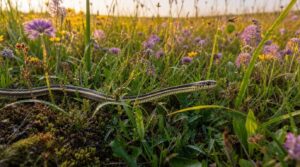
Open grasslands and meadows rank among the most productive habitat types for garter snakes. Native forb diversity sustains dense insect and amphibian populations — reliable prey sources. Soil water retention keeps microhabitats moist.
Fire-driven succession refreshes vegetation structure, while rotational grazing benefits the mosaic of short and tall cover that snakes depend on.
Rich pollinator habitat quality signals a thriving, structurally complex grassland ecosystem.
Wetlands and Marshes

Wetlands and marshes aren’t just wet ground — they’re among the richest habitat types a garter snake can call home. Hydrological variability, sediment trapping, and nutrient cycling fuel remarkable plant diversity, drawing dense amphibian populations that garter snakes actively hunt.
Their aquatic locomotion makes traversing these wetland ecosystems seamless. Carbon storage in marsh soils also stabilizes these critical habitats long-term, sustaining reliable foraging grounds season after season.
Forest Edges and Woodlands

Forest edges function similarly to wetlands — layered, ever-changing, and full of opportunity. Edge temperature gradients shift sharply within 20–60 meters, creating diverse thermal niches that garter snakes exploit for thermoregulation. These dynamic boundaries enable precise microclimate regulation.
Deadwood refugia along boundaries offer shelter and ambush sites, while wind-exposure microclimates regulate humidity. Such features foster complex ecological interactions, blending structural diversity with functional adaptability.
Seasonal edge migration connects grasslands, forests, and marshes, supporting habitat preferences and environmental adaptability. However, habitat loss and fragmentation increasingly interrupt these critical movement corridors, threatening biodiversity and ecosystem resilience.
Hillsides and Riparian Zones
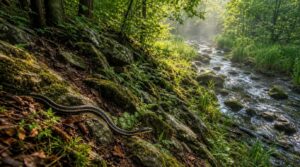
From the leafy forest edge, garter snakes move freely into hillsides and riparian zones — two habitats that complement each other well. Rocky hillsides offer slope stability, microclimate variation, and deep rock crevices for shelter.
Meanwhile, riparian corridors connect freshwater habitats and wetland ecosystems, providing soil moisture preference conditions and vegetation anchoring that facilitates runoff filtration, erosion mitigation, and rich amphibian prey year-round.
Suburban Gardens and Yards

Suburban gardens and yards have become a surprisingly reliable refuge amid ongoing habitat loss. Lawn irrigation, rain gardens, and pollinator borders create moist, prey-rich microhabitats that support urban wildlife year‑round.
Patio shading structures, privacy planting hedgerows, and debris piles mimic natural cover.
Human impacts on garter snake populations are real, yet urban and suburban colonization proves that these snakes adapt remarkably well to our spaces.
Wetlands, Streams, and Water Sources
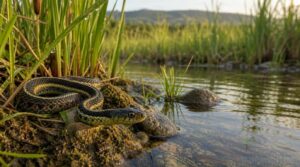
Water isn’t just a backdrop in a garter snake’s life — it’s the whole stage. These snakes have a surprisingly close relationship with wetlands, streams, and other water sources that shapes nearly everything about where they settle and how they hunt.
Here’s a closer look at the key ways water defines their world.
Why Garter Snakes Stay Near Water
Water isn’t just a backdrop for garter snakes — it’s a survival toolkit. Wetland ecosystems and marsh edges deliver prey abundance through concentrations of amphibian prey, aquatic prey capture opportunities, and invertebrates.
These zones also provide thermal buffering, hydration access through damp soil and dew, moulting efficiency in humid air, and reliable escape pathways into dense emergent vegetation.
Five reasons water proximity matters:
- Prey abundance — amphibians and invertebrates concentrate near shorelines
- Thermal buffering — riparian air stays cooler, preventing dangerous overheating
- Hydration access — moist soil reduces water loss through skin and respiration
- Moulting efficiency — humidity allows clean, complete shed cycles
- Escape pathways — water and dense marsh vegetation confuse pursuing predators
Ponds, Lakes, Creeks, and Ditches
Each water body type you’ll encounter — still ponds, stratified lakes, fast-moving creeks, or engineered ditches — offers distinct microhabitat diversity that garter snakes exploit differently.
| Water Body | Key Feature |
|---|---|
| Ponds | Aquatic vegetation, thermal stratification |
| Lakes | Sediment composition, wetland edges |
| Creeks | Current-driven nutrient runoff, rocky cover |
| Ditches | Grasslands, forests and marshes connectivity |
Amphibian-Rich Foraging Areas
Wherever amphibian prey pulses concentrate — spring breeding pools, shallow seepage zones, or moss-lined stream margins — you’ll find garter snakes hunting with precision. Leaf litter mats and herbaceous tussocks create micro-moisture hotspots that sustain dense amphibian populations, directly shaping the diet and feeding habits of garter snakes and their ecological role as predator-prey regulators in wetland ecosystems.
Wherever amphibian prey pulses concentrate, garter snakes hunt with precision, shaping wetland ecosystems as natural predator-prey regulators
Top 5 amphibian-rich foraging zones garter snakes exploit:
- Vernal pools during frog and salamander metamorphosis
- Damp leaf litter edges bordering slow-moving streams
- Wet meadow margins after seasonal rain events
- Mossy seepage lines in shaded forest hollows
- Shallow pond shorelines thick with emergent vegetation
Aquatic and Semi-Aquatic Habitat Use
Though garter snakes aren’t fully aquatic, they’re masters of the land-water interface — traversing wetland ecosystems, swamp margins, and riparian zones with impressive precision. Hydric microhabitat selection, aquatic predator avoidance, and riparian thermoregulation all shape how they use these edges.
Connectivity-driven dispersal links grasslands, forests, and marshes into functional corridors.
Water-edge reproduction ties habitat quality directly to population health — making habitat loss at wetland boundaries especially damaging.
Shelter and Cover in Habitats
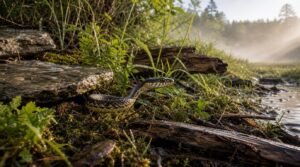
Finding food is only part of the story — garter snakes also need reliable places to hide, rest, and regulate their body temperature throughout the day. The right cover can mean the difference between a snake that thrives and one that doesn’t last the season.
Here’s what actually counts as shelter in a garter snake’s world.
Logs, Rocks, and Leaf Litter
Fallen logs, rock clusters, and leaf litter aren’t just debris — they’re functional architecture for garter snakes.
Logs undergoing log decay, nutrients release moisture that sustains microfauna hotspots teeming with beetles, worms, and salamanders. Rock thermal buffers absorb daytime heat, while crevice egg-guarding shelters vulnerable offspring.
Leaf litter moisture stabilizes ground humidity, making these microhabitats indispensable across grasslands, forests, and marshes wherever soil moisture preference drives foraging decisions.
Dense Grass and Low Vegetation
Dense grass and low vegetation serve a dual purpose in snake habitats. They function as soil erosion control, anchoring moisture gradient corridors that connect wet patches to upland foraging zones—a critical feature across grasslands, forests, and marshes.
Temperature regulation occurs in patches where sunlight filters unevenly through sparse cover, aiding thermoregulation. Meanwhile, thatch layers act as invertebrate refuge zones, concentrating prey for snakes.
Fire-driven succession periodically renews these structures, sustaining habitat conditions and supporting common garter snake populations across savanna or grassland ecosystems.
Stone Walls and Rock Crevices
Stone walls and rock crevices function as nature’s apartment complex — stacked, layered, and packed with life. Their tight gaps deliver microclimate regulation and thermal buffering, stabilizing interior temperatures despite external fluctuations.
For garter snakes navigating urban and suburban landscapes, these structures provide reliable invertebrate refuge, retain moisture, and serve as effective predator hideouts. Such features make them indispensable to snake habitat viability and the broader distribution of common garter snakes.
By offering shelter and thermal stability, these natural formations act as critical components of snake habitat, directly influencing population resilience and ecological connectivity in fragmented environments.
Debris Piles and Burrows
Debris piles differ from rock crevices in their loose, organic structure, which shifts with decomposition. Leaf litter and wood fragments create Microhabitat Moisture pockets and support Prey Accumulation, drawing insects and amphibians that garter snakes hunt across grasslands, wetlands, and forest edges.
Beneath these piles, Burrow Architecture provides Temperature Buffering and reliable Predator Refuge through multi-entrance underground burrows shared with other wildlife.
Natural Vs. Human-Made Shelter
Organic debris offers Camouflage Efficiency that manufactured materials can’t replicate across grasslands, forests, and marshes. Human-made structures—stone walls, building foundations, and cellar edges—compensate with enhanced Structural Strength and Thermal Performance.
Both shelter types support garter snakes navigating urban landscapes shaped by habitat loss and fragmentation.
Moisture Control and Durability Maintenance ultimately determine which shelters persist long enough to facilitate urban wildlife adaptation.
Climate and Temperature Preferences

Temperature isn’t just a comfort thing for garter snakes — it shapes nearly every decision they make, from when to hunt to where to sleep. Like most reptiles, they’re at the mercy of their environment, which means the climate around them matters more than you might think.
Here is a closer look at the specific temperature and climate factors that define where garter snakes truly thrive.
Ideal Activity Temperatures
Garter snakes are wired for precision — their temperature-dependent activity hinges on narrow thermal windows. Daytime Heat Preference sits between 24–30°C, while the Metabolic Temperature Optimum for digestion peaks at 28–32°C.
Drop below 14°C at night, and mobility suffers. This Microhabitat Thermal Gradient — sun-warmed patches alongside cool refuges — drives thermoregulation and shapes Seasonal activity patterns and hibernation.
These thermal dynamics directly influence the Habitat and Distribution of Common Garter Snake populations.
Basking Sites and Sun Exposure
Once ideal temperatures are mapped, the next question is where snakes actually collect that heat. Basking sites span grasslands, forests, and marshes, each offering distinct thermal advantages:
- Gravel Sunbaths — Loose gravel heats fast and radiates warmth evenly.
- Smooth Sun Rocks — Flat surfaces support extended thermoregulation without energy loss.
- Log Sun Perches — Elevated locations enhance sun exposure during communal basking.
- Bare Soil Warmth — Rapidly absorbs direct sunlight, supporting seasonal activity patterns and hibernation preparation.
Cool-Weather Adaptations
When temperatures fall below 20 °C, garter snakes don’t simply shut down — they shift strategies.
Antifreeze Proteins and antifreezelike proteins in the bloodstream sustain cellular function near freezing. Fat Reserve Accumulation through late-summer feeding fuels brumation, while Metabolic Rate Depression conserves energy by reducing enzymatic activity.
Crepuscular Activity Shift minimizes cold daytime exposure, and Thermal Buffering Behavior—using burrows and leaf litter—stabilizes body temperature during hibernation.
| Adaptation | Mechanism | Benefit |
|---|---|---|
| Antifreeze Proteins | Prevent cellular ice formation | Survive near-freezing temps |
| Fat Reserve Accumulation | Late-summer hyperphagia | Fuel metabolism through brumation |
| Metabolic Rate Depression | Reduced enzymatic activity | Extend survival without feeding |
| Crepuscular Activity Shift | Avoid cold daytime exposure | Optimize thermal regulation |
| Thermal Buffering Behavior | Burrow and leaf-litter use | Stabilize body temperature during hibernation |
Humidity and Moisture Needs
Moisture is just as critical as warmth for garter snakes. Relative humidity between 40–70% facilitates healthy shedding cycles and prey availability across wetlands, marshes, and grasslands and forests alike.
Here’s what drives their moisture needs:
- Humidity Gradient — guides thermoregulation between ground and air layers
- Microclimate Moisture — logs and leaf litter retain localized dampness
- Dewfall Utilization — cool-morning dew extends crepuscular foraging windows
- Rainfall Triggers — soil saturation events spike movement and feeding activity
Regional Climate Differences
From the fog-draped Pacific coastline to sun-baked inland plateaus, regional climate shapes where garter snakes thrive. Latitude temperature gradients, elevation gradients, coastal fog, and mountain rain shadows all influence temperature-dependent activity across geographic distribution in North America.
Oceanic wind patterns moderate coastal zones, while cold tolerance allows range persistence in northern latitudes. These climatic forces collectively dictate habitat suitability and behavioral adaptations.
Climate change implications—combined with habitat loss and fragmentation—add growing pressure on vulnerable populations, threatening long-term survival in rapidly shifting environments.
Seasonal Habitat Use
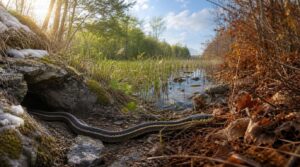
Garter snakes don’t stay in one place year-round — their habitat use shifts with the seasons in ways that are surprisingly deliberate. Each phase of the year pulls them toward different environments, from open basking spots to deep underground dens.
Here’s how that seasonal rhythm actually plays out.
Spring Emergence Areas
As winter loosens its grip, garter snakes follow precise Temperature Thresholds — usually when ground temperatures climb into the 20–29 °C range — to begin Emergence Timing from hibernation. During early spring (March–May), sunlit refuges along south-facing edges of grasslands, forests, and marshes draw them out first.
Microhabitat Connectivity between wetland ecosystems and rocky cover facilitates Predator Avoidance while snakes reestablish seasonal activity routes.
Summer Foraging Habitats
Summer turns garter snakes into precision hunters. Across grasslands, forests, and marshes, they exploit Thermal Microclimates—sunlit moist soil patches along wetland ecosystems where prey availability peaks.
Vegetation structure in meadow edges and riparian buffers offers both concealment and access to their insectivorous diet of earthworms, frogs, and slugs.
This ecological role as pest control agents depends entirely on negotiating Predation Risk Zones between open ground and dense cover.
Fall Movement to Dens
As days shorten, photoperiod cues trigger fall seasonal migration toward hibernation sites — snakes don’t wander randomly. Route fidelity guides individuals along familiar riparian corridors and hedgerows to established dens.
Key fall movement behaviors include:
- Gradual foraging cessation to build energy reserves
- Microclimate selection prioritizing stable-temperature crevices
- Intermittent travel with thermal pauses under debris
- Early den crowding driven by habitat loss and fragmentation reducing available cold tolerance refuges
Winter Hibernation Sites
Once snakes reach their dens, the real test of cold adaptation begins. They settle into subterranean chambers — rodent burrows, concrete crevices, moss‑covered rocks — wherever temperature stability holds above freezing.
Multi-entrance dens allow airflow regulation, supporting energy budgeting during winter hibernation. These features help snakes manage their metabolic demands in freezing conditions.
However, habitat fragmentation limits access to quality sites, forcing snakes into suboptimal refuges. This strain on their cold tolerance arises from prolonged exposure to harsher environments, exacerbating survival risks.
Communal Hibernacula
Some dens shelter thousands of individuals, where thermal inertia and microclimate stability keep internal temperatures just above freezing. These behavioral aggregations during hibernation are not accidental — they reflect cold adaptation refined over generations.
Key features that make communal hibernacula work:
- Den entrance design limits heat loss and predation
- Species cohabitation maximizes energy conservation across occupants
- Habitat fragmentation increasingly threatens access to quality sites
Habitat Differences by Species
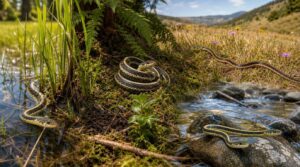
Not every garter snake plays by the same rules regarding where it calls home. Across the roughly 35 species in the genus, habitat preferences can look surprisingly different from one to the next.
Here’s how some of the most well-known species stack up.
Common Garter Snake Habitat
Across North America, Thamnophis sirtalis thrives wherever grasslands, forests, and marshes converge — and that range is impressively broad.
You’ll find it traversing wetland ecosystems, suburban backyards, and riparian corridors with equal ease, driven by predation pressure, invertebrate prey availability, and habitat connectivity.
| Habitat Type | Key Feature |
|---|---|
| Moist grasslands | Seasonal flooding sustains prey |
| Marsh edges | Amphibian-rich foraging zones |
| Forest edges | Reduced human disturbance |
| Suburban gardens | Dense cover, water access |
Western Terrestrial Garter Snake Habitat
Where T. sirtalis favors edge zones, Thamnophis elegans — the Western Terrestrial Garter Snake — pushes deeper into grasslands, forests, and marshes across the western U.S. and Canada.
Its five core habitat traits:
- Rocky hillsides enabling microclimate variations for thermoregulation
- Antifreeze proteins supporting activity near freezing temperatures
- Genetic polymorphism driving stripe-pattern diversity across populations
- Predator avoidance through dense shrubs and talus cover
- Reproductive site selection near sun-warmed, moisture-retaining slopes
Giant Garter Snake Wetland Habitat
Giant garter snake (Thamnophis gigas) ranks among North America’s most wetland-dependent reptiles, existing almost exclusively within California’s Central Valley marshes. These ecosystems are shaped by marsh nutrient dynamics, vegetation succession impacts, and complex predator-prey interactions.
The species forages through cattail-dense sloughs, where water quality indicators reflect healthy amphibian populations. This behavior underscores its reliance on intact wetland habitats for survival.
Habitat loss and fragmentation now threaten critical conservation breeding sites, diminishing its ecological role as pest control agents. Urgent protection of these wetlands is essential to safeguard the snake’s future and maintain ecosystem balance.
Northwestern Garter Snake Coastal Habitat
Unlike its valley-dwelling relatives, the Northwestern Garter Snake thrives along fog-belt coastlines — traversing Tidal Foraging zones, sheltering beneath Driftwood Refugia, and moving through Dune Corridor Linkages that connect grasslands, forests, and marshes.
Its Salt-spray Adaptation and tolerance for cool humidity distinguish it from species like the Western Terrestrial Garter Snake.
Habitat loss and fragmentation along developed coastlines increasingly disrupt these critical wetland ecosystems and coastal movement corridors.
Regional Habitat Specialization
Each species doesn’t just occupy a habitat — it locks into a precise Microhabitat Patchwork shaped by Regional Prey Coupling and Subregional Habitat Fidelity. From Canada’s prairies to Costa Rica’s wetlands, Habitat Mosaic Dynamics drive how populations balance grasslands, forests, and marshes.
Landscape Connectivity Strategies sustain suburban populations through interactions with wetland ecosystems, ensuring each regional lineage tracks the prey, shelter, and climate it evolved alongside.
Urban and Backyard Habitats

Garter snakes are surprisingly comfortable living alongside people, and your backyard might already offer everything they need. Understanding what draws them in — and how to respond — makes all the difference.
Here’s what you should know about urban and backyard habitats.
Why Garter Snakes Enter Yards
Garter snakes don’t wander into your yard by accident — your property is basically a fully stocked pantry. Insect abundance, rodent prey, and irrigation moisture re-create the moist, prey-rich conditions they depend on.
In suburban and urban areas, habitat loss and fragmentation push them closer to human spaces. Their diet composition and prey capture methods make them remarkably effective ecological pest control agents.
Garden Habitat Features
Your garden can do more than look good — it can function as a structured microhabitat. Three features make the biggest difference:
- Log Refuge Design near moisture-retaining mulch beds
- Rock Pile Basking platforms with shaded retreats
- Native Groundcover and Water Feature Placement near wetland-edge plantings
These elements mirror grasslands, forests, and marshes — compensating for wetlands lost to suburban and urban areas through effects of habitat loss and fragmentation.
Safe Cover Around Homes
Think of your yard as a series of quiet rooms—each one serving a purpose. Mossy Log Placement near moisture-retaining mulch mimics forest understory, while Rock Pile Spacing facilitates predator avoidance and thermoregulation. Low Hedge Design creates functional wildlife corridors between cover zones.
A Water Feature Buffer of roughly 1.5 meters keeps activity visible. Together, these features compensate meaningfully for habitat loss and fragmentation across urban areas.
Reducing Human-Snake Conflict
Once your yard’s cover zones are set, the next step is managing where snakes and people actually cross paths. Thoughtful Buffer Zone Design — trimming dense ground cover within one meter of foundations — paired with screen installations on vents considerably reduces unwanted entries.
Natural deterrents like coarse gravel strips reinforce boundaries. Community outreach and seasonal exclusion checks each spring, guided by clear Human Safety and Interaction Guidelines, make coexistence genuinely workable.
Creating Snake-Friendly Spaces
Beyond conflict reduction, you can actively shape your yard into a functional reptile habitat. Layer native shrubs over mulch moisture retention zones, add seasonal water features near rain garden design areas, and install insect houses to rebuild the prey web.
These elements echo grasslands, forests, and marshes—the wetlands, forest, and swamp edges where garter snakes naturally thrive.
Threats to Garter Snake Habitats

Garter snakes are remarkably adaptable, but even the most resilient species has its breaking point. Across North America, their habitats are quietly shrinking under pressures that don’t always make headlines.
Here’s what’s actually pushing them out.
Wetland Loss and Development
Wetland loss hits garter snakes harder than most threats because their entire lifestyle — foraging, thermoregulation, reproduction — depends on water-adjacent habitat. Since the year 2000, roughly 20% of wetland areas have disappeared, driven by:
- Urban Expansion clearing marshes for housing
- Agricultural Drainage converting wetlands to cropland
- Dam Hydrology disrupting natural flood cycles
- Coastal Reclamation eliminating tidal zones
Conservation status monitoring confirms accelerating population declines where habitat loss intersects human impacts.
Habitat Fragmentation
Even where habitat loss doesn’t erase a landscape entirely, fragmentation quietly dismantles it. Roads and development slice continuous habitat into isolated patches, triggering patch connectivity loss, edge microclimate shifts, and prey community fragmentation that destabilize local populations.
Genetic isolation effects accumulate over generations, while dispersal barrier impacts block seasonal migration to hibernacula.
Road mortality spikes wherever snakes attempt crossings, turning movement itself into a survival gamble.
Pesticides and Water Pollution
Pesticide pollution and water pollution quietly unravel garter snake habitats from the inside out. Runoff reduction failures allow herbicides like atrazine and insecticides such as organophosphates to flush into wetlands, initiating a cascade of ecological damage.
This contamination triggers invertebrate decline, which in turn strips away the amphibian prey base garter snakes depend on. Chemical bioaccumulation further compounds the damage as toxins concentrate across trophic levels, exacerbating population stress.
- Runoff carries pesticides directly into foraging wetlands
- Invertebrate decline collapses amphibian prey availability
- Chemical bioaccumulation accumulates toxins across trophic levels
While environmental monitoring and buffer strip effectiveness remain critical mitigation tools, regulatory limits alone cannot reverse the cumulative human impacts on garter snake populations.
Road Mortality Near Habitats
Roads cutting through wetland margins act as silent predators — and unlike natural predators, they don’t discriminate by age or season. Traffic speed around 40–60 km/h leaves drivers with almost no reaction time. Crossing hotspots form near amphibian-rich verges, peaking during spring emergence and fall den migrations — the two sharpest seasonal mortality peaks in human impacts on garter snake populations.
Wildlife underpasses, roadside fencing, and population monitoring serve as critical mitigation tools. These strategies reduce crossing fatalities, guide snakes away from lanes, and identify high-risk corridors, respectively.
| Mitigation Tool | Effectiveness |
|---|---|
| Wildlife underpasses | Reduces crossing fatalities |
| Roadside fencing | Guides snakes away from lanes |
| Population monitoring | Identifies high-risk corridors |
Habitat Conservation Recommendations
Protecting garter snakes starts with addressing habitat loss at its source. Native vegetation restoration and buffer zone creation around wetlands stabilize ecosystems that snakes depend on.
Pesticide reduction strategies protect amphibian prey, while connectivity corridors and den site protection counter fragmentation and climate change’s impact.
Population monitoring ties it all together — tracking conservation status and management efforts so interventions stay targeted and effective.
Frequently Asked Questions (FAQs)
What does it mean when a small snake enters your house?
A small snake indoors usually signals structural gaps or prey attraction cues like mice or insects nearby.
It’s a human-snake interaction worth addressing calmly — inspect entry points, guide it out safely, and seal the gaps.
What snake has 100% fatality?
No snake guarantees 100% fatality, but the Inland Taipan comes closest — untreated bites are nearly always fatal. Unlike the nonvenomous garter snake thriving across North America’s grasslands, forests, and marshes, even the Black Mamba, Eastern Brown, Russell’s Viper, and Saw-scaled Viper depend heavily on treatment delay and individual factors, not absolute lethality.
The resilience behind these deadly bites comes down to biology, as how snakes evolved immunity to their own venom reveals why even the most potent toxins leave their producers unharmed.
What is the natural habitat of a garter snake?
Garter snakes thrive across temperate North America, naturally occupying grasslands, forests, and marshes.
Their comfort with marshy habitats hints at strong swimming instincts, and whether garter snakes can swim is worth understanding before setting up their enclosure.
Anywhere wetlands, moisture, and dense cover support predator avoidance, microclimate selection, and reproductive sites.
Though habitat loss increasingly pressures their population density.
What are some interesting facts about garter snakes?
Picture a striped ribbon slipping through wet grass — that’s your first clue.
Garter snakes use mild venom, deliver live birth, and rank among the most nonvenomous North American snakes you’ll ever encounter.
Are garter snakes aggressive?
No — they’re harmless and non-venomous. Defensive displays like musk release or bluffing postures are their go-to responses, not biting. Bite likelihood stays low when you use calm, confident handling techniques.
Is it good or bad to have garter snakes in your yard?
Having one in your yard is genuinely good. They handle pest control and rodent regulation naturally, cutting your need for chemicals.
A quiet, low-risk ally, they support your garden’s ecological balance without threatening human safety.
How to make a garter snake habitat?
To create a garter snake habitat, use a 20-gallon aquarium with enclosure security.
Incorporate substrate selection, UVB lighting, a water dish, and live plants to replicate grasslands, forests, and marshes conditions effectively.
Where do garter snakes like to nest?
Garter snakes nest in moisture microhabitat zones — near wetlands, grasslands, forests, and marshes — favoring burrows, leaf litter, and rock crevices.
Their viviparity eliminates egg incubation temperature concerns, while dense cover ensures predator avoidance year-round.
How long do garter snakes typically live?
In the wild, most individuals survive 2–4 years, with first-year mortality being the biggest hurdle. Captive longevity commonly reaches 6–10 years.
Maximum lifespan, influenced by longevity variations in habitat and care, approaches 15 years.
What predators commonly hunt garter snakes?
Several predator species — hawks, herons, raccoons, foxes, and snapping turtles — actively hunt garter snakes across land and water.
This creates significant predation pressure that shapes their anti-predator defenses, including musk release and rapid retreat.
Conclusion
Here’s what the evidence keeps confirming: garter snakes don’t simply end up somewhere—they engineer their presence around moisture, warmth, prey, and shelter with quiet precision. Every piece of information about garter snake natural habitats points to the same truth: these reptiles are environmental readers, not wanderers.
Protect a wetland edge, leave a brush pile undisturbed, or plant dense ground cover, and you’re not just tolerating a snake—you’re sustaining a finely tuned ecological relationship worth understanding.