This site is supported by our readers. We may earn a commission, at no cost to you, if you purchase through links.

Most corn snake breeding attempts fail before the animals ever share an enclosure. The real work happens in the months prior, in body condition scoring, parasite screening, and the precise temperature drops of brumation. Skip those steps, and a healthy clutch becomes an unlikely outcome.
Corn snakes are resilient. But strength isn’t the same as forgiveness when you’re asking their bodies to take on the metabolic demands of reproduction.
Knowing how to breed corn snakes means understanding a sequence where each stage depends on the one before it. That sequence starts now.
Table Of Contents
- Key Takeaways
- Are Your Corn Snakes Ready to Breed?
- Prepare Corn Snakes for Safe Brumation
- Pair Corn Snakes and Prepare Egg-Laying
- Handle and Incubate Corn Snake Eggs
- Raise Healthy Corn Snake Hatchlings
- Frequently Asked Questions (FAQs)
- Are corn snakes hard to breed?
- What’s the easiest snake to breed?
- What age do corn snakes start breeding?
- How to tell if a baby cornsnake is a boy or girl?
- Do corn snakes need a male to reproduce?
- What is the Best Way to Sex a Corn Snake?
- How Often Should I Feed Adult Corn Snakes?
- Are There Any Special Incubation Requirements for Corn Snake Eggs?
- How Do I Know When Corn Snakes Are Ready to Mate?
- How to make corn snakes breed?
- Conclusion
Key Takeaways
- Breeding success depends entirely on pre-pairing preparation: females must be at least 18 months old, parasite-free, and in stable body condition before any introduction occurs.
- Brumation isn’t optional — a 2–4 week fast followed by a controlled temperature drop to 65–70°F is what triggers the hormonal cycle that makes successful mating possible.
- Once eggs are laid, orientation and precision matter more than anything: mark each egg immediately, never rotate it, and hold incubator conditions at 82–84°F with 70–90% humidity throughout incubation.
- Hatchlings must be separated by size from the moment they emerge, since even siblings from the same clutch will cannibalize each other if housed together.
Are Your Corn Snakes Ready to Breed?

Before a single snake meets another, you need to verify readiness. Rushing this step is the most common mistake breeders make, and it costs hatchlings. Run through these four checks first.
Before you even think about pairing, confirm both snakes have hit the minimum breeding age and weight for corn snakes—a female who looks ready often isn’t.
Check Age, Size, and Condition
Every breeding mistake begins here. Your age assessment must confirm females are at least 18 months old and males aren’t far behind.
- Female age threshold: 18 months minimum, no exceptions.
- Body condition score: aim for 3 to 4 on a five-point scale.
- Weight gain patterns: two months of stable mass.
Weight monitoring and health monitoring confirm what the calendar can’t.
Confirm Sex With Expert Help
Age and condition matter. Confirmed sex determines the pair.
Sexing corn snakes takes expert hands. Subcaudal scale count and tail morphology reveal sexual dimorphism; visual cues alone mislead.
| Method | Indicator |
|---|---|
| Scale count | Males: more subcaudal scales |
| Tail base | Males: wider, longer |
| Probing | Greater depth = male |
| Ultrasound | Hemipenal bulge visible |
| DNA test | Shed skin; definitive |
Never attempt probing technique solo.
For best results, review recommended substrates for gravid snake nesting before setting up a humid, burrow-ready coconut husk lay box.
Screen for Illness and Parasites
Sex confirmed, now verify health. Before pairing, screen both animals:
- Run fecal parasite testing on fresh samples collected across two separate days.
- Check for open-mouth breathing, skin lesions, and retained shed.
- Isolate new snakes 30 to 60 days; quarantine effectiveness depends on strict separation.
Appetite loss signals systemic stress. Don’t breed a snake that isn’t feeding consistently.
Plan Homes Before Breeding
Your snakes cleared health checks. Now build the right spaces before pairing starts.
Enclosure Size Design begins with a 40-60 gallon tank for your breeding pair. Keep a separate terrarium ready for any sick or quarantined animal. A neutral enclosure cuts territorial stress on introduction day.
| Setup Element | Specification | Purpose |
|---|---|---|
| Breeding pair | 40-60 gallon tank | Habitat Setup for Breeding Success |
| Quarantine unit | Individual terrarium | Isolate sick or new snakes |
| Substrate Selection | Reptile carpet or aspen | Absorbs moisture, resists mold |
| Ventilation Control | Locking vents, secure lid | Airflow and escape prevention |
| Water bowl | Large, changed daily | Soaking access during conditioning |
Prepare Corn Snakes for Safe Brumation

Cooling brumation is the key to corn snake breeding, but only if you execute it correctly. Start by fasting your snakes 2-4 weeks before entry. Undigested food sitting in the gut during brumation causes bacterial infections that can prove fatal.
Proper fasting also sets the stage for a successful breeding season ahead, and understanding how long corn snake eggs take to hatch helps you plan incubation conditions that keep temperature fluctuations within that critical 2–3°F window.
Your enclosure setup determines whether brumation goes smoothly:
- Use a secure tub with deep aspen substrate to allow natural burrowing
- Drop temperatures to 65-70°F during the active cooling period
- Keep humidity between 40-60% to balance hydration and prevent mold
- Place a shallow water dish inside in case snakes rouse and need to drink
Seasonal cycling demands a gradual shift. You’ll reduce ambient temperature and photoperiod over 1-2 weeks. During temperature regulation, check snakes weekly for sunken eyes or loose skin, signs of dehydration. Treat problems before resuming brumation.
Pair Corn Snakes and Prepare Egg-Laying

Time the pairing right. Introduce your male to the female’s enclosure during late winter to early spring, when rising temperatures and an increased photoperiod trigger breeding behavior. Supervise every session. Watch for chin-nudging, tail-rattling, and cloacal contact, then remove the male after confirmed mating or within 30 minutes. Document copulatory plugs, biting, and behavioral cues. They confirm success and set your timeline.
Once you have a gravid female, shift full attention to enclosure setup. She needs at least 6 to 8 inches of coconut fiber substrate and a humid micro-habitat maintained at 70 to 90% humidity. Install an egglaying box with a secure, slidable lid in a warm, sheltered corner. She’ll locate it when she’s ready. Don’t disturb her.
Handle and Incubate Corn Snake Eggs
The moment those eggs appear, how you handle them decides everything. Every action from this point forward — marking, positioning, temperature, humidity — determines whether they hatch or fail. Here’s exactly what to do.
How you handle corn snake eggs the moment they appear determines whether they hatch or fail
Mark and Position Eggs Correctly
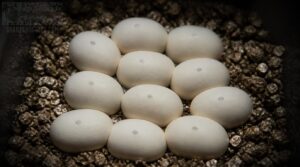
Orientation isn’t optional. Mark the top hemisphere of each egg with a soft pencil right after laying. That small dot preserves correct egg orientation during transfer and protects clutch viability by keeping each embryo properly positioned.
Place eggs marked-end up on damp vermiculite. Don’t rotate individual eggs once they’re set. Movement in the first 24 hours risks embryo stress.
Maintain Heat and Humidity
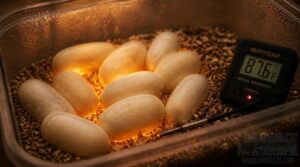
Eggs demand precision. Use heat tape on a thermostat to hold 80–84°F and maintain a reliable thermal gradient.
- Target 82°F as your baseline temperature
- Log temperature morning and night
- Hold incubation humidity at 70–90% early
- Drop humidity to 60–70% after week four
- Ventilate daily to stop mold
Moisture is your biggest risk. Control it.
Candle Eggs After Two Weeks

At day 14, candling technique confirms viability. In darkness, press a flashlight against each egg’s base. Watch for veins, embryo movement, and a stable air cell. Poor incubation humidity shows fast. A focused beam matters when shells are thick, so many keepers prefer a dedicated reptile egg candler flashlight over a standard phone light for clearer vein visibility.
| Appearance | Likely Cause | Action |
|---|---|---|
| Dark shadow, veins | Active embryo development | Leave undisturbed |
| Clear, no movement | Infertile or dead | Remove |
| Shriveled, overly dark | Humidity or temp failure | Relocate, adjust |
Inspect Incubating Eggs Weekly
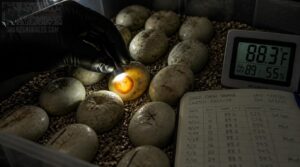
Weekly inspection isn’t passive. Throughout the incubation period, check each egg for color shifts, surface sheen loss, and mold. Record substrate moisture, temperature, and any drafts at every visit.
Sudden darkening or off-odors after two weeks demand immediate isolation. Use the candling technique to confirm embryo development and air cell stability. Photograph each egg. Your log catches problems early.
Raise Healthy Corn Snake Hatchlings
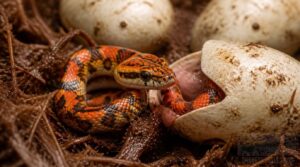
Once the incubator’s job is done, hatchling care starts immediately. Hatchling emergence happens fast, so don’t intervene and don’t handle. Wait for yolk sac absorption to complete before moving each animal. Pulling hatchlings prematurely raises mortality risk.
Separate by size immediately. Hatchling cannibalism is real. Even same-clutch siblings will consume each other if crowded or mismatched.
House each hatchling individually in 10-15 liters minimum, with two hides and aspen or cypress substrate. Hold a warm side at 28-32°C and humidity at 60-70% through the first shed. Keep enclosure enrichment simple until they’re settled.
After that first shed, offer appropriately sized pinkies twice a week. Run weight checks every seven days. Steady, linear growth without fat deposits is what you’re after.
Frequently Asked Questions (FAQs)
Are corn snakes hard to breed?
No, they’re among the easiest snakes to breed. You need patience and precision: proper brumation, correct temperature humidity during incubation, and diligent hatchling care. Master those fundamentals, and success follows naturally.
What’s the easiest snake to breed?
Corn snakes are the easiest snake to breed. They tolerate the brumation cycle well, lay reliably, and produce strong hatchlings with minimal intervention. Master temperature, humidity, and egg laying basics, and your breeding program succeeds.
What age do corn snakes start breeding?
Patience decides everything here. Breed too early and you risk stunted females, poor egg development, even death. Sexual maturity arrives at 2–3 years, males first, females closer to three. Never rush a brumation cycle. Size matters more than age.
How to tell if a baby cornsnake is a boy or girl?
Sexing hatchlings isn’t pure guesswork. Males show a slightly thicker tail base and develop hemipenal bulges near the vent after molts. For certainty, use cloacal probing with an experienced keeper’s hands. Don’t guess; confirm it.
Do corn snakes need a male to reproduce?
Without a male, your corn snake breeding program is dead before it starts. Mating requirements exist for a reason. Parthenogenesis is real but vanishingly rare. Sperm fertilizes the ova. No male simply means no hatchlings.
What is the Best Way to Sex a Corn Snake?
Probe the tail region. In males, the probe slides 8-12 subcaudal scales deep; females stop at 2- Get an experienced handler to confirm it. Visual tail taper helps narrow things down, but probing always decides.
How Often Should I Feed Adult Corn Snakes?
Feed, assess, adjust. Adult corn snakes need prey every 10–14 days. Match rodent sizing to body width. Your body condition assessment guides frequency. Proper thermal regulation ensures healthy digestion. Stick to your feeding schedule consistently.
Are There Any Special Incubation Requirements for Corn Snake Eggs?
Corn snake eggs need 82–88°F and 85–92% humidity sustained across the full 55–60 days. Don’t rotate them once they’re placed. Use a reliable thermometer and hygrometer. Temperature deviations shift hatch timing or kill embryos outright.
How Do I Know When Corn Snakes Are Ready to Mate?
Well-fed snakes can reach sexual maturity in just 18 months. Size predicts readiness more reliably than age alone. Your female needs 0–2 meters, solid body condition, and a clean health screening. So does your male.
How to make corn snakes breed?
Getting corn snakes to breed starts with brumation, pairing, and gravid monitoring. Drop temperatures, reintroduce after warming, and provide a laying box. Control every variable.
Conclusion
When you finally see those first hatchlings push through their shells, you’ll understand that knowing how to breed corn snakes isn’t really about snakes at all. It’s about discipline.
Brumation, parasite screening, careful incubation. Every single step was a test of your commitment to the whole process. The animals don’t reward shortcuts.
But when you’ve done it right, that first clutch feels less like an outcome and more like proof of something you truly built.