This site is supported by our readers. We may earn a commission, at no cost to you, if you purchase through links.
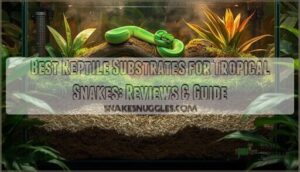
Your tropical snake’s substrate isn’t just bedding—it’s the foundation of respiratory health, thermoregulation, and shedding success. Get it wrong, and you’ll battle stuck sheds, respiratory infections, and stressed animals despite perfect temperatures and feeding schedules.
Reptile substrates for tropical snakes must maintain 60-80% humidity while preventing bacterial growth, a balance that eliminates half the products marketed to keepers. Cypress mulch, coconut fiber, sphagnum moss, and bioactive blends each excel in specific scenarios, but matching substrate to species behavior separates thriving snakes from those merely surviving.
Whether you’re housing a burrowing blood python or an arboreal green tree python, substrate choice directly impacts enclosure humidity gradients, waste management, and your snake’s ability to express natural behaviors.
Table Of Contents
Key Takeaways
- Tropical snake substrates must maintain 60-80% humidity while preventing bacterial growth, with cypress mulch, coconut fiber, sphagnum moss, and bioactive blends each excelling for specific species behaviors like burrowing or climbing.
- Substrate choice directly impacts respiratory health, shedding success, and thermoregulation—wrong materials cause stuck sheds and infections despite perfect temperatures.
- Match substrate depth to your snake’s natural behavior (4-6 inches for burrowers, shallower for arboreal species), and replace every 4-12 months depending on substrate type and species waste load.
- Coconut fiber offers the best balance of moisture retention, safety if ingested, and low dust levels for most tropical species, while bioactive substrates reduce maintenance through self-sustaining waste decomposition.
Best Substrates for Tropical Snakes
Tropical snakes need substrates that hold moisture without turning into a soggy mess, and your choice directly impacts their respiratory health and shedding cycles. The right material maintains 60-80% humidity while allowing your snake to burrow, thermoregulate, and behave naturally.
Tropical snakes demand substrates that balance moisture retention and airflow—your choice shapes their respiratory health, shedding success, and natural behavior
Here’s a breakdown of the most effective substrate options for tropical species, along with what works and what doesn’t.
Cypress Mulch: Benefits and Drawbacks
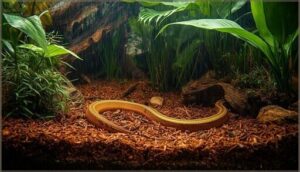
Cypress mulch maintains humidity levels effectively for tropical snakes, absorbing and releasing moisture gradually while supporting natural burrowing behaviors. However, you’ll need to watch for mold growth in overly damp conditions, which poses health risks.
The substrate may contain phenolic compounds that irritate your skin during handling, and ingestion of fragments can create digestive concerns. Always verify your supplier’s quality standards to avoid pesticide residues.
Researchers emphasize the importance of using scientific study methods to guarantee the validity of findings related to animal care.
Coconut Fiber: Moisture Retention and Suitability

Coconut fiber substrate retains moisture exceptionally well, holding up to 7-10 times its weight in water—perfect for maintaining the 70-80% humidity your tropical snakes need. You’ll find it pH-neutral and low in dust, reducing respiratory risks. If accidentally ingested during feeding, coconut fiber breaks down more safely than wood products, though you should still monitor your snake’s feeding behavior closely to prevent impaction.
Researchers can explore language patterns to better understand the terminology used in herpetology.
Sphagnum Moss: High Humidity Support
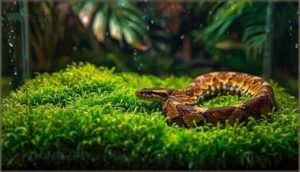
For even higher humidity retention, sphagnum moss holds several times its weight in water—often outperforming coconut fiber when you’re pushing toward that 80% upper range. It buffers humidity swings between misting cycles and provides soft, compressible bedding for burrowing species.
Just watch for mold if airflow drops or substrate stays saturated too long, which compromises substrate safety.
Bioactive Substrates: Naturalistic Enclosures
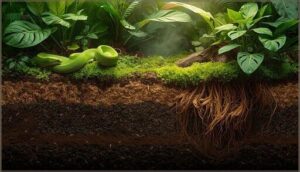
Building on moisture retention, bioactive substrates take things further by introducing microbial balance and ecological cycling into your enclosure. You’ll layer natural soil blend, coconut fiber, sphagnum moss, and sometimes ReptiChip reptile substrate over a drainage layer, then seed the system with isopods and springtails. This substrate ecology breaks down waste organically, supporting naturalistic design and reducing your cleaning frequency—though bioactive systems demand careful monitoring of humidity and microfauna populations.
- Self-sustaining waste decomposition reduces manual labor
- Living soil mimics your snake’s wild habitat authentically
- Microfauna control odor and prevent pathogen buildup
- Naturalistic design encourages instinctive burrowing and foraging
Substrate Blends for Custom Humidity
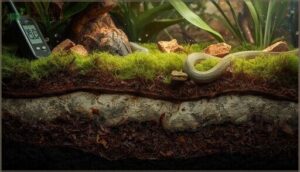
For fine-tuned humidity control, you can combine coconut fiber and sphagnum moss in a 60/40 ratio—this custom blend raises relative humidity 5–15 percentage points over coconut fiber alone while improving airflow and reducing mold.
Many keepers find that sourcing both components through a comprehensive ball python bedding guide helps them compare texture, particle size, and moisture retention before committing to a custom mix.
Substrate layering with a damp base and drier top creates stable microclimate management. Add orchid bark for porosity, and monitor moisture balance with a hygrometer to maintain consistent terrarium design.
Regular upkeep becomes easier when you incorporate durable habitat decoration materials that withstand high humidity and frequent handling during maintenance cycles.
Top Substrate Products for Tropical Snake Enclosures
You’ve narrowed down the substrate types that work for tropical snakes, but choosing a specific product can feel overwhelming with so many options on the market.
Each substrate brand offers different moisture retention rates, particle sizes, and safety profiles that directly impact your snake’s health.
Some brands prioritize natural odor control and balanced humidity, which is why understanding how substrate choice affects your snake’s respiratory health can save you from costly vet visits down the line.
The following reviews break down six proven products, highlighting their strengths and limitations for tropical species.
1. Bioactive Reptile Terrarium Soil Mix
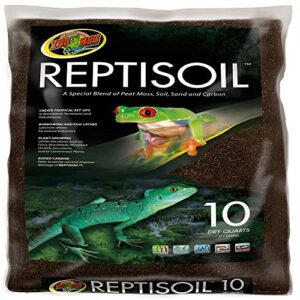
If you’re ready to replicate a thriving slice of rainforest floor, bioactive substrate delivers living ecosystems right inside your terrarium design. This reptile substrate combines coconut fiber, composted topsoil, and amendments that support springtails and isopods—your cleanup crew.
You’ll control humidity while the microbe balance processes waste naturally. Substrate depth matters: aim for 3–4 inches to allow burrowing and root growth. Monitor moisture by hand-squeeze testing, ensuring it clumps without dripping.
For snakes that dig frequently, choosing the right substrate for burrowing species prevents tunnel collapse and supports their natural behaviors.
Proper substrate selection transforms reptile care from routine maintenance into a self-sustaining habitat that benefits your tropical snake’s health and natural behavior.
| Best For | Reptile keepers who want a low-maintenance, self-sustaining tropical habitat that supports burrowing species and live plants while naturally controlling odors and waste. |
|---|---|
| Material Type | Coconut fiber |
| Odor Control | Yes |
| Moisture Retention | High |
| Weight | 1.06 ounces |
| Natural Material | Yes |
| Ease of Cleaning | Moderate |
| Additional Features |
|
- Creates a living ecosystem with beneficial bacteria and cleanup crews like springtails and isopods that break down waste and reduce manual cleaning
- Retains moisture effectively for tropical species while supporting natural behaviors like burrowing, egg-laying, and foraging
- Supports long-term plant growth and root development, turning your terrarium into a thriving mini rainforest
- Requires careful humidity monitoring to prevent mold growth or anaerobic pockets that can harm your reptile
- Initial setup demands more effort and investment compared to simple substrates, including sourcing cleanup crews and bioactive amendments
- May arrive dusty or contain larger wood pieces that need sifting or rinsing before use
2. Reptile Terrarium Liner Carpet
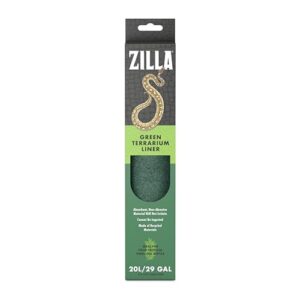
When you prioritize spotless enclosures over natural burrowing, reptile carpet offers a wipeable solution that simplifies reptile care. This terrarium liner rolls out in green polyethylene or polypropylene mesh, cutting neatly to fit your terrarium design.
You’ll notice enzyme treatments reduce odor, while the non-abrasive carpet texture protects belly scales during movement. Humidity control remains lower than coconut fiber, so pair it with a moisture hide.
Cleaning methods involve lifting, scrubbing with mild disinfectant, and air-drying—substrate safety without ingestion risk. Liner material lasts months with routine spot checks.
| Best For | Reptile owners who want a low-maintenance, easy-to-clean substrate that eliminates impaction risks and keeps enclosures sanitary with minimal effort. |
|---|---|
| Material Type | Synthetic liner |
| Odor Control | Yes |
| Moisture Retention | Low |
| Weight | 3.2 ounces |
| Natural Material | No |
| Ease of Cleaning | Easy |
| Additional Features |
|
- Enzyme-treated material reduces odors and prevents bacterial buildup, making daily maintenance much simpler than loose substrates.
- Non-ingestible surface eliminates impaction risks for reptiles prone to eating substrate during feeding or exploration.
- Wipeable and reusable design allows quick spot cleaning and disinfecting without full substrate replacement.
- Lower moisture retention than natural substrates means you’ll need extra misting or humidity hides for tropical species.
- Can shrink when dried and may allow reptiles to burrow underneath if not secured properly in the enclosure.
- Provides no natural digging or burrowing opportunities, which may affect species that need substrate enrichment.
3. Zoo Med Forest Floor Bedding
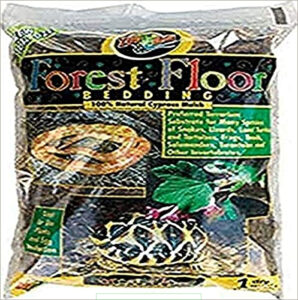
Zoo Med’s Forest Floor Bedding pulls compressed organic mulch into a loose, leaf-litter texture that mimics naturalistic environments, perfect for tropical species craving substrate aeration and authentic reptile enclosures. The mulch composition blends wood fibers and plant materials, retaining moisture without over-saturating—a balance that maintains humidity control and humidity dynamics in your snake substrate setup.
You’ll find it digestible if ingested, reducing impaction risk. Watch for mold during spot checks, and maintain proper ventilation. This reptile substrate choice suits burrowers seeking substrate selection that combines forest floor benefits with practical hygiene.
| Best For | Keepers of tropical snakes, amphibians, and burrowing reptiles who want a naturalistic substrate that holds humidity while staying loose enough for digging and movement. |
|---|---|
| Material Type | Cypress mulch |
| Odor Control | Minimal |
| Moisture Retention | High |
| Weight | 10.6 pounds |
| Natural Material | Yes |
| Ease of Cleaning | Moderate |
| Additional Features |
|
- Mimics forest floor environments with organic mulch that expands when moistened, creating a realistic habitat for tropical species
- Retains moisture effectively to maintain humidity without becoming waterlogged, helping snakes shed properly
- Safe if accidentally ingested in small amounts, reducing impaction concerns compared to harder substrates
- Can arrive with mites or insects, requiring soaking in hot water before use to minimize infestation risk
- Develops mold quickly if over-watered or ventilation is poor, demanding regular moisture checks
- Dusty out of the bag and may need rinsing, plus batch consistency varies in particle size and expansion rate
4. Natural Reptile Bedding Alfalfa Meal
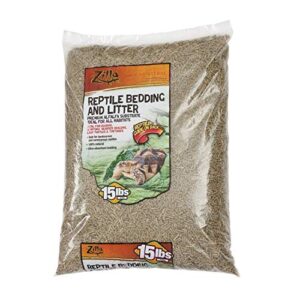
Alfalfa Meal Safety becomes murky when you evaluate this plant-based pellet against tropical snake demands. Zilla’s 15-lb Natural Reptile Bedding won’t deliver consistent Humidity Control or Substrate Enrichment.
Though it’s labeled digestible and bacteriostatic, alfalfa meal retains moisture poorly, can mold when damp, and produces dust that jeopardizes respiratory health.
You’ll find better Snake Bedding options in coconut fiber or cypress for tropical species. If you’re considering Substrate Selection for Reptile Care, skip alfalfa meal—it falls short on humidity dynamics and lacks the reliable moisture retention tropical snakes require.
| Best For | Herbivorous reptiles in dry habitats where you need a compostable, digestible substrate and don’t require high humidity retention. |
|---|---|
| Material Type | Alfalfa pellets |
| Odor Control | Yes |
| Moisture Retention | Moderate |
| Weight | 15 pounds |
| Natural Material | Yes |
| Ease of Cleaning | Easy |
| Additional Features |
|
- Made from 100% natural alfalfa with a bacteriostatic agent that helps minimize bacterial growth and odors
- Safe if accidentally ingested by reptiles and biodegradable for easy disposal
- Easy to spot-clean and works well as a designated dig area for burrowing species
- Gets soggy and molds quickly when wet, making it unsuitable for tropical or high-humidity setups
- Produces dust and has a strong farm smell that can be unpleasant and may affect respiratory health
- Retains moisture poorly compared to coconut fiber or cypress, requiring more frequent substrate changes
5. Zoo Med Eco Earth Coconut Fiber Substrate
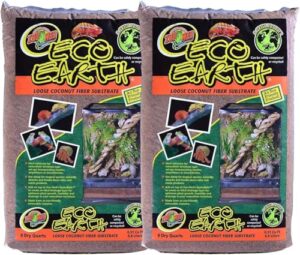
You’ll appreciate how Zoo Med Eco Earth Coconut Fiber Substrate transforms Tropical Humidity Control without drenching your enclosure. This Eco Friendly Substrate—compressed coconut fiber from husk—holds moisture steadily, accommodates Snake Burrowing Behavior, and keeps dust minimal compared to mulches.
Coconut Fiber Benefits include low odor absorption, bioactive compatibility, and safe ingestion if your snake strikes prey on it. Available in 8-quart packs, it’s an ideal reptile substrate for tropical species needing consistent Substrate Moisture Levels.
Monitor drainage to prevent mold pockets, and you’ve got reliable humidity control for your snake tank substrates.
| Best For | Snake keepers with tropical species that need consistent humidity and natural burrowing opportunities without excessive dust or mess. |
|---|---|
| Material Type | Coconut fiber |
| Odor Control | Yes |
| Moisture Retention | High |
| Weight | 6.4 pounds |
| Natural Material | Yes |
| Ease of Cleaning | Easy |
| Additional Features |
|
- Holds moisture steadily for weeks without turning swampy, so you’re not constantly misting
- Low dust levels mean cleaner air and less respiratory irritation for both you and your snake
- Works great in bioactive setups and won’t hurt your snake if accidentally ingested during feeding
- Some batches arrive bone-dry and need serious hydration before they’re usable
- Price adds up quickly if you’re maintaining multiple large enclosures
- Packaging inconsistencies mean you might get one 8-quart brick instead of the advertised two-pack
6. Zoo Med Aspen Snake Bedding
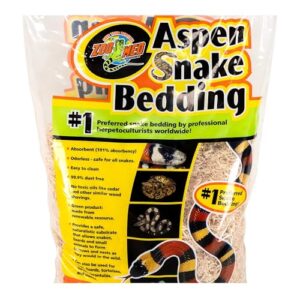
While coconut fiber excels at moisture retention, Zoo Med Aspen Snake Bedding offers a drier alternative for tropical snakes that tolerate lower humidity—or when blended with moisture-rich bedding materials for custom humidity management.
This 8-quart wood substrate weighs 2.2 pounds, delivers 191% absorbency, and remains 99.9% dust-free, supporting Aspen Safety without toxic oils.
Its lightweight texture accommodates snake behavior like light burrowing when used at appropriate substrate depth, though you’ll need supplemental humidity sources for rainforest species in your snake habitat creation.
| Best For | Snake owners who need a low-dust, highly absorbent substrate for species that prefer drier conditions or want a blendable base for custom humidity setups. |
|---|---|
| Material Type | Aspen shavings |
| Odor Control | Yes |
| Moisture Retention | Moderate |
| Weight | 2.2 pounds |
| Natural Material | Yes |
| Ease of Cleaning | Easy |
| Additional Features |
|
- 191% absorbency rating and 99.9% dust-free formula keeps enclosures cleaner and reduces respiratory irritants for your snake.
- No toxic oils like cedar, making it safe for snakes, lizards, and other reptiles across different life stages.
- Lightweight texture allows light burrowing behavior and easy spot-cleaning, with full changes needed only every 1–2 months.
- Doesn’t retain moisture well on its own, so tropical snakes needing high humidity require supplemental sources or substrate blending.
- Wet clumps don’t dry effectively after soaking, meaning you’ll need to remove them manually to prevent mold growth.
- Not ideal for deep-burrowing species or rainforest-dwelling snakes unless combined with moisture-rich materials like coconut fiber.
Key Factors in Choosing Tropical Snake Substrates
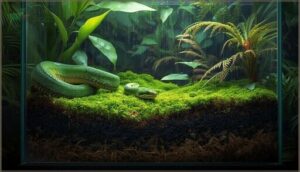
You can’t just grab any substrate off the shelf and hope for the best—tropical snakes have specific needs that demand careful consideration. The right choice balances moisture retention, safety, and compatibility with your snake’s natural behaviors.
Let’s break down the five essential factors that’ll guide you toward the ideal substrate for your setup.
Humidity Control and Moisture Retention
For tropical species requiring 60–80% humidity during shedding, you’ll need substrates with strong moisture retention. Coconut fiber and cypress mulch hold water effectively, reducing frequent misting.
ReptiChip Reptile Substrate’s porous structure creates stable microclimates, though poor ventilation invites mold. Use humidity sensors to monitor evaporation rates and prevent over-saturation.
Smart microclimate management and proper water cycling keep humidity control straightforward while protecting your snake’s respiratory health.
Safety and Digestibility
Beyond maintaining humidity, you need non-toxic materials that won’t harm your snake during feeding. Ingestion hazards peak when snakes strike prey, often swallowing substrate particles.
Digestibility testing shows coconut fiber passes through safely, while cypress must be dust-free for respiratory safety. Avoid substrates with fertilizers or phenolic compounds—toxicity testing reveals these irritate airways.
Monitor stool consistency after substrate changes, watching for allergies or digestion risks that signal incompatibility.
Odor Control and Cleanliness
Managing smells in your snake tank substrates starts with understanding how moisture fuels microbial activity. Coconut fiber excels at odor control through natural absorption, but you’ll still need a maintenance plan:
- Spot-clean waste daily to prevent ammonia buildup and pathogen growth
- Replace substrate every 8-12 weeks to maintain freshness
- Monitor humidity levels since excess moisture accelerates decomposition
- Use bioactive setups where beneficial organisms break down waste naturally
Balance hydration with proper waste reduction for best results.
Substrate Texture and Snake Behavior
Grain size significantly influences a snake’s movement and behavior. Loose substrates encourage horizontal exploration and frequent substrate interaction, whereas fine textures can hinder climbing stability in arboreal species. Rough surfaces affect grip during resting periods, and absorbent materials create localized humidity, prompting specific behavioral adaptations.
Here’s a breakdown of how different textures impact common snake behaviors:
| Texture Type | Burrowing Patterns | Exploration Style | Comfort Level |
|---|---|---|---|
| Fine, loose | Frequent tunneling | High horizontal movement | Moderate ventral pressure |
| Coarse chips | Shallow digging | Cautious navigation | Reduced skin irritation |
| Soft fiber | Deep burrows | Active foraging | High thermal contact |
| Dense, compact | Limited digging | Reduced activity | Stable microclimate anchoring |
Matching the substrate to a snake’s natural behaviors is crucial for preventing stress-related repetitive movements. This ensures the snake can exhibit its full range of natural behaviors comfortably.
Compatibility With Burrowing and Climbing
When selecting reptile substrate for species that burrow and climb, you’ll need layered depth—4 to 6 inches ensures tunnel safety while allowing stable burrow creation. Coconut fiber excels here, offering moisture balance that prevents collapse and maintains climbing surfaces without slipping.
Snake tank substrates with medium particle size enable humidity control across vertical zones, letting your tropical species exhibit natural behaviors without compromising structural integrity.
Substrate Maintenance and Hygiene Tips

Keeping your tropical snake’s substrate clean isn’t just about aesthetics—it’s about preventing respiratory infections, mites, and bacterial overgrowth that can compromise your snake’s health. You’ll need to balance daily maintenance with periodic deep cleaning, and your approach will vary depending on whether you’re using coconut fiber, cypress mulch, or a bioactive setup.
Here’s how to maintain ideal hygiene across different substrate types while keeping your snake’s environment stable and safe.
Spot Cleaning and Waste Removal
You’ll want to remove feces within 1–2 minutes to stop ammonia buildup in your snake tank substrates. Daily cleaning preserves humidity control and substrate maintenance across tropical enclosures:
- Inspect for debris and waste at least once daily
- Remove soiled clumps without disturbing clean areas
- Rinse affected spots with water, then blot dry for humidity balance
- Dispose of waste in sealed bags to prevent odor control issues
- Sanitize tools after each session to guarantee proper substrate sanitization and reptile substrate hygiene
Full Substrate Replacement Schedule
Even perfect snake tank substrates wear out. You should schedule full substrate replacement every 6–12 months for standard tropical enclosures, but shorten that to 3–6 months if you spot mold, compaction, or persistent odor.
Burrowing species demand more frequent substrate rotation—every 4–6 months—while arboreal setups tolerate longer intervals.
Pair humidity monitoring with sanitation protocols, and document each replacement to adjust your maintenance scheduling over time.
Preventing Mold, Mites, and Pathogens
High humidity turns tropical snake substrates into breeding grounds for mold, mites, and pathogens within 24–72 hours if airflow stalls. You’ll prevent these problems through daily spot-cleaning, strategic ventilation, and humidity management that keeps moisture levels steady without creating stagnant pockets.
Bioactive substrates with beneficial microbes suppress harmful bacteria, while semi-inert options like coconut fiber resist mold when you control humidity retention properly.
Cleaning Methods for Different Substrate Types
Substrate sanitizing methods shift dramatically depending on whether you’re working with organic fibers, living bioactive systems, or moss-based humidity layers—each demands customized waste removal and bacterial control strategies.
Core cleaning protocols for snake tank substrates include:
- Cypress mulch: Vacuum weekly, heat-treat compostable waste in sealed bags, rinse soiled sections with dechlorinated water, then dry thoroughly; replace every 4–6 weeks in humid setups
- Coconut fiber substrates: Allow surface drying between cleanups for moisture management, spot-clean with damp cloth, wash accessible portions with reptile-safe soap, conduct full changes at 4–8 week intervals
- Sphagnum moss: Remove visible waste daily, sanitize by soaking in diluted quaternary ammonium solution, guarantee drainage prevents stagnant moisture, replace monthly or when compacted
- Bioactive substrates: Employ clean-up crews (isopods, springtails), sterilize substrate before setup, inspect for mold regularly, refresh 20–30% periodically to maintain ecological balance
- Substrate blends: Schedule staggered cleaning to preserve microclimates, treat hotspots with targeted odor reduction techniques, test moisture levels post-cleaning, document intervals for consistent terrarium maintenance
Match your reptile substrate selection and maintenance approach to humidity demands and waste load—tropical species producing frequent waste require more aggressive protocols than semi-arid species.
Matching Substrates to Tropical Snake Species

Not all tropical snakes interact with their environment the same way, and your substrate choice needs to reflect those differences. A burrowing species requires completely different bedding than an arboreal snake that spends most of its time off the ground.
Let’s match substrate types to specific behavioral categories and humidity needs so you can give your snake exactly what it requires.
Burrowing Species: Ideal Loose Substrates
For snakes that tunnel and dig, you’ll want loose, friable reptile substrate that mimics their natural environment. Fine coconut fiber and cypress mulch are top choices—both support burrowing behavior while maintaining humidity control.
Aim for 3-4 inches of substrate depth so your snake can tunnel comfortably. Sandy loam blends work well too, preventing crust formation that restricts digging and traps moisture in the snake tank.
Arboreal Species: Best Supportive Options
While burrowers need soft flooring, arboreal species demand stability on climbing surfaces and vertical spaces. Coconut fiber provides grip without slipping, and bioactive substrates with tree bark chunks support aerial roots for natural reptile habitat creation.
Tuck sphagnum moss into humidity hides near branches—it holds moisture beautifully for your snake’s shedding needs. Substrate blends combining coarser materials prevent falls during those daring vertical climbs.
Semi-Aquatic Species: High-Moisture Substrates
When your snake loves water time, you’ll need materials that won’t turn into a soggy mess. Coconut fiber and cypress mulch excel at water absorption while maintaining substrate density for burrowing behavior.
Sphagnum moss boosts humidity retention in specific zones—pair it with these reptile substrate options to keep moisture levels stable. This combination maintains proper humidity levels without drowning your enclosure in standing water.
Species-Specific Humidity Requirements
Managing moisture isn’t a one-size-fits-all task—your tropical snake care strategy requires species research and humidity monitoring to dial in the right range. Relative humidity for tropical species usually runs from 60 to 90 percent, depending on:
- Life stage—juveniles often need tighter humidity control than adults
- Arboreal versus terrestrial habits—tree dwellers tolerate higher ambient levels
- Shedding cycles—localized high-humidity zones prevent stuck skin
- Day-night fluctuation—nighttime humidity should peak at the upper species range
- Seasonal climate shifts—regional weather impacts enclosure stability
Calibrated hygrometers in multiple microclimates verify your humidity retention and environmental control stay on target for snake health and wellness in your reptile enclosure design.
Researching Your Snake’s Unique Needs
How do you pinpoint the right substrate when every species brings its own quirks? Species research anchors your humidity assessment and environmental analysis—you’ll map natural habitat data, temperature gradients, and behavioral tendencies like burrowing or climbing.
Substrate testing follows, guided by reptile substrate reviews that evaluate absorbency and safety. This snake care and maintenance approach ensures snake health and wellness through informed reptile enclosure design and snake habitat creation.
Frequently Asked Questions (FAQs)
Can I mix different substrates together safely?
You can mix substrates, but proceed cautiously. Blending risks include uneven humidity control, digestion hazards from particulates, and mold growth. Test small patches first, monitor closely, and follow safety guidelines to avoid stressing your snake.
How do I increase humidity without flooding substrate?
You’ll want a shallow water dish on the warm side for steady evaporation methods, and mist briefly once or twice daily.
Use hygroscopic substrates like coconut fiber that hold moderate moisture without flooding—essential for humidity control.
What substrates work best for snake breeding enclosures?
Breeding enclosures demand substrates that balance humidity management with substrate safety. Coconut fiber and cypress mulch blends excel here, supporting egg-laying behavior while minimizing mold risk through controlled moisture retention and efficient spot cleaning.
Do tropical snakes prefer light or dark substrates?
Most tropical snakes don’t show a clear preference for substrate color; your choice should prioritize humidity retention, visual waste detection, and ease of cleaning.
Light substrates simplify monitoring in moisture-rich enclosures.
How does substrate depth affect burrowing behavior?
Substrate depth directly influences burrowing frequency and tunnel stability. Most tropical snakes show peak digging activity at 4–8 cm depths, where humidity gradients support thermoregulation while maintaining burrow architecture without excessive collapse risk.
Conclusion
A blood python burrowing through two inches of cypress mulch versus six inches reveals everything: shallow substrate forces surface behavior, while proper depth unlocks natural thermoregulation and stress reduction. Your substrate choice determines whether your snake tolerates captivity or thrives in it.
Match reptile substrates for tropical snakes to your species’ wild behavior—burrowing depth, humidity preferences, activity patterns—and you’ll prevent 90% of husbandry problems before they start. The foundation matters more than you think.
- http://www.lllreptile.com/articles/211-substrates-ideal-for-holding-humidity
- https://reptifiles.com/corn-snake-care-guide/corn-snake-substrate
- https://www.reddit.com/r/ballpython/comments/zi01rm/substrate_options_that_dont_mould_so_much_so
- https://journals.biologists.com/jeb/article/221/10/jeb153130/19493/Passive-water-collection-with-the-integument
- https://reptiles.swelluk.com/shop-by-reptile/snake/snake-substrates