This site is supported by our readers. We may earn a commission, at no cost to you, if you purchase through links.

A pinky that’s too wide can lodge in your snake’s throat and cause a fatal strike gone wrong. That single mismatch sends more hatchlings to the emergency vet than any other feeding mistake you’ll see in a reptile clinic. Size, temperature, and timing all decide whether a meal builds muscle or builds a problem.
Most new keepers focus on schedule and forget the math. Your snake’s mid-body girth tells you nearly everything: prey width should sit at 60-70% of that measurement, never past 90%. Get that ratio wrong and even a healthy feeder mouse turns risky.
This guide walks through picking the right pinky, thawing and warming it safely, and using tongs to trigger a clean strike, so every meal aids growth instead of gambling with it.
Table Of Contents
- Key Takeaways
- Choose The Right Pinky Mouse
- Feed Pinkies Step by Step
- Pinky Mouse Feeding Schedule
- Top 9 Pinky Mouse Feeders
- 1. Strike 1 Day Pinky Mice
- 2. Frozen Feeder Mice Combo Pack
- 3. Large Pinky Mice Snake Food
- 4. Frozen Mice Pinkies and Fuzzies
- 5. MiceDirect Frozen Pinkie Mice Feeders
- 6. Pinky Mice for Baby Snakes
- 7. MiceDirect Frozen Mice Combo Pack
- 8. MiceDirect Frozen Pinkie Rats Reptile Food
- 9. Large Frozen Mice Snake Food
- Prevent Feeding Health Problems
- Frequently Asked Questions (FAQs)
- How to feed a pinky mouse to a snake?
- How many pinky mice do I feed my corn snake?
- How long can you leave a pinky mouse in a snake cage?
- How do I properly feed a pinky to my snake?
- How often do you feed pinky mice?
- How many pinky mice should I feed my corn snake?
- How much should a 5ft corn snake eat?
- Can snakes eat frozen mice straight from freezer?
- How long do thawed pinky mice stay fresh?
- What temperature should feeding enclosures maintain during meals?
- Conclusion
Key Takeaways
- Match prey width to 60-70% of your snake’s mid-body girth (never exceeding 90%) since oversized pinkies raise the risk of regurgitation, gut impaction, and fatal strikes gone wrong.
- Thaw pinkies safely in the refrigerator (5-8 hours) or cold water (1-2 hours), then warm them until limp before feeding, since cold or stiff prey won’t trigger a strike.
- Use feeding tongs to wiggle the pinky in short, irregular bursts near your snake’s head to mimic live prey movement and improve strike success, while keeping your fingers out of the strike zone.
- Feed hatchlings every 5 days, juveniles every 7 days, and adults every 10-21 days, sizing up only after post-meal bulge fades within 24 hours and weight gain stays steady.
Choose The Right Pinky Mouse
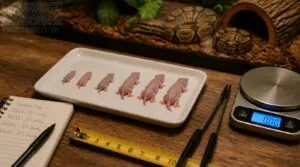
Picking the right pinky mouse isn’t guesswork. Size, weight, and timing all play a part in getting it right. Here’s what to check before you feed.
Rather than eyeballing weight alone, measure your snake’s mid-body girth against the mouse to nail the size, and check this guide on when to start feeding baby corn snakes for timing tips too.
Match Mid-body Girth
Wrap a finger around your snake’s mid-body, right behind the head, and that measurement is your starting point.
Match mid-body girth to prey width, not length. Aim for pinky size at 60-70% of that circumference, never past 90%. Too tight a fit strains swallowing alignment and raises regurgitation risk, especially during growth spurts when circumference shifts fast.
Use 1 to 3 Grams
Once you’ve matched girth, weight is the next check. Pinky mice in the 1 to 3 gram range suit most hatchlings and support steady growth without overloading a small stomach. Lighter hatchlings do well starting at 1 gram, while slightly older ones handle 2 to 3 grams. This range fits typical hatchling metabolic needs across many species.
Avoid Oversized Prey
Bigger isn’t better. Prey wider than your snake’s midbody girth forces extra jaw stretching, raising regurgitation risk and gut impaction odds. Watch for swallowing difficulty, repeated gaping, or stalled progress mid-strike. As a rule, don’t exceed twice the girth, ideally closer to 1.5 times.
Oversized meals cause metabolic stress your snake’s small body can’t handle yet. You should monitor for risks of oversized prey to keep them safe.
Watch Post-meal Bulge
After feeding, check for a visible bulge behind the head. This is normal gastric distension as the stomach fills, but it should shrink within 24 hours.
A bulge that lingers longer signals slow digestion, often tied to prey size, temperature, or body condition.
Once it’s gone, your snake’s stomach is empty and ready for the next size up.
Progress to Fuzzies
Graduating off pinky mice happens on the snake’s schedule, not the calendar’s. Watch for strike acceptance cues: fast, confident hits with no hesitation.
- Two to five clean pinky meals in a row
- No lingering post-meal bulge
- Steady weight gain between feedings
Fuzzies run 0.8 to 1.2 grams, about 60-90% of mid-body width. That prey width ratio keeps refusals rare during the switch.
Feed Pinkies Step by Step
Once you’ve picked the right pinky, feeding it correctly matters just as much. Each step, from thawing to cleanup, plays a role in keeping your snake safe and interested in its meal. Here’s how to walk through the process from start to finish.
If you notice cloudy eyes or dulled scales, it’s worth holding off on feeding and checking out this guide on soaking your snake to help it shed instead.
Thaw Frozen Pinkies Safely
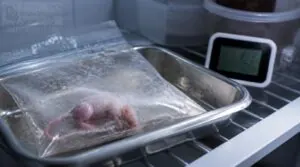
Refrigerator thawing keeps things safest: 5-8 hours at 40°F or below, on a tray to catch drips. Need speed? Try the cold water method — sealed package, water changed every 30 minutes, ready in 1-2 hours. Skip room temperature thawing.
Microwave defrost risks include hot spots and partial cooking. Check often, and never refreeze once thawed.
Warm Until Limp

Cold prey won’t trigger a strike. Snakes hunt by heat, so mimicking natural temperature matters here.
Set thawed pinkies on a paper towel until they feel warm and limp, never stiff or cool to touch. Test by pressing gently against your wrist, like checking a baby bottle. This avoids cold stress and gives frozen prey the texture and warmth needed to stimulate predatory instinct.
Use Feeding Tongs

Your fingers should never enter a snake’s strike zone. That’s what tongs are for.
Stainless steel stays easiest to sanitize between feedings. Match length to your snake: 12-14 inches for small feeders, 18-24 for confident adults.
Look for:
- Rounded, angled tips
- Textured grip
- Rubber-coated ends for slippery pinkies
- Non-slip grips
- Full tip coverage
Clean thoroughly after each use.
Wiggle to Trigger Strikes

A motionless pinky rarely gets noticed. Snakes track movement, not stillness, so grip the tong-held pinky and move it in short, side-to-side bursts near your snake’s head. This mimics prey motion and stirs natural predatory instincts.
For picky eaters, pause briefly between wiggles, like a startled mouse freezing then bolting. That irregular rhythm often improves strike probability dramatically.
Pausing between wiggles like a mouse freezing then bolting often triggers strikes from picky eaters
Remove Uneaten Prey
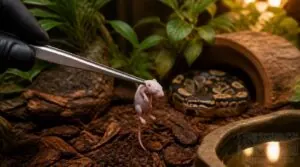
A leftover pinky won’t stay harmless for long. Within 12 to 24 hours, decomposition sets in, raising odor, mold, and bacteria risk.
Use feeding tongs or a small scoop to remove it. Skip harsh handling that stresses your snake.
Prompt removal helps keep your enclosure clean, prevents pest problems, and keeps food refusal from becoming a pattern in your snake feeding routine.
Pinky Mouse Feeding Schedule
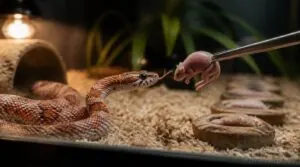
Feeding schedules change as your snake grows, and timing matters as much as portion size. Different ages and species need different intervals between meals. Here’s how to set a schedule that fits your snake’s stage of life.
Hatchlings Every 5 Days
Every five days, your hatchling’s body is doing serious growth work, and feeding follows that rhythm.
Five-day cycles match metabolic growth needs and give digestion time to finish before the next meal.
- Watch for steady weight gain
- Confirm belly bulge fades each cycle
- Check hydration and skin condition
- Track girth changes signaling readiness
Monitor body condition every cycle. Skipping checks risks overfeeding or missed growth cues.
Corn Snake Pinky Portions
Corn snakes take pinkies sized to their mid-body girth, usually 1 to 3 grams for hatchlings. Measure gently, no guessing.
| Age | Prey Weight | Signal |
|---|---|---|
| Hatchling | 1-2g | Bulge fades in 24hrs |
| 4-8 weeks | 2-3g | Steady weight gain |
| 8-20 weeks | 3g+ | Girth increase |
Track digestion and adjust weight before sizing up.
Juveniles Every 7 Days
Growing juveniles shift from pinkies to fuzzies once past hatchling stage. A weekly feeding frequency fits most, with consistent feeding windows supporting digestion.
Track each meal in a log, noting weight and behavior. Watch for growth spurts, sizing up gradually.
If refusal happens twice, check temperatures before retrying. Monitoring weight gain keeps reptile nutrition on track without guesswork.
Adults Need Larger Prey
Once your snake passes the one-year mark, pinkies won’t cut it anymore. Adults need larger prey to meet caloric energy needs and maintain muscle mass.
Bigger meals also support reproductive health in breeding females, fueling egg production. Size up gradually, always matching mid-body girth, and factor in seasonal appetite shifts and individual size variation before locking in a feeding schedule.
Adjust by Species
Ball pythons and corn snakes don’t eat alike, and treating them the same invites trouble. Species-specific girth dictates pinky mouse prey size progression, while metabolic rate variations set feeding frequency.
Ground dwellers take prey at floor level; arboreal feeders often prefer it offered higher, mimicking natural strikes. Watch prey shape preferences too, and expect seasonal growth spurts to temporarily raise dietary portion control needs.
Top 9 Pinky Mouse Feeders
A good pinky supplier makes feeding easier and safer for your snake. Quality varies, from freshness to sizing to packaging, so it pays to know your options. Here are nine trusted picks worth checking out.
1. Strike 1 Day Pinky Mice
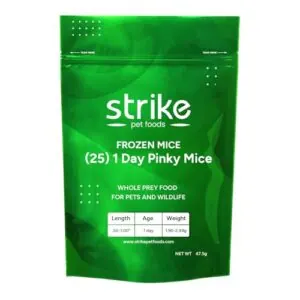
Strike 1 Day Pinky Mice fit hatchling snakes still working on their first strikes. Each pinky weighs 1.9 to 2.49 grams and measures about half an inch to an inch long, sized for tiny mouths and thin bodies.
They’re pre-weaned and hairless, which makes them easy to grip and swallow. Raised on clean bedding at a USDA-certified facility, they arrive frozen in resealable bags, so storage stays simple and hygiene stays consistent between feedings.
| Best For | Owners of hatchling snakes who need an appropriately sized first-feeder that supports healthy growth from day one. |
|---|---|
| Frozen Form | Yes |
| Storage Requirement | Freezer |
| Feed Quality | No additives |
| Target Life Stage | Hatchling |
| Packaging Type | Resealable bags |
| Prey Species | Mouse |
| Additional Features |
|
- Sized specifically for tiny mouths, reducing feeding difficulty for young snakes
- Frozen packaging and resealable bags keep storage simple and hygienic
- Raised at a USDA-certified facility with no artificial ingredients or additives
- Requires constant freezer storage, offering no room-temperature flexibility
- Narrow size range means it’s only useful for a short window in a snake’s growth
- Must be thawed before feeding, adding an extra prep step at mealtime
2. Frozen Feeder Mice Combo Pack
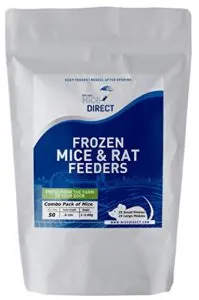
Mixing pinkies and fuzzies in one order solves a real problem: growing collections with mixed ages. This combo pack pairs 0.25 to 0.5 inch pinkies under 2 grams with 0.5 to 1 inch fuzzies at 2 to 4 grams, covering hatchlings through young juveniles without separate orders.
Zoo-grade feed keeps protein between 14 and 22 percent, and dry ice packaging holds sub-zero temps in transit. Bags stay separated to prevent clumping, so portioning stays simple at feeding time.
| Best For | Reptile and snake owners with mixed-age collections who want pinkies and fuzzies covered in a single order. |
|---|---|
| Frozen Form | Yes |
| Storage Requirement | Freezer |
| Feed Quality | Zoo-grade |
| Target Life Stage | Mixed ages |
| Packaging Type | Separated bags |
| Prey Species | Mouse |
| Additional Features |
|
- Combo pack covers hatchlings through young juveniles without needing separate orders
- Zoo-grade feed with 14–22% protein supports solid nutrition
- Bags are kept separated to prevent clumping, making portioning easy
- Product must stay frozen at all times, which limits storage flexibility
- Feeding schedules require careful monitoring to keep quantities consistent
- Customer support may be less accessible since it’s mainly handled via email
3. Large Pinky Mice Snake Food
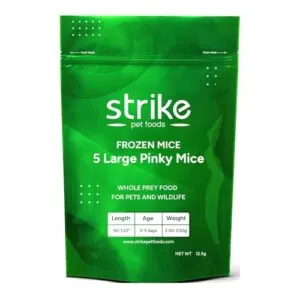
Growth spurts call for bigger portions, and this size fills that gap. Each mouse weighs 2.5 to 3.5 grams, measuring 10 to 14 millimeters wide, matched to thickening mid-body girth on juveniles outgrowing standard pinkies.
Thaw in cold water for 15 to 30 minutes, never a microwave. Corn snakes and king snakes usually accept these without fuss. Feed every 5 to 7 days during growth phases, then watch body condition to confirm the size still fits.
| Best For | Owners of growing corn snakes and king snakes that have outgrown standard pinkies and need a larger, consistent-sized feeder. |
|---|---|
| Frozen Form | Yes |
| Storage Requirement | Freezer |
| Feed Quality | USDA facility |
| Target Life Stage | Juvenile |
| Packaging Type | Aluminum-laminated bags |
| Prey Species | Mouse |
| Additional Features |
|
- Pre-weaned and hairless mice make digestion easier on juvenile snakes
- Raised and packaged at a USDA-certified facility for consistent quality
- Sealed in resealable aluminum-laminated bags to lock in freshness during frozen storage
- Requires freezer space and safe thawing (cold water only, never a microwave)
- Frozen delivery means it can’t be fed immediately upon arrival
- Must be handled with care to follow proper food safety protocols
4. Frozen Mice Pinkies and Fuzzies
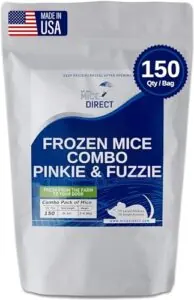
One pack covers two growth stages, so you’re not reordering every few weeks. Pinkies run under 2 grams for hatchlings, while fuzzies weigh 4 to 6 grams with light fur, suited to juveniles with widening jaws.
Thaw each size separately in warm water until limp. Never refreeze leftovers. Match prey width to your snake’s mid-body girth, and size up only after the digestive bulge fully disappears. This combo simplifies planning for corn snakes and young ball pythons moving through early size classes.
| Best For | Owners of corn snakes and young ball pythons who need a reliable supply of both pinkies and fuzzies to cover early growth stages without frequent reordering. |
|---|---|
| Frozen Form | Yes |
| Storage Requirement | Freezer |
| Feed Quality | Zoological-grade |
| Target Life Stage | Hatchling-Juvenile |
| Packaging Type | Separate size bags |
| Prey Species | Mouse |
| Additional Features |
|
- Combines two size stages (pinkies and fuzzies) in one order, simplifying feeding as your snake grows
- Zoological-grade, humanely processed rodents offer high-quality, disease-reduced nutrition
- Farm-direct sourcing and dry ice shipping via FedEx help preserve freshness during transit
- Requires proper frozen storage immediately upon arrival
- Handling frozen items and dry ice safely takes extra care
- Each size must be thawed separately, adding a bit more prep time at feeding
5. MiceDirect Frozen Pinkie Mice Feeders
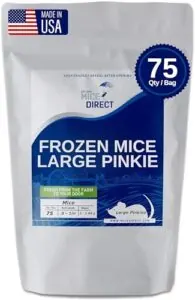
MiceDirect raises mice on zoo-grade feed, then flash-freezes each pinky to lock in moisture and texture. Individuals run 0.15 to 0.30 grams, with protein near 44% minimum, fat around 17%, and moisture capped at 12%.
Bags are resealable for freezer storage, and some batches are irradiated to cut Salmonella risk. This makes MiceDirect a solid choice when you want traceable, nutritionally consistent pinkies for hatchling and juvenile snakes without guessing at quality.
| Best For | Snake and reptile owners who need a reliable, bulk supply of humanely raised, disease-free pinkie mice for hatchling and juvenile feeding. |
|---|---|
| Frozen Form | Yes |
| Storage Requirement | Freezer |
| Feed Quality | Zoo-grade Mazuri |
| Target Life Stage | Hatchling-Juvenile |
| Packaging Type | Resealable bags |
| Prey Species | Mouse |
| Additional Features |
|
- Raised on zoo-grade Mazuri feed with no artificial ingredients, ensuring a clean, premium food source
- Humanely processed with CO2 euthanasia and shipped frozen with dry ice to preserve freshness
- Delivered in a large 75-count pack within about a week, offering a high-quality alternative to imported or surplus feeders
- Requires immediate cold storage and significant freezer space to hold the full 75-count pack
- Delivery takes roughly a week, so it’s not ideal for urgent or last-minute feeding needs
- Buying in bulk means less flexibility if your snake’s feeding needs change or if pinkies aren’t used quickly enough
6. Pinky Mice for Baby Snakes
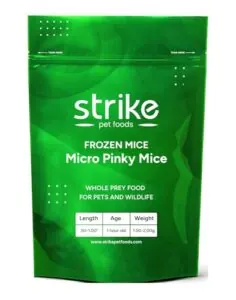
This option is built specifically for hatchlings, with mice weighing just 1.00–1.89 grams and only about 1 hour old. Bred at a USDA-certified facility and shipped frozen in resealable bags, they’re soft-bodied and easy to digest.
No artificial ingredients, no guesswork. For newborn corn snakes, hognoses, or baby ball pythons, this size keeps feedings safe and appropriately scaled until your snake outgrows the pinky stage.
| Best For | Owners of newborn or baby snakes—like corn snakes, hognoses, or young ball pythons—who need appropriately sized, ready-to-feed prey for hatchlings just starting to eat. |
|---|---|
| Frozen Form | Yes |
| Storage Requirement | Freezer |
| Feed Quality | No additives |
| Target Life Stage | Hatchling |
| Packaging Type | Resealable bags |
| Prey Species | Mouse |
| Additional Features |
|
- Sized specifically for hatchlings (1.00–1.89 grams, soft-bodied and easy to digest)
- Bred at a USDA-certified facility with no artificial ingredients
- Delivered frozen in resealable bags for freshness and convenience
- Requires freezer storage and safe thawing before feeding
- Only suitable for a specific life stage—snakes will quickly outgrow this size
- Handling frozen feeder mice may not appeal to every owner
7. MiceDirect Frozen Mice Combo Pack
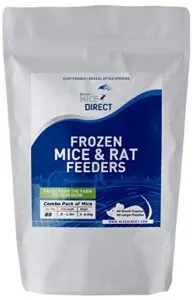
Once a hatchling graduates past the pinky stage, this combo pack covers the next stretch without a second order. It splits 40 small fuzzies and 40 fuzzies, giving you 80 total feeders sized for juveniles gaining girth.
Each rodent is raised on Mazuri feed and processed with CO2, then shipped frozen with dry ice to protect the cold chain.
No fillers, no flavoring—just whole prey. It’s a practical bridge as your snake’s mid-body outgrows pinkies but isn’t ready for adult-sized meals yet.
| Best For | Snake owners with juvenile reptiles that have outgrown pinkies but aren’t yet ready for adult-sized prey. |
|---|---|
| Frozen Form | Yes |
| Storage Requirement | Freezer |
| Feed Quality | Mazuri feed |
| Target Life Stage | Juvenile |
| Packaging Type | Dry ice shipped |
| Prey Species | Mouse |
| Additional Features |
|
- Raised in humane conditions on Mazuri zoological-grade feed with no artificial ingredients or fillers
- Mixed sizing (40 small fuzzies, 40 fuzzies) offers flexibility as your snake grows through this stage
- Shipped frozen with dry ice to maintain freshness and reduce disease risk compared to imported feeders
- Requires immediate freezer storage upon arrival
- Temperature-controlled shipping means you can’t leave the package sitting around
- Sized specifically for juveniles, so you’ll need a different product once your snake reaches adulthood
8. MiceDirect Frozen Pinkie Rats Reptile Food
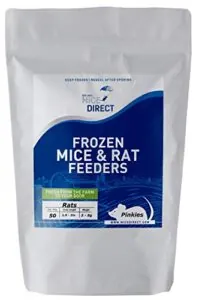
Once your snake outgrows mouse pinkies entirely, this line steps up in both species and size. Each rat is raised on Mazuri zoological feed, then CO2 euthanized and flash frozen to lock in nutrition.
Weights run 0.5 to 2.0 grams depending on batch, so check the label before ordering. Shipping arrives packed in dry ice, keeping the cold chain intact from farm to freezer.
Store below 0°F and never mix with other frozen prey types.
| Best For | Snake owners whose reptiles have outgrown pinkie mice and need a larger, nutritionally dense prey option delivered fresh and ready for the freezer. |
|---|---|
| Frozen Form | Yes |
| Storage Requirement | Freezer |
| Feed Quality | Mazuri feed |
| Target Life Stage | Adult-stage |
| Packaging Type | Dry ice shipped |
| Prey Species | Rat |
| Additional Features |
|
- Raised on zoological-grade Mazuri feed for high nutritional value
- Farm-direct sourcing keeps transit time short and freshness high
- Humane CO2 euthanasia paired with fast processing and flash freezing
- Requires reliable frozen storage at or below 0°F
- Bulk orders of 50 rats may demand significant freezer space
- Weights vary by batch (0.5–2.0 grams), so sizing isn’t always consistent
9. Large Frozen Mice Snake Food
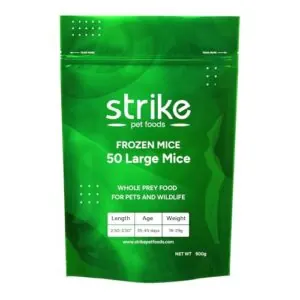
Rats aren’t the only option once size becomes a factor. This product fills the gap for adult ball pythons, king snakes, and other mid-to-large species that need more calories per feeding.
Each mouse weighs 18 to 29 grams, ages 35 to 45 days, and measures 2.5 to 3.5 inches. Whole prey with natural fur promotes bone, digestive, and muscle health.
Packaged in resealable aluminum-laminated bags from a USDA-certified facility, the 18-pound bulk box demands real freezer space, so plan accordingly.
| Best For | Owners of adult ball pythons, king snakes, and other mid-to-large snake species that need a bigger, more calorie-dense prey option. |
|---|---|
| Frozen Form | Yes |
| Storage Requirement | Freezer |
| Feed Quality | Clean bedding |
| Target Life Stage | All stages |
| Packaging Type | Aluminum-laminated bags |
| Prey Species | Mouse |
| Additional Features |
|
- Whole mice with natural fur support bone, digestive, heart, muscle, and skin health
- USDA-certified facility and resealable aluminum-laminated bags help ensure freshness and quality
- Consistent sizing (18–29 grams, 2.5–3.5 inches) makes portioning predictable for larger feedings
- Requires ample freezer space to store the full 18-pound bulk box
- No flavoring or additives, so pickier eaters may need extra encouragement
- Must stay frozen at all times, adding a storage requirement not every household can accommodate
Prevent Feeding Health Problems

Feeding problems rarely come out of nowhere. Most trace back to a handful of habits you can control. Here’s what to watch for before trouble starts.
Use Captive-bred Rodents
Where your feeder mice come from matters as much as their size. Captive-bred rodents offer genetic size consistency, controlled diets, and pathogen screening that wild-caught prey can’t match.
- Predictable pinky mass
- Fewer parasites
- Ethical sourcing standards
- Uniform body condition
- Reliable dietary management
Choosing captive-bred feeder mice helps prevent parasites and ensures steadier mouse prey size progression for your snake.
Avoid Live Prey Bites
Live rodents can bite back, and a defensive nick on your snake’s skin often leads to infection. Frozen-thawed feeder mice remove that risk entirely while still triggering a normal strike reflex.
Always present prey with tongs, never bare hands. This keeps your fingers clear during the strike and gives you better control over portion size and feeding pace.
Check Enclosure Temperatures
Why won’t a snake strike at a perfectly good pinky? Often the enclosure itself is off. Check for thermal gradients between 30 and 35 C, watch for vertical heat stratification near vents, and confirm sensor calibration accuracy monthly.
- Test heat source placement
- Scan for hotspots with infrared
- Log temps over 24 hours
- Adjust before feeding
Stable temperature zones support healthy metabolic rate and digestion.
Wait After Regurgitation
A regurgitation event means the stomach acids weren’t strong enough to finish digestion. Give a 24 to 48 hour recovery window before offering food again, and always keep fresh water available.
| Step | Action | Why |
|---|---|---|
| 1 | Wait 24-48 hrs | Lets digestion reset |
| 2 | Check appetite | Confirms readiness |
| 3 | Downsize prey 60-75% | Prevents repeat episodes |
Monitor Body Condition
Your snake’s body tells the real story between meals. Run your hands along the spine and sides: you want smooth curves, not sharp ridges or bulging fat pads.
This simple body scoring scale check, done monthly, catches obesity or underfeeding early. Track weight alongside prey size, and adjust portions before small issues become metabolic health problems.
Consistent monitoring beats guesswork every time.
Frequently Asked Questions (FAQs)
How to feed a pinky mouse to a snake?
Thaw the pinky using safe thawing methods, then warm it until limp to mimic body heat. Grip it with feeding tongs and wiggle it gently, simulating natural movement to stimulate predatory strikes. Remove uneaten prey promptly.
How many pinky mice do I feed my corn snake?
One pinky per feeding, matching prey weight to girth, works best for hatchling corn snakes. Feed every 5-7 days at first. Skip a second pinky at juvenile stages—it invites obesity rather than healthy growth.
How long can you leave a pinky mouse in a snake cage?
Fifteen minutes is the cutoff for unattended live prey—beyond that, bite risk climbs sharply. For a thawed pinky, remove it within 24 hours to prevent mold and bacterial growth and stop leftover stress from building in the enclosure.
How do I properly feed a pinky to my snake?
Warm the pinky first, then grip it gently with feeding tongs and wiggle it to mimic live motion. Offer it in a dim, quiet space. Keep temperature stable, since it directly affects digestion and appetite.
How often do you feed pinky mice?
Frequency depends on growth stage and metabolic rate. Hatchling corn snakes eat pinkies every 5 days, juveniles every 7-10 days, and adults every 10-21 days.
Seasonal shifts and species-specific needs may require adjusting intervals, so monitor digestion and body condition closely.
How many pinky mice should I feed my corn snake?
Your corn snake could eat you out of house and home if you let it—but don’t. Feed one pinky per meal, matching prey width to girth. Track growth rate and adjust portion size as weight gain and metabolic rate change.
How much should a 5ft corn snake eat?
Match one prey item to your snake’s mid-body girth, roughly 1 to 5 times its thickness, never doubling it. Feed every 14 to 21 days as an adult, watching body condition and bulge digestion within 24 to 72 hours for proper portion control.
Can snakes eat frozen mice straight from freezer?
Straight from the freezer is a jaw-breaker waiting to happen. Icy prey risks mouth injury and temperature shock. Thaw prekilled rodents fully first, feeding only once fully warmed and pliable, never partially frozen.
How long do thawed pinky mice stay fresh?
Best used within 24 hours, but sealed and refrigerated at 32 to 39°F, thawed pinkies stay safe up to 7 days. Never refreeze them. Check for off odors, sliminess, or discoloration before feeding.
What temperature should feeding enclosures maintain during meals?
Keep the warm side at 88 to 92°F and the cool side between 78 and 85°F. This gradient helps with proper digestion and metabolic rate, matching species heat needs while keeping husbandry safe during meals.
Before breeding season, confirm your setup is dialed in and review ball python breeding basics for beginners to ensure your animals are healthy and ready.
Since a poorly balanced gradient can leave your snake stressed even after quiet nighttime exploring, it’s worth learning to spot common signs of stress in ball pythons before temperature issues take a toll.
If you’re curious how these dramatic white patches develop alongside their heat requirements, this complete guide to piebald ball python genetics and care breaks down the mutation in detail.
Conclusion
Slow and steady wins the race, and that’s the whole spirit behind a solid snake feeding guide pinky mouse routine.
Rushing size, skipping the wiggle, or ignoring bulge invites trouble you can’t undo.
Your snake doesn’t need speed. It needs consistency: right girth, right warmth, right pause between meals.
Master those basics and feeding stops feeling like a gamble.
It becomes routine, predictable, and safe.
That’s the whole goal, every time you open the enclosure.